
The Tiara Syndrome: Something that will never happen unless you ask for it

A term coined by Carol Frohlinger and Deborah Kolb, the founders of Negotiating Women, Inc, the Tiara Syndrome or the Tiara Effect is used to describe how many women approach salary and raise negotiations.

As Carol Frohlinger says, “Women expect that if they keep doing their job well someone will notice them and place a tiara on their head. That never happens.”

The fact is, most women don’t negotiate. That tiara is the recognition in the form of increased salary or pay. Women believe that they will be recognised for their value and automatically be paid what they are worth but the reality is, you have to ask for what you want. And if you don’t ask, the answer is always no.

In her bestselling book, Lean-In, Sheryl Sandberg says, “Women are also more reluctant to apply for promotions even when deserved, often believing that good job performance will naturally lead to rewards.”
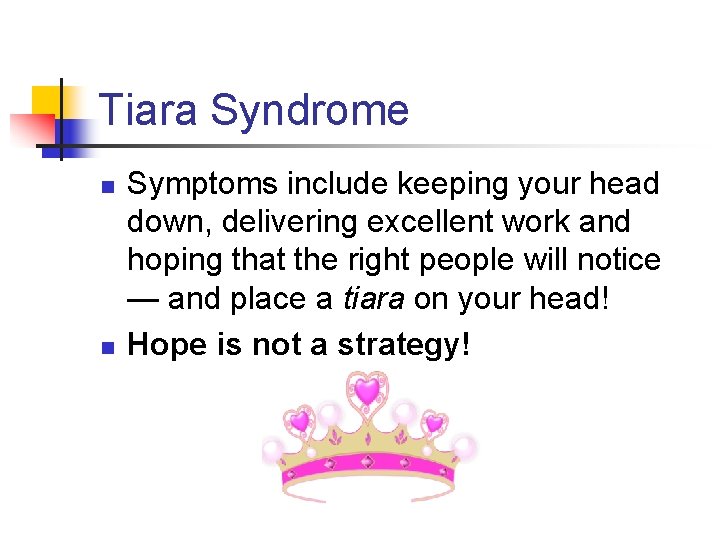
Many women feel that working hard and doing a good job will be enough and the reality is that women are often extremely conscientious at delivering against their objectives. Just as at school where girls’ conscientiousness often leads to higher academic results than achieved by boys, many women believe that this same strategy will lead to success at work. However, sometimes this very diligence gets in the way of fast-tracking their careers. Many women are so so focused on doing the operational aspects of their job well that they don’t have time to step back and focus on strategic priorities and they often feel they do not have space in their busy working weeks to fit in networking which is seen as an unnecessary, and often uncomfortable, use of their precious time. In the same vein, they do not seek mentors to guide them or get the support of sponsors to give them the invaluable exposure and opportunities needed to step up to senior leadership positions.

Academic psychologist Cordelia Fine says such behaviour stems from socialisation, not innate differences between the sexes. And, of course, some men are sufferers, just as many women aren’t. But how do those who have been schooled not to boast learn to champion their cause and get over tiara syndrome?

A 2003 study of thirty-eight business students conducted University of California at Irvine discovered that 85% of the men believed that it was up to them to make sure their company paid them what they were worth. Only 17% of the women in the study believed this to be the case. The remaining 15% of the men and 83% of women assumed their worth would be determined by what their company paid them. The Tiara Syndrome only adds to the pay disparity between men and women. If we don’t ask for more pay based on our contributions, the answer is always no.

As women, we don’t negotiate. Most of us don’t negotiate our first job offer, which has been calculated to equal $500,000 over the length of her career. And all because we don’t speak up for ourselves and our worth.

So why do we women avoid negotiating? This is to a large extent because of the social conditioning females are brought up in where we are always told to be polite and quiet. Asking for money seems, greedy and rude and it is also uncomfortable. Frohlinger advises women to keep a work journal by month detailing the projects and accomplishments achieved, client kudos, amounts in new business created, or savings generated. This compelling evidence of their value to the company can be persuasively presented during a salary negotiation. Even if one gets an automatic raise annually, this substantiation of the corporate value could pay off in a larger increase. If you are stepping into a new role or moving to a new organization, don’t settle for the first offer.

Tory Johnson, the CEO of Women for Hire and Good Morning America’s career expert recommends the following for negotiating that initial offer. Start positive and get the whole compensation package in writing if it has been verbal so far. Be firm. If you have been offered a package lower than your expectations, then let them know politely with an emphasis on the skills and experience you bring to the role and ask them how much wriggle room is available. Every organisation will have a wriggle room, especially for someone they deem the best fit. Follow up especially if the hiring manager is firm on their offer. Work towards reaching an agreement, on paper, for a salary negotiation or review within a pre-determined period. Also try and negotiate on non-money aspects like vacation time, flexible working arrangements, medical benefits, etc.

What are the blocks that don’t allow extremely able women from progressing? These include insufficient impact and presence and lack of a strong personal brand, a lowered productivity and overwhelm through being pulled in too many directions at once as well as poor work-life balance, a belief that doing a good job will be enough and not seeking sponsors, discomfort with networking both internally and externally, being insufficiently strategic and too stuck in the detail, a lack of strategic career planning and reduced confidence and lack of self-belief as a leader.

If you suffer from this syndrome, here’s what you can do to overcome it:

Own your career, acknowledge that you suffer from the syndrome and come up with an action plan. If you don’t like talking about it, use technology instead. Copy your boss into relevant emails and share them on your professional social media accounts. Keep a career journal to keep a record of your accomplishments. This is great for building evidence required for negotiations, it can be confidence boosting and be useful for CVs, appraisals, and other career development opportunities. Stop comparing yourself to others and plan for and maximise the formal opportunities for negotiation, whether for a pay rise or a promotion. Build your brand and internal network. Your brand also includes managing your energetic presence, personal image and communication, including body language. Harness Your Potential which includes identifying and capitalising on strengths as well as being clear about which weaker areas are mission-critical and maximising time and energy. Creating a balance between work and other aspects of life is also vital for sustainable career success. Cultivate supportive relationships within your current work setting as well as the wider professional network, including sponsors and mentors. It is important to be able to initiate these relationships, enhance your influence and also handle difficult relationships. Focus on strategy and volunteer for strategic or extra credit projects so that you can develop an idea of the big picture. Thinking like a leader is necessary to develop a leadership mindset and this includes handling the little voice of doubt that we all have in our heads and also learning to let go of some of what we have excelled at to take on even higher level leadership tasks.

It’s naive to think that delivering excellent results is all that it takes to succeed in the workplace. The playing field is not yet equal for women; the fact is that women have to negotiate for things their male colleagues can often take for granted. In addition to the obvious issue regarding compensation, women should negotiate for high visibility assignments, the resources they need to get the job done, support from those senior in the organization and buy-in from colleagues. They should also negotiate in their personal lives for the things that will enable them to be successful in the workplace. Effective negotiation is a prerequisite to “leaning in”. As Sheryl Sandberg says, “Do not wait for power to be offered. Like that tiara, it might never materialise.” So to all the women reading this post, if you have the Tiara Syndrome, shrug it off and know that you too are worth it!

In My Hands Today…

Cassandra Speaks: When Women Are the Storytellers, the Human Story Changes – Elizabeth Lesser

What story would Eve have told about picking the apple? Why is Pandora blamed for opening the box? And what about the fate of Cassandra who was blessed with knowing the future but cursed so that no one believed her? What if women had been the storytellers?

Elizabeth Lesser believes that if women’s voices had been equally heard and respected throughout history, humankind would have followed different hero myths and guiding stories—stories that value caretaking, champion compassion, and elevate communication over vengeance and violence.

Cassandra Speaks is about the stories we tell and how those stories become the culture. It’s about the stories we still blindly cling to, and the ones that cling to us: the origin tales, the guiding myths, the religious parables, the literature and films and fairy tales passed down through the centuries about women and men, power and war, sex and love, and the values we live by. Stories written mostly by men with lessons and laws for all of humanity. We have outgrown so many of them, and still they endure. This book is about what happens when women are the storytellers too—when we speak from our authentic voices, when we flex our values, when we become protagonists in the tales we tell about what it means to be human.

Lesser has walked two main paths in her life—the spiritual path and the feminist one—paths that sometimes cross but sometimes feel at cross-purposes. Cassandra Speaks is her extraordinary merging of the two. The bestselling author of Broken Open and Marrow, Lesser is a beloved spiritual writer, as well as a leading feminist thinker. In this book she gives equal voice to the cool water of her meditative self and the fire of her feminist self. With her trademark gifts of both humor and insight, she offers a vision that transcends the either/or ideologies on both sides of the gender debate.

Brilliantly structured into three distinct parts, Part One explores how history is carried forward through the stories a culture tells and values, and what we can do to balance the scales. Part Two looks at women and power and expands what it means to be courageous, daring, and strong. And Part Three offers “A Toolbox for Inner Strength.” Lesser argues that change in the culture starts with inner change, and that no one—woman or man—is immune to the corrupting influence of power. She provides inner tools to help us be both strong-willed and kind-hearted.

In My Hands Today…

Half the Sky: Turning Oppression Into Opportunity for Women Worldwide – Nicholas D. Kristof and Sheryl WuDunn

With Pulitzer Prize winners Nicholas D. Kristof and Sheryl WuDunn as our guides, we undertake an odyssey through Africa and Asia to meet the extraordinary women struggling there, among them a Cambodian teenager sold into sex slavery and an Ethiopian woman who suffered devastating injuries in childbirth. Drawing on the breadth of their combined reporting experience, Kristof and WuDunn depict our world with anger, sadness, clarity, and, ultimately, hope.

They show how a little help can transform the lives of women and girls abroad. That Cambodian girl eventually escaped from her brothel and, with assistance from an aid group, built a thriving retail business that supports her family. The Ethiopian woman had her injuries repaired and in time became a surgeon. A Zimbabwean mother of five, counseled to return to school, earned her doctorate and became an expert on AIDS.

Through these stories, Kristof and WuDunn help us see that the key to economic progress lies in unleashing women’s potential. They make clear how so many people have helped to do just that, and how we can each do our part. Throughout much of the world, the greatest unexploited economic resource is the female half of the population. Countries such as China have prospered precisely because they emancipated women and brought them into the formal economy. Unleashing that process globally is not only the right thing to do; it’s also the best strategy for fighting poverty.

In My Hands Today…

Difficult Women: A History of Feminism in 11 Fights – Helen Lewis

Well-behaved women don’t make history: difficult women do.

Feminism’s success is down to complicated, contradictory, imperfect women, who fought each other as well as fighting for equal rights. Helen Lewis argues that too many of these pioneers have been whitewashed or forgotten in our modern search for feel-good, inspirational heroines. It’s time to reclaim the history of feminism as a history of difficult women.

In this book, you’ll meet the working-class suffragettes who advocated bombings and arson; the princess who discovered why so many women were having bad sex; the pioneer of the refuge movement who became a men’s rights activist; the ‘striker in a sari’ who terrified Margaret Thatcher; the wronged Victorian wife who definitely wasn’t sleeping with the prime minister; and the lesbian politician who outraged the country. Taking the story up to the present with the twenty-first-century campaign for abortion services, Helen Lewis reveals the unvarnished – and unfinished – history of women’s rights.

Drawing on archival research and interviews, Difficult Women is a funny, fearless and sometimes shocking narrative history, which shows why the feminist movement has succeeded – and what it should do next. The battle is difficult, and we must be difficult too.

The Invisible Woman Syndrome

The Invisible Woman Syndrome is a social phenomenon where women in their 40s and 50s disappear from public view, in shops, on public transport, at work and in television and film. The invisible woman might be the actor no longer offered roles after her 40th birthday, the 50-year-old woman who can’t land a job interview, or the widow who finds her dinner invitations declining with the absence of her husband. She is the woman who finds that she is no longer the object of the male gaze—youth faded, childbearing years behind her, social value diminished.

At the half century mark, men are typically viewed as being at the zenith of their professional and personal lives, often leading organizations and companies and are viewed as accomplished and experienced. This is in contrast to women whose main stock in trade is assumed to be their physical appearance, which we’re sold and told should be youthful and appealing to the male gaze.

A survey that studied 2,000 women revealed that by the time they reach the age of 51, many women believed they had become invisible to men. Only 15% of the women felt that they had high or very high confidence in any area of their lives and 46% thought no one understood or addressed what aging and older women go through.

According to researchers, many women feel more and more invisible as they age with this issue being quite difficult for some women while for others, it’s not a problem. For those who have always been someone who’s very involved, noticed it especially more. This subtle form of cultural isolation is pervasive yet largely unnoticed by anyone who isn’t a female on the other side of 40. Women may be passed over for service in a department store, overlooked for a spare seat on the train or passed over for a promotion in the office.

On television and in film the absence of women of a certain age is perhaps more visible. Research by the University of Southern California found women were cast as just 26 per cent of characters aged 40 or older in 414 films and television shows aired in 2014 and 2015.

At work, women are opting to stay below the radar over concerns that asserting themselves may lead to negative consequences, according to a recent Stanford study. In that study, three sociologists spent two years immersed in a female professional development scheme at a large, US non-profit, where they conducted interviews with 86 participants and observed 36 discussion groups, plus 15 programme-wide meetings. Many of the women in the study felt a double bind: If they worked on the side-lines, they could be overshadowed by their colleagues and overlooked for job promotions, but having a more assertive presence in the office, could also backfire. Instead, they adopted a strategy that the researchers called intentional invisibility, a risk-averse, conflict-avoidant approach to navigating unequal workplaces. While the women in the study recognised that being less visible in the office could hurt their odds of a promotion or other career opportunities, they acknowledged that violating feminine norms, like being assertive or authoritative when they are expected to be nice, collaborative and communal could have the same effect. As a result, to craft careers that felt rewarding, women sought to reduce the chances for interpersonal conflict and to increase opportunities for friendly relationships within their work teams.

So, what is it about older women that society find so unpalatable, and why can’t the same be said for men?

Our society traditionally expects men and women to play different roles, and a woman’s role in a very conservative society, which even though many of our societies have evolved, we are still traditional in many aspects, is to be attractive and to perhaps have the role of a mother. If a woman starts to no longer be attractive, which is what some people consider if a woman ages, then she becomes less relevant. The same doesn’t apply to men because as they get older, they get more respect, if anything, and it doesn’t really matter what they look like. According to some researchers, women are seen to have lost their influence in middle age, because culture and history says an older woman is no longer powerful and therefore has nothing to offer.

But there is also a positive side to being invisible. According to Doris Lessing “And then not expecting it, you become middle-aged and anonymous. No one notices you. You achieve a wonderful freedom. It is a positive thing. You can move about, unnoticed and invisible.”

So how can women who have become invisible counter this syndrome. There are four ways to be seen and heard according to performance coach, Louise Mahler

Learn to attract attention: A female CEO in the superannuation industry uses sudden movements in meetings, says Mahler. When she is not being heard, she announces she wants a coffee, jumps out of her seat, gets one, and then remains standing. Then, when she speaks, people tend to listen.

Equalise the height: Corporate coach and former managing director of Apple Australia, Diana Ryall, just scrapes in at five foot three and says she asks people to sit down when they talk to her, so that she is not at a disadvantage.

Use movement: Mahler says she uses a technique developed by actors to draw attention, movement followed by standing still. “It is time to start playing the games,” she says.

Mindfulness: Find ways to deal with other people’s rudeness. “I use a mantra to not get angry,” says Mahler. “Forgive them Lord they know not what they do”.

Not only do we owe it to ourselves to remain visible, but we also owe it to younger women who are learning that their value is tied to a timeline that suspiciously coincides with changes in physical appearance. To any woman facing invisibility, remember that while attitudes towards ageing and female beauty are persistently stubborn, voices don’t age, so use your voice to be heard and don’t think you’re inconsequential because you’re not.