Book Smart or Street Smart

Source

A topic that has been in my mind for a while now, is the eternal debate between being book smart and street smart and which is better. Book smart is an adjective that refers to the learning or education one gets and describes a person whose knowledge greatly derives from book-learning, as opposed to practical experience, or street smarts. Book smart is knowledge derived from facts, science and communication and is explicit knowledge. Street smart, on the other hand, is procedural or practical knowledge on how to accomplish something. It is often tacit knowledge, which means that it can be difficult to transfer to another person through writing it down or verbalising it.

Someone who is known as being book smart people is usually well-read and often have read the classics, know facts and information that many other people don’t and are usually good at things like trivia games and crossword puzzles. The stereotype of a book-smart person is someone who deals with ordinary but challenging situations, especially bad or difficult ones, only from an intellectual point of view by basing their decisions strictly on available facts, accumulated knowledge, or personal insights primarily obtained from an educational environment. Book smart people are good with exams and academically inclined and enjoy the structure of the learning environment. They believe value lies in knowing things and reading things and are sometimes described as smart dumb people. In fact, in Tamil, there is a term for such people known as Padicha Muttal which means an educated fool
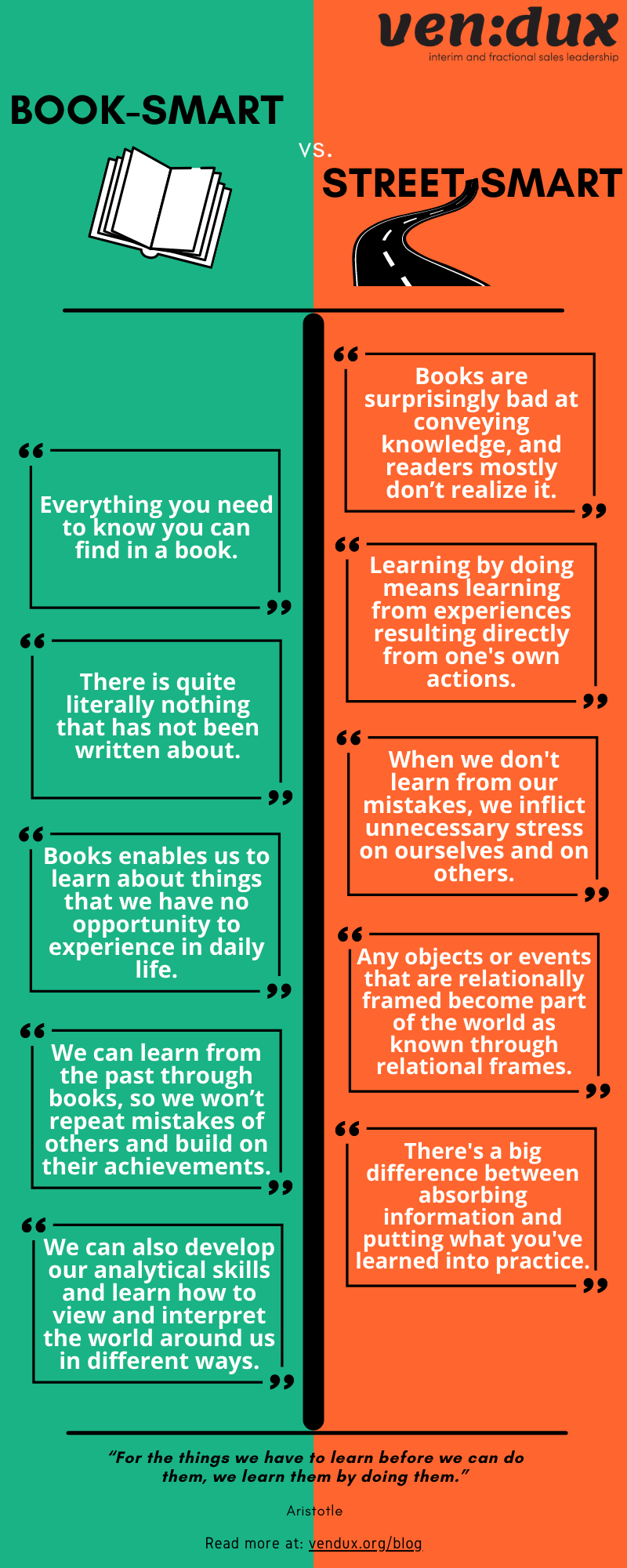
On the other hand, people who are good at dealing with practical life problems have lots of street-smarts. They may not be as educated or read as much as those with book smarts, but they have something just as valuable – the ability to use their experiences in many different situations. They are very aware of their surroundings. The stereotype of a street-smart person is someone who knows how to handle practical situations in everyday life necessary to get things done but is not as inherently educated or gifted academically.

In their most extreme and negative stereotypes, book-smart people are essentially naive, easily manipulated, unfeeling, and display bad judgment in ordinary situations while street-smart people are unintelligent and incapable of achieving higher education, but are more passionate and can usually find an answer to a problem through trial and error.

In my opinion, neither alone is good and a combination of book smarts with a dash of street smartness is what differentiates the wheat from the chaff. A highly educated person should not be derided for the advantages they may have and at the same time, just having a certificate does not prove that they know. Conversely, street-smart people are often demeaned simply because they are classified as those who didn’t have the grades to study at an institute of higher learning. Sometimes they are much smarter than those who are highly qualified.

Politics, power, social dynamics, leadership abilities, professional networks, and social status play a big part in an individual’s ability to succeed in life. To succeed in this environment, a person needs to navigate successfully in an opaque world and make the right decisions. In many situations and, in most industries, with the possible exception of teaching and academia, being book smart but not street smart is a distinct disadvantage. Being street smart doesn’t mean one is uneducated, undereducated or unintelligent and dumb. Being street smart means one is more aware of what is happening around them. They have environmental and situational awareness and can judge a situation so they can react to it accordingly. Street smartness comes from life’s experiences and situations that one would have encountered.

Someone who is only book smart, with low to no street smartness will only have the theoretical aspects of what he or she has learnt, but will not know if the theory works in real life. But, without the foundation of that theory, maybe the practical applications can only go so far. So a combination of both is where you hit that sweet spot. The key to success in the workplace and, in all aspects of life, is to have some, actually quite a bit of street smartness. With only book knowledge, when an individual enters the real world, the going is get tough. In these situations, those with street smarts are ready to fight and defend themselves because they have prepared themselves for these moments. This is where their expertise comes into play. They have the world experience, which trumps the book smarts word experience every single time. They have life skills, which trumps the abstract learning of those with bookish knowledge and they know and understand their environment and who is in it.

For someone who is not very street smart, and I count myself in this, here are some good tips to increase your confidence levels.

Recognise your faults and use setbacks to learn and grow. Get in there, the environment you want to succeed in and immerse yourself in it. Get involved with all the nitty-gritty of the work you are doing and be completely hands-on. Learn from mistakes and make sure every experience, whether positive or negative, teaches you something, even if it is what not to do. Doing so will make you more accustomed, more comfortable, and more aware of your world. Also, learn to look for opportunities that are everywhere, but need a keen eye to spot. Acknowledge that people are different and so keep track of their biases, consciously put them aside and judge each person on their merit. That will make you more effective at evaluating people. Choose what feels most certain rather than what’s most logical. And this is something I struggle with, I feel some decisions, and then my logical brain takes over and I change my decision which more often than not backfires. If something is too perfect, too simple, then it’s probably not right, you need to prod and find out more. Everything you do, keep an eye on the future and not just be in the present. A street-smart person puts aside the primal pull of scarcity and assesses value based on utility. In some cases, they may even profit off of other people’s obsession with scarcity.

Become more aware, detach yourself from your emotions because emotions lead to poor decision-making skills, slow down your thinking and become more deliberate using logic which allows seeing through manipulative efforts to choose what’s best for you rather than what feels emotionally satisfying will make you more street smart, even if you are not one now.

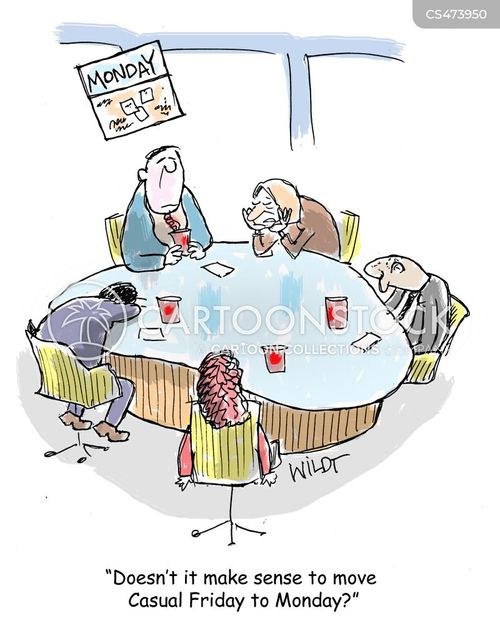
Mondays: Dread or Look forward to?

Source

Every Monday morning, across the world, scores of people wake up with a sense of dread. The Monday morning blues refer to a kind of mild depression people feel when it’s time to go back to work or school. They wake up with no enthusiasm for the day and in fact, dread the day.

The term Monday Blues describe a set of negative emotions that many people get at the beginning of the workweek if they’re not happy at work. It contains elements of depression, tiredness, hopelessness and a sense that work is unpleasant but unavoidable. Monday morning blues need not only happen on a Monday, but can happen any time of the week

A 2018 LinkedIn survey found that 80% of professionals experience what they called the Sunday Scaries, a prelude to the Monday morning blues. The Monday Blues are so prevalent that they have become a cultural phenomenon, but they can be much more than just passing tiredness; they are often a serious warning sign that something is not right at work. If you were happy, you’d be excited and energised on Mondays, not tired and depressed. If one is feeling under-appreciated or unsatisfied with their job, it can be especially difficult to start another seemingly endless workweek. And the case of the Monday Blues can have a negative impact on performance and productivity, as well as the people around us.

Countless studies in psychology and neurology have shown that a person’s current emotional state has a huge effect on the quality of their work and when they’re feeling blue they are less productive, less motivated, more pessimistic, less creative, less engaged and learn more slowly. The Monday Blues are contagious and one’s stress or bad mood can drastically change the overall work environment. When one is unhappy at work, it makes it very difficult for those around them to be happy, and oftentimes just one worker with a case of the Mondays can spread the doldrums to the whole team.

So what can one do to help overcome the Monday blues? Read on.

Identify the problem. If you have the Monday Blues most weeks, then this is not something you should laugh off or just live with. It’s a significant sign that you are unhappy at work and you need to fix it or move on and find another job. You need to ask yourself what is wrong and start with making a list of the things that are causing this stress and clarifying what is bothering you can help in trying to be active in finding solutions. It’s a way of empowering one to take charge and try to improve the situation.

Continue with your normal routine over the weekend. One of the reasons why Mondays are so hard is because we often leave all of our normal eating, sleeping, and exercise habits over the weekend. When we eat more, richer food and eat late drink and sleep and wake up late over the weekend, then when Monday morning comes, this catches up and we feel out of sorts. Not to say that this should not be done, but a balance should be found which lets us unwind while still keeping up with major routines.

Disconnect over the weekend. If you are constantly thinking of work and checking work emails when you should be using the weekend to relax, it’s a sign we are setting ourselves up for burnout sooner or later. When we feel stressed just thinking of work on Sunday, it’s a clear indication that we need to have stricter boundaries between work and play. One way to break the habit is to try turning off email notifications on Friday evening and unplugging from any work-related problems to focus on personal time over the weekend. Drawing clearly defined boundaries between work and personal time can help keep things in check.

As a piece of contrary advice to the above one, sometimes, when you know you have a big week ahead of you, you can get a head start on important tasks, but only if it is absolutely necessary. Maybe an hour or so on Sunday to plan the week and get some work done to take some of the pressure off come Monday. If this is something you would do once a while, make sure you spend one day relaxing and then work a bit the other day. You can also prepare for the next week on Friday evenings, by taking five or 10 minutes to prepare for the next week by straightening up the workspace, tying up loose ends and making a to-do list. Investing this time will help ease the mind for the next 48 hours.

If Monday mornings or Sunday evenings are usually scary and full of anxiety, then take some time to really think about what’s causing this anxiety. When you are able to figure that out, it’s easier to focus on what’s within your control, not on what’s beyond it and certainly not on that which might be based merely on fiction. Although it might seem counter-intuitive, waking up an extra 15 to 30 minutes early on Monday morning can actually make going back to the office easier. Having a little more ‘me time’ instead of feeling like you’re trapped in a time crunch can make that transition a little easier.

Another way to help combat that Monday morning anxiety is to be sure to leave as few dreadful tasks as possible on Friday afternoon so by taking care of the things you least want to handle at the end of one workweek, you’re making the start of the next that much better.

Don’t mess with your sleep cycle. An obvious thing, but not feeling well-rested can have a huge impact on how you feel come Monday morning. Experts advise keeping the sleep and wake schedule close to what it is during the week to avoid messing up your internal clock. Also, it is recommended that you wake up at the same time each day, even over weekends, so your body internal clock is still in sync. Even if you are unable to stick to the exact same routine, avoid going to bed more than an hour or two later than you would during the week.

Avoid overscheduling on Monday. It’s normal to feel overwhelmed when you’re flooded with meetings after coming back from a relaxing weekend, so whenever possible, try to avoid scheduling meetings or big tasks on Monday. It is also a good idea to make sure all the tasks scheduled for the week are completed before you start enjoying your weekend. If this is an issue, then using time management tools may help track activities and schedule events easily. This will help you to come into Monday with more ease from the weekend. Instead of tackling the biggest and most complicated tasks early on Monday, take some time for easier, more routine stuf. This might get you up and running and give you the energy for the more difficult or unpleasant tasks. But if you do have any unpleasant tasks awaiting your attention Monday morning, get them done as early as possible so that you don’t spend the rest of the day procrastinating or feeling as if there’s a black cloud hanging over your head. You’ll feel a lot better once it’s over.

Have fun at work. Take it upon yourself to do things that you enjoy in the office on Monday. Create an event that you will look forward to on Mondays as a way to break up the day with some known positivity. At the very least, it gives you a chance to take a deep breath, talk with a friend, and regroup for the rest of the day.

Write down your feelings. When our minds are overactive and we start overthinking, we can’t relax and destress, especially over the weekend. In such cases, jotting down your worries, can calm the mind and even make you more productive. I generally use Google Docs for this, but you can use the good old pen and paper or any other way to write down your thoughts and once you do that, the concerns and anxieties will feel much smaller and more manageable and the mind is clearer and calmer. According to the University of Rochester Medical Center, the simple act of journaling can help to manage anxiety, reduce stress and cope with depression.

Another way to beat the Monday Blues is to make a list of the things you’re excited about. We often look at the week ahead of us and think of all the tough stuff we have to do and the difficult tasks ahead of us, so we can just turn that around. On Sunday evening, make a list of three things you look forward to at work that week and this might put you in a more positive mood. If you can’t think of three things you look forward to, that might be an indication that you need to make some changes.

Dress for success. Mondays are when you should wear your favourite or a new outfit. It will perks you up and lets you be positive and also help others be positive. This can also help build your confidence because when you look good, you feel good and feeling good about yourself is half of the battle on Monday mornings, because rather than being deflated by work you want to face it with confidence.

Start the week out with an attitude of gratitude and take time to recognise and appreciate the things that you enjoy about work. Be positive and start even before you get into work. Try listening to favourite songs, with some upbeat, high-energy music into your morning preparation or commute to pump yourself up. And when you get into office, don’t listen to other people’s Monday gripes because creating or contributing to a culture of complaining is no way to improve your attitude. Make someone else happy and do something nice for someone else as soon as you get to work on Monday. This will definitely can lift the spirits and could actually help shift the overall mood. Research shows that according to positive psychology one of the best ways to cheer yourself up is to make someone else happy.

Have a post-work plan. Your day shouldn’t just be about trudging through Monday to get it over with, but about looking forward to something. By making Monday a special day where you get to go out with friends, make your favourite dinner, or eat a bowl of popcorn and catch up on a TV show you recorded, the day doesn’t have to be all about getting up to go into the office.

So here are some things you can do to get out the funk of the Monday Blues and have a great week.

The Good and the Bad: Boss Edition

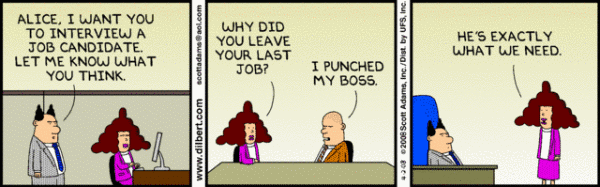
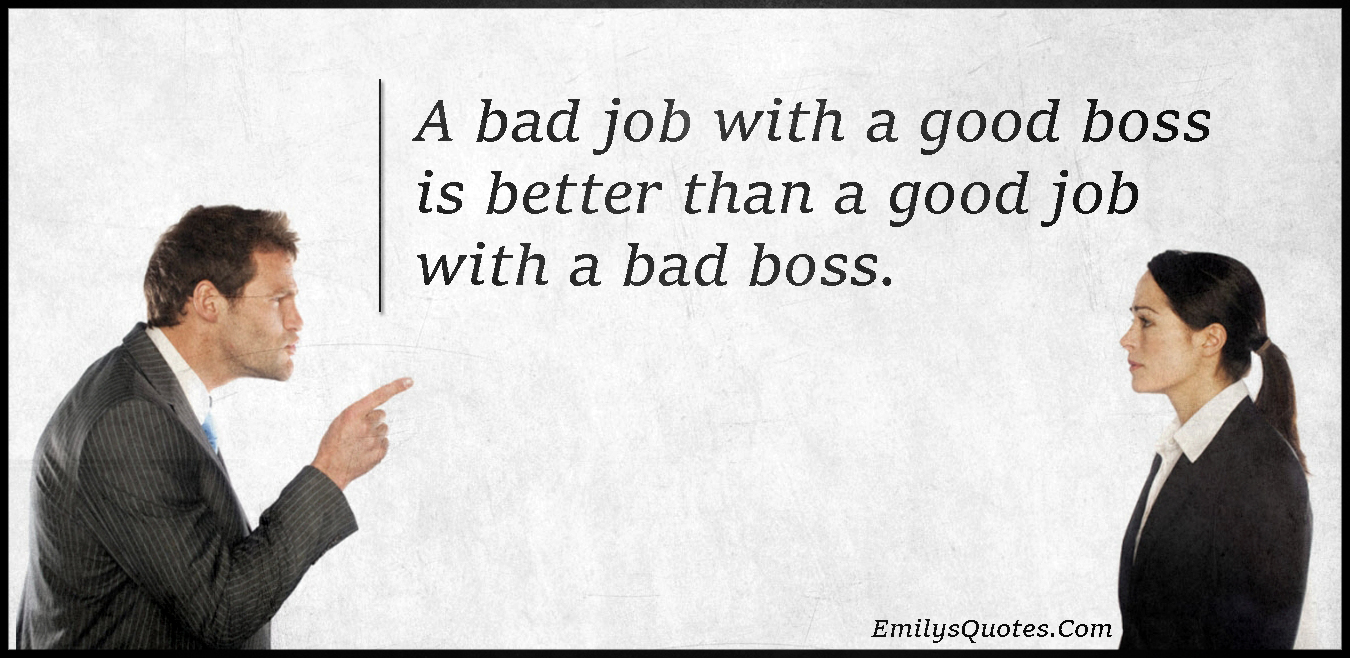
It is often said people don’t leave bad organisations, but leave bad bosses. And this is so true. When coworkers get together, stories are bandied about bosses and rarely are good managers discussed, but the spotlight is mostly on bad bosses. Many bosses fall into the bad boss category because they fail to provide clear direction, regular feedback, recognition for contributions, and a strategic framework of goals that enable their employees to see their progress. These kinds of bad bosses are what are called generic bad bosses because all employees need these types of support and feedback, and they suffer when they don’t receive it.

I’ve had my fair share of bosses, both good and bad. In my first job, we were a very young team, all of us fresh out of school and in our first jobs. The company was also a fairly young one, but the management were not very young, they had about a decade plus experience and you could probably call them middle management. While we didn’t really really report to them, they oversaw our work. My expectations with managers and bosses are most likely influenced by how they interacted with us. They were friendly and fair and had an open office policy. But one thing really stands out for me and is something that has been a sort of guiding principle for me all these years.

The office was a split office, with us in the ground floor and the managers and finance people in level 2. Officially the office would end at 5:30 pm and at 6 pm, one of the bosses, lets call him D would come down to go back home and if he saw us around, we would have to have a good reason why we were still around. 90% of the time, we were around, because we were hanging out with each other. Except for one, none of us were married and had no responsibilities, so there was no pressure to get out of the office and go home.

When D saw us hanging around, not leaving the office, he would ask us why were still there and used to say something like this. I am paraphrasing this, but he would say that if you are staying late because you have too much work, then there could be two reasons for this. One because you have too much on your plate or two because you have not finished your work in the scheduled hours of work. In both cases, we should have a talk, because if you have too much work, then we need to figure out how to reduce your workload and if it’s the second reason, then we also need to talk about why you are not able to finish your work on time. This is something that has always resonated with me and I have always tried to be as productive as possible while at work and leave on time as much as possible.

Another manager who made an impact in my life was someone who was my manager for the longest period of time. I was also in this organisation the longest, for almost a decade and of the multiple managers whom I reported to, this one was the one I reported to the longest. He was fair, but had his faults, the biggest of which was playing favourites. While I was not a favourite, I was also on his dislike list and so I escaped some of the worst things he said to others. From him I learnt how not to play favourites, especially when hiring people for the organisation and to not enable them so much they they believed to be above all others. He used to catch up with us every time he passed through Singapore but died a few years back.  

The third manager was someone whom I reported to for less than a couple of years, but he was a peer in terms of age. A very supportive manager, he gave me more responsibilities when he saw I could handle them and also credit where it is due. I learnt a lot from him, especially on how to manage people as he was someone who was friendly with everyone and even learnt some of the finer points of office politics from him. Unfortunately after about two years of reporting to him, he was transferred to a different country, but we are still in touch.

The last manager I was to talk about was the most toxic one. I have written about this person previously and even today, years after I left the organisation, I still have nightmares about how they used to literally torture me there. I can now think about them without my heart palpitating and getting stressed out, but it took me many years to get there.

Bosses are just like people, there are good ones and bad ones. A good boss or manager will set clear expectations from their subordinates, coach and give feedback, is inclusive and recognises efforts made by those reporting to him, knows his reportees, especially their talents and what they are good at and most importantly is there for them and takes a stand when it is needed.

A bad boss on the other hand, is everthing but what a good boss is. A boss is the umbilical cord that connects employees to an organisation, and if that cord is damaged, the employees will eventually leave. So if you are one of the lucky employees who has a great boss, don’t take that relationship for granted and show your boss how much you appreciate them.

Lessons I learnt from the Corporate World

We have been spending some time recently talking about work and the working life, especially since GG & BB will start their six-month industrial attachment next year and I thought that some of what we discussed could be of use to others, especially someone who is either just entering the corporate space or are a few years in and want to succeed in their careers.

In no particular order, here’s what I have learnt:

  • Be good to those below you more than those above you. Treat everyone with the respect you expect from them for yourself. Be nice to everyone, you never know when you are being judged.
  • Be careful when you work with friends, it may sometimes end badly
  • Keep your opinions about others to yourself and never share it with anyone else at work
  • Don’t Gossip! Especially in the pantry and public spaces, you never know who could be listening
  • Office politics is a fact of life and you can’t escape it. Learn to play the game
  • Network, network and then network some more. As you grow in your career, your networks will become more and more useful and informative.
  • Make your boss look good. That’s the key to success because they are the only ones who will battle for you and promote you. Make sure you know what your boss needs to accomplish and do your best to help them accomplish it.
  • Document everything! Your wins, commendations, compliments and learnings.
  • Train someone else to do your job and do it well. Because if you are irreplaceable in your position, you will never move up because there is nobody else to do what you are doing and doing best.
  • Any organisation you work for is not running a charity, they are here to make money and you have also been hired for that reason. You are hired because you have something that the organisation needs and any employment is a two-way process, one where both parties benefit.
  • Be reliable, be punctual and if you give someone a deadline, make sure you stick to it and in fact try to finish your work before the deadline.
  • Under promise and over deliver. It’s very simple actually. If you think you need 2 days to get a task done, ask for three days. This way, you have an extra day for any unforeseen circumstances that may come up and you are prepared and if all goes well, you get the task done ahead of your deadline, making you look super-efficient.
  • Become friends with all the secretaries, PAs and other co-ordinators. They will help you in tight spots and are also a good source of information that may not be found elsewhere.
  • Stay calm, cool and collected even if you are a withering mass inside. Be like the swan who looks calm and placid above the water, but is furiously paddling below it.
  • Leave your emotions at the door when you enter your place of work. Always think twice when you send emails or make phone calls when you are angry or upset. One tip I use during these times is to type your email first without typing in the email address and keep it aside for a while. Then when you are in a better frame of mind, edit the email, add the email address and send it.
  • Be well-dressed at work. Stand out, but not in the wrong way. If your work environment is conservative, then don’t wear outlandish clothes and vice-versa. Discreet jewellery, perfume and clothes which are classic will be better than fast fashion.
  • You are your own brand, so everything you do, say, write, dress, behave showcases the brand. So, create the brand that resonates with your work environment and maybe a couple of steps above your current role and stay true to your brand image at all times.
  • Have a life outside the office. You are not just a corporate drone, you should and must have a life outside of work. Have a hobby and do something that is totally unrelated to what you do at work.
  • Ask and encourage feedback from your managers because sometimes there may be something that you don’t see, but someone more experienced may instantly see.
  • Share successes, especially when you work as a team. When you do this, you let others share the glory and they will feel part of the successful project. Also, it never helps to have people think positively about you and your ethics. Giving others a chance to claim credit is an easy and effective way to magnify results.
  • Never stop learning. Every opportunity, good or bad teaches you something, even if it is what not to do, so don’t stagnate and become too comfortable in your job.
  • Always look at the bright side, and the positive side of things. Don’t get bogged down by pessimism. When days, weeks or even months are difficult, take heart and the hardest times will pass.
  • Focus on what you do best and try to compensate for your weaknesses. Nobody is perfect and everyone has some areas they are not good at, so amplify your strengths and work on the weaknesses.
  • Procrastination is something all of us are prone to, but procrastination has clear repercussions in the workplace resulting in challenges such as falling behind tasks. So, make sure you have clear daily goals which you tick off before you start slacking.
  • Failure is not the death kneel of your career. You will fail and multiple times in your career, but don’t stress about them. With no mistakes, there would be no opportunity to learn. Every failure gives you the chance to grow both personally and professionally.
  • Speak up. In meetings, in discussions and anyplace where you may have some input. This is not the time to be shy and refrain from speaking. If you have something to add to the discussion, make sure you put your point across. It may not be accepted, but for every ten points you put across, maybe one will be the one that is what was needed. But also ensure that when you speak, you understand what is being said and don’t speak illogically and nonsense.
  • Proactively seek new responsibilities, but only if you can handle. Conversely, don’t take up anything and everything that is thrown your way. Learn to say no to those above you if you are unable to manage or are hitting way above your weight and expertise.
  • Learn that everyone is expendable. If you don’t go to work, your organisation will not shut down, they will move on. But if you are not around, your family will be extremely affected and will find it very hard to move on. So don’t prioritise your job over your family.
  • Never burn bridges. You never know when you may have to go back to someone you have fought with, bad-mouthed or just generally been unpleasant to. People remember and will take their revenge when its their turn.
  • Work hard when you are at work, and when you leave the office, try to turn off. Most importantly have fun doing what you are doing and the eight or nine hours you spend at work won’t feel very long.
  • Stay two steps ahead. No matter what we do, success is less about any given moment and more about the next. Learn to anticipate what your manager or customer needs before they know how to ask for it and that’s one of the quickest ways to distinguish yourself in the workplace. Take initiative and don’t wait around to be told what to do, but at the same time, don’t make any assumptions, either.
  • Don’t take anything personally. Be professional, even when you think someone is out to get you.
  • Don’t trust anyone, especially at work. Everyone is looking out for themselves and a someone you consider a friend can easily throw you under a bus to save themselves. And at the same time, there’s a well know saying which is apt here to keep your friends close and enemies closer and is 100% true in a corporate setting.
  • Listen more and speak less. We have been given two ears and a mouth for a reason. So listen more than you speak and actually listen instead of rehearsing what you are going to say. At the same time, pay attention to what is happening around you and you will never be caught off guard.
  • Never betray anyone’s trust. Keep other people’s secrets as well as your own, and don’t share information that was given to you in confidence
  • Keep your social media to your social circle. Don’t ever add your co-workers and bosses to your social media platforms. You wouldn’t want them to know what is going on in your life which can give them ammunition to hurt or harm you. This doesn’t include LinkedIn as that is a work social platform.
  • Be flexible. Have an opinion, but don’t have hard opinions.
  • Don’t run after money. No doubt having money in the bank and being financially independent is important, but don’t let money dictate what you are in life and what you want to do in life. Let money be an accessory, not the focus.
  • Go the extra mile. Nobody ever achieved success by doing the bare minimum. Go above and beyond and you will be rewarded in one way or another.
  • Last, keep your goal in front of you and remember that whatever you do, you need to be true to yourself

So, there you have it, 40 lessons I learnt while in the corporate world. I am going to share it with BB & GG and their friends. Hope this was useful to you too. If you have more lessons from the corporate world, please share in the comments below.

Traits of a Great Leader

A couple of weeks back, I was having a conversation with GG & BB about their future and what they want to achieve in life. The conversation then turned to leadership and we started talking about what makes a good leader.

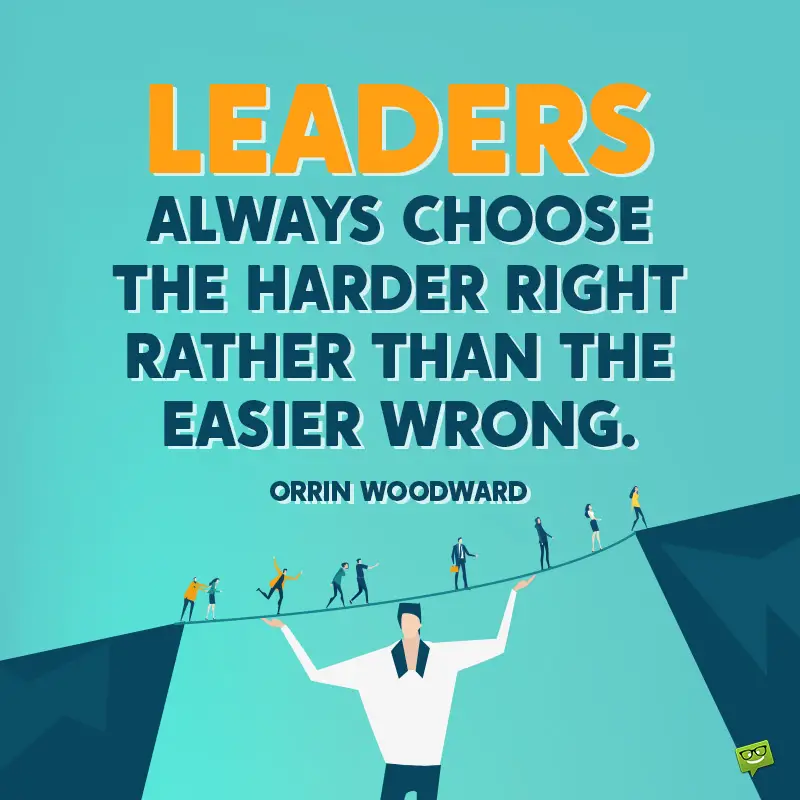
A leader is defined as someone who who leads or commands a group, organisation, or country and leadership is seen as both a research and a practical skill encompassing the ability of an individual, group or organization to lead, influence or guide other individuals, teams, or entire organisations. Leadeship is the act of motivating other people toward a common goal. And good leaders are essential, to drive communities, organisations and countries and to make the large scale decisions to keep our worlds, be them big or small moving. People that have leadership skills showcase a strong personality and interpersonal skills to lead others in their direction.So what makes a good leader?

A successful leader is one who is the power and intellect behind their organisation. They are the visionaries charged with steering their brand around pitfalls and must know when to seize opportunities and how to rally those under them to work hard toward their common goals. An effective leader is one who transcends the leadership title they have and find ways to achieve the right combination of charisma, enthusiasm and self-assurance, probably with a healthy dose of luck and timing. Most of us think and feel that some people are just gifted with these skills, but the truth is most leadership traits can be learned and sharpened with time and practice.

Before we go into what are the traits of a good leader, what should a leader not do? Leaders should act a certain way and there are some negative qualities that leaders should never exhibit. Some of these include failure to set clear goals for their teams, insult or degrade people, give praise too easily, act inappropriately or exhibit behavior that one wouldn’t expect from others, not hold regular meetings with their subordinates, fail to take decisive actions and act tough or lack empathy.

Source

A good leader is one who has most, if not all of the following character traits:

Integrity: A good leader has integrity and the importance of this trait is obvious. Integrity is essential for an individual and an organisation and especially important for top-level executives who are charting an organisation’s course and making many significant decisions.

Delegation: A good leader is able to delegate. Delegating is one of the core responsibilities of a leader and the goal of delegating is not just free up time, but to enable direct reports, facilitate teamwork, provide autonomy, lead to better decision-making, and help direct reports grow. In order to delegate well, one needs to build trust with their team.

Communication: An effective leader is one who is able to communicate their ideas, be able to coach their people and since communication is a two way process, the leader is one who should be able to listen to and communicate with a wide range of people. Powerful leaders know when to talk and when to listen. They are effective communicators and are able to clearly and succinctly explain to those under them everything from goals to specific tasks. They will need to be able to communicate on all levels, be it one on one, or to many, as well as via phone, email and social media.C ommunication is built on a steady flow of verbal and nonverbal exchanges of ideas and information, so to be a good leader one needs to work on being approachable and involving people from different levels.

Gratitude: Being thankful can make one a better leader. Gratitude can lead to higher self-esteem, reduced depression and anxiety, and even better sleep. Few people regularly say thank you, even though most people say they’d be willing to work harder for an appreciative leader.

Learning Agility: This is the ability to know what to do when one don’t know what to do. If one is a quick study or is able to excel in unfamiliar circumstances, they might already be learning agile, but this is a learned skill and anybody can foster learning agility through practice, experience, and effort. Truly great leaders know that the strength of their leadership is built on their ability to adapt to suddenly changing circumstances and to know how and when to seize on opportunities amid a changing landscape. Having an insatiable curiosity will fuel the desire to constantly learn and grow. Learning agility hinges on developing critical thinking skills, being accepting of uncertainty, having social and emotional intelligence and always having the desire and determination to push forward.

Influence and Relationships: To some influence and influencers may have negative connotations, but the ability to convince people through logical, emotional, or cooperative appeals is a component of being an inspiring, effective leader. Influence is quite different from manipulation, and it needs to be done authentically and transparently and requires emotional intelligence and trust-building. A compelling leader does more than just inspire others to follow them; they know how to motivate the people under them to strive wholeheartedly for common goals. Subordinates who feel valued and appreciated, who feel like what they do makes a difference, will feel invigorated to push harder to achieve success. Outstanding leaders also understand that they need to be effective at networking, not just to advance their own careers, but for the benefit of what they are leading. By creating a vast and varied network of people, leaders establish impactful relationships with everyone.

Empathy: Correlated with job performance, empathy is a critical part of emotional intelligence and leadership effectiveness. If you show more empathy towards your direct reports, our research shows you’re more likely to be viewed as a better performer by your boss. Empathy can be learned, and in addition to making you more effective, it will also improve work for you and those around you.

Courage: This is self-explanatory because without courage, it can be hard to speak up at work, whether to voice a new idea, provide feedback, or flag concerns and this is a key skill for good leaders. Rather than avoiding problems or allowing conflicts to fester, courage enables leaders to step up and move things in the right direction and it has been proven that a psychologically safe workplace culture encourages speaking the truth.

Respect: Treating people with respect on a daily basis is one of the most important things a leader can do. It will ease tensions and conflict, create trust, and improve effectiveness. Respect is more than the absence of disrespect, and it can be shown in many different ways. Explore how you can cultivate a climate of respect at work.

Self-Managing: A good leader is someone who is able to manage himself well as it is hard to manage others effectively if they can’t manage themself. Self-managing means being able to prioritise their goals and being responsible for accomplishing those objectives. An effective leader is able to regulate their time, attention and emotions, while remaining aware of others’ strengths, weaknesses and potential sources of bias. They are adept at handling stress and balancing their personal and professional lives, maintaining self-control and discipline in their actions, without becoming overly reserved or inflexible.

Act Strategically: A forward-thinking, open-minded approach is necessary for today’s leaders. Leaders must always be prepared to adjust their strategies to capture emerging opportunities or tackle unexpected challenges. Thinking strategically is an ongoing process that involves assessing the environment which can be cultivated by being curious and genuinely interested in the environment around them, being flexible in their mindset and trying new approaches and ideas, focusing on the future and maintaining a positive outlook.

Accountable and Responsible: A successful leader is one who know how to use the power and authority they have appropriately without overwhelming or overpowering those under them. Effective leaders hold themselves accountable and take responsibility for their own mistakes, and expect others to do the same. They can work within established procedures, and be productive and efficient in their decisions. They appreciate the importance of supporting and encouraging individuality while also understanding organisational structures and the need to follow rules and policies and are able to balance different perspectives while taking appropriate action.

Goal Setting: To be a successful and effective leader, set clear goals and be determined and purposeful in achieving them. Back it all up with unshakable self-confidence. If one radiates enthusiasm and are truly excited about what they’re doing, people will be naturally drawn to them. Also something to remember is that writing down goals is key to the success, but accomplishing those goals takes time. If one give up, so will everyone around them. So to be a successful leader, one must be willing to keep going when others are tempted to throw in the towel.

Future Vision: An exceptional leader is one who has the ability to look into the future and make clear, concrete goals that will benefit them and the people under them. They are confident and optimistic, inspiring enthusiasm in those around them. Being a visionary is about managing change while striking a balance between stability and growth and incorporating new approaches without getting distracted from the main goals. Being a visionary means understanding that continuous change is occurring all around, so what worked in the past may not always work now. Practicing being adaptable and agile as new strategies are implemented is what makes strategies evolve over time.

Problem Solving: A good leader must be a problem solver who can make decisions under rapidly shifting circumstances with learning to lead in a complex environment a vital skill for any leader. Even before any definitive information is available, effective leaders must assess a situation’s complexity and choose appropriate courses of action. This means being able to scan the environment in search of subtle trends and indicators of disruptive change, and establish practices that allow you and what you are leading to respond swiftly.

Creativity And Innovation: A great leader is one with the courage to risk experimentation and encourage creativity. The key is to always be persistent in pursuing the goals set, and be open minded and flexible in how to get there. A good leader will encourage the people around them to spend at least 15 percent of their time exploring new ideas through brainstorming and prototyping.

Teamwork: Successful leadership is built on the people around them. Team building is essential to leading a diverse and unique group of people with distinct personalities, motivations and skills. Strong teams and teamwork are key to achieving many of things above, such as fostering innovation, effective communication and achieving goals. With the right kind of people under them, recruited, developed and nutured carefully, they can create an unstoppable force that will drive success.

So there you have it, the traits that one needs to nuture to become an effective and successful leader. It is also essential to realise that leadership is a social process and if one demonstrates several of the characteristics of a good leader but fail to grasp this, chances are they won’t get very far on their own. One may be well-liked and respected, but it will be challenging to accomplish team or organisational goals. And it’s worth remembering that leadership isn’t a destination, it’s something that one will have to work at regularly throughout their career, regardless of the level they are in. Leadership is less about a strong or charismatic individual and more about a group of people working together to achieve results. That’s why leadership is a journey, with different teams, projects, situations, and organisations that will require one to apply these skills in different ways.