In My Hands Today…

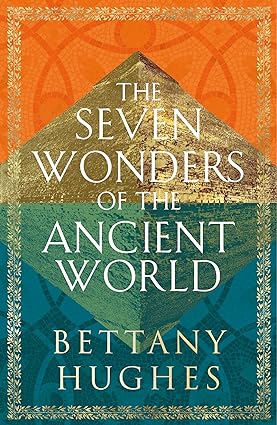
The Seven Wonders of the Ancient World – Bettany Hughes

Their names still echo down the ages: The Great Pyramid at Giza. The Hanging Gardens of Babylon. The Temple of Artemis. The statue of Zeus at Olympia. The mausoleum of Halikarnassos. The Colossus at Rhodes. The Lighthouse of Alexandria. The Seven Wonders of the World were staggeringly audacious impositions on our planet. They were also brilliant adventures of the mind, test cases of the reaches of human imagination. Now only the pyramid remains, yet the scale and majesty of these seven wonders still enthral us today.

In a thrilling, colourful narrative enriched with the latest archaeological discoveries, bestselling historian Bettany Hughes walks through the landscapes of both ancient and modern time; on a journey whose purpose is to ask why we wonder, why we create, why we choose to remember the wonder of others. She explores traces of the Wonders themselves, and the traces they have left in history. A majestic work of historical storytelling, The Seven Wonders of the Ancient World reinforces the exciting, and nourishing, notion that humans can make the impossible happen.

In My Hands Today…

Histories of Nations: How Their Identities Were Forged – edited by Peter Furtado

Global histories tend to be written from the narrow viewpoint of a single author and a single perspective, with the inevitable bias that it entails. But in this thought-provoking collection, twenty-eight writers and scholars give engaging, often passionate accounts of their own nation’s history.

The countries have been selected to represent every continent and every type of state: large and small; mature democracies and religious autocracies; states that have existed for thousands of years; and those born as recently as the twentieth century. Together, they contain two-thirds of the world’s population.

In the United States, for example, the myth of the nation’s “historylessness” remains strong, but in China, history is seen to play a crucial role in legitimising three thousand years of imperial authority.

“History wars” over the content of textbooks rage in countries as diverse as Australia, Russia, and Japan. Some countries, such as Iran or Egypt, are blessed—or cursed—with a glorious ancient history that the present cannot equal; others, such as Germany, must find ways of approaching and reconciling the pain of the recent past.

In My Hands Today…

The Horde: How the Mongols Changed the World – Marie Favereau

The Mongols are widely known for one thing: conquest. In the first comprehensive history of the Horde, the western portion of the Mongol empire that arose after the death of Chinggis Khan, Marie Favereau shows that the accomplishments of the Mongols extended far beyond war. For three hundred years, the Horde was no less a force in global development than Rome had been. It left behind a profound legacy in Europe, Russia, Central Asia, and the Middle East, palpable to this day.

Favereau takes us inside one of the most powerful sources of cross-border integration in world history. The Horde was the central node in the Eurasian commercial boom of the thirteenth and fourteenth centuries and was a conduit for exchanges across thousands of miles. Its unique political regime―a complex power-sharing arrangement among the khan and the nobility―rewarded skillful administrators and diplomats and fostered an economic order that was mobile, organized, and innovative. From its capital at Sarai on the lower Volga River, the Horde provided a governance model for Russia, influenced social practice and state structure across Islamic cultures, disseminated sophisticated theories about the natural world, and introduced novel ideas of religious tolerance.

The Horde is the eloquent, ambitious, and definitive portrait of an empire little understood and too readily dismissed. Challenging conceptions of nomads as peripheral to history, Favereau makes clear that we live in a world inherited from the Mongol moment.