In My Hands Today…

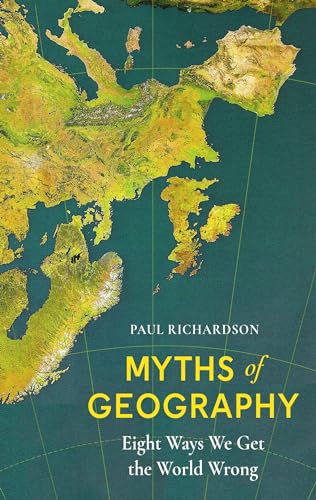
Myths of Geography: Eight Ways We Get the World Wrong – Paul Richardson

Is geography really destiny?

Our maps may no longer be stalked by dragons and monsters, but our perceptions of the world are still shaped by geographic myths. Myths like Europe being the centre of the world. Or that border walls are the solution to migration. Or that Russia is predestined to threaten its neighbours.

In his punchy and authoritative new book, Paul Richardson challenges recent popular accounts of geographical determinism and shows that how we see the world represented often isn’t how it really is – that the map is not the territory.

Along the way we visit some remarkable Iceland’s Thingvellir National Park, where you can swim between two continents; Bir Tawil in North Africa, one of the world’s only territories not claimed by any country; and we follow the first train that ran across Eurasia between Yiwu in east China and Barking in east London.

Written with verve and full of quotable facts, Myths of Geography is a book that will turn your world upside down.

In My Hands Today…

Four Points of the Compass: The Unexpected History of Direction – Jerry Brotton

North, south, east, and west: almost all societies use these four cardinal directions to orientate themselves and to understand who they are by projecting where they are. For millennia, these four directions have been foundational to our travel, navigation, and exploration, and are central to the imaginative, moral, and political geography of virtually every culture in the world. Yet they are far more subjective—and sometimes contradictory—than we might realize.

Four Points of the Compass takes us on a journey of directional discovery. Societies have understood and defined directions in very different ways based on their locations in time and space. Historian Jerry Brotton reveals why Hebrew culture privileges east; why Renaissance Europeans began drawing north at the top of their maps; why early Islam revered the south; why the Aztecs used five color-coded cardinal directions; and why no societies, primitive or modern, have ever orientated themselves westwards. In doing so, politically-loaded but widely used terms such as the “Middle East,” the “Global South,” the “West Indies,” the “Orient,” and even the “western world” take on new meanings. Who decided on these terms and what do they mean for geopolitics? How have directions like “east” and “west” taken on the status of cultural identities—or more accurately stereotypes?

Yet today, because of GPS capability, cardinal points are less relevant. Online, we place ourselves at the center of the map as little blue dots moving across geospatial apps; we have become the most important compass point, though in the process we’ve disconnected ourselves from the natural world. Imagining what future changes technology may impose, Jerry Brotton skillfully reminds us how crucial the four cardinal directions have been to everyone who has ever walked our planet.

In My Hands Today…

Outlandish: Walking Europe’s Unlikely Landscapes – Nick Hunt

In Outlandish, acclaimed travel writer Nick Hunt takes us across landscapes that should not be there, wildernesses found in Europe yet seemingly belonging to far-off a patch of Arctic tundra in Scotland; the continent’s largest surviving remnant of primeval
forest in Poland and Belarus; Europe’s only true desert in Spain; and the fathomless grassland steppes of Hungary.

From snow-capped mountain range to dense green forest, desert ravines to threadbare, yellow open grassland, these anomalies transport us to faraway regions of the world.

More like pockets of Africa, Asia, the Poles or North America, they make our own continent seem larger, stranger and more filled with secrets.

Against the rapid climate breakdown of deserts, steppes and primeval jungles across the
world, this book discovers the outlandish environments so much closer to home – along
with their abundant reindeer; bison; ibex; wolves and herds of wild horses.

Blending sublime travel writing, nature writing and history – by way of Paleolithic cave art,
reindeer nomads, desert wanderers, shamans, Slavic forest gods, European bison, Wild
West fantasists, eco-activists, horseback archers, Big Grey Men and other unlikely spirits
of place – these desolate and rich environments show us that the strange has always been
near.

In My Hands Today…

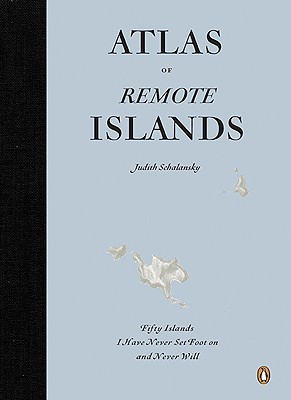
Atlas of Remote Islands: Fifty Islands I Have Never Set Foot On and Never Will – Judith Schalansky, translated by Christine Lo

There are still places on earth that are unknown. Visually stunning and uniquely designed, this wondrous book captures fifty islands that are far away in every sense-from the mainland, from people, from airports, and from holiday brochures.

Author Judith Schalansky used historic events and scientific reports as a springboard for each island, providing information on its distance from the mainland, whether its inhabited, its features, and the stories that have shaped its lore.

With stunning full-colour maps and an air of mysterious adventure, Atlas of Remote Islands is perfect for the traveller or the romantic in all of us.

In My Hands Today…

Brilliant Maps for Curious Minds: 100 New Ways to See the World – Ian Wright

Which countries don’t have rivers? Which ones have North Korean embassies? Who drives on the “wrong” side of the road? How many national economies are bigger than California’s? And where can you still find lions in the wild? You’ll learn answers to these questions and many more in Brilliant Maps for Curious Minds. This one-of-a-kind atlas is packed with eye-opening analysis (Which nations have had female leaders?), whimsical insight (Where can’t you find a McDonald’s?), and surprising connections that illuminate the contours of culture, history, and politics.

Each of these 100 maps will change the way you see the world—and your place in it.