In My Hands Today…

Sultan: A Memoir – Wasim Akram, Gideon Haigh

For twenty years, Wasim Akram let his cricket do the talking – his electrifying left-arm pace, his explosive left-handed striking, his leadership and his inspiration. For another twenty years he kept his own counsel about those days, full of drama, controversy and even mystery, in a country, Pakistan, that to outsiders is a constant enigma. Until now.

Sultan tells the story of cricket’s greatest left-arm bowler, and one of its greatest survivors, who was chosen from the streets of Lahore and groomed by Imran Khan to become champion of the world – man of the match in the final of the 1992 World Cup. Along the way were unforgettable rivalries with the greatest of his time, from Viv Richards and Ian Botham to Sachin Tendulkar and Shane Warne. Along the way, too, a backdrop of conspiracy and intrigue over ball tampering and match fixing about which Wasim finally sets the story straight.

But there’s more: Sultan goes frankly into the crumbling and rebuilding of Wasim’s private life, marred by the tragedy of his first wife’s death and the torment of addiction. The result is an unprecedented insight into the life of a cricketer who revolutionised the game with his speed and swing, and a patriot buoyed and burdened by the expectation of one of the game’s most fanatical public.

In My Hands Today…

Crossings: How Road Ecology Is Shaping the Future of Our Planet – Ben Goldfarb

An eye-opening account of the global ecological transformations wrought by roads, from the award-winning author of Eager.

Some 40 million miles of roadways encircle the earth, yet we tend to regard them only as infrastructure for human convenience. While roads are so ubiquitous they’re practically invisible to us, wild animals experience them as entirely alien forces of death and disruption.

In Crossings, environmental journalist Ben Goldfarb travels throughout the United States and around the world to investigate how roads have transformed our planet. A million animals are killed by cars each day in the U.S. alone, but as the new science of road ecology shows, the harms of highways extend far beyond roadkill.

Creatures from antelope to salmon are losing their ability to migrate in search of food and mates; invasive plants hitch rides in tire treads; road salt contaminates lakes and rivers; and the very noise of traffic chases songbirds from vast swaths of habitat. Yet road ecologists are also seeking to blunt the destruction through innovative solutions.

Goldfarb meets with conservationists building bridges for California’s mountain lions and tunnels for English toads, engineers deconstructing the labyrinth of logging roads that web national forests, animal rehabbers caring for Tasmania’s car-orphaned wallabies, and community organizers working to undo the havoc highways have wreaked upon American cities. Today, as our planet’s road network continues to grow exponentially, the science of road ecology has become increasingly vital. Written with passion and curiosity, Crossings is a sweeping, spirited, and timely investigation into how humans have altered the natural world―and how we can create a better future for all living beings.

In My Hands Today…

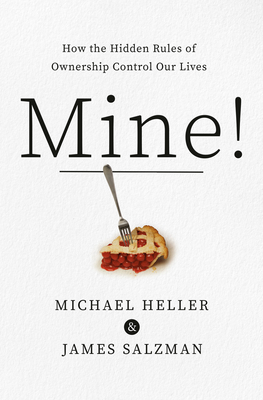
Mine!: How the Hidden Rules of Ownership Control Our Lives – Michael A. Heller, James Salzman

A hidden set of rules governs who owns what–explaining everything from whether you can recline your airplane seat to why HBO lets you borrow a password illegally–and in this lively and entertaining guide, two acclaimed law professors reveal how things become mine.

Mine is one of the first words babies learn. By the time we grow up, the idea of ownership seems natural, whether buying a cup of coffee or a house. But who controls the space behind your airplane seat: you reclining or the squished laptop user behind? Why is plagiarism wrong, but it’s okay to knock-off a recipe or a dress design? And after a snowstorm, why does a chair in the street hold your parking space in Chicago, but in New York you lose the space and the chair?

Mine! explains these puzzles and many more. Surprisingly, there are just six simple stories that everyone uses to claim everything. Owners choose the story that steers us to do what they want. But we can always pick a different story. This is true not just for airplane seats, but also for battles over digital privacy, climate change, and wealth inequality. As Michael Heller and James Salzman show–in the spirited style of Freakonomics, Nudge, and Predictably Irrational–ownership is always up for grabs.

With stories that are eye-opening, mind-bending, and sometimes infuriating, Mine! reveals the rules of ownership that secretly control our lives.

In My Hands Today…

Word Perfect: Etymological Entertainment For Every Day of the Year – Susie Dent

From ‘Turning a Blind Eye’ (Nelson putting the telescope to his missing eye to ignore the order to stop fighting) to why May Day became a distress call; from stealing someone’s thunder to the real Jack the Lad, from tartle (forgetting someone’s name) to snaccident (unintentionally eating a whole packet of biscuits), Word Perfect is her brilliant linguistic almanac full of unforgettable true stories tied to every day of the year. You’ll never be lost for words again.

In My Hands Today…

The Art of Fermentation: An in-Depth Exploration of Essential Concepts and Processes from Around the World – Sandor Ellix Katz

Winner of the 2013 James Beard Foundation Book Award for Reference and Scholarship, and a New York Times bestseller, The Art of Fermentation is the most comprehensive guide to do-it-yourself home fermentation ever published. Sandor Katz presents the concepts and processes behind fermentation in ways that are simple enough to guide a reader through their first experience making sauerkraut or yogurt, and in-depth enough to provide greater understanding and insight for experienced practitioners.

While Katz expertly contextualizes fermentation in terms of biological and cultural evolution, health and nutrition, and even economics, this is primarily a compendium of practical information–how the processes work; parameters for safety; techniques for effective preservation; troubleshooting; and more.

With two-color illustrations and extended resources, this book provides essential wisdom for cooks, homesteaders, farmers, gleaners, foragers, and food lovers of any kind who want to develop a deeper understanding and appreciation for arguably the oldest form of food preservation, and part of the roots of culture itself.

Readers will find detailed information on fermenting vegetables; sugars into alcohol (meads, wines, and ciders); sour tonic beverages; milk; grains and starchy tubers; beers (and other grain-based alcoholic beverages); beans; seeds; nuts; fish; meat; and eggs, as well as growing mold cultures, using fermentation in agriculture, art, and energy production, and considerations for commercial enterprises. Sandor Katz has introduced what will undoubtedly remain a classic in food literature, and is the first–and only–of its kind.