

A flowing six-yard drape of beauty and grace, the saree can be called India’s national dress for women. Every state and community has their fabrics and materials that are unique to the region and drapes that instantly brings a specific community to mind. The saree consists of an un-stitched stretch of woven fabric arranged over the body as a robe, with one end tied to the waist, while the other end rests over one shoulder as a stole or shawl, with a part of the midriff showing. It may vary from 4.1 to 8.2 metres or 4.5 to 9 yards in length, and 60 to 120 cm in breadth. The saree is part of the traditional wear of women of the Indian subcontinent in India, Pakistan, Bangladesh, Sri Lanka & Nepal. There are various names and styles of sari manufacture and draping, the most common being the Nivi style. The sari is worn with a fitted bodice commonly called a blouse and a petticoat.
This post started as my ode to the different fabrics and sarees available in the country and I soon realised this is much larger than just naming the various fabrics in the country. So this is now a three-part short series because I wanted to showcase as much as I can of the amazing fabrics available. And on a personal note, this is also a repository for me to refer to because one of my dreams is to have a saree from every Indian state.
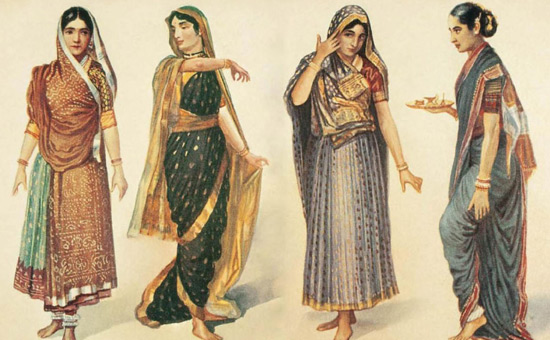
Sadee is a Hindustani word that means a strip of cloth that evolved to sāṛī in modern Indian languages. The word śāṭika is mentioned as describing women’s dharmic attire in Sanskrit literature and Buddhist literature called Jatakas which could be equivalent to the modern-day saree. The term for female bodice, the choli evolved from ancient stanapaṭṭa. Rajatarangini, a tenth-century literary work by Kalhana, states that the choli from the Deccan was introduced under the royal order in Kashmir. The petticoat is called sāyā in Hindi and Urdu, parkar in Marathi, ulpavadai in Tamil, sāẏā in Bengali and eastern India, and sāya in Sinhalese. Apart from the standard petticoat, it may also be called an inner skirt or an inskirt.
The history of a sari-like drapery is traced back to the Indus Valley Civilisation, which flourished during 2800–1800 BC around the northwestern part of the Indian subcontinent. Cotton was first cultivated and woven in the Indian subcontinent around the 5th millennium BC and dyes used during this period are still in use, particularly indigo, lac, red madder, and turmeric. Silk was woven around 2450 BCE and 2000 BCE.
The word sari evolved from śāṭikā a Sanskrit word mentioned in earliest Hindu literature as women’s attire. The sari or śāṭikā evolved from a three-piece ensemble comprising the antarīya or the lower garment; the uttarīya which was a a veil worn over the shoulder or the head; and the stanapatta, a chestband. This ensemble is mentioned in Sanskrit literature and Buddhist Pali literature during the 6th century BCE. This complete three-piece dress was known as poshak, a generic term for a costume. The ancient antariya closely resembled the dhoti wrap in the fishtail” version which was passed through legs, covered the legs loosely and then flowed into a long, decorative pleats at front of the legs. It further evolved into the Bhairnivasani skirt, today known as ghagri and lehenga. The Uttariya was a shawl-like veil worn over the shoulder or head, and evolved into what is known today known as dupatta and ghoonghat. Likewise, the stanapaṭṭa evolved into the choli by the 1st century CE.

It is generally accepted that wrapped sari-like garments for the lower body and sometimes shawls or scarf like garments called uttariya for the upper body, have been worn by Indian women for a long time, and that they have been worn in their current form for hundreds of years. Based on sculptures and paintings, tight bodices or cholis are believed to have evolved between the 2nd century BCE and the 6th century CE in various regional styles.
After this short history about the saree, let’s take a trip around the country to see the various fabrics and sarees available in the different states of India. This is by no means an exhaustive list and I have probably missed many regional varieties, so apologies in advance if I have missed something I should not have.
Andhra Pradesh

Chirala: A coastal town also known as Kshiraputi, Chirala, which means saree in Telugu is renowned for its handlooms that are soft and durable. With more than 60% of the town’s population belonging to the weaving community, the looms used in the town are mostly pit or fly shuttle looms and the motifs in the fabrics and sarees are usually geometrical designs. The weavers of Chirala produce, cotton sarees, seico sarees that are a fine blend of cotton and silk fibres and kuppadam or the Gadwal type. The hand butta is another fascinating design feature of Chirala sarees, where colours are manually added in-between the zari design. Kalamkari printing is also a speciality of the Chirala saree.

Dharmavaram: Handloom silk sarees, Dharmavaram fabrics are textiles woven by hand with mulberry silk and zari which is fine thread traditionally made from gold or silver. The Dharmavaram fabric has a GI or Geographical Indications tag. Kriya Shakthi Vodavaru Swamy named Dharmavaram after the name of his mother, Dharmambai around 1153–54 and by the 19th century, the silk handloom industry emerged as the main occupation. Paintings on the roof wall of Lepakshi temple and the Latha Mandapam depict the designs of Dharmavaram sarees. These saris are worn in the winter months or when it is cold and on special occasions and are mostly used by dancers of Bharatnatyam and Kuchipudi.

Kalamkari: A type of hand-painted or block-printed cotton textile, Kalamkari is produced in Isfahan in Iran and Andhra Pradesh. Only natural dyes are used in Kalamkari, which involves twenty-three steps. There are two distinctive styles of Kalamkari art in India, the Srikalahasti style and the Machilipatnam style. The Srikalahasti style of Kalamkari is where the kalam or pen is used for freehand drawing of the subject and filling in the colours and is entirely hand-worked. This style flourished in temples centred on creating unique religious identities, appearing on scrolls, temple hangings, chariot banners as well as depictions of deities and scenes taken from the Hindu epics like the Ramayana, the Mahabharata and the Puranas. The Machilipatnam style of Kalamkari involves vegetable-dyed block painting, where the dye is applied to the fabric with the help of wooden blocks. The natural dyes for the cloth are obtained by extracting colours from various roots, leaves, and mineral salts of iron, tin, copper, and alum and mixing them with cow dung, seeds, flowers, and milk. Historically, Kalamkari used to be termed Pattachitra, an art form still found in neighbouring Odisha and other parts of India and Nepal. The term Pattachitra translates to patta, meaning a cloth, with picture or chitra. Paintings made on fabric and fabric scrolls are mentioned in ancient Hindu, Buddhist and Jain literature. Under medieval Islamic rule, the term Kalamkari is derived from the words kalam, which means pen in Telugu, and kari, which means craftmanship and this style became popular under the patronage of the Golconda sultanate.
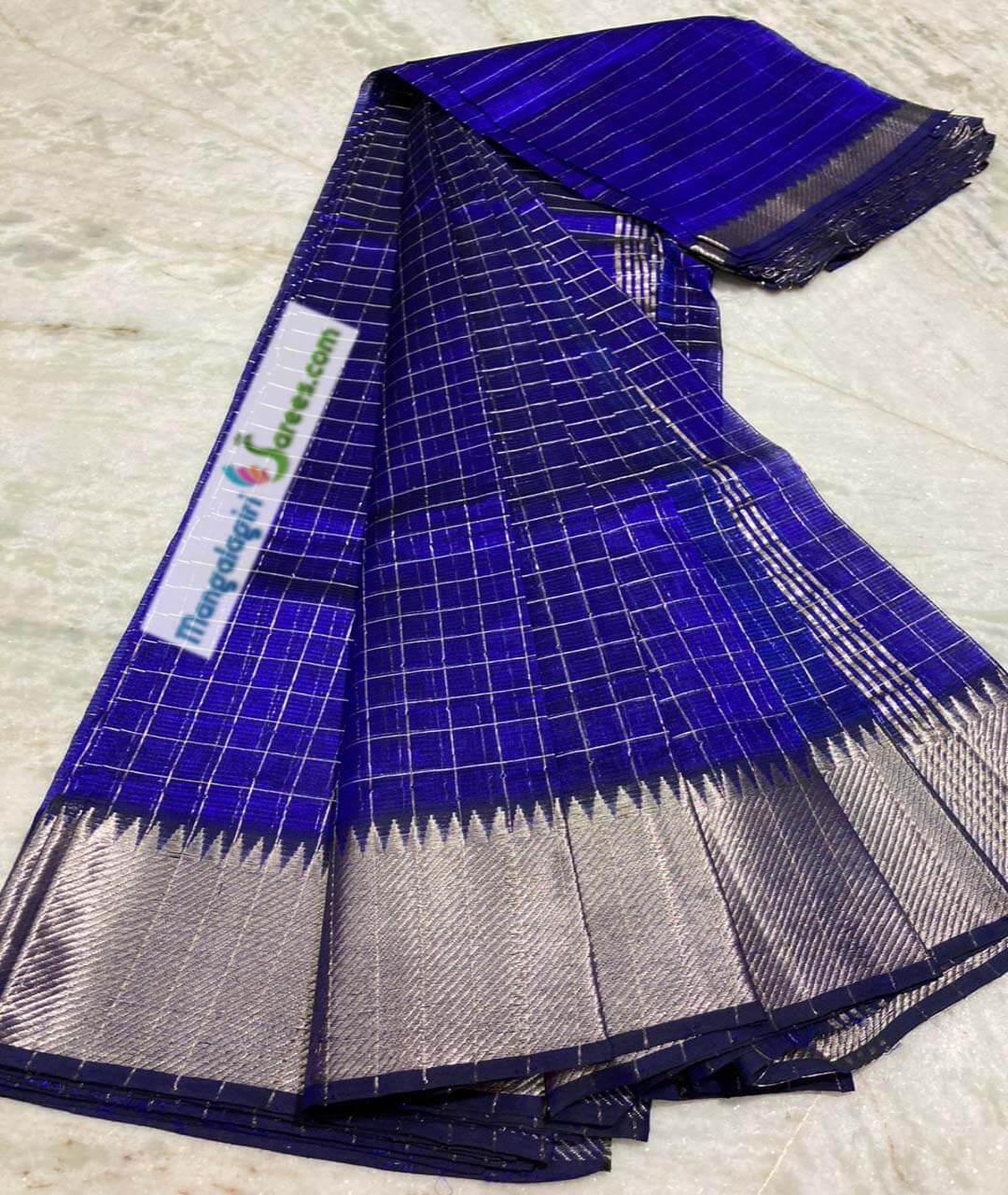
Mangalagiri: Mangalagiri Sarees and fabrics are produced by handloom weaving in Mangalagiri, a town in Andhra Pradesh. Mangalagiri cotton silk sarees are a unique variety, woven from cotton, and feature characteristic features such as zari on the border and no woven pattern on the body. Borders in thick gold thread or zari, traditional patterns in Nizam, and simple mono or multicoloured striped pallus adorn the fabric. The sarees have various designs like leaves, mango, parrot, and gold coins. The soft and comfortable all-weather fabric generally has no pattern on the body and is known to have no gaps in its weaving with missing saree threads rarely found. As the town is also the abode of Lord Narasimha Temple, the saris are also used by the devotees for devotional purposes.
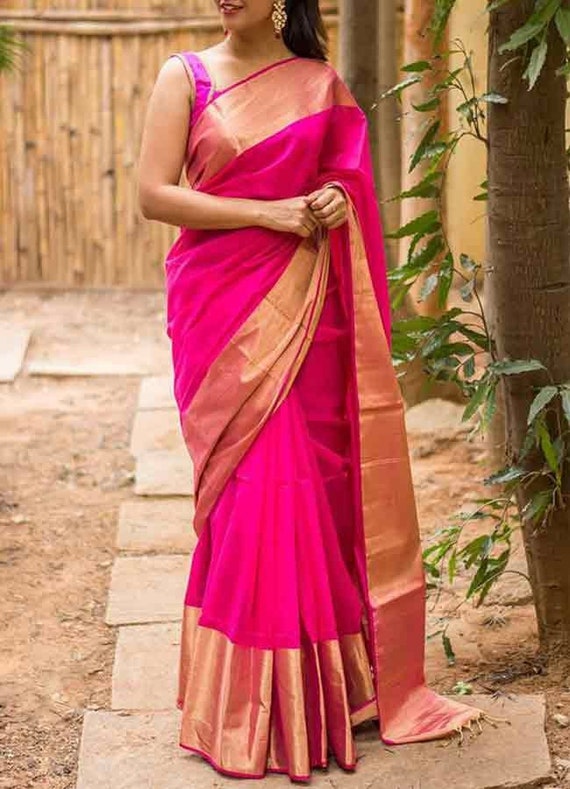
Uppada: The Uppada Jamdani Sari is a silk sari style woven in the town of Uppada in Andhra Pradesh and is known for its light weight. The saree was also accorded the Geographical Indication tag from Andhra Pradesh. The name Jamdani is a Persian terminology, in which Jam means flower and Dani means a vase. The Jamdani style of weaving originated in Bangladesh and was brought to the south and Uppada village in the 18th century and recreated with a local flavour. old The Jamdani style of weaving is about 300 years old and in 1972, Uppada weavers were recognised by the Indian government with the President’s award. The Uppada Jamdani saree is a beautiful textile with a silk-like texture and is lightweight. The weaving of the saree takes between 10 to 60 days for which least 2-3 weavers spend 10 hours a day. There are around 3000 looms producing Jamdani sarees in and around the Uppada and Kothapalli area. Around 40% of the local weavers are women. The saree consists of a cotton body with a silk pallu and is completely handwoven. The saree is woven in such a way that it can be folded and fit inside a matchbox. The speciality of the Jamdani saree is that the design is shown on both sides of the fabric.
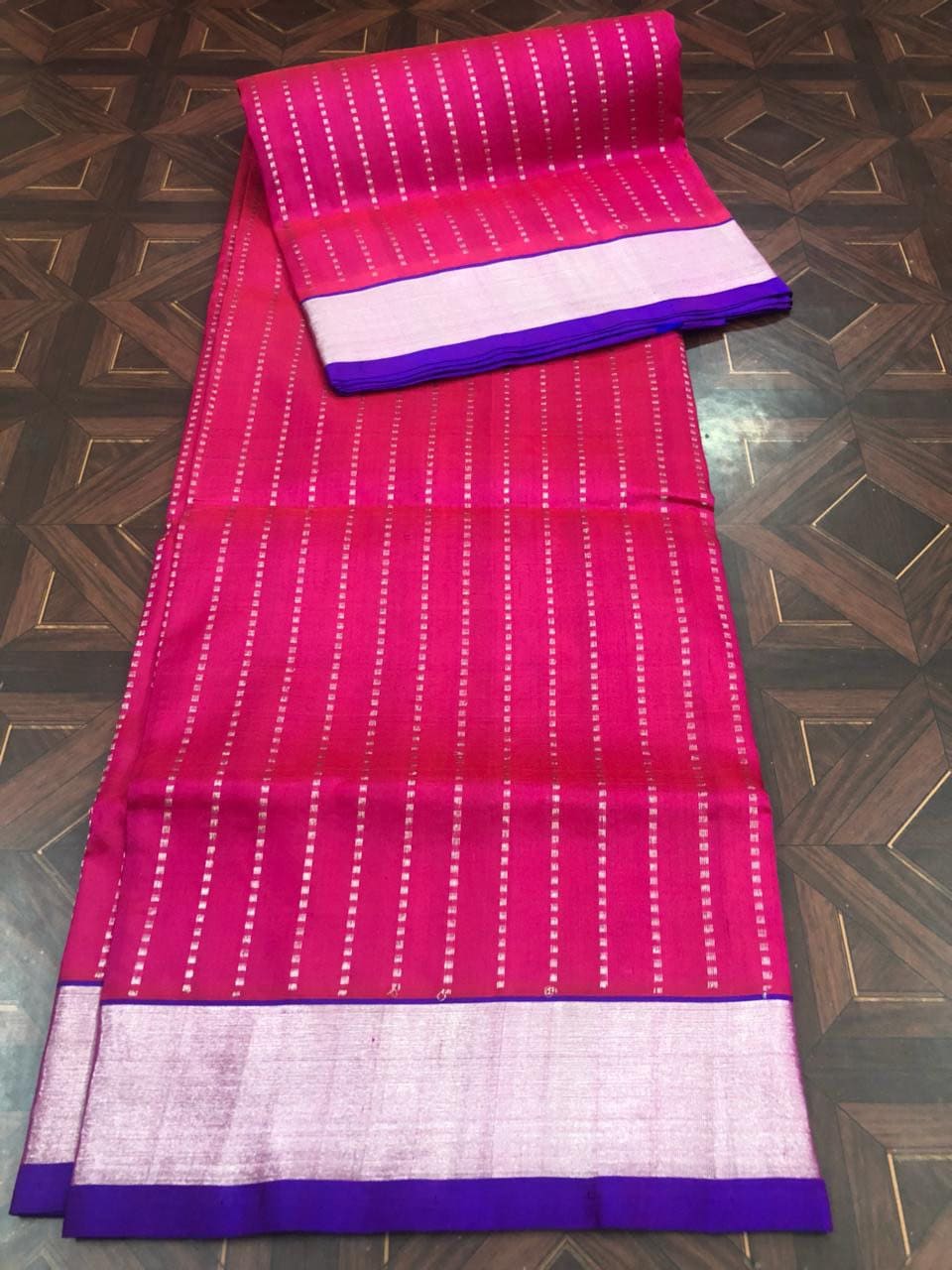
Venkatagiri: Woven in Venkatagiri near Tirupati in Andhra Pradesh, this fabric has also been accorded the GI tag and is known for its fine weaving. The history of the saree dates back to the early 1700s in the Venkatagiri village and were encouraged by the Velugoti dynasty of Nellore and also by the Bobbili and Pithapuram dynasties. In those days, they were mostly woven fabrics for royalty and landowners.
Assam

Assam Silk: Assam silk refers to the three major types of indigenous wild silks produced in Assam —golden muga, white pat and warm eri silk. Assam was well known for the production of high-quality silk since ancient times. The knowledge of sericulture probably arrived with the Tibeto-Burman groups which arrived from China around 3000-2000 BC. Genetic research on silkworms shows that Assam silk originated in two specific regions of Assam, the Garo Hills in the ancient Kamrupa Kingdom and Dhakuakhana in the ancient Chutia kingdom.
Muga silk is the product of the silkworm Antheraea assamensis endemic to Assam. The silk produced is known for its glossy, fine texture and durability and has a natural yellowish-golden tint. It was previously reserved for the use of royalty. This silk can be hand washed with its lustre increasing after every wash. Very often the silk outlives its owner. The silk has been given the Geographical Indication (GI) status since 2007.
Pat silk is produced by the Bombyx textor silkworms which feed on mulberry leaves. It is usually brilliant white or off-white and must be dried in the shadows and not in direct sunlight. Eri silk is made by the Samia cynthia ricini which feed on leaves of castor oil plant. It is also known as endi or errandi silk. Because the manufacturing process of eri allows the pupae to develop into adults and only the open-ended cocoons are used for turning into silk, it is also popularly known as non-violent silk which is soft and warm and is popular used as shawls and quilts.
Bihar

The Bhagalpuri or Kosa or Tussar Saree is Tussar silk that is valued for its rich texture and natural deep gold colour. The tussar silk weaving industry in Bhagalpur is more than a century old and has about 30,000 handloom weavers working in producing the sarees. Bhagalpuri silk is made from cocoons of Antheraea paphia silkworms which are only found in India and is processed at Nathnagar at Bhagalpur. The unique dyeing technique of these Bhagalpuri silk sarees sets them apart from the art silk sarees. The saree was supposed to have been produced in ancient times and even Mughal rulers patronised the weavers. But the technique soon got extinct and was revived about 200 years back by the weavers. The silk fabric is extremely soft and lightweight and is known as the queen of fabrics.
Chhatisgarh
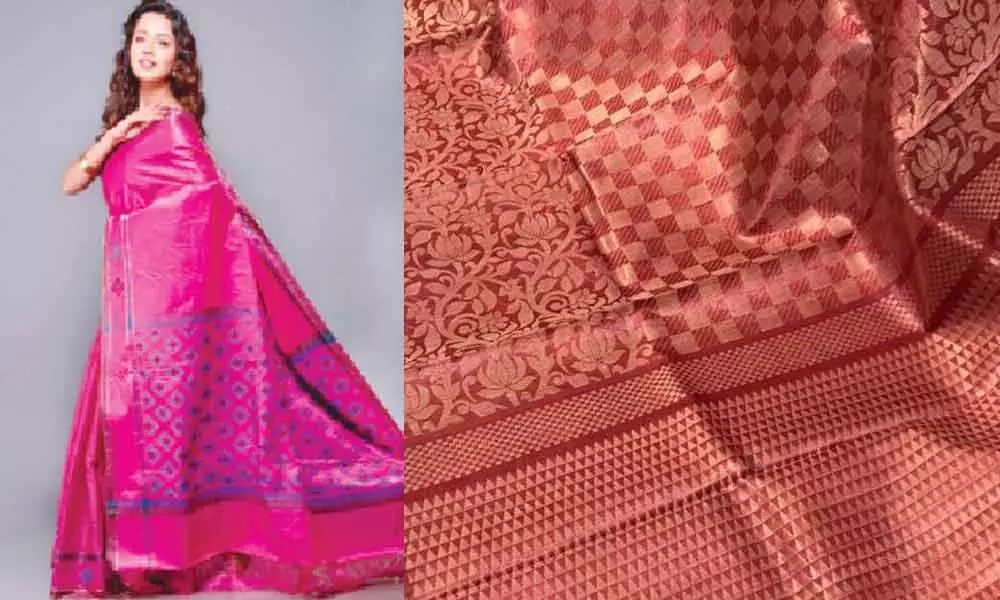
The Chattisgarh Kosa saree is Tussar silk similar to the Bhagalpuri Kosa. Kosa silk is mainly derived from Antheraea mylitta, an Indian silkworm and is special type of tussar silk that is drawn out of the cocoons grown on trees like Saja, Sal, and Arjun mostly grown in Chattisgarh. The silk is widely popular owing to its sturdiness, purity and soft texture. The dull golden brownish texture of the silk is its signature trait, but can also be found in natural shades of dark honey, fawn, orange, pale golden and cream. The actual colour of kosa is a dull gold, but the finished fabric is dyed with natural dyes extracted from natural dyes. The towns of Champa and Korba are known for their production of Kosa Silk, and the silk produced in Champa is considered to be the best silk.
Gujarat

Bandhini: A type of tie-dye textile decorated by plucking the cloth with the fingernails into many tiny bindings that form a figurative design, Bandini or Bandhani dates back to the Indus Valley Civilization where dyeing was done as early as 4000 BC. The earliest example of the most pervasive type of Bandhani dots can be seen in the 6th-century paintings depicting the life of Buddha found on the wall of Cave 1 at Ajanta. The main colours used in Bandhana are natural. As Bandhani is a tie and dye process, dying is done by hand and hence best colours and combinations are possible in Bandhanis. The fabric used for making Bandhani sarees and dupattas are loosely woven silk called Georgette, or cotton known as Malmal. The knots are tightly tied, and the rest of the fabric is dyed in multiple stages. This leaves the knots undyed and hence a beautiful flower-like pattern appears all over the cloth as a design.
The term bandhani is derived from the Sanskrit verbal root bandh which means to bind or to tie. Today, most Bandhani can be found in Gujarat, Rajasthan, Sindh, Punjab and Tamil Nadu where it is known as Sungudi and is known as chunri in Pakistan. The art of Bandhani is a highly skilled process with the technique involving dyeing a fabric which is tied tightly with a thread at several points, thus producing a variety of patterns, depending on how the cloth is tied. The main colours used in Bandhana are yellow, red, blue, green and black.
The Bandhani work has been exclusively carried out by the Khatri community of Kutchh and Saurashtra. Bandhani work is also done in Rajasthan, where different colours and designs are used than in the Kutch and Saurashtra regions of Gujarat. Establishments of varying sizes in the entire Kutch belt in Gujarat produce many varieties of Bandhani. This Bandhani style is called Kutchi Bandhani. Bandhani tying is often a family trade, and the women of these families work at home to tie patterns.

Patola: A double ikat woven sari, usually made from silk, the Patola saree comes from the town of Patan. Similar to Bandhani, Patola sarees are also a type of tie and dye process and are well known for not losing their colour at all. They are very expensive, once worn only by those belonging to royal and aristocratic families. Patola sarees are found in two different types – the Rajkot Patola and the Patan Patola. These two are differentiated with the Rajkot Patola having a single ikat weave that is dyed vertically, while the Patan Patola has a double ikat weave and is dyed horizontally. The word patola is the plural form; the singular is patolu.
To create a patola sari, both the warp and weft threads are wrapped to resist the dye according to the desired pattern of the final woven fabric. This tying is repeated for each colour that is to be included in the finished cloth. The technique of dyeing the warp and weft before weaving is called double ikat. The bundles of thread are strategically knotted before dyeing. Patola saris from Surat, Ahmedabad and Patan are renowned for their colourful diversity and geometrical style.
Silk weavers of the Salvi community from Maharashtra chose Gujarat as the home for their renowned patola fabric. It is believed that the Salvis went to Gujarat in the 12th century to acquire the patronage of the Chaulukyas Rajputs, who ruled Gujarat and parts of Malva and south Rajasthan, with Anahiwad Patan as their capital. Legend says that over 700 patola weavers came to the palace of Raja Kumarpal, at the personal request of the king. The Solanki or Chalukya rulers used to dress in patola silk on special occasions. The art of Patola weaving is an ancient one. According to some historians, the art of Patola weaving was known also in the 4th century as seen by the carvings at the Ajanta caves. After the decline of the Solanki empire, the Salvis founded a rich trade in Gujarat. Patola saris quickly became a sign of social status among Gujarati women and girls, especially as part of streedhan or the items that a woman can claim as her wealth.
There are four distinct patterns which are woven primarily in Gujarat by the Salvi community. In Jain and Hindu communities, double ikat saris with entire designs of parrots, flowers, elephants and dancing figures are generally used. In Muslim communities, saris with geometric designs and floral patterns are typical, being worn mostly for weddings and other special occasions. Maharashtrian Brahmins wear saris woven with plain, dark-coloured borders and body and a bird design called Nari Kunj.

Tanchoi: Tanchoi sarees are one of a kind, having spots all over the surface and woven with a dual colour warp. The stand-alone feature of the Tanchoi saree is that the fabric texture background has a satin finish. Extra threads are added to give these sarees the appearance of being embroidered. Famed for the intricate and small weaving patterns over the fabric, the commonly used motifs are those of flowers, small birds in flight, peacocks and parrots. Tanchoi silk is said to have been brought to India by Chinese traders in the 19th century and later adapted to suit the preferences of the Indian market. Three Parsi brothers are said to have travelled from India to China in the 19th century and were enamoured by the technique. After learning the skill, they came back to Surat, Gujarat and trained the weavers in the technique and then evolved the Tanchoi weaving technique into Indian versions.
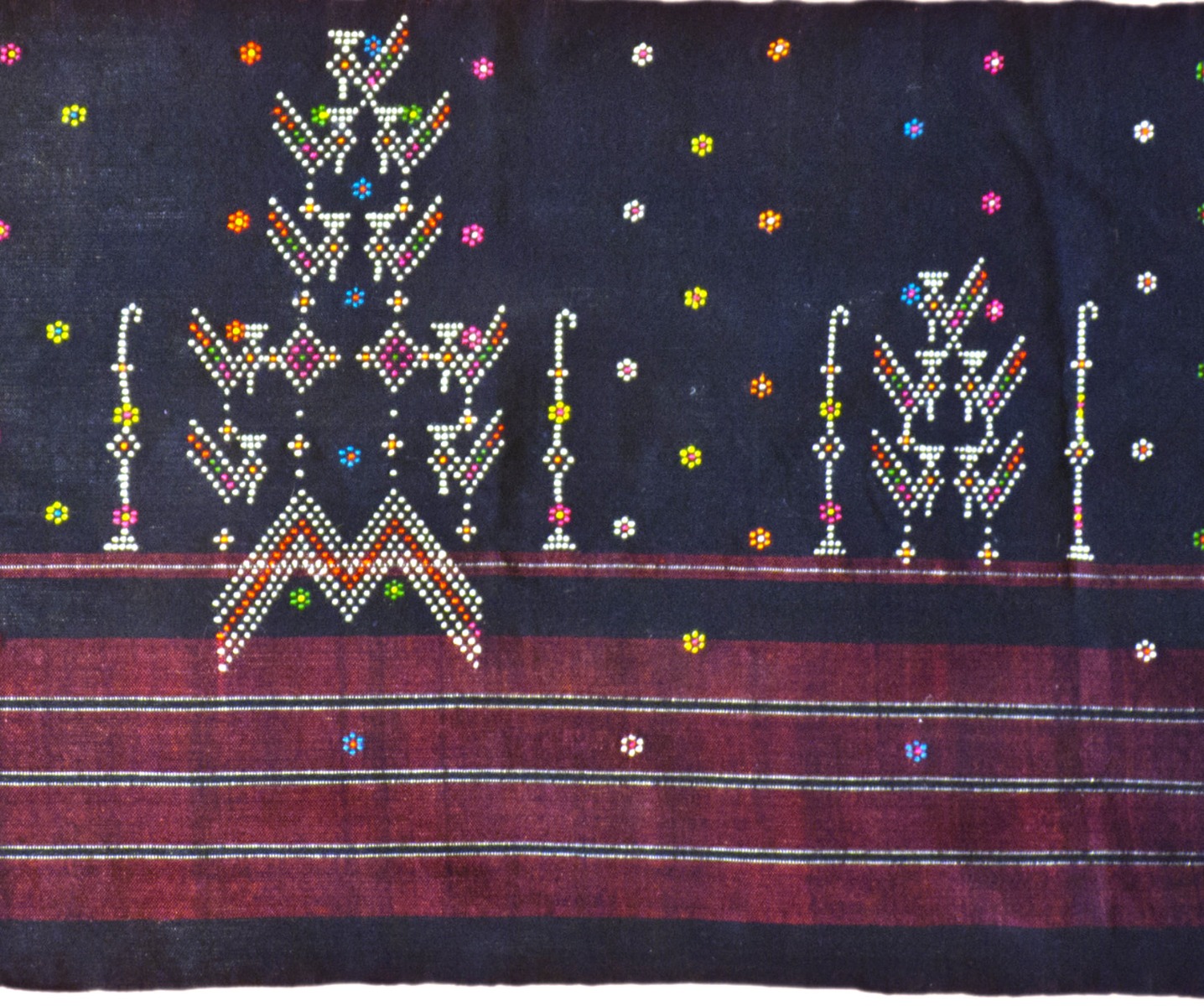
Tangaliya: A handwoven, GI-protected textile, made by the Dangasia community, the 700-year-old indigenous Tangaliya is native to the Surendranagar district in the Saurashtra region. The textile was usually used as a shawl or wraparound skirt by women of the Bharwad shepherd community. Woven on pit looms at homes, the technique involves weaving knots in colours contrasting to the warp colour to create the effect of raised dots. The weaving is based on precise mathematical calculations. The weaver has to count the warp yarns each time, before hand-knotting the dot in acrylic yarn, to produce geometric patterns. A single mistake can lead to the final design looking faulty. The effect of the pattern also has a tactile feel, similar to braille, because of the raised surface of the dots. This has become the signature style of the textile. Another important aspect is the visual effect of dots, which is most striking and appealing on dark colour bases, especially black. The graphic quality of white dots mixed with other bright coloured dots gives the craft its special appeal. Moreover, due to the ease of knotting the white colour yarn compared to coloured yarns, white dots were common. Traditionally, most woollen shawls featured graphic patterns of white and maroon coloured dots on a black base. With every wash, the cotton textile tends to become denser and integrates the dots even more finely between the warp and weft. Today, there are only fifteen families in Surendranagar pursuing this craft.
Jammu & Kashmir
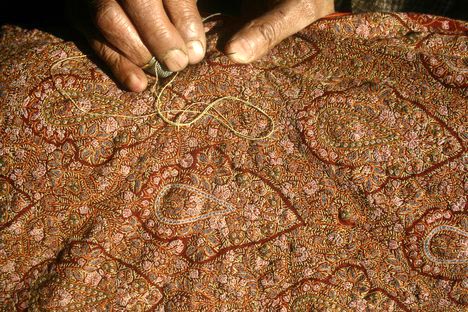
Jamawar: Jamawar is believed to have been derived from the word jam which means a shawl or robe and war, which implies the chest, in either Persian or Kashmiri. The fabric is believed to have found its way to Kashmir from Persia and reached its peak during the heyday of the Mughal dynasty in India. Owing to the elaborateness that goes into the making of the weave, it takes months on end to craft a finished Jamawar piece, and sometimes, even years, depending on the level of intricacy involved. Jamawar is traditionally woven with a rich blend of Pashmina wool, cotton and silk. Given the generous use of colours and motifs, the finished weave is highly iridescent. One of the many distinguishing factors of the Jamawar is that it is so intricately woven that its front and back, both look identical, with no stray thread sticking out of its surface. A dominating design element of the weave is the paisley, which derives inspiration from Persia; other motifs of flora and fauna, too, are seen. Jamawars also feature a wide use of hand embroidery and traditionally, a single jamawar piece was woven with up to 50 varying hues.

Kani: The Kani weave is said to have originated in Kanihama village of Jammu and Kashmir, and its exquisiteness earned it the Geographical Indication (GI) tag in 2008. The word Kani translates to bobbins in Kashmiri because the weave involves extensive use of wooden bobbins on which varicoloured threads are wound. Legend has it that the art of weaving Kani shawls was first brought to Kashmir in the 15th century by Persian and Turkish weavers, who introduced this art to Ghiyas-ud-Din Zain-ul-Abidin, the eighth sultan of Kashmir. One of the most defining characteristics of the Kani weave, colloquially known as Kaniwar, is its impeccably patterned motifs. These motifs, which include flowers, gardens, creepers and paisleys are brought to life through a technique called twill tapestry featuring double interlocking, wherein both the warp and weft yarns are mounted diagonally onto each other on the loom.
Traditionally, Kanis are crafted from the pashmina wool of the local Changthangi goat. At the time of weaving, the loom is packed with bobbins or kanis, through which the craftsmen carry out the fashioning of the weave; a total of nearly a thousand bobbins or more can be used for a single weave. Each colour is woven in individually, with the help of bobbins wound with threads of that particular colour. The designs are first drafted in the form of sketches, in a grid-like format called naksh, after which each step from the draft is dictated to the weaver. An elaborately woven Kani shawl can take anywhere from 9 months to a year to be made, with two artisans working on it.
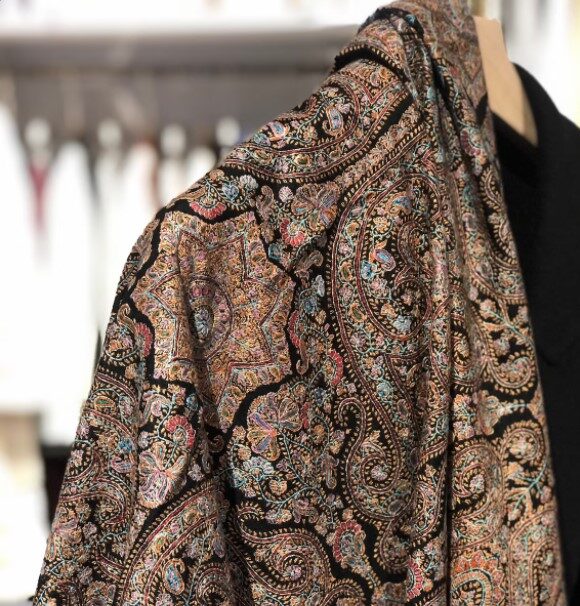
Pashmina Silk: A fine variant of spun cashmere, the animal hair fibre forming the downy undercoat of the Changthangi goat, Pashmina today may refer either to the material or to the variant of the Kashmir shawl that is made from it. The word pashm means wool in Persian, but in Kashmir, pashm referred to the raw unspun wool of the domesticated Changthangi goats. Both generic cashmere and pashmina come from the same goat, but generic cashmere ranges from 12 to 21 microns in diameter, whereas pashmina refers only to those fibres that range from 12 to 16 microns.
Samples of wool fibres discovered from corroded copper artefacts from Harappa dating back to the Indus valley civilization are extremely fine and resemble Pashmina and Shatoosh. In Mughal times, this was used as an indicator of rank and nobility. Pashmina blankets were also vital additions to a wealthy woman’s dowry in India, Pakistan and Nepal. The wool for pashmina is collected by combing the undercoat of the goat, and not by shearing, as in other fine wools. The entire process is carried out by hand by specialised craftsmen. The approximate time put into producing a single traditional pashmina stole is about 180 hours. Kashmiri embroidery or Kashida as it is known, employs bright and colourful designs, with motifs of floral borders, paisley and chinar leaves and other inspirational settings of nature. The patterns and the colours of Pashmina silk saree harmonises with nature. A heavily adorned pashmina silk sari with zardozi aari embroidery is a must in any bride’s trousseau. China accounts for 70% of the world’s cashmere production.
In the next part, we’ll see more fabrics and sarees from other states.








/buddhas-first-sermon-56a0c4795f9b58eba4b3a55d.jpg)


 Memories and Such


