
I normally don’t post about beauty or skincare and so if I am right, this is a first for me!
But I have been hearing a lot about Korean skincare products and makeup and some time at the beginning of this year, I decided to start a night-time skincare ritual and soon realised that I had already subconsciously incorporated the ten steps.
Living in Singapore means having easy access to Korean and Japanese skincare and beauty products, most of which are highly affordable. This means a lot of the skincare products I use are from these countries. I am a little wary about Japanese and Korean makeup as the colours may not suit my south Asian skin, being more geared to east Asian skin. I like their skincare products because I believe that skin types are pretty much similar across races and so this meant that I could use Korean and Japanese skincare products and also start doing the 10-step skin care.
The 10-Step Skincare method refers to the number of products layered onto the skin one by one. A lot of people (including me) are initially put off by the sheer amount of time that we think this process will take. But after two months of diligently doing it, I can confidently tell you that it does not take more than 10 minutes (more if you are putting on a mask).
Although there are a total of 10 steps in this beauty ritual, most of the time you do between 6-8 steps on any given day or night. It is quite rare that someone does all the steps all the time. The steps change depending on your skin type as well as any seasonal changes where you live. Since I live in the tropics, my skincare regime does not change through the year, but if you are inspired on doing the 10-Step Skincare Regime after reading this post, then please do take note of seasonal changes and your own skin type when you embark on this journey.
So what’s the Korean 10-Step Skincare Routine?
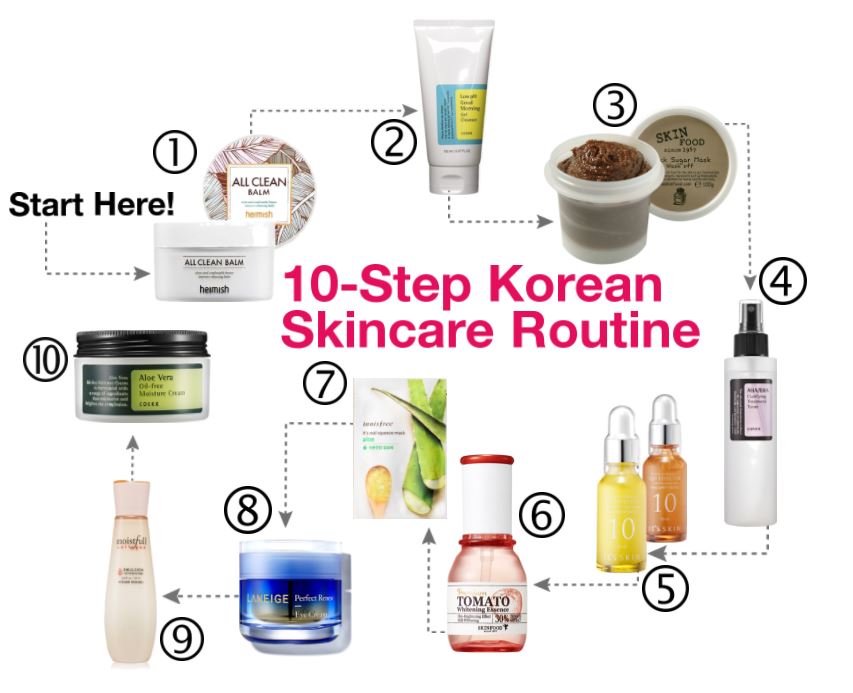
The 10 steps commonly associated with this regime are:
- Oil cleanser
- Foam/cream cleanser
- Exfoliation
- Toner
- Essence
- Treatments
- Masks
- Eye Cream
- Moisturizer
- Suncare/Lip Care
Step 1 and Step 2: Double Cleansing
Makeup removal and then cleansing with an oil cleanser is the mainstay of the Korean 10-step regime. Not only are oil cleansers relaxing to use, but applied to dry skin, they also remove all makeup and other oil-based product debris like sebum, sunscreen and pollution particles. You can also massage your skin as you oil cleanse which will stimulate the surface of the skin, preparing it for the products you’re about to apply. It also drains lymphatic glands in your face and neck that can cause puffiness.
Cleansing twice is recommended by dermatologists as it helps to thoroughly remove all impurities that can cause breakouts. Water-based cleansers dissolve the water-based impurities such as dirt and sweat that your oil cleanser didn’t pick up.
I normally don’t use make-up, so generally skip this step, moving straight to my normal cleanser. On days when I do apply some make-up, I usually will use micellar water to remove the make-up before cleansing with my usual foam or cream cleanser.
Step 3: Exfoliation
Exfoliation not only cleans out clogged pores, but it also sloughs off dead skin cells. When you remove this dull layer of cells, brighter skin is revealed. Regular exfoliation will also help your other skincare products absorb and work more efficiently. This step is not recommended for daily use. If you have sensitive skin, you’ll only want to exfoliate once a week. If you have a tougher complexion, you can do it more regularly (about three times a week).
I usually exfoliate around three times a week.
Step 4: Toner
In Korean skincare, toners are typically a thin layer of moisture meant to regulate your pH and soften your skin, preparing it for the steps that will follow. Toners remove any leftover residue from the cleansers while also repairing your skin’s barrier to effectively absorb the moisturisers that follow. Toners also balance the skin’s pH levels, otherwise, the skin can become dry and dehydrated.
I usually apply toner by pouring some in the palms of my hand and then patting it on my skin. I also very lightly slap my skin to help the toner melt into the skin and prep it for the next step.
Step 5: Essence
One of the keys to the glowy results of a regular Korean skincare routine is layering products. Rather than relying on one thick cream to do all the work, Koreans believe that layering products allow the skin to breathe and avoids clogging the pores. So if you think of your toner as the first layer of moisture, think of the essence as the second. These products are typically also thinner in texture, and some even feel watery. They penetrate the skin at a deeper level and aid with the absorption of the products to come.
I pretty much use the essence the same way I use the toner, which is pouring a small amount in the palms of my hands and patting it in with very mild slaps.
Step 6: Treatments
This step includes boosters, serums and ampoules. Packed with powerful ingredients, they target specific skin concerns such as acne, fine lines and hyperpigmentation. This is where you get to play with what you need for your skin. You could also use multiple treatments on the same day, depending on what your skin requires or if you already have perfect skin, you can ignore this step.
I generally use two treatment serums daily, a vitamin C serum and another treatment depending on what my skin needs. I pour a bit in my palms and then pat the serums on my skin. I normally wait for a couple of minutes before the next treatment.
Step 7: Masks
If essences are the heart of Korean skincare, masks or specifically sheet masks are the soul. The key to sheet masks is the sheet, which when in prolonged contact with your face, allows the skin to fully absorb the nutrients and moisture. The purpose of the mask is to give your skin what it needs. Korean sheet masks are also very affordable, especially where I live and it’s very easy to amass a huge stash.
I usually flit between sheet masks and other traditional wash off masks. If I am using a wash off mask, then I do it right after cleansing and before toning. If using sheet masks, then it comes here, in step seven.
Step 8: Eye Cream
The eye cream is not unique to the Korean skincare routine, but it is one of the hardest products to consistently use because it’s more a preventative product if you’re under the age of 40. The eye cream is designed to moisturize the ultra-thin skin around your eyes where crow’s feet and fine lines are bound to appear. However, if you use eye cream regularly before they show up, you’ll see a marked difference in how old you look (or in this case, how young!)
I miss this step more often than I do it, so this post is a reminder for me to do this step more consistently.
Step 9: Moisturiser
More moisture you may be thinking, but in the traditional Korean beauty 10-step routine, you use a cream – also known as an occlusive layer – to seal in all the layers before it. Think of it as making a fragrant stew and putting the lid on the pot. It allows the fragrances and flavours inside to mingle and absorb, which is a lot like what all the luscious ingredients you layered are doing in your epidermis when you add a moisturizer.
I usually use a facial oil and then any normal moisturiser in this step during the day. During the night, I use the facial oil plus a sleeping mask, which I use as a moisturiser since I sleep in an air-conditioned room and I have super dry skin which the air conditioning makes drier.
Step 10: Sun Care/Lip Care
We all know that we should always wear sun protection, even if we are inside the house. It’s the easiest and most effective way to prevent skin cancer as well as ageing that comes from the sun’s harmful rays. It should be the last step, just before you start applying make-up so that it does not get diluted by other skincare products.
I try to use sunscreen as the last step in my morning ritual. This is another step I am sometimes guilty of skipping, especially if I am going to be at home the whole day. But I will make sure I don’t do that and use SPF daily.
In the night, I use a heavy lip balm to finish up my Korean 10-Step Skincare ritual before calling it a night!
My thoughts on doing this diligently for slightly over two months now is that it no longer seems a chore to me now as it was when I first started doing it. Previously, I used to sometimes skip doing a night-time skincare ritual if I was tired or sleepy, but now it’s a part of what I do at night before sleeping, the same as brushing my teeth. It does not take very long to do, I timed it last night and it took me less than 10 minutes to do all steps excluding exfoliation and masking. So to those who are intimidated by the sheer number of steps, take heart that it will become simpler as you continue doing it.
Was this post useful? Did you learn something new? Are you using a skincare regime which is similar to the Korean one? Would love to hear comments, so please write and comment below.
 Memories and Such