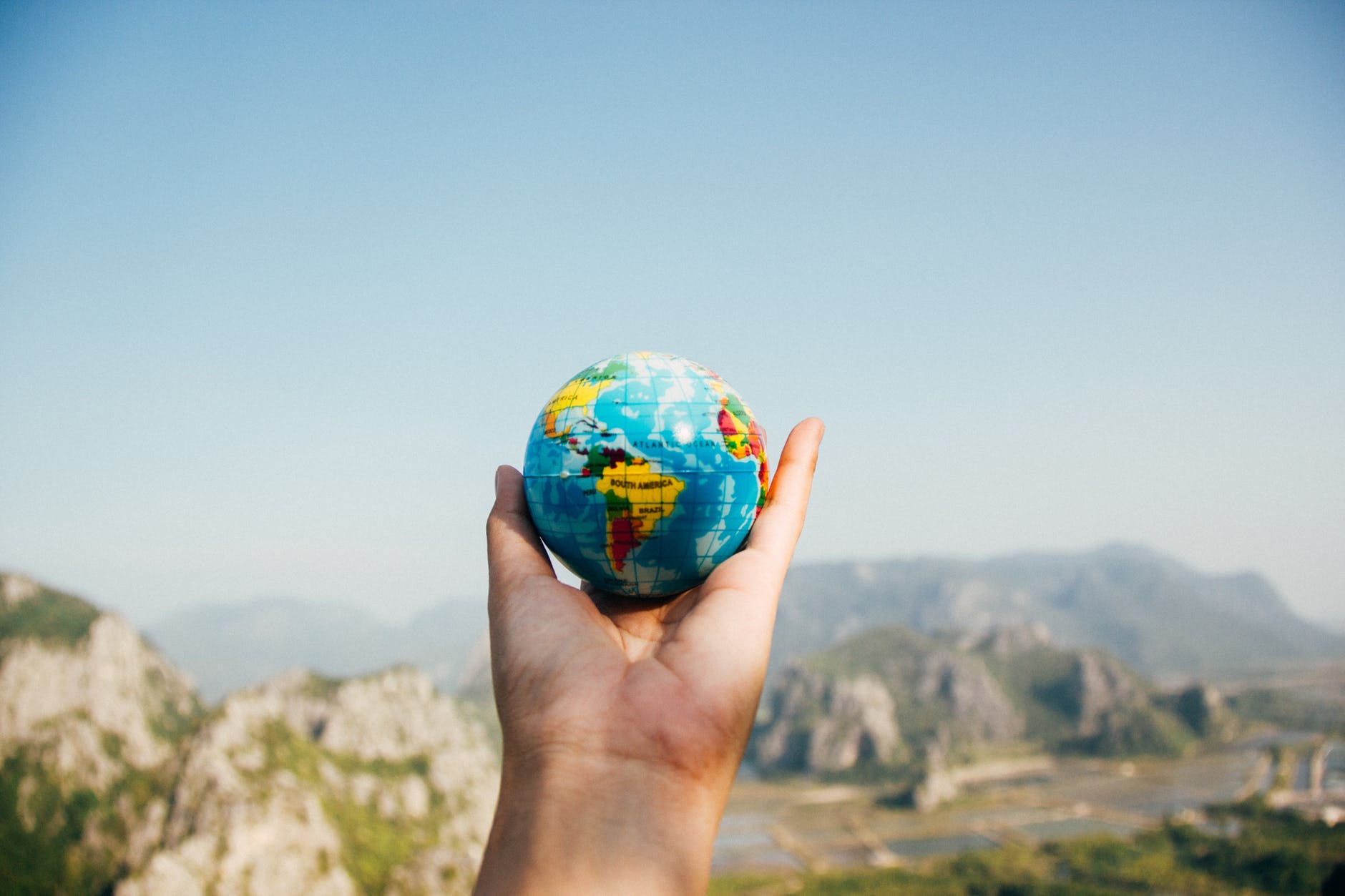
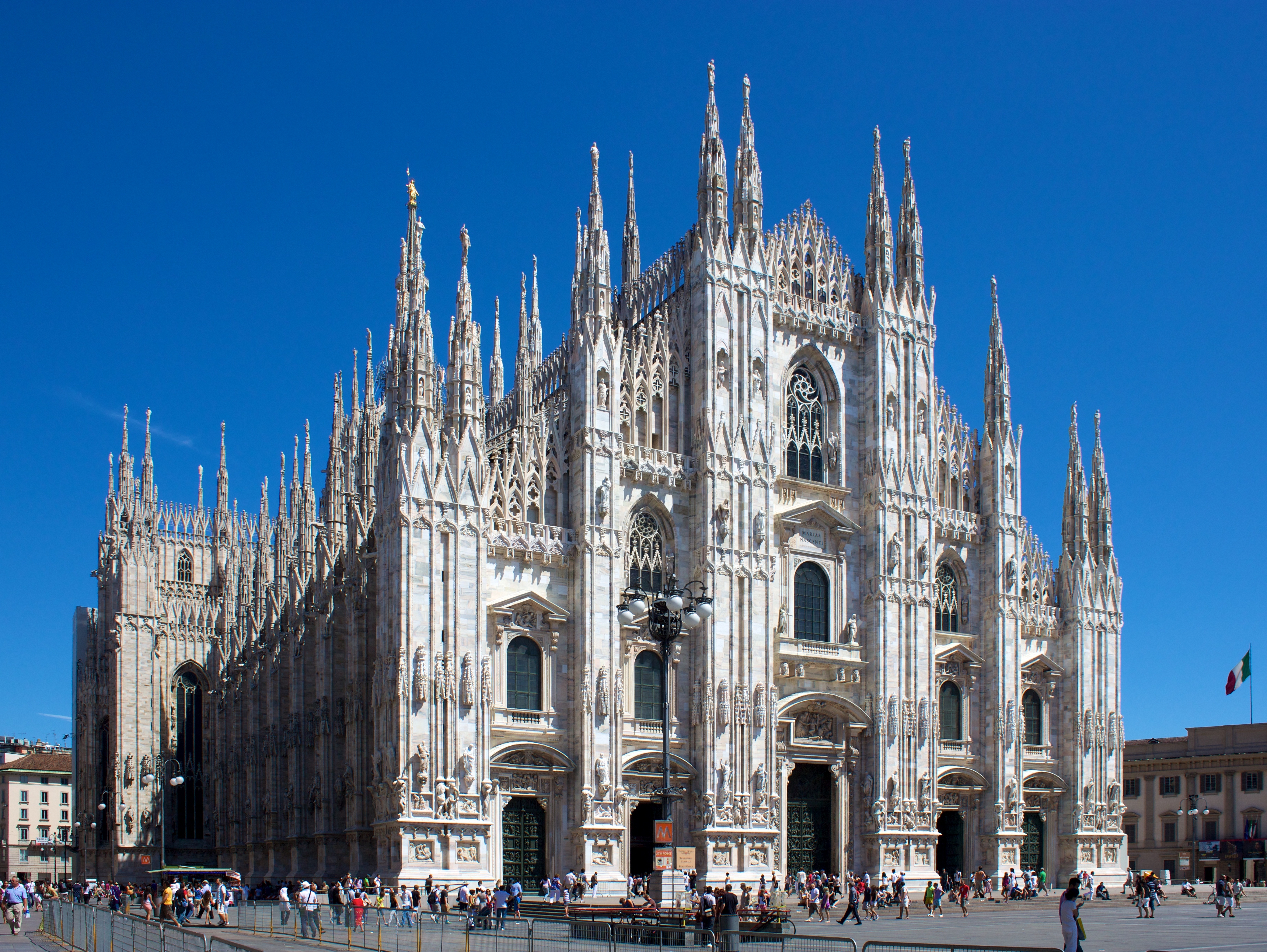
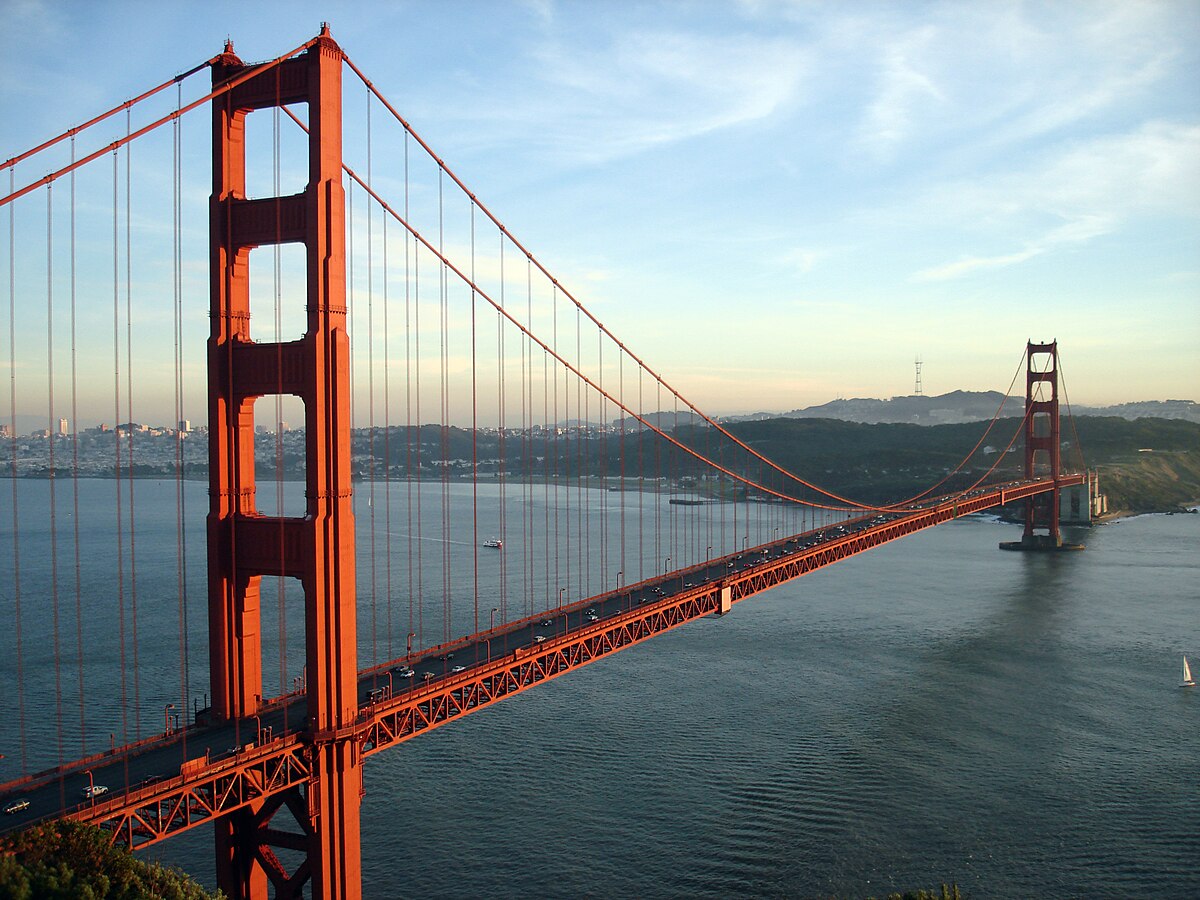
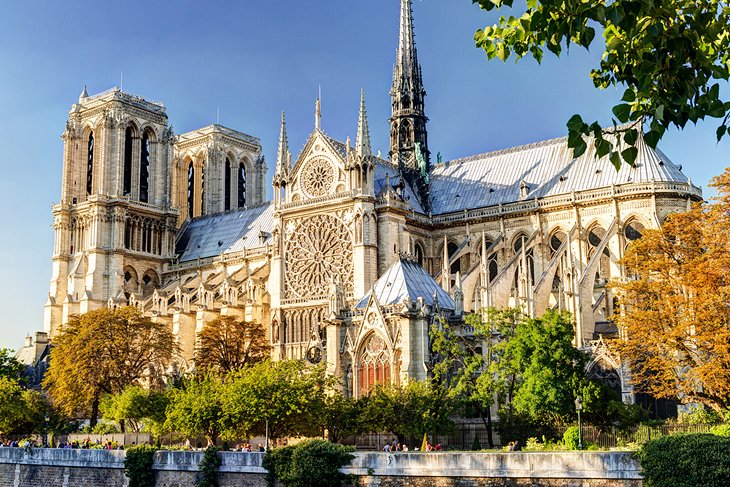
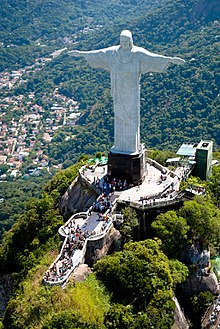
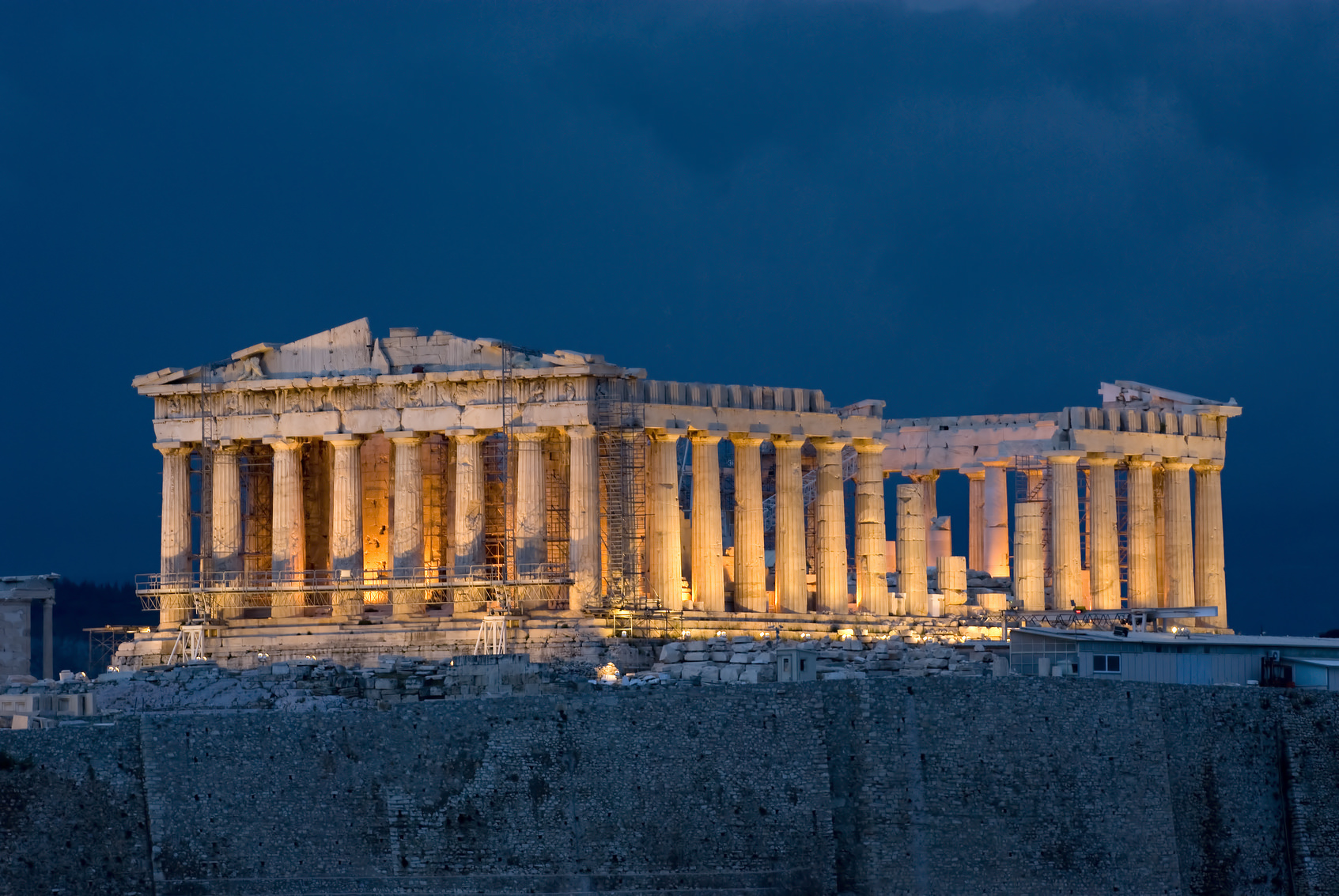
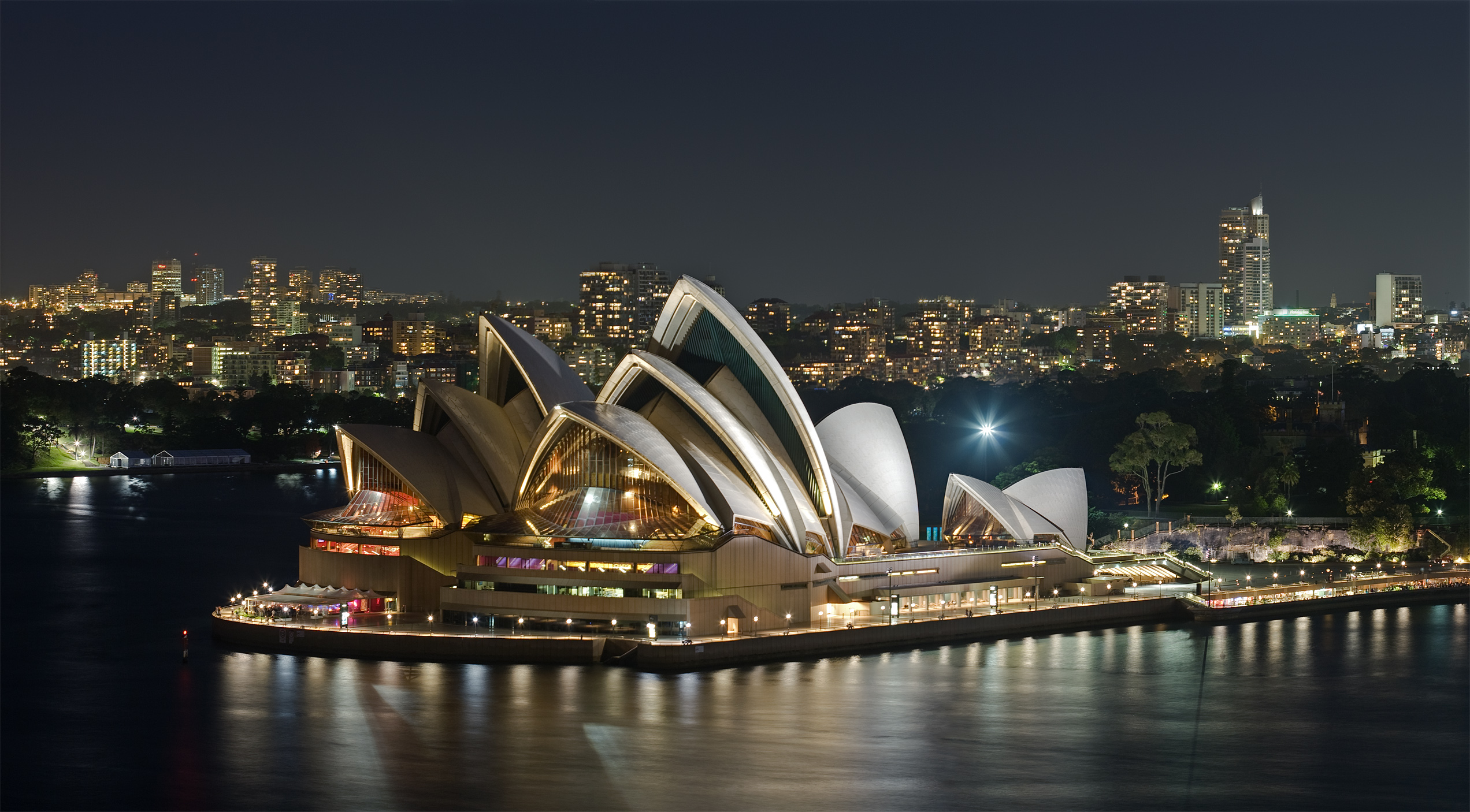
With travel still in my mind, here’s a Trip Advisor list of the top 25 landmarks in the world. How many of these have you visited or are in your bucket lists?
Shaped like a teardrop, south of India, the nation previously called Serendip and Ceylon and now called Sri Lanka has been on my travel bucket list for some time now. But every time we decide to make a trip there, something happens and the trip gets postponed. But I am not going to give up hope and will get there one of these days.
Sri Lanka has been intrinsically intertwined with the mythological and historical records of India. A major portion of the mythological epic the Ramayana takes place in Sri Lanka and most, if not all Indians would have heard of this country by the time they were in their teens.
Growing up, the Tamil Tiger situation in Sri Lanka dominated the news cycle and it was pretty unanimous that this country was not very safe to travel to. Then, there was a time when Indians were not welcome there, probably because of the Indian peacekeeping forces in the island.
Sri Lanka’s documented history spans 3,000 years, with evidence of prehistoric human settlements dating back to at least 125,000 years. It has a rich cultural heritage and the first known Buddhist writings of Sri Lanka, the Pāli Canon, date back to the Fourth Buddhist council in 29 BC. Its geographic location and deep harbours made it of great strategic importance from the time of the ancient Silk Road through to the modern Maritime Silk Road.
One of the first written references to the island is found in the Indian epic Ramayana, which provides details of a kingdom named Lanka that was created by the divine sculptor Vishwakarma for Kubera, the Lord of Wealth. It is said that Kubera was overthrown by his demon stepbrother Ravana, the powerful emperor who built a mythical flying machine named Dandu Monara. The modern city of Wariyapola is described as Ravana’s airport.
Now that we have some of the history of the country taken care of, lets go on to the more interesting part, which are the places I would love to visit in Sri Lanka. My ideal trip to this beautiful and lush country would be about ten days to a week so that I can take in as much as I can of the varied landscapes of the country. So here goes my favourite Sri Lanka destinations and spots to visit:
Sigiriya: Located near the town of Dambulla in central Sri Lanka, this ancient rock fortress is a site of historical and archaeological significance that is dominated by a massive column of rock nearly 200 metres (660 ft) high. According to the ancient Sri Lankan chronicle the Culavamsa, this site was selected by King Kasyapa (477 – 495 CE) for his new capital. He built his palace on the top of this rock and decorated its sides with colourful frescoes. On a small plateau about halfway up the side of this rock he built a gateway in the form of an enormous lion. The name of this place is derived from this structure —Sīhāgiri, the Lion Rock. The capital and the royal palace was abandoned after the king’s death. It was used as a Buddhist monastery until the 14th century and today is a UNESCO listed World Heritage Site.
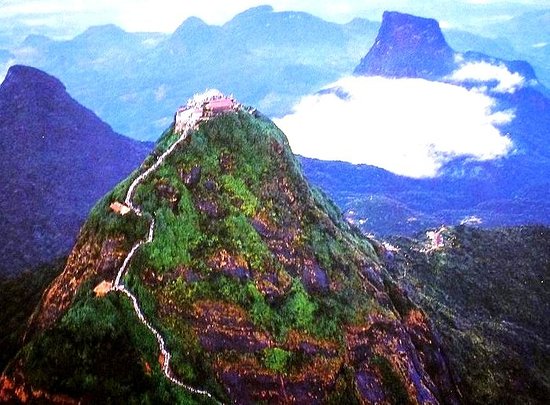
Adam’s Peak: Located in a diverse biological site, Adam’s Peak is a tall, pointed mountain in central Sri Lanka. This peak is a 2,243 m (7,359 ft) tall conical mountain, well known for the Sri Pada, i.e., “sacred footprint”, a 1.8 m (5 ft 11 in) rock formation near the summit, which in Buddhist tradition is held to be the footprint of the Buddha, in Hindu tradition that of Shiva and in Islamic and Christian tradition that of Adam, or that of St. Thomas and is a common pilgrimage route. Walking to the top in the early hours of the day will get you to see an unforgettable sunrise.
Galle: Located around 120 km from the capital Colombo, Galle is a well preserved colonial city with a well preserved fortified fort built by the Portuguese and extensively fortified by the Dutch in the 17th century. The fort is a world heritage site and is the largest remaining fortress in Asia built by European occupiers. The town is full of charming Dutch-era villas and delightful seaside views. Other good places to visit in Galle include the natural harbour, St. Mary’s Cathedral, the National Maritime Museum, St. Mary’s Cathedral founded by Jesuit priests, one of the main Shiva temples on the island, and Amangalla, the historic luxury hotel and Galle International Stadium, which is widely regarded as the most picturesque cricket ground. Important natural geographical features in Galle include Rumassala in Unawatuna, a large mound-like hill that forms the eastern protective barrier to Galle Harbour. Local tradition associates this hill with some events of Ramayana, one of the great Hindu epics.
Yala National Park: Yala National Park is the place to go to see big cats in Sri Lanka. The park is home to the highest concentration of leopards in the world, and it is also an important sanctuary for Sri Lankan elephants and aquatic birds. Monkeys, crocodiles, and other critters run around the park’s grassy plains and forest areas. The park is located on the southeast coast of the island, bordering the Indian Ocean. The area around Yala has hosted several ancient civilizations. Two important pilgrim sites, Sithulpahuwa and Magul Vihara, are situated within the park.
Polonnaruwa: Another UNESCO World Heritage Site, Polonnaruwa has very fine examples of ancient Sinhalese art and architecture. Numerous well-preserved ruins of tombs, temples, statues and other archaeological sites are located in the town. Hundreds of years ago, Polonnaruwa was a capital of the island as well as a busy commercial and religious hub. Don’t miss the historical treasures this World Heritage Site has to offer.
Kandy: Home of one of the most sacred places of worship for the Buddhists, the Temple of the Tooth holding a very sacred relic – Buddha’s tooth, Kandy was the last capital of the ancient kings’ era of Sri Lanka. Surrounded by the central highland mountains, this large city which is a World Heritage Site is the place to go to get a taste of Sinhalese culture, especially if you can visit during the Esala Perahera festival in the summer.
Nuwara Eliya: Another plateau town surrounded by mountains is Nuwara Eliya, also known as Little England for its old British colonial buildings like the Queen’s Cottage and the General’s House. The area holds many natural beauties, like waterfalls, hills, tea plantations, and the towering Pidurutalagala, the tallest mountain in Sri Lanka. Nuwara Eliya is one of many tea plantation areas in Sri Lanka, but it is regarded as the most important spot for tea production in the country.
Pinnawala Elephant Orphanage: Gaze at the adorable faces of baby elephants bathing in the river at Pinnawala Elephant Orphanage. The orphanage was founded in 1975 to feed and nurse wild orphaned elephants found abandoned in the forests of Sri Lanka. An elephant breeding program was launched at the facility in 1982, and as of 2012, there were 78 elephants living at the site.
Dambulla: This large town has the largest and best-preserved cave temple complex in all of Sri Lanka, holding five cave temples containing a huge collection of Sri Lankan Buddhist artwork, including statues, shrines, and murals. The paintings and statues tell stories from Buddha’s life—there are a whopping 153 Buddha statues created over 2,000 years ago and very well preserved till date throughout the complex. Other statue subjects include Sri Lankan kings, gods, and goddesses. The amazingly crafted murals cover a total area of 2,100 square meters. Various kings have contributed to this magnificence over the centuries, and King Nissanka Malla had the cave interiors gilded – thus earning the temple earned its name, Rangiri Dambulu (Golden Temple of Dambulla), now a UNESCO World Heritage site.
Anuradhapura: The city of Anuradhapura was the first ancient capital of Sri Lanka, and it is still a sacred Buddhist religious centre. It lies around 200 kilometres (124 miles) north of Colombo, the current capital. Buddhist worshippers and pilgrims visit the well-preserved ruins of the temples and religious centres along the bank of the river Malwathu Oya year-round. The city is also home to one of the largest and most sacred Bodhi trees in Sri Lanka, believed to be a descendant of the Bodhi tree where Buddha was illuminated. Anuradhapura became a UNESCO World Heritage Site in 1982.
While researching for this post, I’ve now realised that any trip to Sri Lanka can’t and should not be lesser than a minimum of two weeks so that we can soak up everything this beautiful country has to offer. I am now really yearning to visit this country, what about you?
Recently a dear friend of mine moved to the mountainous central Asian country of Kyrgyzstan for work. So my Facebook feed has been filled with gorgeous pictures of amazingly blue skies and picture-perfect pretty lakes and meadows as she settles down in her new home. Seeing those pictures, I got intrigued by this country, whose name I couldn’t even spell and decided to find out more about this gorgeous place.
Wikipedia tells me that Kyrgyzstan is a landlocked, mountainous country in central Asia with a 2,000-year-old recorded history which encompasses a variety of cultures and empires. Because of its highly mountainous terrain, it has been able to preserve its ancient culture and because it has been at the crosswords of several great civilizations as part of the Silk Road, it has also absorbed those cultures which have passed through it. When the Soviet Union came into existence, Kyrgyzstan became a part of it and achieved sovereignty only after the break up of the erstwhile Union in 1991.
Ethnic Kyrgyz make up the majority of the country’s 6 million people, followed by significant minorities of Uzbeks and Russians. Kyrgyz is closely related to other Turkic languages, although Russian remains widely spoken and is an official language, a legacy of a century of Russification. The majority of the population are non-denominational Muslims. In addition to its Turkic origins, Kyrgyz culture bears elements of Persian, Mongolian, and Russian influence.
The best time to visit Kyrgyzstan is between May and October, with the peak trekking season happening between June and September. The summers are extremely hot and dry, while winters (between November and March) are very cold and snowy. The climate is more moderate in the Issyk Kul Lake region.
Some of the places which are on my bucket list include:
Bishkek: The capital city and the place where my friend is currently based in. Bishkek borders Central Asia’s Tian Shan range. It’s a gateway to the Kyrgyz Ala-Too mountains and Ala Archa National Park, with glaciers and wildlife trails. The city’s arts scene encompasses the monumental State Museum of Fine Arts and the collonaded Opera and Ballet Theater. The vast, central Ala-Too Square features the Manas monument, honouring the hero of the Kyrgyz Epic of Manas. The Soviet-era State History Museum, next to the presidential White House, explores the country’s history and ethnic groups. Dubovy Park is known for its oak trees and sculptures, while the nearby M. V. Frunze Museum preserves the birthplace of Mikhail Vasilievich Frunze, a prominent Soviet military leader who was born in the city. West of here, sprawling Osh Bazaar features traditional costumes and Kyrgyz produce. East of Bishkek, the intricately carved Burana Tower and its adjacent ruins mark the site of the 9th-century city of Balasagun.
Issy-Kul Lake: Issyk-Kul means “hot lake” translated from Kyrgyz. It is a salty and mineral rich lake that does not freeze even in the coldest of winters. More than a hundred rivers flow into lake yet not one of them flows out. It is the second largest mountain lake in the world, located at an altitude of 1607 meters and at its maximum, a depth of 668 meters. To give you an idea of the scale of the lake, it takes about nine hours to circumnavigate by car. If you take a tour of Issyk Kul, why not stop at Balykchy, Bokonbaevo, Barskon, or Cholpon Ata? Wherever you stop, you can’t fail to notice the stunning backdrop. Issyk Kul is surrounded by the Ala-Too Mountains, part of the Tian Shan range. There are several local legends about how the lake appeared, but we won’t spoil the surprise.
Ala Archa National Park: Just around half an hour away from Bishkek’s suburbs is a magnificent alpine national park. You can get closer to the mountains that form the backdrop to the city. The highest peak in the national park reaches 4895 meters and the Ala Archa range has more than fifty peaks. It is a favourite local haunt for picnics as well as being popular with tourists looking to do short hikes.
Burana Tower: Built in the 11th century, the Burana Tower was once part of a flourishing Silk Road city called Balasaghun. Originally the tower was a minaret reaching over 40 meters in height and the earliest of such towers in the whole of Central Asia. Sadly, an earthquake in the 15th century destroyed the top half of the tower. Today it stands just over 20 meters high and you can even climb up it! Near the tower, you can also take a look at the small museum and have a look at some ancient stone carvings known as balbals.
Song Kul Lake: Song Kol Lake is a vast summer pasture, accessible only from June to September. Nomads graze their animals there as they have been for millennia. It is located at an altitude of 3016 meters, but don’t expect rugged peaks – it actually looks pretty flat. Song Kul is a freshwater lake that stretches for 29 km in length and about 18 km in breadth. Its maximum depth is only about 13 meters. If you head up there, you’ll enjoy sleeping in real yurts and feeling free just like your nomad hosts. Central Asia with yurts
Tash Rabat: Tash Rabat is a historic stone caravanserai. These were places used by merchants and their caravans on the ancient Silk Road. It is one of the best preserved of such places in Central Asia. You can sleep in yurts nearby or go horse riding. It was originally built as a Nestorian monastery and then turned into a caravanserai.
Osh: Osh is the oldest city in Kyrgyzstan, celebrating its 3000th anniversary in 2000. It lies in the heart of the fertile Ferghana Valley. The centre of the city is occupied by Sulaiman-Too. This is a sacred mountain that has been continuously worshipped for millennia. You will see women sliding down stones in the belief that this practice will increase their chance of giving birth to healthy children. This is one of those perfect examples of longstanding traditions of the Silk Road, that combine prehistoric, pre-Islamic, Islamic and local beliefs into one holy site. Sulaiman is the local pronunciation of Solomon. It is thought that the throne of Solomon was once located on this mountain; some legends go so far as to say that he was buried there. Another important site in Osh is the 16th-century mosque of Babur, the founder of the Mughal Empire.
Peak Lenin: Peak Lenin base camp is around one to three hours away from Osh, situated on the border between Kyrgyzstan and Tajikistan. At its highest point, it reaches 7134 meters. It is considered to be one of the easiest ascents to over 7000 meters by climbers. If you cannot get that high it is impressive even to enjoy the view of the peak from the first base camp which can be reached by car. Even in the hottest summers, you can admire the snow-capped peaks of the mountains of the Trans-Alay Range where the Tian Shan & Pamir Mountain systems come together.
Karakol: Karakol is the administrative centre of the Issyk-Kul region. However although it isn’t located right on the shores of the lake, it’s easy to make day trips to the lake or to the nearby mountains. In the 19th century, it became a strategic point separating the Russian Empire from China and an important Russian military settlement was established there in 1869. It also attracted Chinese Muslims fleeing oppression in China. These two important events of history can be seen in Dungan Mosque and Karakol’s Orthodox Church.
Djeti Oguz & Altyn Arashan: From Karakol, there are numerous opportunities to go for a hike or go horse riding. Local favourites include the Djety Oguz valley with its red cliff formations and Altyn Arashan that reminds people of Swiss mountain valleys. Djety Oguz means seven bulls. The colourful cliffs are the setting for beautiful and tragic local legends that you can hear during our Kyrgyzstan tour or other Central Asia adventures. Altyn Arashan offers one of the most beautiful Kyrgyz trekking routes and best of all, it’s easy enough that anyone can do it.
Sary Chelek Biosphere Reserve: Few places hold a candle to the Sary Chelek Biosphere Reserve. This 23.9 sq km piece of wilderness is remote, virginal, and spectacular. Untouched by the rest of the world, Sary Chelek contains 7 pristine alpine lakes, 157 bird species, deer, long-horned mountain goats, porcupines, and wild boar. Sary Chelek is located in the province of Jalal-Abad in between the Chatkal and At Oynok Mountain Ranges.
Writing this post has made me see just how beautiful Kyrgyzstan is. I really want to take a few weeks off and perhaps do some solo travel to this beautiful, but very underrated country. I do want to do this soon, before my friend’s tenure here ends and she goes back home! So are you having a serious case of wanderlust like me?
The school holidays are almost here and instead of a planned trip to India, I am now thinking of other options. One destination which keeps coming to mind and which I have been looking at for a few years now is Hanoi and the Halong Bay cruise. So what should we expect from a few days in Hanoi? Read on…
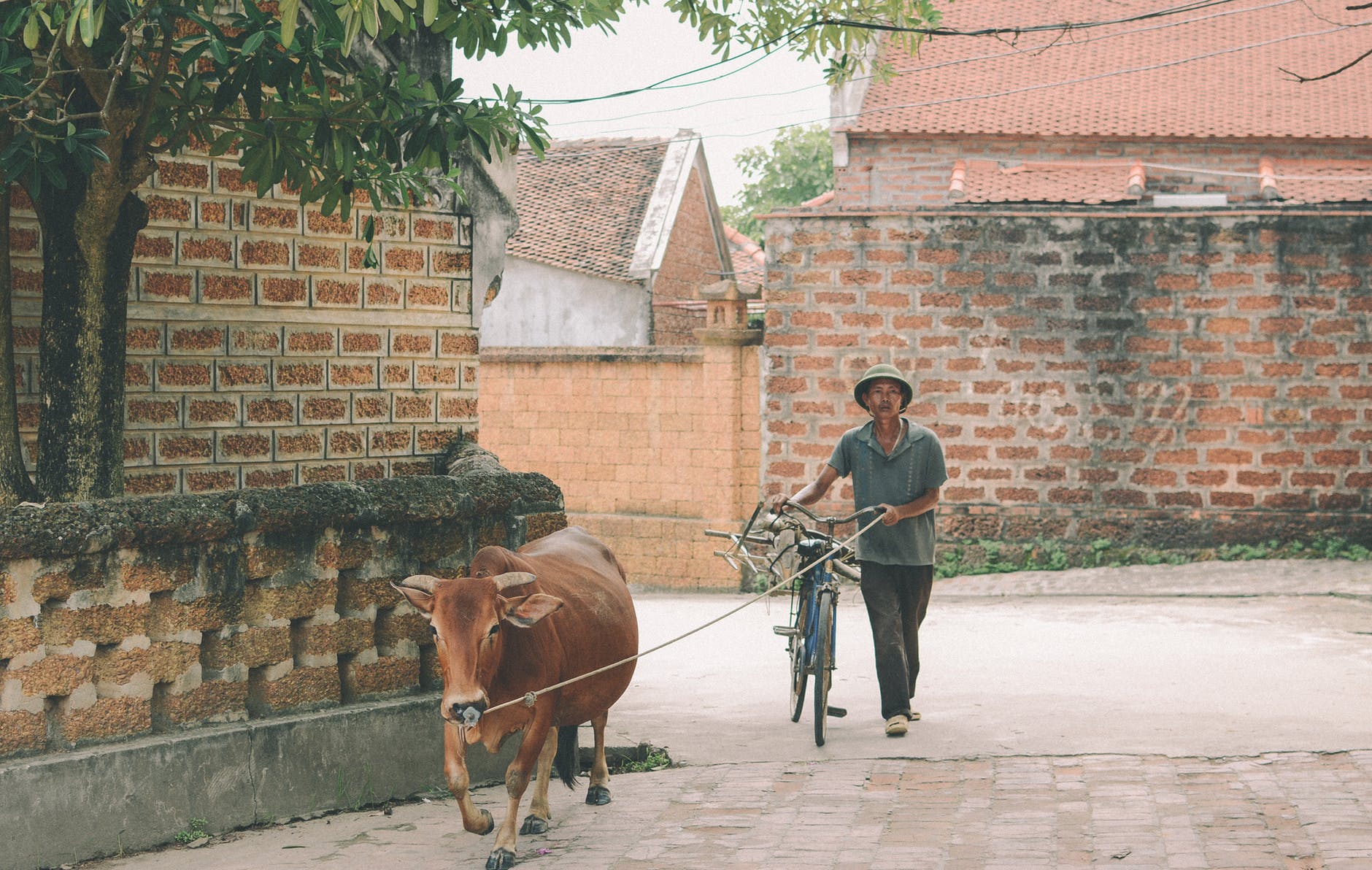
Located on the banks of the Red River, Hanoi is one of the most ancient capitals in the world. Colonised by the French in 1873, the city was the administrative centre of French Indochina from 1883 to 1945. Because of its French colonial past, the city filled with broad, perpendicular tree-lined avenues, well-preserved colonial buildings, ancient pagodas, and unique museums within the city centre. After the reunification of Vietnam in 1976, it became the capital of the country. October 2010 officially marked 1,000 years since the establishment of the city.
Hanoi is known for its two main neighbourhoods, namely the French Quarter and Old Quarter. Both are packed with attractions, but easily accessible on foot. Of course, not forgetting the iconic Ha Long Bay which is the main reason for planning a trip to Hanoi. Some of the sights I want to really see, do and soak up in Hanoi are…
The Old Quarter: The prominent district of the Old Quarter is relatively pedestrian-friendly compared to other cities in Vietnam – on weekends and evenings, the streets are closed off to motorised vehicles to make way for bia hoi bars and food stalls selling a variety of Vietnamese food. For a feel of rich old Vietnamese customs, you can also stroll along ancient commercial streets surrounding Hoan Kiem Lake, which are named after their original businesses dating back about 1,000 years. Located on the northern end of Hoan Kiem Lake, Hanoi Old Quarter’s most popular attractions comprise mostly quaint Buddhist shrines, street markets, and traditional Vietnamese arts.
Imperial Citadel of Thang Long: The Imperial Citadel of Thang Long, is an intriguing relic of Vietnam’s history and, signifying its historical and cultural importance, was made a UNESCO World Heritage Site in 2010. Also known as the Hanoi Citadel, many artefacts and items dating back to between the 6th and 20th centuries were excavated in 2004, including foundations of old palaces, ancient roads, ponds and wells. On top of these discoveries, archaeologists also found bronze coins, ceramics and pottery from China and many places in Asia, all of which demonstrate a close trading relationship in the area. Visitors should head for the display room that features interesting excavated items and mock-ups of the citadel itself. The site also has more modern resonance as the home to the D67 Tunnel and House, the headquarters of the Vietnamese People’s Army, from which war was waged from 1955 to 1975.
Ho Chi Minh Mausoleum: The Ho Chi Minh Mausoleum is a place of pilgrimage for many Vietnamese people who come to pay tribute to “Uncle Ho”, the man who led the fight for an independent, unified Vietnam. Queues to see Ho Chi Minh’s embalmed corpse can stretch for hours outside the gigantic mausoleum, and once inside talking, photography and hands in pockets are banned.
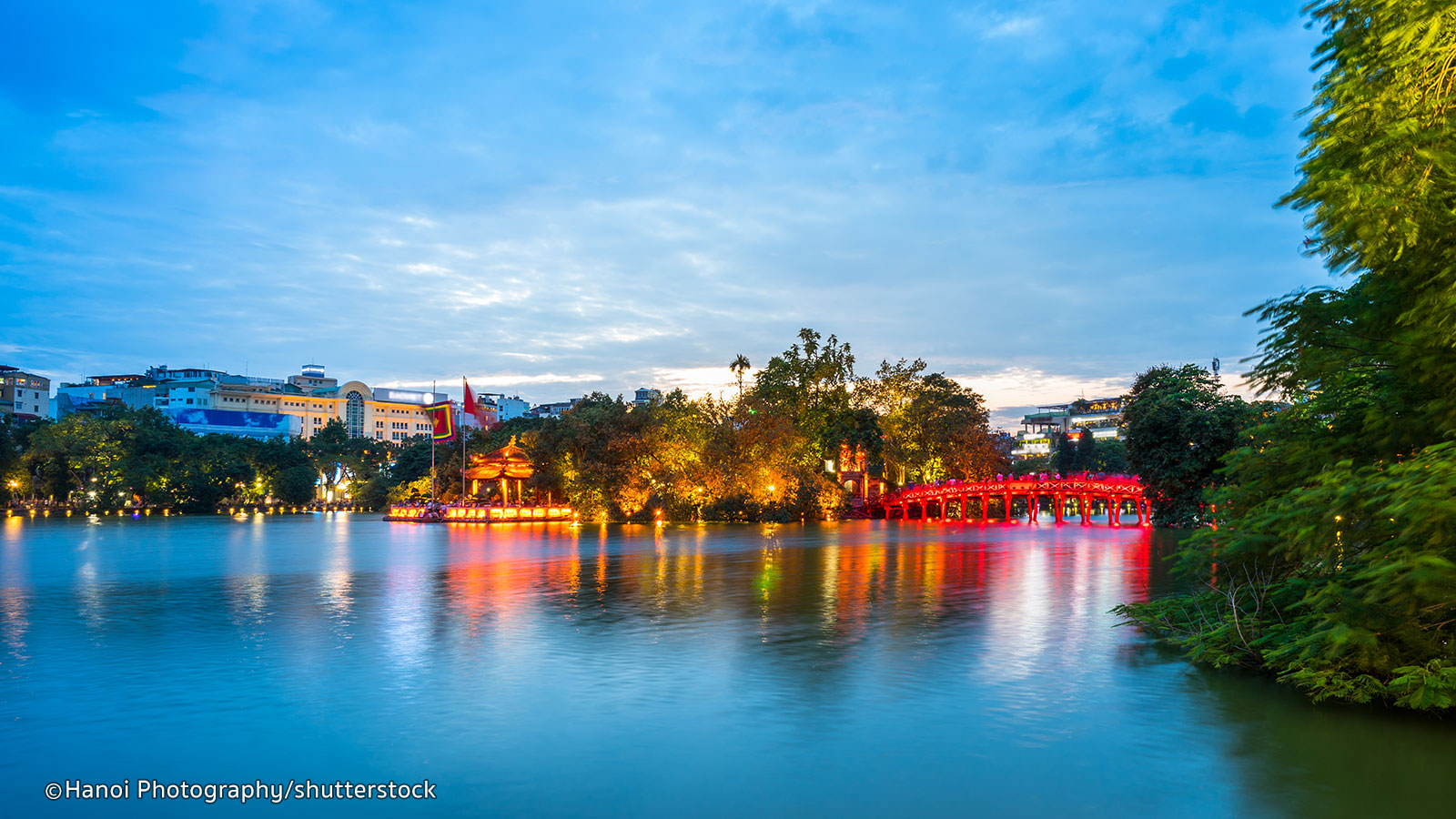
Hoan Kiem Lake: The Hoan Kiem Lake in Hanoi attracts tourists and locals looking to get away from the noise and frenetic pace of the city. Peaceful and quiet, the lake surrounds Ngoc Son Temple, a pagoda sitting in the centre on a small island. The temple attracts many visitors and was built in commemoration of the 13th-century military leader Tran Hung Dao who was renowned for his bravery in the battle against the Yuan Dynasty. Homage is also paid to scholar Van Xuong and Confucian master Nguyen Van Sieu. The island on which the temple is built is known as Jade Island and is accessible by the iconic Huc Bridge or Rising Sun Bridge which is a charming scarlet-painted wooden bridge of classical Vietnamese design. The pagoda is also guarded by two towering posts decorated with Chinese writing. The lake and temple are probably the most famous places in Hanoi city in which to rest and enjoy the view and are a great place to sit back and watch the locals.
Water Puppet Theatre: The world-famous Thang Long Water Puppet Theatre in Hanoi has its roots in an art form that dates back to the 11th century. The tradition of water puppet theatre stems from a time when rice paddy fields were flooded and villagers would make entertainment by standing in the waist-deep water with the puppets performing over the water. Using large rods to support the puppets it appeared as if they were moving across the water with the puppeteers hidden behind a screen.
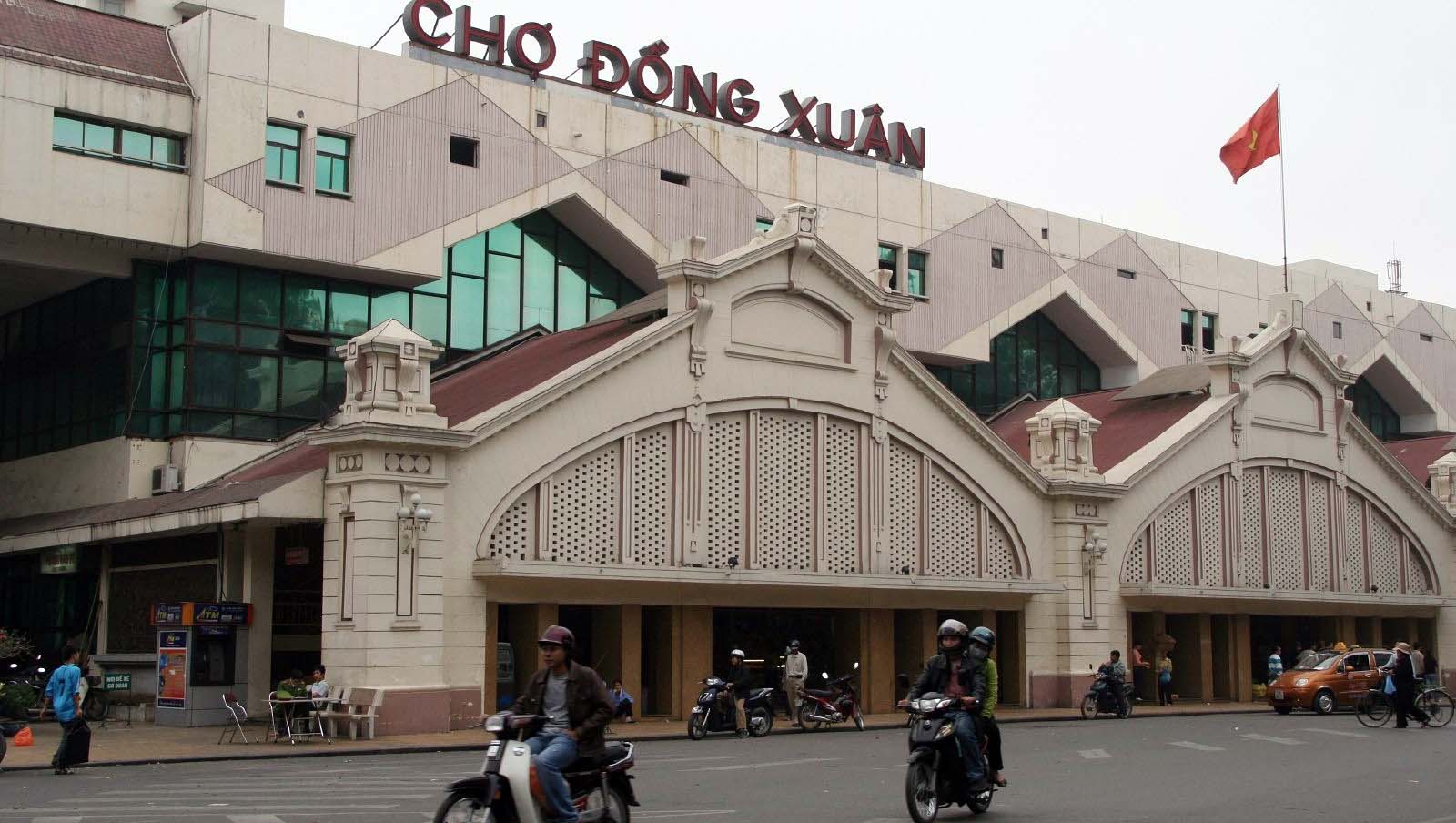
Don Xuan Market: Dong Xuan Market is the largest market in Hanoi and has a wide array of products for sale over four floors. Located on the northern edge of the Old Quarter, it is an imposing Soviet-style building, surrounded on all sides by merchant shops and stalls. It is a rough-and-ready type of market (some might even say ‘dirty’), especially in the ground floor wet market area. However, head up the stairs and you will find cheap items available at wholesale prices. It is quite an experience, even if you only leave with a pair of cheap sunglasses and a Vietnamese conical hat.
Hang Gai Street: Hang Gai Street is the best place in Hanoi to shop for high quality, fashionable silk materials, traditional Vietnamese apparel, and home furnishings. Also known as Silk Street, the entirety of this 300 metre-long street is lined with fashion boutiques and local tailor shops that have been operating for decades, where you can also order personally tailored suits and dresses that are made to measure. Set on the edge of Hanoi’s Old Quarter near Hoan Kiem Lake, Silk Street is renowned for its quality and choice of craftsmen.
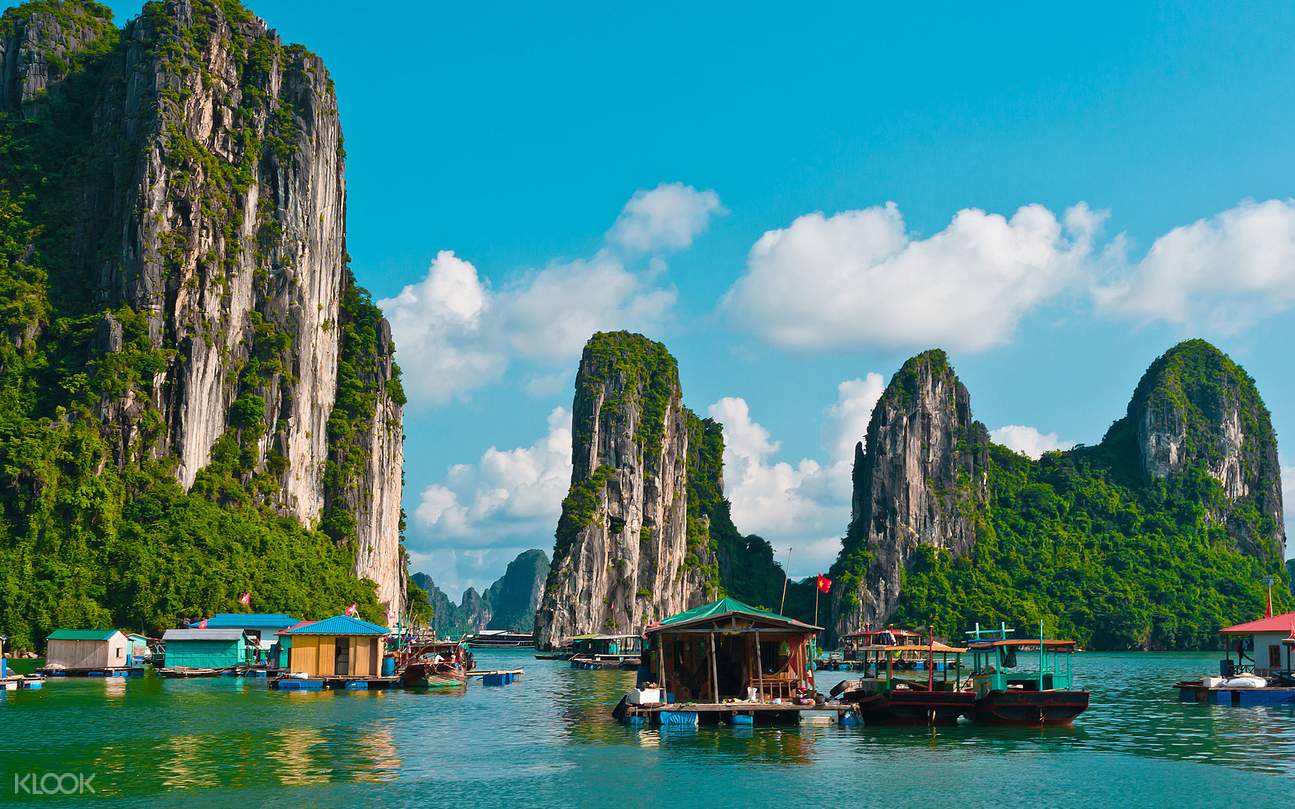
Halong Bay: You can do Halong Bay either as a full day tour or as an overnight one. I am leaning towards the overnight tour as that will give us an experience of sleeping in the cruise itself. Hanoi is only 170 kilometres west of UNESCO-listed Halong Bay, so just about every tour company in the city offers excursions at varying price points. A full day tour to Halong Bay is usually inclusive of roundtrip hotel transport, lunch, tour guide, and cruise along through the incredible scenery of the bay. You also get to explore some of the most popular limestone caves, floating villages, and islets such as Cat Ba Island and Bon Hon Island. Food may be a big issue with us (because we are vegetarians) and so this is something I need to figure out beforehand.
We all love coffee and so I am excited to try Vietnamese coffee at its very source! All in all, this post has made me excited to start planning our holiday to Hanoi. Has it whetted your appetite to visit this lovely city too?
The older I get, the more solo travelling has started to appeal to me. S and I are completely different when it comes to travel goals and so as the children get older and I am not bound by their schedules.
But there seems to be a big societal deterrent to travelling alone, especially in Asian cultures. Solo travels these days, also seems to the domain of the young millennial. As a middle-aged woman, I have certain standards and so don’t fall into the same category. I like my luxuries and don’t think I can rough it out like the young set, and since if I travel alone, I will have the money to finance it, I don’t see it too much of an issue.
It gives you the complete freedom to do what you want without having any regard for other people in your group. You feel like exploring a certain place in depth, go ahead and do that. On the other hand, if you just want to be a sloth on a particular day, that’s your prerogative.
You gain confidence in yourself. Since you have to depend only on yourself to do all the grunt work for and during your travels and this makes you get out of your comfort zone and forces you to interact with people of different strata. You may make friends with them, some of whom become life-long friends, but again, it’s your call how much further you want to take this.
You become comfortable in your own skin. When you travel alone, you are forced to eat and sightsee alone. I remember the first time I had to eat alone in a restaurant. It was very intimidating (I was travelling on business, not pleasure), but soon realised how much I enjoyed eating alone. I was free to read or watch what I wanted while I ate, without making small talk with people I barely knew and somehow since then, I would not mind eating slightly early or later just so I can eat alone. I am also more comfortable with myself than I was in my twenties. I recently even watched a movie alone in the theatre and found that I actually liked doing things alone.
You step outside your comfort zone. You are responsible for yourself when you travel alone and any hiccups along the way are yours to solve. This helps you develop problem-solving skills as well as the ability to think on your feet. This will stand you in good stead irrespective of what stage of life you are in.
Solo travelling strengthens your creativity. When you have the time to chill and be with yourself, you have the time and more importantly, the bursts of creativity to start on the book you’ve always been meaning to write or start any of the projects you wanted to do like knitting, needlework, embroidery etc.
One other benefit of travelling alone, for a reader like me, is to have the unlimited time to read. You don’t have others impinging on your reading time, while in the hotel room or even while moving from one attraction to the other. Actually, this is not just true of reading, but also of watching movies or anything you wanted to watch but didn’t have the time for.
It may make you happier in the long run. Research suggests that getting into vacation mode has the potential to increase our happiness levels. And spending time alone has also been shown to stave off depression.
However, travelling alone makes you more vulnerable to attacks as you don’t have the safety of numbers and seeing a woman alone may make you the target of potential attackers and molesters. So you have to be very careful and have all eyes and ears open all the time. Make sure you guard all your belongings and dress with respect to local cultures and norms. In addition, always do your homework: find out the do’s and don’ts of an area prior to arrival.
Travel, in general, is one of the most beneficial life experiences you can have but there are even more benefits if you decide to do it alone. So what are you waiting for? As for me, I still have one more year before I am free to start to travel alone. Till then, I am going to make my solo travel bucket list.














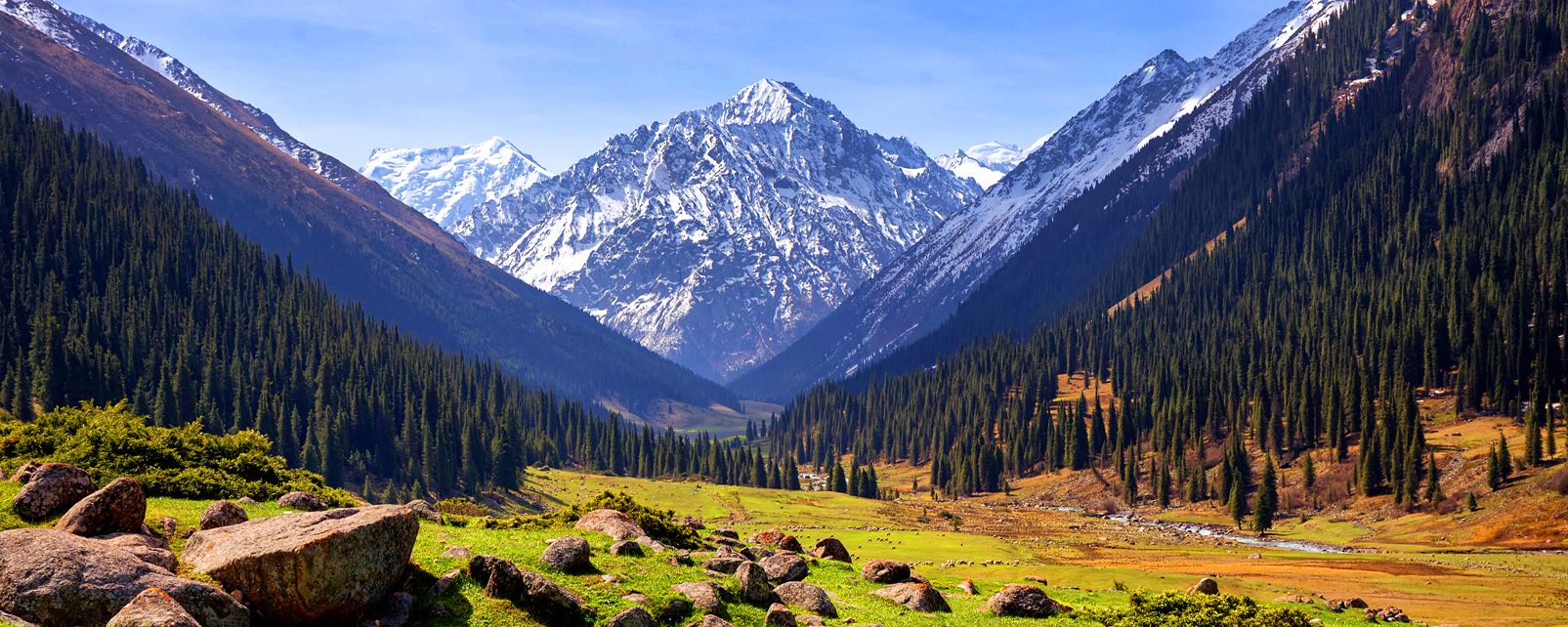 Recently a dear friend of mine moved to the mountainous central Asian country of Kyrgyzstan for work. So my Facebook feed has been filled with gorgeous pictures of amazingly blue skies and picture-perfect pretty lakes and meadows as she settles down in her new home. Seeing those pictures, I got intrigued by this country, whose name I couldn’t even spell and decided to find out more about this gorgeous place.
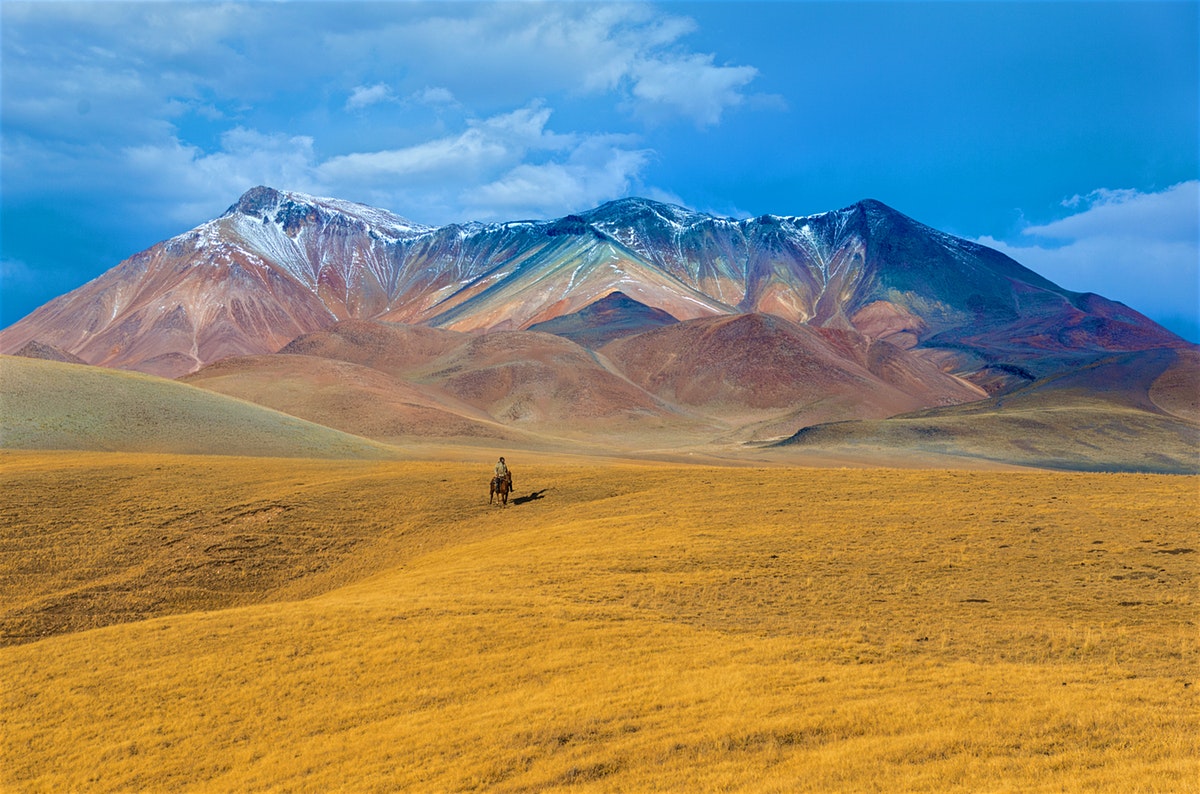 Ethnic Kyrgyz make up the majority of the country’s 6 million people, followed by significant minorities of Uzbeks and Russians. Kyrgyz is closely related to other Turkic languages, although Russian remains widely spoken and is an official language, a legacy of a century of Russification. The majority of the population are non-denominational Muslims. In addition to its Turkic origins, Kyrgyz culture bears elements of Persian, Mongolian, and Russian influence.
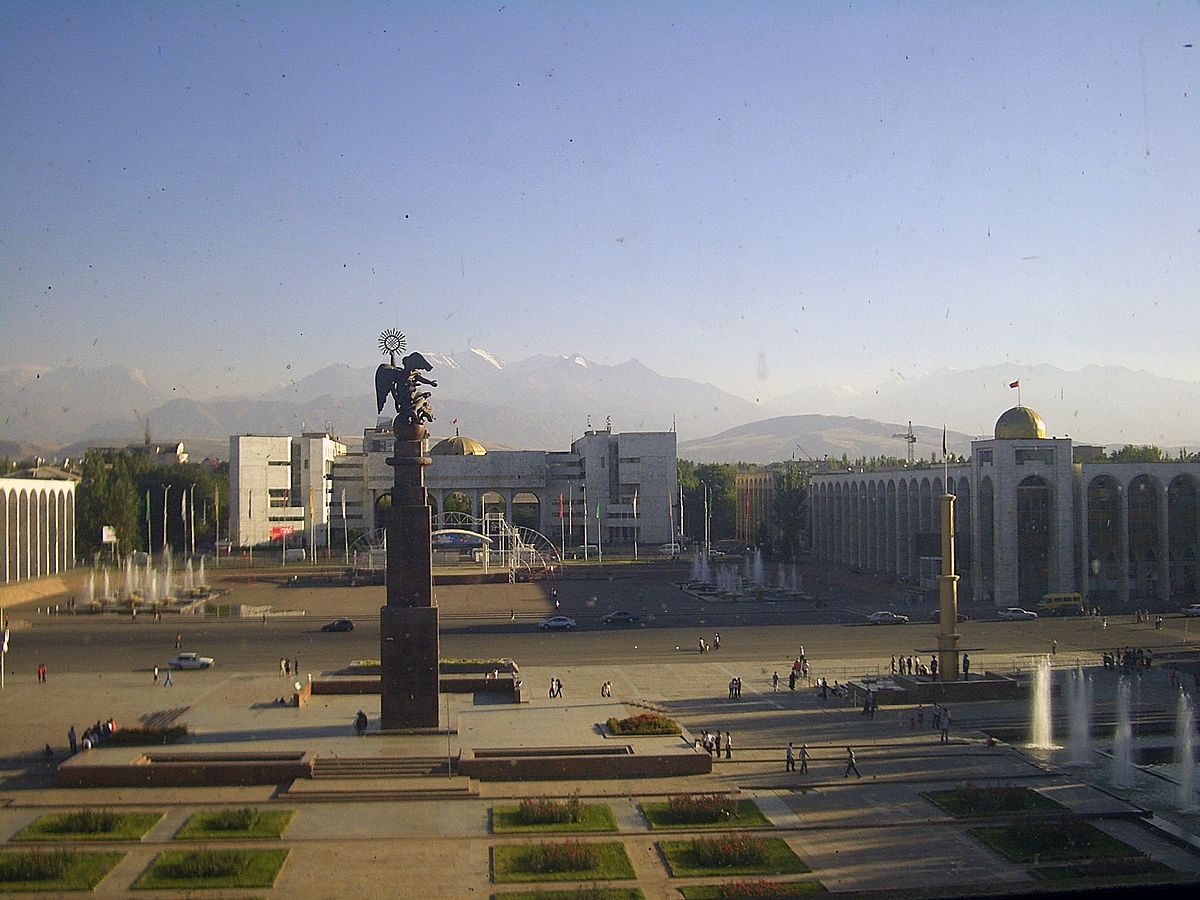 Bishkek: The capital city and the place where my friend is currently based in. Bishkek borders Central Asia’s Tian Shan range. It’s a gateway to the Kyrgyz Ala-Too mountains and Ala Archa National Park, with glaciers and wildlife trails. The city’s arts scene encompasses the monumental State Museum of Fine Arts and the collonaded Opera and Ballet Theater. The vast, central Ala-Too Square features the Manas monument, honouring the hero of the Kyrgyz Epic of Manas. The Soviet-era State History Museum, next to the presidential White House, explores the country’s history and ethnic groups. Dubovy Park is known for its oak trees and sculptures, while the nearby M. V. Frunze Museum preserves the birthplace of Mikhail Vasilievich Frunze, a prominent Soviet military leader who was born in the city. West of here, sprawling Osh Bazaar features traditional costumes and Kyrgyz produce. East of Bishkek, the intricately carved Burana Tower and its adjacent ruins mark the site of the 9th-century city of Balasagun.
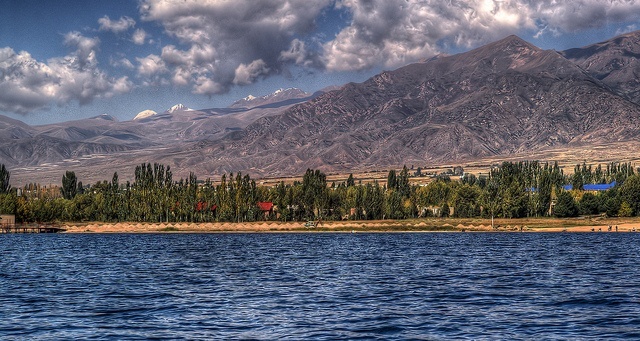 Issy-Kul Lake: Issyk-Kul means “hot lake” translated from Kyrgyz. It is a salty and mineral rich lake that does not freeze even in the coldest of winters. More than a hundred rivers flow into lake yet not one of them flows out. It is the second largest mountain lake in the world, located at an altitude of 1607 meters and at its maximum, a depth of 668 meters. To give you an idea of the scale of the lake, it takes about nine hours to circumnavigate by car. If you take a tour of Issyk Kul, why not stop at Balykchy, Bokonbaevo, Barskon, or Cholpon Ata? Wherever you stop, you can’t fail to notice the stunning backdrop. Issyk Kul is surrounded by the Ala-Too Mountains, part of the Tian Shan range. There are several local legends about how the lake appeared, but we won’t spoil the surprise.
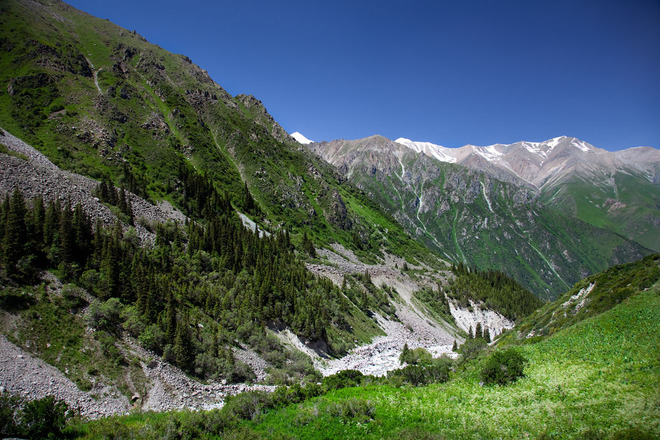 Ala Archa National Park: Just around half an hour away from Bishkek’s suburbs is a magnificent alpine national park. You can get closer to the mountains that form the backdrop to the city. The highest peak in the national park reaches 4895 meters and the Ala Archa range has more than fifty peaks. It is a favourite local haunt for picnics as well as being popular with tourists looking to do short hikes.
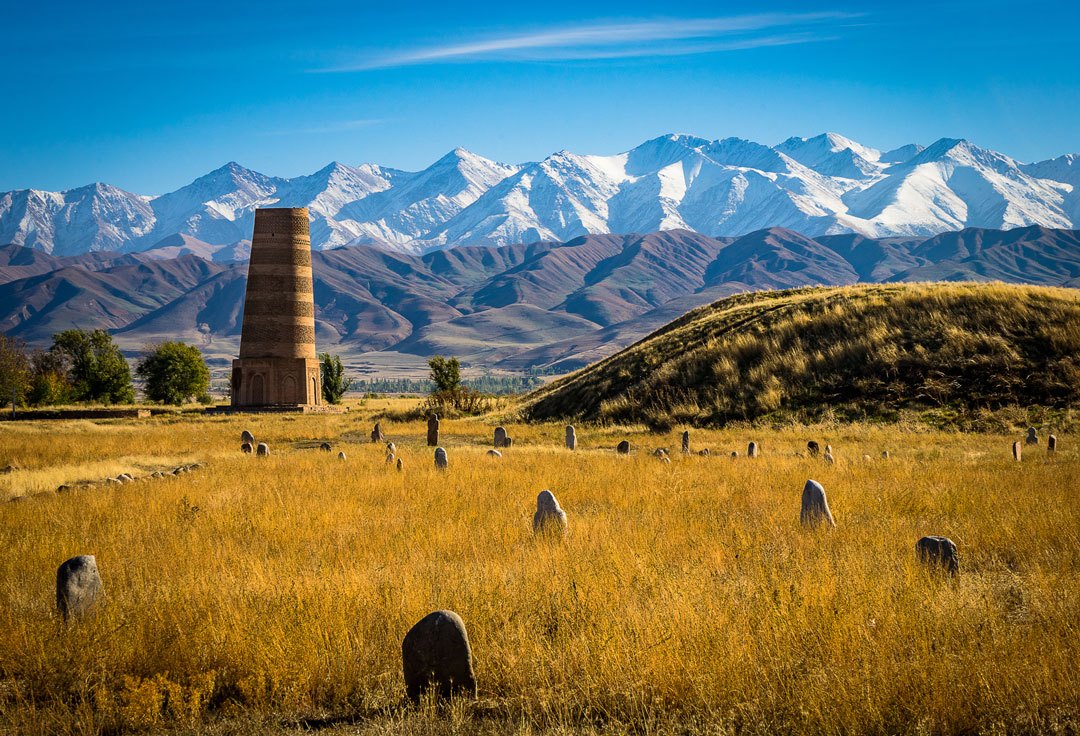 Burana Tower: Built in the 11th century, the Burana Tower was once part of a flourishing Silk Road city called Balasaghun. Originally the tower was a minaret reaching over 40 meters in height and the earliest of such towers in the whole of Central Asia. Sadly, an earthquake in the 15th century destroyed the top half of the tower. Today it stands just over 20 meters high and you can even climb up it! Near the tower, you can also take a look at the small museum and have a look at some ancient stone carvings known as balbals.
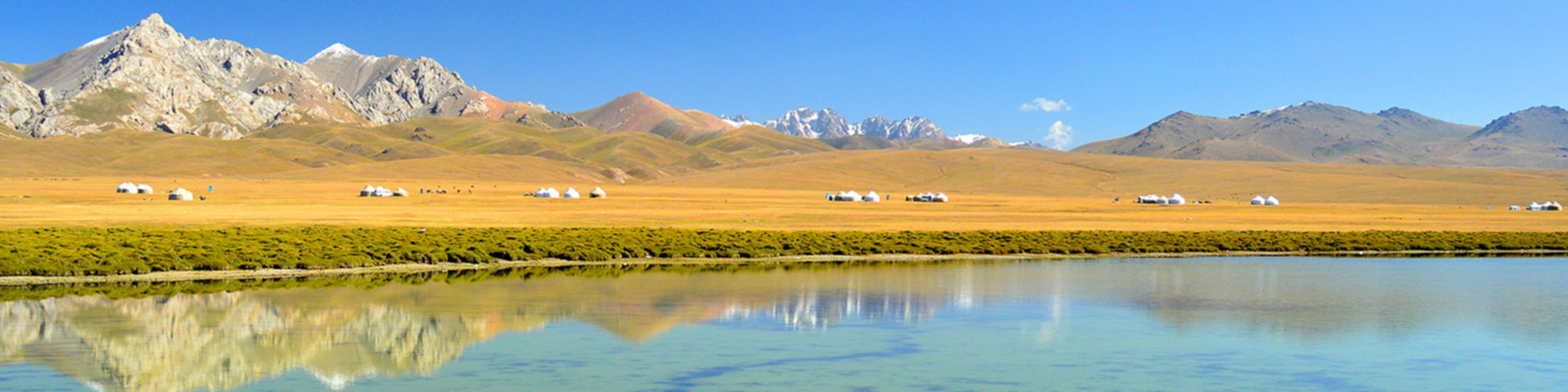 Song Kul Lake: Song Kol Lake is a vast summer pasture, accessible only from June to September. Nomads graze their animals there as they have been for millennia. It is located at an altitude of 3016 meters, but don’t expect rugged peaks – it actually looks pretty flat. Song Kul is a freshwater lake that stretches for 29 km in length and about 18 km in breadth. Its maximum depth is only about 13 meters. If you head up there, you’ll enjoy sleeping in real yurts and feeling free just like your nomad hosts. Central Asia with yurts
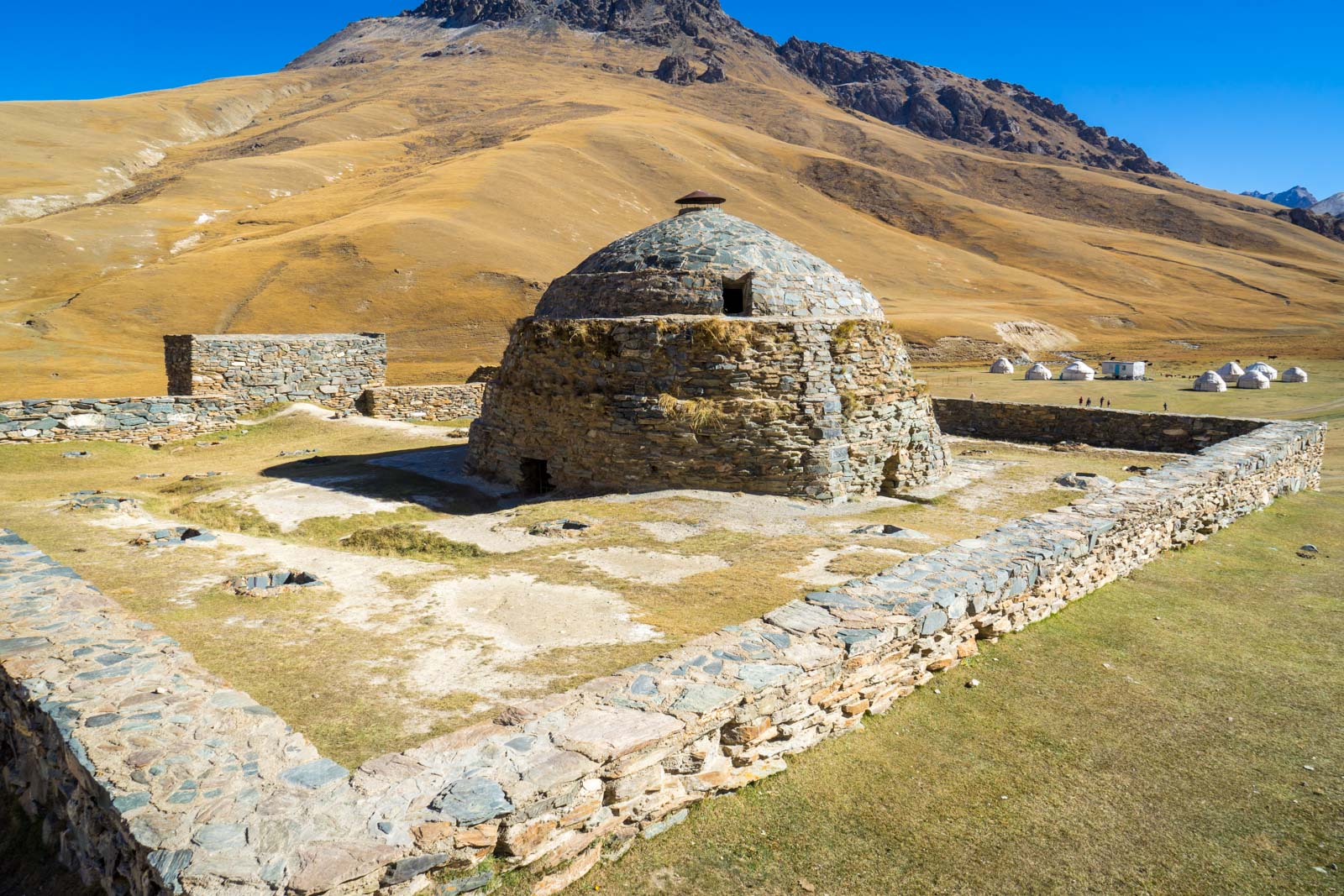 Tash Rabat: Tash Rabat is a historic stone caravanserai. These were places used by merchants and their caravans on the ancient Silk Road. It is one of the best preserved of such places in Central Asia. You can sleep in yurts nearby or go horse riding. It was originally built as a Nestorian monastery and then turned into a caravanserai.
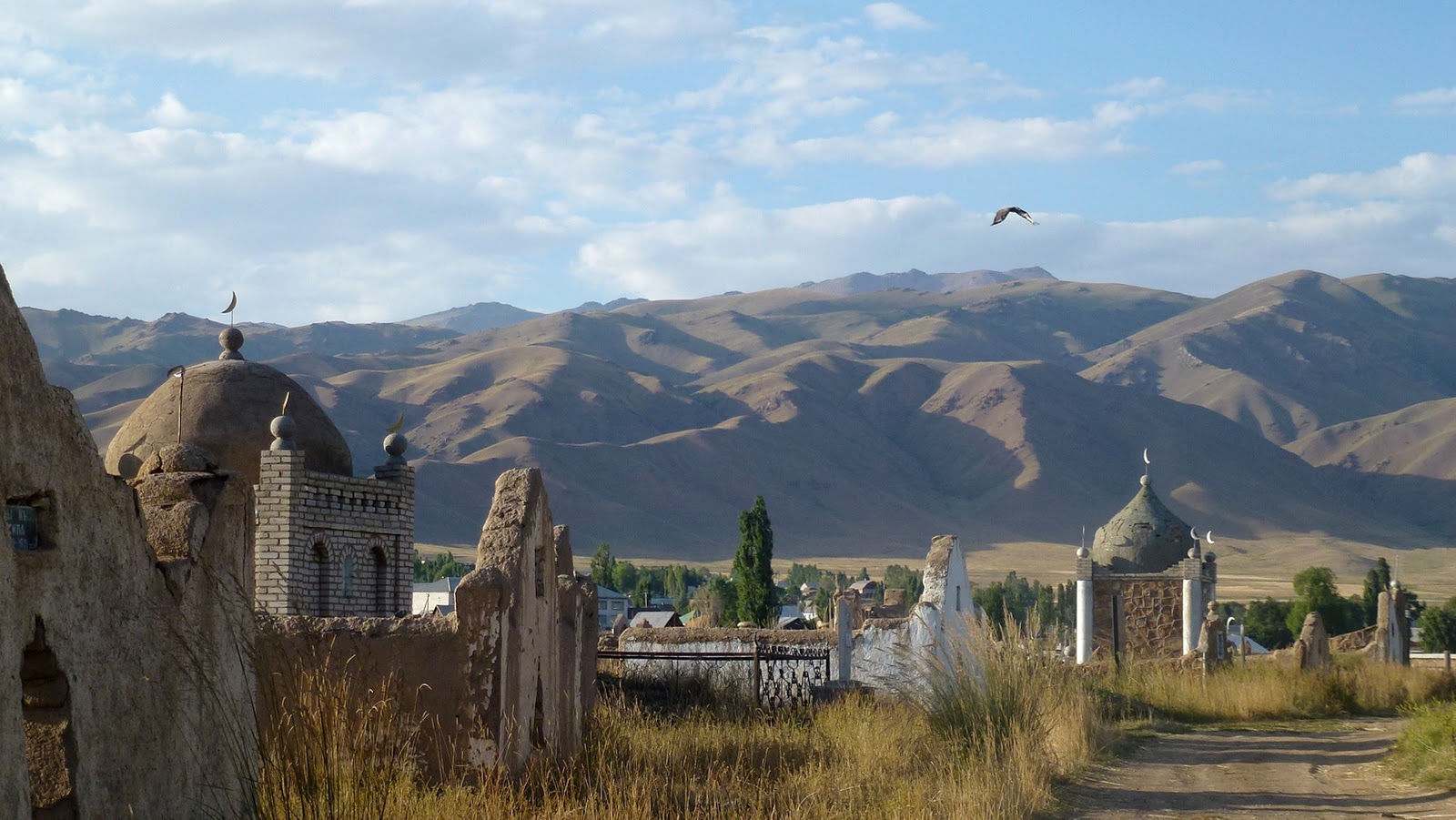 Osh: Osh is the oldest city in Kyrgyzstan, celebrating its 3000th anniversary in 2000. It lies in the heart of the fertile Ferghana Valley. The centre of the city is occupied by Sulaiman-Too. This is a sacred mountain that has been continuously worshipped for millennia. You will see women sliding down stones in the belief that this practice will increase their chance of giving birth to healthy children. This is one of those perfect examples of longstanding traditions of the Silk Road, that combine prehistoric, pre-Islamic, Islamic and local beliefs into one holy site. Sulaiman is the local pronunciation of Solomon. It is thought that the throne of Solomon was once located on this mountain; some legends go so far as to say that he was buried there. Another important site in Osh is the 16th-century mosque of Babur, the founder of the Mughal Empire.
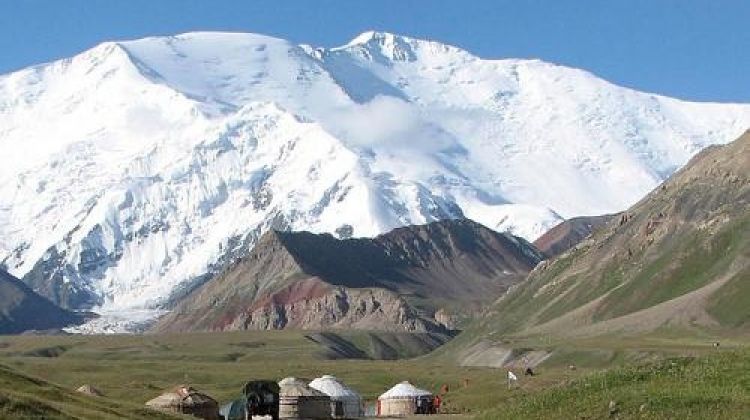 Peak Lenin: Peak Lenin base camp is around one to three hours away from Osh, situated on the border between Kyrgyzstan and Tajikistan. At its highest point, it reaches 7134 meters. It is considered to be one of the easiest ascents to over 7000 meters by climbers. If you cannot get that high it is impressive even to enjoy the view of the peak from the first base camp which can be reached by car. Even in the hottest summers, you can admire the snow-capped peaks of the mountains of the Trans-Alay Range where the Tian Shan & Pamir Mountain systems come together.
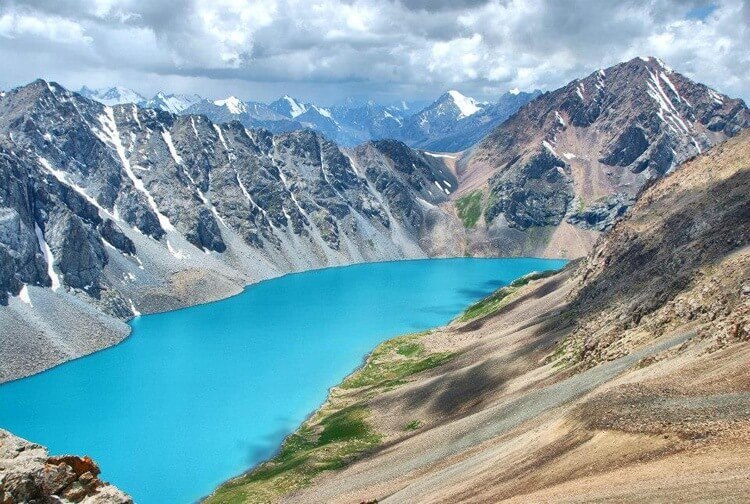 Karakol: Karakol is the administrative centre of the Issyk-Kul region. However although it isn’t located right on the shores of the lake, it’s easy to make day trips to the lake or to the nearby mountains. In the 19th century, it became a strategic point separating the Russian Empire from China and an important Russian military settlement was established there in 1869. It also attracted Chinese Muslims fleeing oppression in China. These two important events of history can be seen in Dungan Mosque and Karakol’s Orthodox Church.
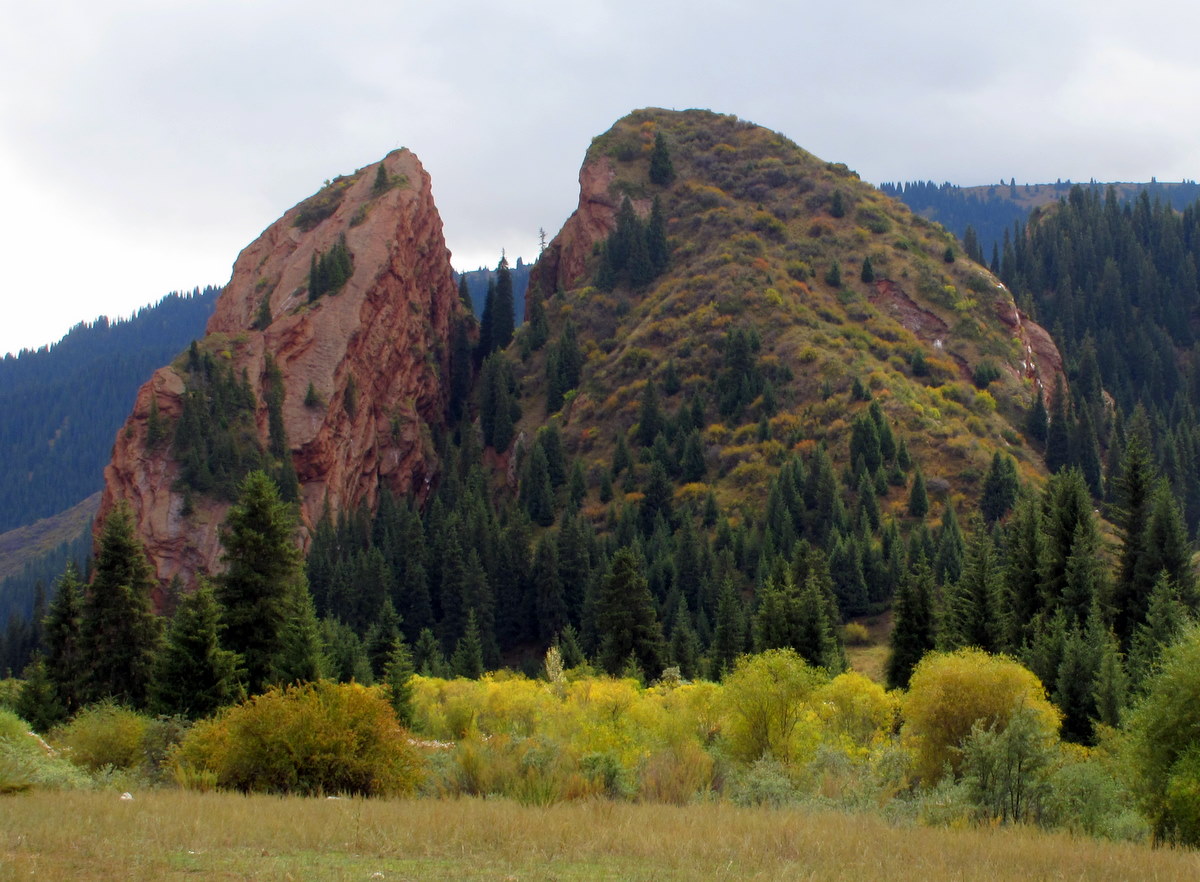 Djeti Oguz & Altyn Arashan: From Karakol, there are numerous opportunities to go for a hike or go horse riding. Local favourites include the Djety Oguz valley with its red cliff formations and Altyn Arashan that reminds people of Swiss mountain valleys. Djety Oguz means seven bulls. The colourful cliffs are the setting for beautiful and tragic local legends that you can hear during our Kyrgyzstan tour or other Central Asia adventures. Altyn Arashan offers one of the most beautiful Kyrgyz trekking routes and best of all, it’s easy enough that anyone can do it.
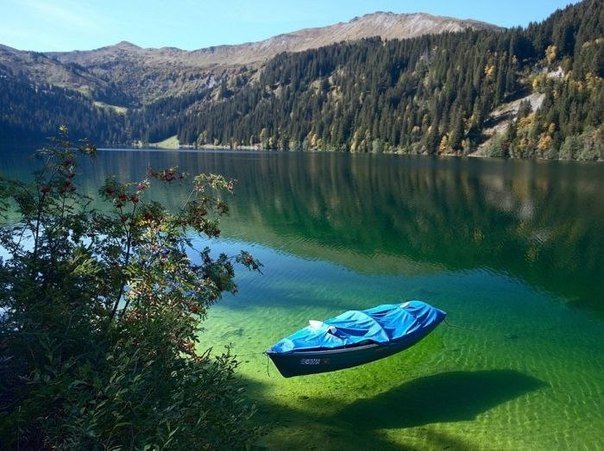 Sary Chelek Biosphere Reserve: Few places hold a candle to the Sary Chelek Biosphere Reserve. This 23.9 sq km piece of wilderness is remote, virginal, and spectacular. Untouched by the rest of the world, Sary Chelek contains 7 pristine alpine lakes, 157 bird species, deer, long-horned mountain goats, porcupines, and wild boar. Sary Chelek is located in the province of Jalal-Abad in between the Chatkal and At Oynok Mountain Ranges.