In My Hands Today…

The Toss of a Lemon – Padma Viswanathan

In south India in 1896, ten-year old Sivakami is about to embark on a new life. Hanumarathnam, a village healer with some renown as an astrologer, has approached her parents with a marriage proposal. In keeping with custom, he provides his prospective in-laws with his horoscope. The problem is that his includes a prediction, albeit a weak one, that he will die in his tenth year of marriage.

Despite the ominous horoscope, Sivakami’s parents hesitate only briefly, won over by the young man and his family’s reputation as good, upstanding Brahmins. Once married, Sivikami and Hanumarathnam grow to love one another and the bride, now in her teens, settles into a happy life. But the predictions of Hanumarathnam’s horoscope are never far from her new husband’s mind. When their first child is born, as a strategy for accurately determining his child’s astrological charts, Hanumarathnam insists the midwife toss a lemon from the window of the birthing room the moment his child appears. All is well with their first child, a daughter, Thangam, whose birth has a positive influence on her father’s astrological future. But this influence is fleeting: when a son, Vairum, is born, his horoscope confirms that his father will die within three years.

Resigned to his fate, Hanumarathnam sets himself to the unpleasant task of readying his household for his imminent death. Knowing the hardships and social restrictions Sivakami will face as a Brahmin widow, he hires and trains a servant boy called Muchami to help Sivakami manage the household and properties until Vairum is of age.

When Sivakami is eighteen, Hanumarathnam dies as predicted. Relentless in her adherence to the traditions that define her Brahmin caste, she shaves her head and dons the white sari of the widow. With some reluctance, she moves to her family home to raise her children under the protection of her brothers, but then realizes that they are not acting in the best interests of her children. With her daughter already married to an unreliable husband of her brothers’ choosing, and Vairum’s future also at risk, Sivakami leaves her brothers and returns to her marital home to raise her family.

With the freedom to make decisions for her son’s future, Sivakami defies tradition and chooses to give him a secular education. While her choice ensures that Vairum fulfills his promise, it also sets Sivakami on a collision course with him. Vairum, fatherless in childhood, childless as an adult, rejects the caste identity that is his mother’s mainstay, twisting their fates in fascinating and unbearable ways.

In My Hands Today…

Water – Bapsi Sidhwa and Deepa Mehta

Set in 1938, against the backdrop of Gandhi’s rise to power, Water follows the life of eight-year-old Chuyia, abandoned at a widow’s ashram after the death of her elderly husband. There, she must live in penitence until her death. Unwilling to accept her fate, she becomes a catalyst for change in the widows’s lives. When her friend Kalyani, a beautiful widow-prostitute, falls in love with a young, upper-class Gandhian idealist, the forbidden affair boldly defies Hindu tradition and threatens to undermine the ashram’s delicate balance of power. This riveting look at the lives of widows in colonial India is ultimately a haunting and lyrical story of love, faith, and redemption.

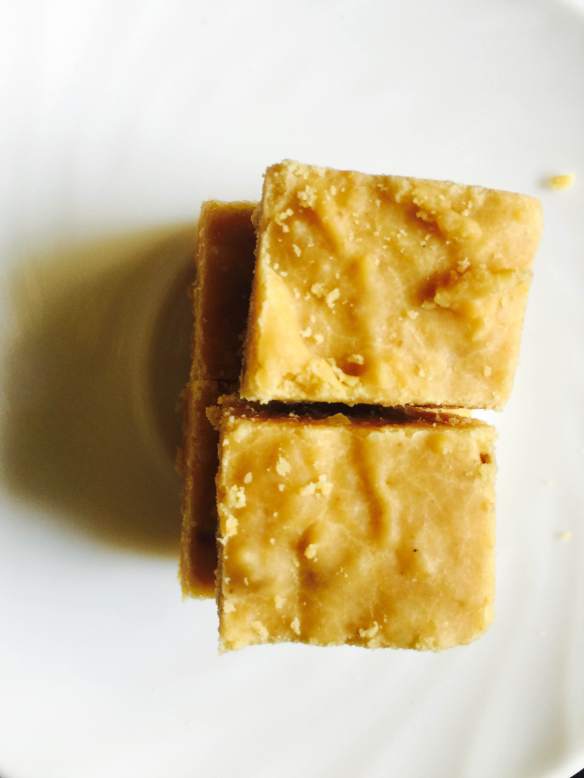
Diwali Recipes: 7 Cup Cake

IMG_5059

This is another traditional tambram recipe and which is one of my go-to recipes when I need to make something quickly. It does take a bit of time to make, but the efforts are super worth it! The ingredients are given as cups which is where the name of the recipe came from, but essentially it’s just a measure. It doesn’t matter how big your cup size is, just use the same amount for all the ingredients and your cake or barfi will come out fab!

IMG_5057

Ingredients:

  • 1 cup chickpea flour or besan
  • 1 cup ghee
  • 1 cup grated coconut (you can fresh or frozen, I’ve used fresh for this recipe)
  • 1 cup Milk
  • 3 cups Sugar

Method:

  • Take a big plate or cake tin and grease it slightly. Or, you could lightly spray it with oil and then put baking paper over to completely cover it, this reduces the amount of ghee used in the recipe slightly.
  • Fry the chickpea flour or besan in a dry pan and do not overfry it. Stop when it starts changing colour. At this point, add the coconut, sugar and milk to the pan and continue stirring.
  • When the sugar starts to dissolve, add the ghee and keep stirring. You will need to keep stirring the pan, so that the mixture does not catch in the bottom.
  • After about 15 minutes (more or less depending on your quantity), the mixture will start leaving the sides of the pan. At this point, take a few drops and put it in your greased plate. If it stays in shape, it is ready, otherwise continue stirring and repeating this step till you get to this point.
  • Switch off the gas and pour it into your prepared greased plate. Using a clean spatula, level the mixture and make it smooth. Let it cool for a while and when still slightly warm, lightly score lines in the mixture with a knife or pizza cutter. You could cut squares or diamonds in any size. Let it cool completely before transferring to an airtight container.

This should be good for a week or so outside and around 2 weeks or so inside the fridge.

IMG_5060

In My Hands Today…

Leap of Faith : Memoirs of an Unexpected Life – Queen Noor of Jordan

“Leap of Faith is the dramatic and inspiring story of an American woman’s remarkable journey into the heart of a man and his nation.” “Born into a distinguished Arab-American family and raised amid privilege, Lisa Halaby joined the first freshman class at Princeton to accept women, graduating in 1974 with a degree in architecture and urban planning.Two years later, while visiting her father in Jordan, she was casually introduced on the airport runway to King Hussein. Widely admired in the Arab world as a voice of moderation, and for his direct lineage to the prophet Muhammad, Hussein would soon become the world’s most eligible bachelor after the tragic death of his wife. The next time they met, Hussein would fall headlong in love with the athletic, outspoken daughter of his longtime friend. After a whirlwind, secret courtship Lisa Halaby became Noor Al Hussein, Queen of Jordan.” “With eloquence and candor, Queen Noor speaks of the obstacles she faced as a naive young bride in the royal court, of rebelling against the smothering embrace of security guards and palace life, and of her own successful struggle to create a working role as a humanitarian activist in a court that simply expected Noor to keep her husband happy. As she gradually took on the mantle of a queen, Noor’s joys and challenges grew. After a heartbreaking miscarriage, she gave birth to four children. Meshing the demands of motherhood with the commitments of her position often proved difficult, but she tried to keep her young children by her side, even while flying the world with her husband in his relentless quest for peace. This mission would reap satisfying rewards, including greater Arab unity and a peace treaty with Israel, and suffer such terrible setbacks as the Gulf War and the assassination of Prime Minister Rabin.” Leap of Faith is a remarkable document. It is the story of a young American woman who became wife and partner to an Arab monarch.