In My Hands Today…

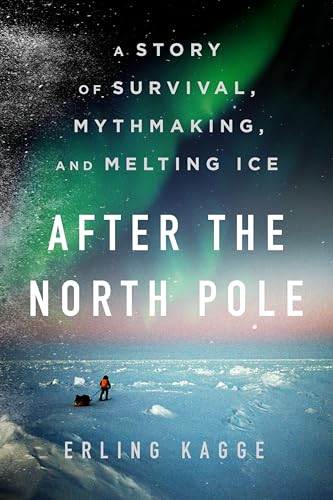
After the North Pole: A Story of Survival, Mythmaking, and Melting Ice – Erling Kagge

The North Pole looms large in our collective psyche—the ultimate Otherland in a world mapped and traversed. It is the center of our planet’s rotation, one of the places that is most vulnerable in an epoch of global climate change. Its sub-zero temperatures and strange year of one sunset and one sunrise make it an eerie, utterly disorienting place that challenges human endurance and understanding.

Erling Kagge and his friend Børge Ousland became the first people “to ever reach the pole without dogs, without depots and without motorized aids,” skiing for 58 days from a drop off point on the ice edge of Canada’s northernmost island.

In magisterial prose, Erling narrates his epic, record-making journey, probing the physical challenges and psychological motivations for embarking on such an epic expedition, the history of the territory’s exploration, its place in legend and art, and the thrilling adventures he experienced during the trek. It is another example of what bestselling author Robert MacFarlane has called “Kagge’s extraordinary life in wild places,”

Erling offers surprises on every page while observing the key role that this place holds in our current climate and geopolitical conversations. As majestic, mesmerizing, and monumental as the terrain it captures, The North Pole is for anyone who has gazed out at the horizon—and wondered what happens if you keep going.

In My Hands Today…

The Third Pole: Mystery, Obsession, and Death on Mount Everest – Mark Synnott

Shivering, exhausted, gasping for oxygen, beyond doubt . . .

A hundred-year mystery lured veteran climber Mark Synnott into an unlikely expedition up Mount Everest during the spring 2019 season that came to be known as “the Year Everest Broke.” What he found was a gripping human story of impassioned characters from around the globe and a mountain that will consume your soul—and your life—if you let it.

The mystery? On June 8, 1924, George Mallory and Sandy Irvine set out to stand on the roof of the world, where no one had stood before. They were last seen eight hundred feet shy of Everest’s summit, still “going strong” for the top. Could they have succeeded decades before Sir Edmund Hillary and Tenzing Norgay? Irvine is believed to have carried a Kodak camera with him to record their attempt, but it, along with his body, has never been found. Did the frozen film in that camera have a photograph of Mallory and Irvine on the summit before they disappeared into the clouds, never to be seen again? Kodak says the film might still be viable. . . .

Mark Synnott made his own ascent up the infamous North Face along with his friend Renan Ozturk, a filmmaker using drones higher than any had previously flown. Readers witness first-hand how Synnott’s quest led him from oxygen-deprivation training to archives and museums in England, to Kathmandu, the Tibetan high plateau, and up the North Face into a massive storm. The infamous traffic jams of climbers at the very summit immediately resulted in tragic deaths. Sherpas revolted. Chinese officials turned on Synnott’s team. An Indian woman miraculously crawled her way to frostbitten survival. Synnott himself went off the safety rope—one slip and no one would have been able to save him—committed to solving the mystery.

Eleven climbers died on Everest that season, all of them mesmerized by an irresistible magic. The Third Pole is a rapidly accelerating ride to the limitless joy and horror of human obsession.

In My Hands Today…

The King’s Shadow: Obsession, Betrayal, and the Deadly Quest for the Lost City of Alexandria – Edmund Richardson

For centuries the city of Alexandria Beneath the Mountains was a meeting point of East and West. Then it vanished. In 1833 it was discovered in Afghanistan by the unlikeliest person imaginable: Charles Masson, deserter, pilgrim, doctor, archaeologist, spy, one of the most respected scholars in Asia, and the greatest of nineteenth-century travelers.

On the way into one of history’s most extraordinary stories, he would take tea with kings, travel with holy men and become the master of a hundred disguises; he would see things no westerner had glimpsed before and few have glimpsed since. He would spy for the East India Company and be suspected of spying for Russia at the same time, for this was the era of the Great Game, when imperial powers confronted each other in these staggeringly beautiful lands. Masson discovered tens of thousands of pieces of Afghan history, including the 2,000-year-old Bimaran golden casket, which has upon it the earliest known face of the Buddha. He would be offered his own kingdom; he would change the world, and the world would destroy him.

This is a wild journey through nineteenth-century India and Afghanistan, with impeccably researched storytelling that shows us a world of espionage and dreamers, ne’er-do-wells and opportunists, extreme violence both personal and military, and boundless hope. At the edge of empire, amid the deserts and the mountains, it is the story of an obsession passed down the centuries.

In My Hands Today…

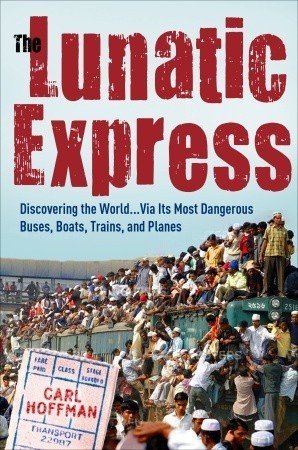
The Lunatic Express: Discovering the World… via Its Most Dangerous Buses, Boats, Trains, and Planes – Carl Hoffman

Indonesian Ferry Sinks. Peruvian Bus Plunges Off Cliff. African Train Attacked by Mobs. Whenever he picked up the newspaper, Carl Hoffman noticed those short news bulletins, which seemed about as far from the idea of tourism, travel as the pursuit of pleasure, as it was possible to get. So off he went, spending six months circumnavigating the globe on the world’s worst conveyances: the statistically most dangerous airlines, the most crowded and dangerous ferries, the slowest buses, and the most rickety trains. The Lunatic Express takes us into the heart of the world, to some its most teeming cities and remotest places: from Havana to Bogotá on the perilous Cuban Airways. Lima to the Amazon on crowded night buses where the road is a washed-out track. Across Indonesia and Bangladesh by overcrowded ferries that kill 1,000 passengers a year. On commuter trains in Mumbai so crowded that dozens perish daily, across Afghanistan as the Taliban closes in, and, scariest of all, Los Angeles to Washington, D.C., by Greyhound.

The Lunatic Express is the story of traveling with seatmates and deckmates who have left home without American Express cards on conveyances that don’t take Visa, and seldom take you anywhere you’d want to go. But it’s also the story of traveling as it used to be — a sometimes harrowing trial, of finding adventure in a modern, rapidly urbanizing world and the generosity of poor strangers, from ear cleaners to urban bus drivers to itinerant roughnecks, who make up most of the world’s population. More than just an adventure story, The Lunatic Express is a funny, harrowing and insightful look at the world as it is, a planet full of hundreds of millions of people, mostly poor, on the move and seeking their fortunes.

In My Hands Today…

The Wager: A Tale of Shipwreck, Mutiny and Murder – David Grann

On January 28, 1742, a ramshackle vessel of patched-together wood and cloth washed up on the coast of Brazil. Inside were thirty emaciated men, barely alive, and they had an extraordinary tale to tell. They were survivors of His Majesty’s Ship the Wager, a British vessel that had left England in 1740 on a secret mission during an imperial war with Spain. While the Wager had been chasing a Spanish treasure-filled galleon known as “the prize of all the oceans,” it had wrecked on a desolate island off the coast of Patagonia. The men, after being marooned for months and facing starvation, built the flimsy craft and sailed for more than a hundred days, traversing nearly 3,000 miles of storm-wracked seas. They were greeted as heroes.

But then … six months later, another, even more decrepit craft landed on the coast of Chile. This boat contained just three castaways, and they told a very different story. The thirty sailors who landed in Brazil were not heroes – they were mutineers. The first group responded with countercharges of their own, of a tyrannical and murderous senior officer and his henchmen. It became clear that while stranded on the island the crew had fallen into anarchy, with warring factions fighting for dominion over the barren wilderness. As accusations of treachery and murder flew, the Admiralty convened a court martial to determine who was telling the truth. The stakes were life-and-death–for whomever the court found guilty could hang.