In My Hands Today…

My Feudal Lord – Tehmina Durrani, William Hoffer and Marilyn Hoffer
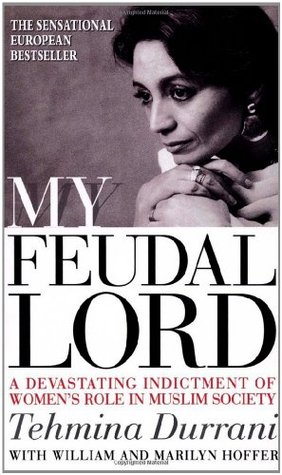
Born into one of Pakistan’s most influential families, Tehmina Durrani was raised in the privileged milieu of Lahore high society. Like all women of her rank, she was expected to marry a prosperous Muslim from a respectable family, bear him many children and lead a sheltered life of leisure.

Her marriage to Mustafa Khar, one of Pakistan’s most eminent political figures, soon turned into a nightmare. Violently possessive and pathologically jealous, Mustafa Khar succeeded in cutting her off from the outside world. For fourteen years, Tehmina suffered alone, in silence.

When she decided to rebel, the price she paid was extremely high: as a Muslim woman seeking a divorce, she signed away all financial support, lost the custody of her four children, and found herself alienated from her friends and disowned by her parents.
When this book was first published it shook Pakistani society to its foundations. Here at last was someone who had succeded in reconciling her faith in Islam with her ardent belief in women’s rights. Tehmina Durrani’s story provided extraordinary insights into the vulnerable position of women caught in the complex web of Muslim society.

In My Hands Today…

A Suitable Boy – Vikram Seth

Vikram Seth’s novel is, at its core, a love story: Lata and her mother, Mrs. Rupa Mehra, are both trying to find — through love or through exacting maternal appraisal — a suitable boy for Lata to marry. Set in the early 1950s, in an India newly independent and struggling through a time of crisis, A Suitable Boy takes us into the richly imagined world of four large extended families and spins a compulsively readable tale of their lives and loves. A sweeping panoramic portrait of a complex, multi ethnic society in flux, A Suitable Boy remains the story of ordinary people caught up in a web of love and ambition, humor and sadness, prejudice and reconciliation, the most delicate social etiquette and the most appalling violence.

In My Hands Today…

The God of Small Things – Arundhati Roy

The year is 1969. In the state of Kerala, on the southernmost tip of India, fraternal twins Esthappen and Rahel fashion a childhood for themselves in the shade of the wreck that is their family. Their lonely, lovely mother, Ammu, (who loves by night the man her children love by day), fled an abusive marriage to live with their blind grandmother, Mammachi (who plays Handel on her violin), their beloved uncle Chacko (Rhodes scholar, pickle baron, radical Marxist, bottom-pincher), and their enemy, Baby Kochamma (ex-nun and incumbent grandaunt). When Chacko’s English ex-wife brings their daughter for a Christmas visit, the twins learn that things can change in a day, that lives can twist into new, ugly shapes, even cease forever, beside their river…

In My Hands Today…

Swallows of Kabul – Yasmin Khadra

Since the ascendancy of the Taliban the lives of Mosheen and his beautiful wife, Zunaira, have been gradually destroyed. Mosheen’s dream of becoming a diplomat has been shattered and Zunaira can no longer even appear on the streets of Kabul unveiled. Atiq is a jailer who guards those who have been condemned to death; the darkness of prison and the wretchedness of his job have seeped into his soul. Atiq’s wife, Musarrat, is suffering from an illness no doctor can cure. Yet, the lives of these four people are about to become inexplicably intertwined, through death and imprisonment to passion and extraordinary self-sacrifice.

The Swallows of Kabul is an astounding and elegiac novel of four people struggling to hold on to their humanity in a place where pleasure is a deadly sin and death has become routine.

In My Hands Today…

The Feast of Roses (Taj Mahal Trilogy #2) – Indu Sundaresan

The love story of Emperor Jahangir and Mehrunnisa, begun in the critically praised debut novel The Twentieth Wife, continues in Indu Sundaresan’s The Feast of Roses. This lush new novel tells the story behind one of the great tributes to romantic love and one of the seven wonders of the world — the Taj Mahal.

Mehrunnisa, better known as Empress Nur Jahan, comes into Jahangir’s harem as his twentieth and last wife. Almost from the beginning of her royal life she fits none of the established norms of womanhood in seventeenth-century India.

Mehrunnisa is the first woman Jahangir marries for love, at the “old” age of thirty-four. He loves her so deeply that he eventually transfers his powers of sovereignty to her.

Power and wealth do not come easily to Mehrunnisa — she has to fight for them. She has a formidable rival in the imperial harem, Empress Jagat Gosini, who has schemed and plotted against Mehrunnisa from early on. Mehrunnisa’s problems do not just lie within the harem walls, but at court, too, as she battles powerful ministers for supremacy. These ministers, who have long had Emperor Jahangir’s confidence and trust, consider Mehrunnisa a mere woman who cannot have a voice in the outside world.

Mehrunnisa combats all of this by forming a junta of sorts with three men she can rely on — her father, her brother, and Jahangir’s son Prince Khurram. She demonstrates great strength of character and cunning to get what she wants, sometimes at a cost of personal sorrow when she almost loses her daughter’s love. But she never loses the love of the man who bestows this power upon her — Emperor Jahangir. The Feast of Roses is a tale of this power and love, the story of power behind a veil.

Taj Mahal Trilogy