In My Hands Today…

Who Sought to See the Future – Peter Moore
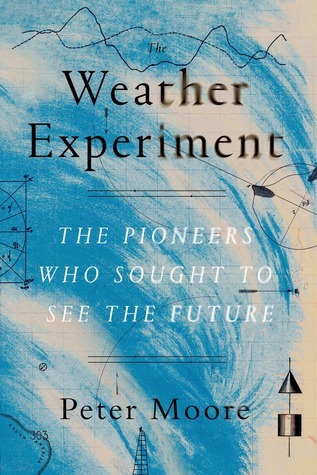
In 1865 Admiral Robert FitzRoy locked himself in his dressing room and cut his throat. His grand meteorological project had failed. Yet only a decade later, FitzRoy’s storm warning system and “forecasts” would return, the model for what we use today.

In an age when a storm at sea was evidence of God’s wrath, nineteenth-century meteorologists had to fight against convention and religious dogma. Buoyed by the achievements of the Enlightenment, a generation of mavericks set out to decipher the secrets of the atmosphere and predict the future. Among them were Luke Howard, the first to classify clouds; Francis Beaufort, who quantified the winds; James Glaisher, who explored the upper atmosphere in a hot-air balloon; Samuel Morse, whose electric telegraph gave scientists the means by which to transmit weather warnings; and FitzRoy himself, master sailor, scientific pioneer, and founder of the U.K.’s national weather service.

Reputations were built and shattered. Fractious debates raged over decades between scientists from London and Galway, Paris and New York. Explaining the atmosphere was one thing, but predicting what it was going to do seemed a step too far. In 1854, when a politician suggested to the Commons that Londoners might soon know the weather twenty-four hours in advance, the House roared with laughter.

Peter Moore’s The Weather Experiment navigates treacherous seas and rough winds to uncover the obsession that drove these men to great invention and greater understanding.
In My Hands Today…

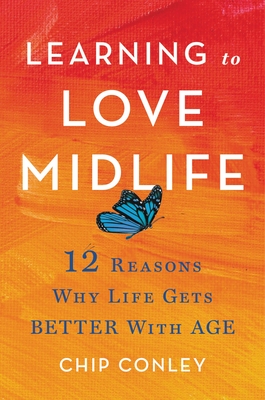
Learning to Love Midlife: 12 Reasons Why Life Gets Better with Age – Chip Conley

The midlife crisis is the butt of so many jokes, but this long-derided life stage has an upside. What if we could reframe our thinking about the natural transition of midlife not as a crisis, but as a chrysalis—a time when something profound awakens in us, as we shed our skin, spread our wings, and pollinate our wisdom to the world?

In Learning to Love Midlife , Chip Conley offers an alternative narrative to the way we commonly think of our 40s, 50s and 60s. Drawing on the latest social science research, inspiring stories, and timeless wisdom, he reveals 12 reasons why life gets better with age. They

No matter where you are in your midlife journey, this perspective‑shifting guide will inspire you to find joy, purpose and success in the years that lie ahead—and how those years can be your best ones yet.

In My Hands Today…

Our Moon: How Earth’s Celestial Companion Transformed the Planet, Guided Evolution, and Made Us Who We Are – Rebecca Boyle

Far from being a lifeless ornament in the sky, the Moon holds the key to some of science’s central questions, and in this fascinating account of our remarkable satellite, award-winning science journalist Rebecca Boyle shows us why it is the secret to our success.

The Moon stabilizes the Earth’s tilt toward the Sun, creating reliable seasons. The durability of this tilt over millennia stabilizes our climate. The Moon pulls on the ocean, driving the tides. It was these tides that mixed nutrients in the sea, enabling the evolution of complex life and, ultimately, bringing life onto land.

But the Moon also played a pivotal role in our conceptual development. While the Sun helped humans to mark daily time, hunters and gatherers used the phases of the Moon to count months and years, allowing them to situate themselves in time and plan for the future. Its role in the development of religion—Mesopotamian priests recorded the Moon’s position to make predictions about the Moon god–created the earliest known empirical, scientific observation.

Boyle deftly reframes the history of scientific discovery through a lunar lens, from Mesopotamia to the present day. Touching on ancient astronomers including Claudius Ptolemy; ancient philosophers from Anaxagoras to Plutarch; the scientific revolution of Copernicus, Galileo, and Kepler; and the lunar fiction of writers like Jules Verne–which inspired Wernher von Braun, the Nazi rocket scientist who succeeded in landing humans on the Moon–Boyle charts our path with the Moon from the origins of human civilization to the Apollo landings and up to the present.

Even as astronauts around the world prepare to return to the Moon, opening up new frontiers of discovery, profit, and politics, Our Moon brings the Moon down to Earth.

In My Hands Today…

On the Map: A Mind-Expanding Exploration of the Way the World Looks – Simon Garfield

Simon Garfield’s Just My Type illuminated the world of fonts and made everyone take a stand on Comic Sans and care about kerning. Now Garfield takes on a subject even dearer to our fanatical human hearts: maps.

Imagine a world without maps. How would we travel? Could we own land? What would men and women argue about in cars? Scientists have even suggested that mapping—not language—is what elevated our prehistoric ancestors from ape-dom. Follow the history of maps from the early explorers’ maps and the awe-inspiring medieval Mappa Mundi to Google Maps and the satellite renderings on our smartphones, Garfield explores the unique way that maps relate and realign our history—and reflect the best and worst of what makes us human.

Featuring a foreword by Dava Sobel and packed with fascinating tales of cartographic intrigue, outsize personalities, and amusing “pocket maps” on an array of subjects from how to fold a map to the strangest maps on the Internet, On the Map is a rich historical tapestry infused with Garfield’s signature narrative flair. Map-obsessives and everyone who loved Just My Type will be lining up to join Garfield on his audacious journey through time and around the globe.

In My Hands Today…

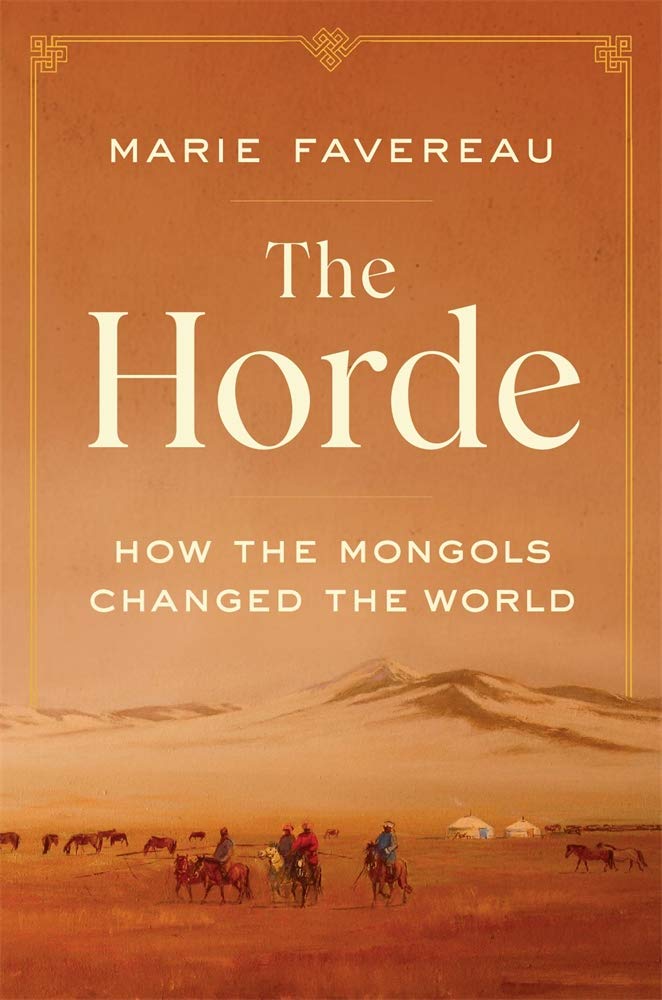
The Horde: How the Mongols Changed the World – Marie Favereau

The Mongols are widely known for one thing: conquest. In the first comprehensive history of the Horde, the western portion of the Mongol empire that arose after the death of Chinggis Khan, Marie Favereau shows that the accomplishments of the Mongols extended far beyond war. For three hundred years, the Horde was no less a force in global development than Rome had been. It left behind a profound legacy in Europe, Russia, Central Asia, and the Middle East, palpable to this day.

Favereau takes us inside one of the most powerful sources of cross-border integration in world history. The Horde was the central node in the Eurasian commercial boom of the thirteenth and fourteenth centuries and was a conduit for exchanges across thousands of miles. Its unique political regime―a complex power-sharing arrangement among the khan and the nobility―rewarded skillful administrators and diplomats and fostered an economic order that was mobile, organized, and innovative. From its capital at Sarai on the lower Volga River, the Horde provided a governance model for Russia, influenced social practice and state structure across Islamic cultures, disseminated sophisticated theories about the natural world, and introduced novel ideas of religious tolerance.

The Horde is the eloquent, ambitious, and definitive portrait of an empire little understood and too readily dismissed. Challenging conceptions of nomads as peripheral to history, Favereau makes clear that we live in a world inherited from the Mongol moment.