In My Hands Today…

Ambedkar’s India – B.R. Ambedkar

Ambedkar’s India is a collection of three of B.R. Ambedkar’s most prominent speeches on caste and the Indian Constitution.

“In the fight for Swaraj, you fight with the whole nation on your side. In fighting caste system, you stand against the whole nation—and that too, your own.”

Annihilation of Caste is one of Ambedkar’s best works in putting together how caste as a system has been eating up the roots of a rich cultural melting pot like India. “Bhakti in religion could lead to salvation. But in politics, Bhakti is a sure road to eventual dictatorship.”

The Grammar of Anarchy reflects Ambedkar’s ideas on how we need to pave the way for Independent India. It reflects his deep love and aspirations for India and its people. “…the sub-divisions [of caste] have lost the open-door character of the class system, and have become self-enclosed units called castes.”

Castes in India: Their Mechanism, Genesis and Development is an in-depth study of how classes went on to become castes and sub-castes to dot the Indian social system. This powerful narrative is a radical eye-opener.

In My Hands Today…

A Little History of Economics – Niall Kishtainy

What causes poverty? Are economic crises inevitable under capitalism? Is government intervention in an economy a helpful approach or a disastrous idea? The answers to such basic economic questions matter to everyone, yet the unfamiliar jargon and math of economics can seem daunting. This clear, accessible, and even humorous book is ideal for young readers new to economics and for all readers who seek a better understanding of the full sweep of economic history and ideas.

Economic historian Niall Kishtainy organizes short, chronological chapters that center on big ideas and events. He recounts the contributions of key thinkers including Adam Smith, David Ricardo, Karl Marx, John Maynard Keynes, and others, while examining topics ranging from the invention of money and the rise of agrarianism to the Great Depression, entrepreneurship, environmental destruction, inequality, and behavioral economics. The result is a uniquely enjoyable volume that succeeds in illuminating the economic ideas and forces that shape our world.

In My Hands Today…

Oxtravels: Meetings with Remarkable Travel Writers – edited by Michael Palin

You have to go back to the 1980s and Granta’s bestselling travel issue to find a book that compares to OxTravels.

Introduced by Michael Palin, OxTravels features original stories from twenty-five top travel writers, including Michael Palin, Paul Theroux, Sara Wheeler, William Dalrymple, Patrick Leigh Fermor, Lloyd Jones, Rory Stewart, Jan Morris, Dervla Murphy, Rory MacLean, and others.

Each of the stories takes as its theme a meeting – life-changing, affecting, amusing by turn – and together they transport readers into a brilliant, vivid atlas of encounters.

This extraordinary collection is published in aid of Oxfam and all royalties from the book will support Oxfam’s work.

In My Hands Today…

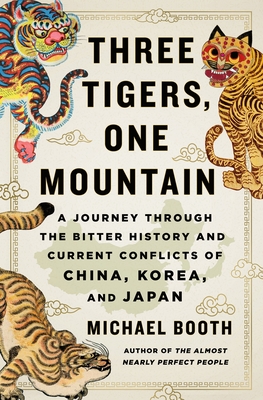
Three Tigers, One Mountain: A Journey Through the Bitter History and Current Conflicts of China, Korea, and Japan – Michael Booth

There is an ancient Chinese proverb that states, “Two tigers cannot share the same mountain.” However, in East Asia, there are three tigers on that mountain: China, Japan, and Korea, and they have a long history of turmoil and tension with each other. In his latest entertaining and thought provoking narrative travelogue, Michael Booth sets out to discover how deep, really, is the enmity between these three “tiger” nations, and what prevents them from making peace. Currently China’s economic power continues to grow, Japan is becoming more militaristic, and Korea struggles to reconcile its westernized south with the dictatorial Communist north. Booth, long fascinated with the region, travels by car, ferry, train, and foot, experiencing the people and culture of these nations up close. No matter where he goes, the burden of history, and the memory of past atrocities, continues to overshadow present relationships. Ultimately, Booth seeks a way forward for these closely intertwined, neighboring nations.

An enlightening, entertaining and sometimes sobering journey through China, Japan, and Korea, Three Tigers, One Mountain is an intimate and in-depth look at some of the world’s most powerful and important countries.

In My Hands Today…

An American Martyr in Persia: The Epic Life and Tragic Death of Howard Baskerville – Reza Aslan

Little known in America but venerated as a martyr in Iran, Howard Baskerville was a twenty-two-year-old Christian missionary from South Dakota who traveled to Persia (modern-day Iran) in 1907 for a two-year stint teaching English and preaching the gospel. He arrived in the midst of a democratic revolution—the first of its kind in the Middle East—led by a group of brilliant young firebrands committed to transforming their country into a fully self-determining, constitutional monarchy, one with free elections and an independent parliament.

The Persian students Baskerville educated in English in turn educated him about their struggle for democracy, ultimately inspiring him to leave his teaching post and join them in their fight against a tyrannical shah and his British and Russian backers. “The only difference between me and these people is the place of my birth,” Baskerville declared, “and that is not a big difference.”

In 1909, Baskerville was killed in battle alongside his students, but his martyrdom spurred on the revolutionaries who succeeded in removing the shah from power, signing a new constitution, and rebuilding parliament in Tehran. To this day, Baskerville’s tomb in the city of Tabriz remains a place of pilgrimage. Every year, thousands of Iranians visit his grave to honor the American who gave his life for Iran.

In this rip-roaring tale of his life and death, Aslan gives us a powerful parable about the universal ideals of democracy—and to what degree Americans are willing to support those ideals in a foreign land. Woven throughout is an essential history of the nation we now know as Iran—frequently demonized and misunderstood in the West. Indeed, Baskerville’s life and death represent a “road not taken” in Iran. Baskerville’s story, like his life, is at the center of a whirlwind in which Americans must ask themselves: How seriously do we take our ideals of constitutional democracy and whose freedom do we support?