In My Hands Today…

Linchpin: Are You Indispensable? – Seth Godin

There used to be two teams in every workplace: management and labor. Now there’s a third team: the linchpins. These people figure out what to do when there’s no rule book. They delight and challenge their customers and peers. They love their work, pour their best selves into it, and turn each day into a kind of art.

Linchpins are the essential building blocks of great organizations. They may not be famous but they’re indispensable. And in today’s world, they get the best jobs and the most freedom.

As Godin writes, “Every day I meet people who have so much to give but have been bullied enough or frightened enough to hold it back. It’s time to stop complying with the system and draw your own map. You have brilliance in you, your contribution is essential, and the art you create is precious. Only you can do it, and you must.”

In My Hands Today…

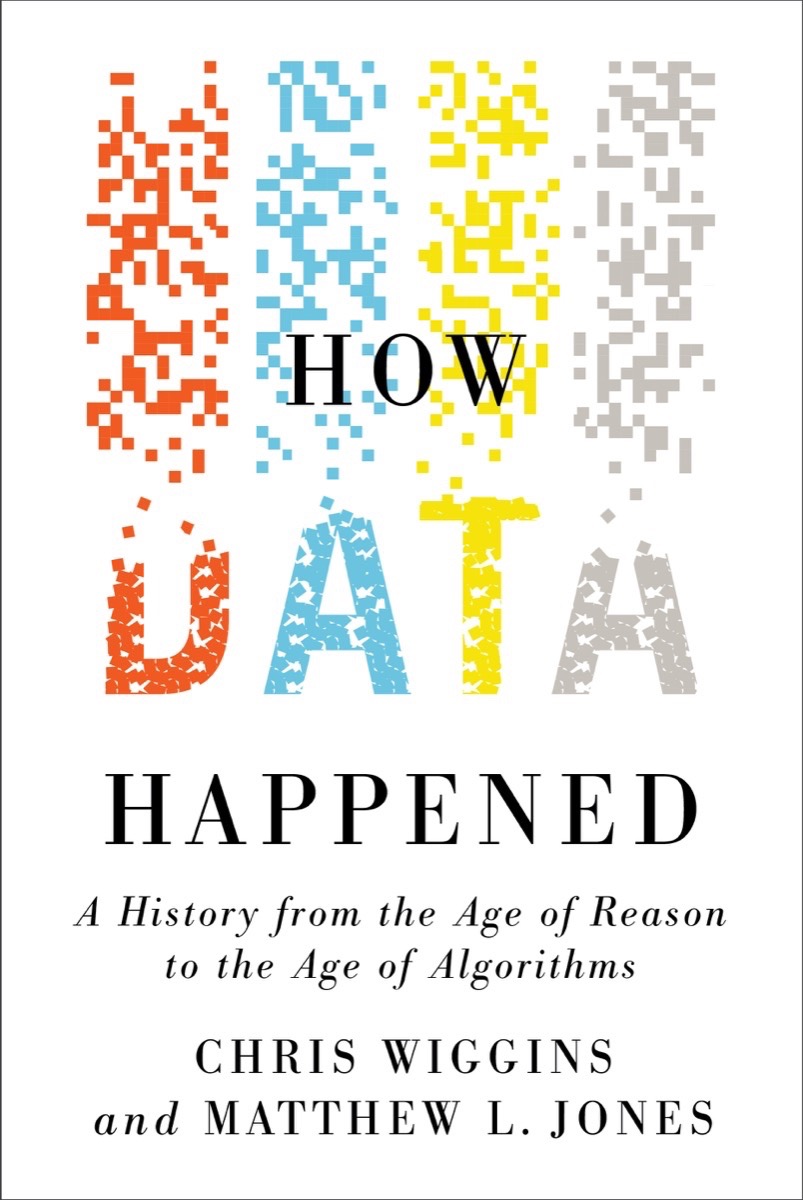
How Data Happened: A History from the Age of Reason to the Age of Algorithms – Chris Wiggins and Matthew L. Jones

From facial recognition—capable of checking us onto flights or identifying undocumented residents—to automated decision systems that inform everything from who gets loans to who receives bail, each of us moves through a world determined by data-empowered algorithms. But these technologies didn’t just appear: they are part of a history that goes back centuries, from the census enshrined in the US Constitution to the birth of eugenics in Victorian Britain to the development of Google search.

Expanding on the popular course they created at Columbia University, Chris Wiggins and Matthew L. Jones illuminate the ways in which data has long been used as a tool and a weapon in arguing for what is true, as well as a means of rearranging or defending power. By understanding the trajectory of data—where it has been and where it might yet go—Wiggins and Jones argue that we can understand how to bend it to ends that we collectively choose, with intentionality and purpose.

In My Hands Today…

Doughnut Economics: Seven Ways to Think Like a 21st-Century Economist – Kate Raworth

Economics is broken. It has failed to predict, let alone prevent, financial crises that have shaken the foundations of our societies. Its outdated theories have permitted a world in which extreme poverty persists while the wealth of the super-rich grows year on year. And its blind spots have led to policies that are degrading the living world on a scale that threatens all of our futures.

Can it be fixed? In Doughnut Economics, Oxford academic Kate Raworth identifies seven critical ways in which mainstream economics has led us astray, and sets out a roadmap for bringing humanity into a sweet spot that meets the needs of all within the means of the planet. En route, she deconstructs the character of ‘rational economic man’ and explains what really makes us tick. She reveals how an obsession with equilibrium has left economists helpless when facing the boom and bust of the real-world economy. She highlights the dangers of ignoring the role of energy and nature’s resources – and the far-reaching implications for economic growth when we take them into account. And in the process, she creates a new, cutting-edge economic model that is fit for the 21st century – one in which a doughnut-shaped compass points the way to human progress.

Ambitious, radical and rigorously argued, Doughnut Economics promises to reframe and redraw the future of economics for a new generation.

In My Hands Today…

Contagious: Why Things Catch On – Jonah Berger

What makes things popular? Why do people talk about certain products and ideas more than others? Why are some stories and rumours more infectious? And what makes online content go viral?

If you said advertising, think again. People don’t listen to advertisements, they listen to their peers. But why do people talk about certain products and ideas more than others? Why are some stories and rumours more infectious? And what makes online content go viral?

Wharton marketing professor Jonah Berger has spent the last decade answering these questions. He’s studied why New York Times articles make the paper’s own Most E-mailed List, why products get word of mouth, and how social influence shapes everything from the cars we buy to the clothes we wear to the names we give our children. In this book, Berger reveals the secret science behind word-of-mouth and social transmission. Discover how six basic principles drive all sorts of things to become contagious, from consumer products and policy initiatives to workplace rumours and YouTube videos.

Contagious combines groundbreaking research with powerful stories. Learn how a luxury steakhouse found popularity through the lowly cheese-steak, why anti-drug commercials might have actually increased drug use, and why more than 200 million consumers shared a video about one of the seemingly most boring products there is – a blender. If you’ve wondered why certain stories get shared, e-mails get forwarded, or videos go viral, Contagious explains why, and shows how to leverage these concepts to craft contagious content. This book provides a set of specific, actionable techniques for helping information spread – for designing messages, advertisements, and information that people will share. Whether you’re a manager at a big company, a small business owner trying to boost awareness, a politician running for office, or a health official trying to get the word out, Contagious will show you how to make your product or idea catch on.

In My Hands Today…

The Price of Admission: How America’s Ruling Class Buys Its Way into Elite Colleges — and Who Gets Left Outside the Gates – Daniel Golden

Every spring thousands of middle-class and lower-income high-school seniors learn that they have been rejected by America’s most exclusive colleges. What they may never learn is how many candidates like themselves have been passed over in favor of wealthy white students with lesser credentials—children of alumni, big donors, or celebrities.

In this explosive book, the Pulitzer Prize–winning reporter Daniel Golden argues that America, the so-called land of opportunity, is rapidly becoming an aristocracy in which America’s richest families receive special access to elite higher education—enabling them to give their children even more of a head start. Based on two years of investigative reporting and hundreds of interviews with students, parents, school administrators, and admissions personnel—some of whom risked their jobs to speak to the author—The Price of Admission exposes the corrupt admissions practices that favor the wealthy, the powerful, and the famous.

In The Price of Admission, Golden names names, along with grades and test scores. He reveals how the sons of former vice president Al Gore, one-time Hollywood power broker Michael Ovitz, and Senate Majority Leader Bill Frist leapt ahead of more deserving applicants at Harvard, Brown, and Princeton. He explores favoritism at the Ivy Leagues, Duke, the University of Virginia, and Notre Dame, among other institutions. He reveals that colleges hold Asian American students to a higher standard than whites; comply with Title IX by giving scholarships to rich women in “patrician sports” like horseback riding, squash, and crew; and repay congressmen for favors by admitting their children. He also reveals that Harvard maintains a “Z-list” for well-connected but underqualified students, who are quietly admitted on the condition that they wait a year to enroll.

The Price of Admission explodes the myth of an American meritocracy—the belief that no matter what your background, if you are smart and diligent enough, you will have access to the nation’s most elite universities. It is must reading not only for parents and students with a personal stake in college admissions, but also for those disturbed by the growing divide between ordinary and privileged Americans.