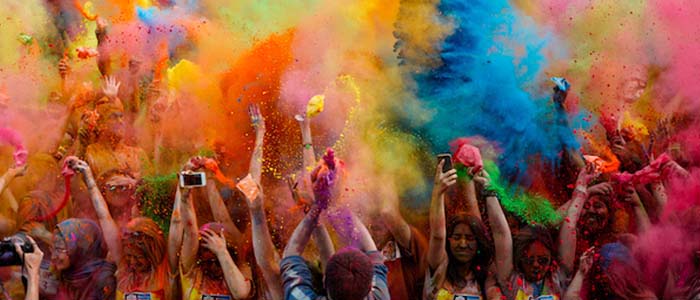
Literally the most colourful of all festivals and the one I am personally not a big fan of, the festival of Holi hearlds the arrival of spring, the end of winter, the blossoming of love, and for many, a festive day to meet others, play and laugh, forget and forgive, and repair broken relationships. The festival also celebrates the beginning of a good spring harvest season. This year, the Holi festivities, which is usually celebrated for a night plus the next day, started yesterday night and today India and especially northern India will be awash in colours.
The first evening is known as Holika Dahan (burning of demon holika) or Chhoti Holi (aka small Holi) and the following day as Holi or Rangwali Holi (aka colourful Holi). This festival is an ancient Hindu religious festival which has become popular with non-Hindus as well in many parts of South Asia, as well as people of other communities outside Asia.
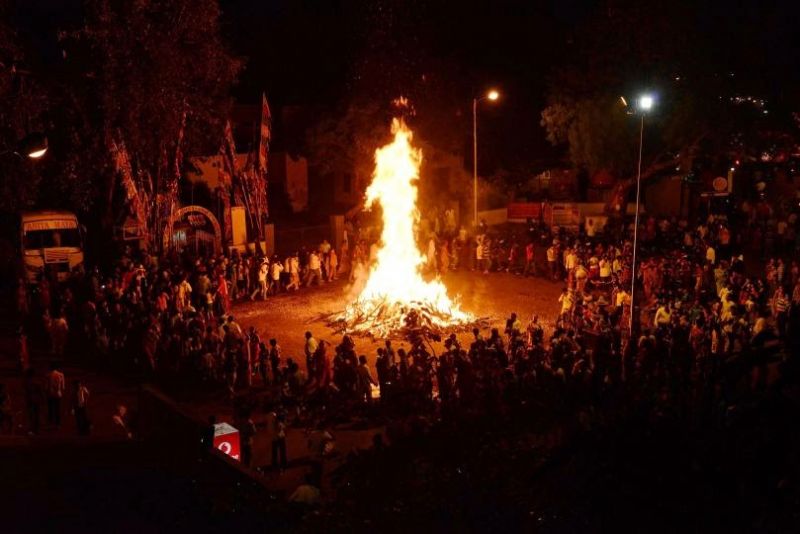
Holi celebrations start on the night before Holi with a Holika Dahan where people gather, perform religious rituals in front of the bonfire, and pray that their internal evil be destroyed the way Holika, the sister of the demon king Hiranyakashipu, was killed in the fire. The next morning is celebrated as Rangwali Holi – a free-for-all festival of colours, where people smear each other with colours and drench each other. Water guns and water-filled balloons are also used to play and colour each other. Anyone and everyone is fair game, friend or stranger, rich or poor, man or woman, children, and elders. The frolic and fight with colours occurs in the open streets, open parks, outside temples and buildings. Groups carry drums and other musical instruments, go from place to place, sing and dance. People visit family, friends and foes to throw coloured powders on each other, laugh and gossip, then share Holi delicacies, food and drinks. Some customary drinks include bhang (made from cannabis), which is intoxicating. In the evening, after sobering up, people dress up and visit friends and family.
There is a symbolic legend to explain why Holi is celebrated as a festival of triumph of good over evil in the honour of Hindu god Vishnu and his follower Prahlada. King Hiranyakashipu, according to a legend found in chapter 7 of Bhagavata Purana, was the king of demonic Asuras, and had earned a boon that gave him five special powers: he could be killed by neither a human being nor an animal, neither indoors nor outdoors, neither at day nor at night, neither by astra (projectile weapons) nor by any shastra (handheld weapons), and neither on land nor in water or air. Hiranyakashipu grew arrogant, thought he was God, and demanded that everyone worship only him. However, Hiranyakashipu’s own son, Prahlada, however, disagreed and was and remained devoted to Lord Vishnu. This infuriated Hiranyakashipu who subjected Prahlada to cruel punishments, none of which affected the boy or his resolve to do what he thought was right. Finally, Holika, Prahlada’s evil aunt, tricked him into sitting on a pyre with her. Holika was wearing a cloak that made her immune to injury from fire, while Prahlada was not. As the fire roared, the cloak flew from Holika and encased Prahlada, who survived while Holika burned. Vishnu, the god who appears as an avatar to restore Dharma in Hindu beliefs, took the form of Narasimha – half human and half lion (which is neither a human nor an animal), at dusk (when it was neither day nor night), took Hiranyakashyapu at a doorstep (which was neither indoors nor outdoors), placed him on his lap (which was neither land, water nor air), and then eviscerated and killed the king with his lion claws (which were neither a handheld weapon nor a launched weapon). The Holika bonfire and Holi signifies the celebration of the symbolic victory of good over evil, of Prahlada over Hiranyakashipu, and of the fire that burned Holika.

In the Braj region of India (Mathura and Agra in the current state of Uttar Pradesh), where the Lord Krishna grew up, the festival is celebrated until Rang Panchmi (which happens around 5-6 days after Holi) in commemoration of the divine love of Radha for Krishna. The festivities officially usher in spring, with Holi celebrated as a festival of love. There is a symbolic myth behind commemorating Krishna as well. As a baby, Krishna developed his characteristic dark skin colour because the she-demon Putana poisoned him with her breast milk. In his youth, Krishna despaired whether the fair-skinned Radha would like him because of his dark skin colour. His mother, tired of his desperation, asks him to approach Radha and ask her to colour his face in any colour she wanted. This she did, and Radha and Krishna became a couple. Ever since, the playful colouring of Radha and Krishna’s face has been commemorated as Holi.
The festival of Holi is celebrated at a time when people are pretty much tired of the gloomy winters and thus have a tendency to feel sleepy and lazy. It’s natural for the body to experience some sluginess due to the changes in temperature. To counteract this, people sing loudly or even speak loudly. Their movements are brisk and their music is loud. All of this helps to rejuvenate the system of the human body. Also, colours when sprayed on the body have a great impact on it. Biologists believe the liquid dye or Abeer penetrates the body and enters into the pores. It has the effect of strengthening the ions in the body and adds health and beauty to it. Of course this is only true for natural colours and not the synthetic colours used today. Another scientific reason for celebrating Holi relates to the tradition of Holika Dahan. The mutation period of winter and spring, induces the growth of bacteria in the atmosphere as well as in the body. When Holika is burnt, temperature rises very high at the bonfire. So when people perform Parikrima (the circumambulation or going around the bonfire) around the fire, the heat from the fire kills the bacteria in the body thus, cleansing it. In the south where winters are not as severe, Holi is rarely celebrated or celebrated in a different way. The day after the burning of Holika people put ash or Vibhuti on their forehead and they would mix sandalwood paste with the young leaves and flowers of the mango tree and consume it to promote good health. Some also believe that play with colours help to promote good health as colours are said to have great impact on our body and our health. Doctors believe that for a healthy body, colours too have an important place besides the other vital elements. Deficiency of a particular colour in our body causes ailment, which can be cured only after supplementing the body with that particular colour.

Traditionally Holi used to be played with colours found in nature. Traditional colours, called ‘Gulal’ are known to have medicinal properties since they were usually made of neem, kumkum, turmeric, bilva and other medicinal herbs. The flowers of the palash or flame of the forest trees provide the bright red and orange colours. Powdered fragrant red sandalwood, dried hibiscus flowers, madder tree, radish, and pomegranate are alternate sources and shades of red. Mixing lime with turmeric powder creates an alternate source of orange powder, as does boiling saffron in water. Henna and the dried leaves of gulmohur tree offer a source of green colour. In some areas, the leaves of spring crops and herbs have been used as a source of green pigment. Turmeric powder is the typical source of yellow colour. Sometimes this is mixed with gram or other flour to get the right shade. Bael fruit, amaltas, species of chrysanthemums, and species of marigold are alternate sources of yellow. Indigo plant, Indian berries, species of grapes, blue hibiscus, and jacaranda flowers are traditional sources of blue colour while beetroot is the traditional source of magenta and purple colour. Often these are directly boiled in water to prepare coloured water. Dried tea leaves offer a source of brown coloured water. Certain clays are alternate source of brown while some types of grapes, gooseberry and charcoal offer gray to black colours.
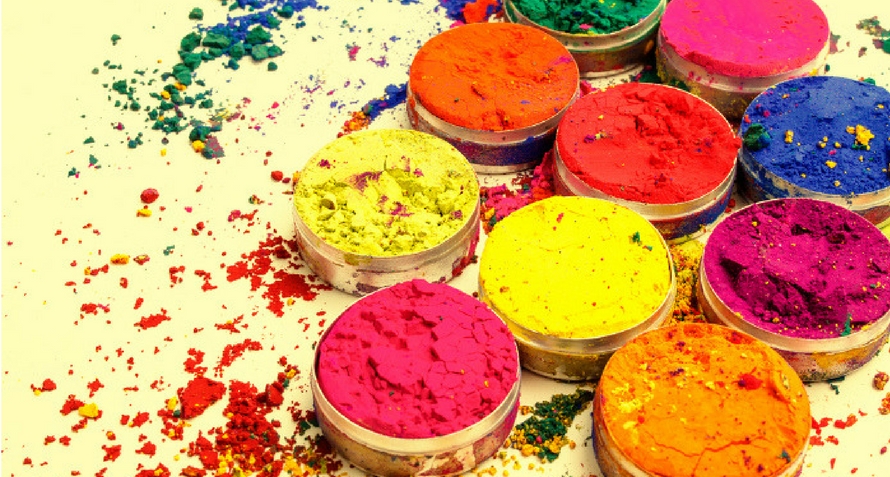
These days however, natural powders are becoming rare and chemically produced industrial dyes have been used to take their place in almost all of urban India. Due to the commercial availability of attractive pigments, slowly the natural colours are replaced by synthetic colours. These colours which more often than not contain questionable chemicals cause mild to severe symptoms of skin irritation and inflammation. Lack of control over the quality and content of these colours is a problem, as they are frequently sold by vendors who do not know their source. I remember friends coming to school, college and work in varying hues, some of which are not found anywhere in nature. Another gripe I have with the synthetic colours is the very weird smell that comes from them which really puts me off. And then let’s talk about the water bombs that contain a mixture of water and these colours which people throw from their homes, balconies and rooftops during this time period. I remember growing up, I used to hate getting out of the house during this time and in Mumbai, this period would typically be examination time, which meant actually getting out more to tuition classes and study sessions. We used to rarely walk alone, preferring to go out in groups so we can look all around us, especially when walking by medium to high rise buildings and preferring to walk in the middle of the road, even if that was not the safest place to walk. So you can see why in the beginning of this post, I said this is not a festival I particularly enjoy.
Happy Holi folks!





 Memories and Such