
There is a particular kind of tiredness that comes not from doing too much but from absorbing too much. You read. You save. You screenshot. You bookmark. You forward articles to yourself on WhatsApp so you do not forget. Your Notes app fills up. Your Trello boards multiply. At some point, something in you switches off. Not dramatically. Quietly.
You stop opening saved links. You skim instead of reading. You tell yourself you will “catch up” later. This is information overload. And for many of us, it does not look chaotic. It looks organised but unprocessed. Most advice focuses on consuming less. That is useful, but incomplete. The deeper question is not only how much we take in, but what we do with what we take in. The Zettelkasten method offers a different answer. Not faster consumption. Not better storage. A better way of thinking.

What Zettelkasten Actually Is
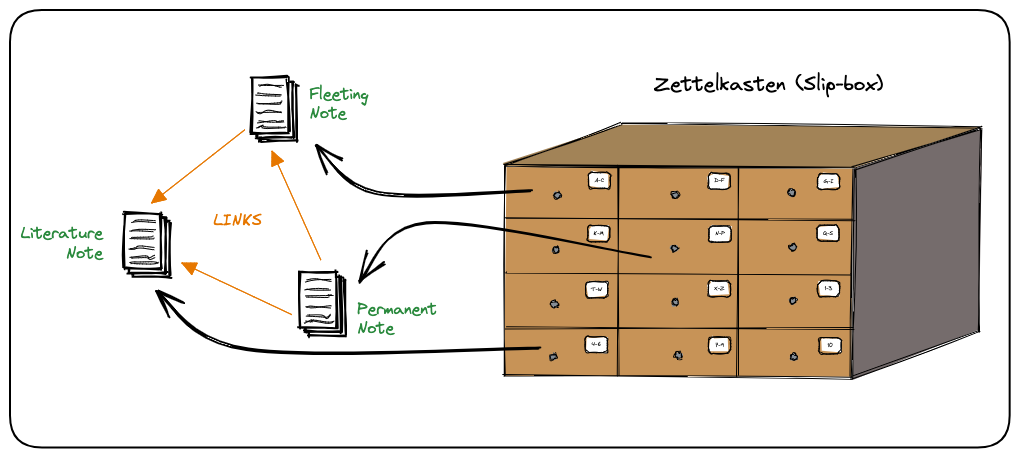
Zettelkasten is a German word meaning “slip box.” Originally, it referred to a box of index cards, each containing one idea, linked to other cards through references. But the physical box is not the point. The philosophy is simple: write one idea per note, in your own words, and deliberately connect it to other ideas. Not archive. Connect. This distinction matters. Most of us store information. Few of us build networks of thought. Zettelkasten assumes that knowledge is not static. It grows through relationships. An isolated note is a reminder. A linked note becomes part of a system. The goal is not to remember everything you read. The goal is to develop your own framework.
Why We Shut Down
When people feel overwhelmed, they often blame volume. Too many articles. Too many books. Too many podcasts. But consider this: if you read only one thoughtful essay today and never integrate it into your thinking, would you still feel unsettled? Often, the fatigue comes not from quantity but from unfinished processing. Your mind does not like loose ends. Saved articles are loose ends. Highlighted paragraphs are loose ends. Good ideas without integration are loose ends. Eventually, the mind protects itself. It slows down. It avoids. It shuts down. This is not laziness. It is cognitive self-preservation. Zettelkasten addresses this at the level of integration.

The Core Habits
You do not need specialised software. You do not need a numbering system that requires a tutorial. You need three habits.
- First, capture one idea per note. Not a summary of a chapter. One idea.
- Second, write it in your own words. If you cannot rephrase it, you have not understood it.
- Third, connect it to an existing idea. Ask where it fits. Does it support something you already believe? Challenge it? Extend it?
That is the method. It is deceptively modest. But modest systems tend to last longer.
A Full Example From Start to Finish
Let us make this concrete.
- You read a sentence: “Clarity reduces anxiety more effectively than motivation.”
- Instead of highlighting it and moving on, you pause. You create a note: Clarity reduces anxiety more effectively than motivation because uncertainty creates cognitive tension.
- That is your thinking note. Now you ask: what does this connect to? Perhaps you already have a note that says: When I feel stuck, I look for motivation instead of defining the next specific action. You link them.
- A week later, while reviewing your notes, you see another idea about decision fatigue. You connect that too.
- Now three ideas form a cluster. Clarity. Motivation. Decision fatigue.
- You are no longer collecting quotes. You are tracing patterns in your own behaviour.
This is where the system begins to feel alive.

Using Trello Without Turning It Into a Task List
If you already use Trello for weekly lists and schedules, you can adapt it.
- Create a separate board purely for thinking notes. Not tasks. Not projects.
- Each card contains one idea. The card title holds the core claim. The description expands slightly if needed, but do not turn it into an essay.
- Avoid workflow columns. This is not “To Do,” “Doing, “Done.” That structure encourages completion, not connection.
- Instead, let all cards live in a single list, or at most a few thematic lists. The power lies in linking.
- When one idea connects to another, paste the related card’s link inside it. Over time, certain cards will accumulate multiple links. Those are anchor ideas. Revisit them.
- If you find yourself colour-coding excessively or reorganising columns frequently, pause. You may be drifting back into productivity theatre.
- The method is not about visual control. It is about intellectual continuity.
Apple Notes works just as well. Paper works just as well. The tool is secondary. The discipline is primary.
Managing Overload in Practical Terms
- If your overwhelm leads to shutdown, start small.
- Limit what you process. Do not try to convert every article into notes. Choose selectively.
- Process immediately. When something feels meaningful, write the note at once. Delayed processing becomes a backlog.
- Keep notes short. If a note feels long, it probably contains more than one idea. Split it.
- Review weekly. Not to admire your collection, but to add links. The connections are the system.
- Most importantly, reduce passive saving. A saved link you never process is mental clutter disguised as organisation.
Where People Complicate It
There are predictable traps.
- One is turning Zettelkasten into an elaborate digital setup. Complex numbering schemes. Hierarchies. Colour systems. The original method used index cards in a box. If your setup feels heavier than that, simplify.
- Another trap is perfectionism. Waiting until you fully understand something before writing a note. Understanding often emerges through writing.
- A third trap is hoarding notes without linking them. A large archive of disconnected thoughts is not a network. It is a storage room. The method only works if ideas are in conversation.

A Brief Comparison
You may have heard of PARA, which organises information into Projects, Areas, Resources and Archives. That system is excellent for managing tasks and responsibilities. Zettelkasten is different. It does not organise by category. It organises by relationship. Commonplace books, historically, collected quotations and passages worth remembering. Zettelkasten moves one step further. It requires interpretation and linkage. If PARA manages your external life, Zettelkasten manages your internal thinking. They can coexist. But they serve different purposes.
System or Boundary?
Before adopting any method, ask yourself a harder question. Is your overwhelm coming from poor integration or from excessive input? If you are constantly consuming news, scrolling social media, or signing up for courses you do not complete, no note-taking system will solve that. Zettelkasten assumes selectivity. It deepens what you choose to engage with. It does not filter for you. If what you need are boundaries, start there. Reduce input. If what you need is integration, build the slip box. Clarity about this distinction prevents the system from becoming another layer of noise.

A Gentle Acknowledgement of Shutdown
When overwhelm leads to shutdown, it can feel like failure. Especially for those who enjoy structure and systems. But shutdown is often the mind saying, enough unfinished loops. A small daily practice of integration can reduce those loops. One idea processed. One link made. That is manageable.
Over time, instead of feeling chased by information, you begin to recognise your own recurring themes. You see what you return to. You notice what truly matters to you. The volume outside may not decrease. But the internal noise often does.
A Reflective Closing
Information is not the same as understanding. In a time when knowledge is everywhere, depth requires intention. The Zettelkasten method is not about efficiency or optimisation. It is about continuity. It allows ideas to mature instead of disappearing into saved folders and forgotten links. You do not have to overhaul your digital life to begin. One idea is written clearly. One connection made deliberately. That may be enough to see whether this way of thinking suits you.

