In My Hands Today…

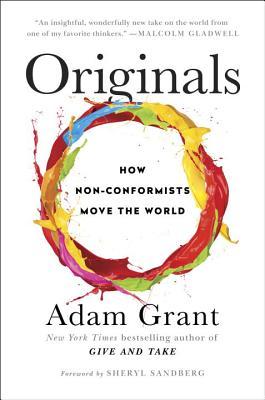
Originals: How Non-Conformists Move the World – Adam M. Grant

In Originals the author addresses the challenge of improving the world from the perspective of becoming original: choosing to champion novel ideas and values that go against the grain, battle conformity, and buck outdated traditions. How can we originate new ideas, policies, and practices without risking it all?

Using surprising studies and stories spanning business, politics, sports, and entertainment, Grant explores how to recognize a good idea, speak up without getting silenced, build a coalition of allies, choose the right time to act, and manage fear and doubt; how parents and teachers can nurture originality in children; and how leaders can build cultures that welcome dissent. Learn from an entrepreneur who pitches his start-ups by highlighting the reasons not to invest, a woman at Apple who challenged Steve Jobs from three levels below, an analyst who overturned the rule of secrecy at the CIA, a billionaire financial wizard who fires employees for failing to criticize him, and a TV executive who didn’t even work in comedy but saved Seinfeld from the cutting-room floor. The payoff is a set of groundbreaking insights about rejecting conformity and improving the status quo.

In My Hands Today…

Good Power: Leading Positive Change in Our Lives, Work, and World – Ginni Rometty

Ginni Rometty led one of the world’s most iconic companies, and in Good Power she recounts her groundbreaking path from a challenging childhood to becoming the CEO of IBM and one of the world’s most influential business leaders. With candor and depth, Rometty shares milestones from her life and career while redefining power as a way to drive meaningful change in positive ways for ourselves, our organizations, and for the many, not just the few—a concept she calls “good power.”

Rometty’s “memoir with purpose” combines the experiences that defined her life—personal hurdles, high-stakes decisions, passionate advocacy—with the actionable advice of a coaching session to highlight lessons that shape authentic leadership. Behind-the-scenes stories and practical guidance offer us a blueprint for how we can all use good power to advance our careers, inspire our teams, improve our companies, and create healthier societies.

The book begins with raw, vivid memories from Rometty’s youth and early professional years as she recalls the trauma and the role models that formed her belief that how we lead is as important as what we achieve. She learns early on that good power is a choice available to everyone, even to those without money, status, or impressive titles.

Rometty then shows us how her concept of good power evolved as she grew from a first-time manager to a transformative CEO. Stories told through the lens of five principles—be in service of others; build belief; know what must change and what must endure; steward good tech; be resilient—reveal tools that anyone can apply to achieve real change at any stage of their life and work.

Rometty also encourages us to use good power at scale to bring about urgent societal change. She shares insights from her own journey to create a more equitable world by leading the SkillsFirst movement, which connects underserved populations with family-sustaining jobs by transforming hiring, education, and training.

With heart, humility, and conviction, Good Power offers an inspiring, compelling guide to creating meaningful change in our lives.

In My Hands Today…

Principles: Life and Work – Ray Dalio

Ray Dalio, one of the world’s most successful investors and entrepreneurs, shares the unconventional principles that he’s developed, refined, and used over the past forty years to create unique results in both life and business—and which any person or organization can adopt to help achieve their goals.

In 1975, Ray Dalio founded an investment firm, Bridgewater Associates, out of his two-bedroom apartment in New York City. Forty years later, Bridgewater has made more money for its clients than any other hedge fund in history and grown into the fifth most important private company in the United States, according to Fortune magazine. Dalio himself has been named to Time magazine’s list of the 100 most influential people in the world. Along the way, Dalio discovered a set of unique principles that have led to Bridgewater’s exceptionally effective culture, which he describes as “an idea meritocracy that strives to achieve meaningful work and meaningful relationships through radical transparency.” It is these principles, and not anything special about Dalio—who grew up an ordinary kid in a middle-class Long Island neighborhood—that he believes are the reason behind his success.

In Principles, Dalio shares what he’s learned over the course of his remarkable career. He argues that life, management, economics, and investing can all be systemized into rules and understood like machines. The book’s hundreds of practical lessons, which are built around his cornerstones of “radical truth” and “radical transparency,” include Dalio laying out the most effective ways for individuals and organizations to make decisions, approach challenges, and build strong teams. He also describes the innovative tools the firm uses to bring an idea meritocracy to life, such as creating “baseball cards” for all employees that distill their strengths and weaknesses, and employing computerized decision-making systems to make believability-weighted decisions. While the book brims with novel ideas for organizations and institutions, Principles also offers a clear, straightforward approach to decision-making that Dalio believes anyone can apply, no matter what they’re seeking to achieve.

In My Hands Today…

Drive: The Surprising Truth About What Motivates Us – Daniel H. Pink

Most people believe that the best way to motivate is with rewards like money—the carrot-and-stick approach. That’s a mistake, says Daniel H. Pink (author of To Sell Is Human: The Surprising Truth About Motivating Others). In this provocative and persuasive new book, he asserts that the secret to high performance and satisfaction at work, at school, and at home—is the deeply human need to direct our own lives, to learn and create new things, and to do better by ourselves and our world.

Drawing on four decades of scientific research on human motivation, Pink exposes the mismatch between what science knows and what business does—and how that affects every aspect of life. He examines the three elements of true motivation—autonomy, mastery, and purpose-and offer smart and surprising techniques for putting these into action in a unique book that will change how we think and transform how we live.

In My Hands Today…

The Knowledge-Creating Company: How Japanese Companies Create the Dynamics of Innovation – Ikujiro Nonaka and Hirotaka Takeuchi

How have Japanese companies become world leaders in the automotive and electronics industries, among others? What is the secret of their success? Two leading Japanese business experts, Ikujiro Nonaka and Hirotaka Takeuchi, are the first to tie the success of Japanese companies to their ability to create new knowledge and use it to produce successful products and technologies. In The Knowledge-Creating Company, Nonaka and Takeuchi provide an inside look at how Japanese companies go about creating this new knowledge organizationally.

The authors point out that there are two types of knowledge: explicit knowledge, contained in manuals and procedures, and tacit knowledge, learned only by experience, and communicated only indirectly, through metaphor and analogy. U.S. managers focus on explicit knowledge. The Japanese, on the other hand, focus on tacit knowledge. And this, the authors argue, is the key to their success–the Japanese have learned how to transform tacit into explicit knowledge.

To explain how this is done–and illuminate Japanese business practices as they do so–the authors range from Greek philosophy to Zen Buddhism, from classical economists to modern management gurus, illustrating the theory of organizational knowledge creation with case studies drawn from such firms as Honda, Canon, Matsushita, NEC, Nissan, 3M, GE, and even the U.S. Marines. For instance, using Matsushita’s development of the Home Bakery (the world’s first fully automated bread-baking machine for home use), they show how tacit knowledge can be converted to explicit knowledge: when the designers couldn’t perfect the dough kneading mechanism, a software programmer apprenticed herself with the master baker at Osaka International Hotel, gained a tacit understanding of kneading, and then conveyed this information to the engineers. In addition, the authors show that, to create knowledge, the best management style is neither top-down nor bottom-up, but rather what they call middle-up-down, in which the middle managers form a bridge between the ideals of top management and the chaotic realities of the frontline.
As we make the turn into the 21st century, a new society is emerging. Peter Drucker calls it the knowledge society, one that is drastically different from the industrial society, and one in which acquiring and applying knowledge will become key competitive factors. Nonaka and Takeuchi go a step further, arguing that creating knowledge will become the key to sustaining a competitive advantage in the future.

Because the competitive environment and customer preferences changes constantly, knowledge perishes quickly. With The Knowledge-Creating Company, managers have at their fingertips years of insight from Japanese firms that reveal how to create knowledge continuously, and how to exploit it to make successful new products, services, and systems.