In My Hands Today…

The Curious History of the Heart: A Cultural and Scientific Journey – Vincent M. Figueredo
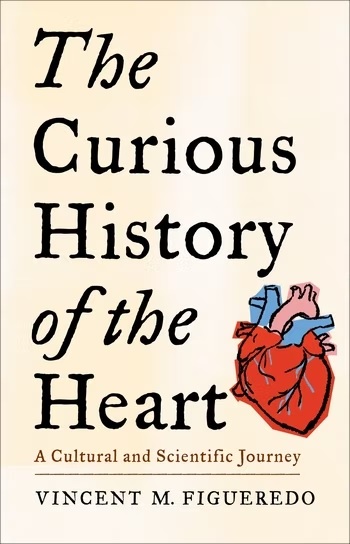
For much of recorded history, people considered the heart to be the most important organ in the body. In cultures around the world, the heart–not the brain–was believed to be the location of intelligence, memory, emotion, and the soul. Over time, views on the purpose of the heart have transformed as people sought to understand the life forces it contains. Modern medicine and science dismissed what was once the king of the organs as a mere blood pump subservient to the brain, yet the heart remains a potent symbol of love and health and an important part of our cultural iconography.

This book traces the evolution of our understanding of the heart from the dawn of civilization to the present. Vincent M. Figueredo–an accomplished cardiologist and expert on the history of the human heart–explores the role and significance of the heart in art, culture, religion, philosophy, and science across time and place. He examines how the heart really works, its many meanings in our emotional and daily lives, and what cutting-edge science is teaching us about this remarkable organ. Figueredo considers the science of heart disease, recent advancements in heart therapies, and what the future may hold. He highlights the emerging field of neurocardiology, which has found evidence of a “heart-brain connection” in mental and physical health, suggesting that ancient views hold more truth than moderns suspect.

Ranging widely and deeply throughout human history, this book sheds new light on why the heart remains so central to our sense of self.

In My Hands Today…

Sickened: The Memoir of a Munchausen by Proxy Childhood – Julie Gregory

A young girl is perched on the cold chrome of yet another doctor’s examining table, missing yet another day of school. Just twelve, she’s tall, skinny, and weak. It’s four o’clock, and she hasn’t been allowed to eat anything all day. Her mother, on the other hand, seems curiously excited. She’s about to suggest open-heart surgery on her child to “get to the bottom of this.” She checks her teeth for lipstick and, as the doctor enters, shoots the girl a warning glance. This child will not ruin her plans.

From early childhood, Julie Gregory was continually X-rayed, medicated, and operated on—in the vain pursuit of an illness that was created in her mother’s mind. Munchausen by proxy (MBP) is the world’s most hidden and dangerous form of child abuse, in which the caretaker—almost always the mother—invents or induces symptoms in her child because she craves the attention of medical professionals. Many MBP children die, but Julie Gregory not only survived, she escaped the powerful orbit of her mother’s madness and rebuilt her identity as a vibrant, healthy young woman.

Sickened is a remarkable memoir that speaks in an original and distinctive Midwestern voice, rising to indelible scenes in prose of scathing beauty and fierce humor. Punctuated with Julie’s actual medical records, it re-creates the bizarre cocoon of her family’s isolated double-wide trailer, their wild shopping sprees and gun-waving confrontations, the astonishing naïveté of medical professionals and social workers. It also exposes the twisted bonds of terror and love that roped Julie’s family together—including the love that made a child willing to sacrifice herself to win her mother’s happiness.

The realization that the sickness lay in her mother, not in herself, would not come to Julie until adulthood. But when it did, it would strike like lightning. Through her painful metamorphosis, she discovered the courage to save her own life—and, ultimately, the life of the girl her mother had found to replace her. Sickened takes us to new places in the human heart and spirit. It is an unforgettable story, unforgettably told.

In My Hands Today…

A Taste for Poison: Eleven Deadly Molecules and the Killers Who Used Them – Neil Bradbury

As any reader of murder mysteries can tell you, poison is one of the most enduring—and popular—weapons of choice for a scheming murderer. It can be slipped into a drink, smeared onto the tip of an arrow or the handle of a door, even filtered through the air we breathe. But how exactly do these poisons work to break our bodies down, and what can we learn from the damage they inflict?

In a blend of popular science, medical history, and true crime, Dr. Neil Bradbury explores the morbidly captivating method of murder from a cellular level. Alongside real-life accounts of murderers and their crimes—some notorious, some forgotten, some still unsolved—are the stories of the poisons involved: eleven molecules of death that work their way through the human body and, paradoxically, illuminate the way in which our bodies function.

Drawn from historical records and current news headlines, A Taste for Poison weaves together the tales of spurned lovers, shady scientists, medical professionals and political assassins to show how the precise systems of the body can be impaired to lethal effect through the use of poison. From the deadly origins of the gin & tonic cocktail to the arsenic-laced wallpaper in Napoleon’s bedroom.

In My Hands Today…

Breaking the Age Code: How Your Beliefs About Aging Determine How Long and Well You Live – Becca Levy

The often-surprising results of Levy’s science offer stunning revelations about the mind-body connection. She demonstrates that many health problems formerly considered to be entirely due to the aging process, such as memory loss, hearing decline, and cardiovascular events, are instead influenced by the negative age beliefs that dominate in the US and other ageist countries. It’s time for all of us to rethink aging and Breaking the Age Code shows us how to do just that.

Based on her innovative research, stories that range from pop culture to the corporate boardroom, and her own life, Levy shows how age beliefs shape all aspects of our lives. She also presents a variety of fascinating people who have benefited from positive age beliefs as well as an entire town that has flourished with these beliefs.

Breaking the Age Code is a landmark work, presenting not only easy-to-follow techniques for improving age beliefs so they can contribute to successful aging, but also a blueprint to reduce structural ageism for lasting change and an age-just society.

In My Hands Today…

The Gene: An Intimate History – Siddhartha Mukherjee

Spanning the globe and several centuries, The Gene is the story of the quest to decipher the master-code that makes and defines humans, that governs our form and function.

The story of the gene begins in an obscure Augustinian abbey in Moravia in 1856 where a monk stumbles on the idea of a ‘unit of heredity’. It intersects with Darwin’s theory of evolution, and collides with the horrors of Nazi eugenics in the 1940s. The gene transforms post-war biology. It reorganizes our understanding of sexuality, temperament, choice and free will. This is a story driven by human ingenuity and obsessive minds – from Charles Darwin and Gregor Mendel to Francis Crick, James Watson and Rosalind Franklin, and the thousands of scientists still working to understand the code of codes.

This is an epic, moving history of a scientific idea coming to life, by the author of The Emperor of All Maladies. But woven through The Gene, like a red line, is also an intimate history – the story of Mukherjee’s own family and its recurring pattern of mental illness, reminding us that genetics is vitally relevant to everyday lives. These concerns reverberate even more urgently today as we learn to “read” and “write” the human genome – unleashing the potential to change the fates and identities of our children.

Majestic in its ambition, and unflinching in its honesty, The Gene gives us a definitive account of the fundamental unit o