In My Hands Today…

An American Martyr in Persia: The Epic Life and Tragic Death of Howard Baskerville – Reza Aslan

Little known in America but venerated as a martyr in Iran, Howard Baskerville was a twenty-two-year-old Christian missionary from South Dakota who traveled to Persia (modern-day Iran) in 1907 for a two-year stint teaching English and preaching the gospel. He arrived in the midst of a democratic revolution—the first of its kind in the Middle East—led by a group of brilliant young firebrands committed to transforming their country into a fully self-determining, constitutional monarchy, one with free elections and an independent parliament.

The Persian students Baskerville educated in English in turn educated him about their struggle for democracy, ultimately inspiring him to leave his teaching post and join them in their fight against a tyrannical shah and his British and Russian backers. “The only difference between me and these people is the place of my birth,” Baskerville declared, “and that is not a big difference.”

In 1909, Baskerville was killed in battle alongside his students, but his martyrdom spurred on the revolutionaries who succeeded in removing the shah from power, signing a new constitution, and rebuilding parliament in Tehran. To this day, Baskerville’s tomb in the city of Tabriz remains a place of pilgrimage. Every year, thousands of Iranians visit his grave to honor the American who gave his life for Iran.

In this rip-roaring tale of his life and death, Aslan gives us a powerful parable about the universal ideals of democracy—and to what degree Americans are willing to support those ideals in a foreign land. Woven throughout is an essential history of the nation we now know as Iran—frequently demonized and misunderstood in the West. Indeed, Baskerville’s life and death represent a “road not taken” in Iran. Baskerville’s story, like his life, is at the center of a whirlwind in which Americans must ask themselves: How seriously do we take our ideals of constitutional democracy and whose freedom do we support?

In My Hands Today…

The Uncaged Sky: My 804 Days in an Iranian Prison – Kylie Moore-Gilbert

‘The sky above our heads was uncaged and unlike us, free.’

On September 12, 2018 British-Australian academic Kylie Moore-Gilbert was arrested at Tehran Airport by Iran’s feared Islamic Revolutionary Guards. Convicted of espionage in a shadowy trial presided over by Iran’s most notorious judge, Dr Moore-Gilbert was sentenced to 10 years in prison.

Incarcerated in Tehran’s Evin and Qarchak prisons for 804 days, this is the full and gripping account of her harrowing ordeal. Held in a filthy solitary confinement cell for months, and subjected to relentless interrogation, Kylie was pushed to the limits of her endurance by extreme physical and psychological deprivation.

Kylie’s only lifeline was the covert friendships she made with other prisoners inside the Revolutionary Guards’ maximum-security compound where she had been ‘disappeared’, communicating in great danger through the air vents between cells, and by hiding secret letters in hava khori, the narrow outdoor balcony where she was led, blindfolded, for a solitary hour each day.

Cut off from the outside world, Kylie realised she alone had the power to change the dynamics of her incarceration. To survive, she began to fight back, adopting a strategy of resistance with her captors. Multiple hunger strikes, letters smuggled to the media, co-ordinated protests with other prisoners and a daring escape attempt led to her transfer to the isolated desert prison, Qarchak, to live among convicted criminals.

On November 25, 2020, after more than two years of struggle, Kylie was finally released in a high stakes three-nation prisoner swap deal orchestrated by the Australian government, laying bare the complex game of global politics in which she had become a valuable pawn.

In My Hands Today…

Option B: Facing Adversity, Building Resilience, and Finding Joy – Sheryl Sandberg and Adam Grant

After the sudden death of her husband, Sheryl Sandberg felt certain that she and her children would never feel pure joy again. “I was in ‘the void,’” she writes, “a vast emptiness that fills your heart and lungs and restricts your ability to think or even breathe.”

Her friend Adam Grant, a psychologist at Wharton, told her there are concrete steps people can take to recover and rebound from life-shattering experiences. We are not born with a fixed amount of resilience. It is a muscle that everyone can build.

Option B combines Sheryl’s personal insights with Adam’s eye-opening research on finding strength in the face of adversity. Beginning with the gut-wrenching moment when she finds her husband, Dave Goldberg, collapsed on a gym floor, Sheryl opens up her heart—and her journal—to describe the acute grief and isolation she felt in the wake of his death. But Option B goes beyond Sheryl’s loss to explore how a broad range of people have overcome hardships including illness, job loss, sexual assault, natural disasters, and the violence of war. Their stories reveal the capacity of the human spirit to persevere . . . and to rediscover joy.

Resilience comes from deep within us and from support outside us. Even after the most devastating events, it is possible to grow by finding deeper meaning and gaining greater appreciation in our lives. Option B illuminates how to help others in crisis, develop compassion for ourselves, raise strong children, and create resilient families, communities, and workplaces. Many of these lessons can be applied to everyday struggles, allowing us to brave whatever lies ahead. Two weeks after losing her husband, Sheryl was preparing for a father-child activity. “I want Dave,” she cried. Her friend replied, “Option A is not available,” and then promised to help her make the most of Option B.

We all live some form of Option B. This book will help us all make the most of it.

In My Hands Today…

Good Power: Leading Positive Change in Our Lives, Work, and World – Ginni Rometty

Ginni Rometty led one of the world’s most iconic companies, and in Good Power she recounts her groundbreaking path from a challenging childhood to becoming the CEO of IBM and one of the world’s most influential business leaders. With candor and depth, Rometty shares milestones from her life and career while redefining power as a way to drive meaningful change in positive ways for ourselves, our organizations, and for the many, not just the few—a concept she calls “good power.”

Rometty’s “memoir with purpose” combines the experiences that defined her life—personal hurdles, high-stakes decisions, passionate advocacy—with the actionable advice of a coaching session to highlight lessons that shape authentic leadership. Behind-the-scenes stories and practical guidance offer us a blueprint for how we can all use good power to advance our careers, inspire our teams, improve our companies, and create healthier societies.

The book begins with raw, vivid memories from Rometty’s youth and early professional years as she recalls the trauma and the role models that formed her belief that how we lead is as important as what we achieve. She learns early on that good power is a choice available to everyone, even to those without money, status, or impressive titles.

Rometty then shows us how her concept of good power evolved as she grew from a first-time manager to a transformative CEO. Stories told through the lens of five principles—be in service of others; build belief; know what must change and what must endure; steward good tech; be resilient—reveal tools that anyone can apply to achieve real change at any stage of their life and work.

Rometty also encourages us to use good power at scale to bring about urgent societal change. She shares insights from her own journey to create a more equitable world by leading the SkillsFirst movement, which connects underserved populations with family-sustaining jobs by transforming hiring, education, and training.

With heart, humility, and conviction, Good Power offers an inspiring, compelling guide to creating meaningful change in our lives.

In My Hands Today…

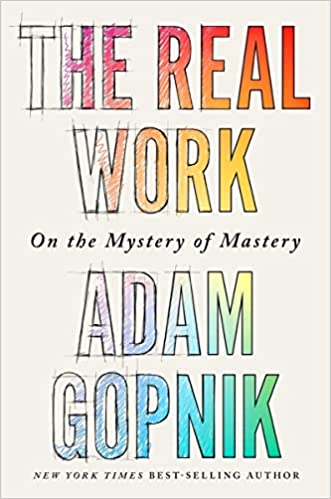
The Real Work: On the Mystery of Mastery – Adam Gopnik

Best-selling author and New Yorker writer Adam Gopnik investigates a foundational human How do we learn―and master―a new skill? For decades now, Adam Gopnik has been one of our most beloved writers, a brilliantly perceptive critic of art, food, France, and more. But recently, he became obsessed by a more fundamental matter, one he had often meditated on in The New Yorker : How do masters learn their miraculous skill, whether it was drawing a museum-ready nude or baking a perfect sourdough loaf? How could anyone become so good at anything? There seemed to be a fundamental mystery to mastery. Was it possible to unravel it?

In The Real Work ―the term magicians use for the accumulated craft that makes for a great trick―Gopnik becomes a dedicated student of several masters of their a classical painter, a boxer, a dancing instructor, a driving instructor, and others. Rejecting self-help bromides and bullet points, he nevertheless shows that the top people in any field share a set of common qualities and methods. For one, their mastery is always a process of breaking down and building up―of identifying and perfecting the small constituent parts of a skill and the combining them for an overall effect greater than the sum of those parts. For another, mastery almost always involves intentional imperfection―as in music, where vibrato, a way of not quite landing on the right note, carries maximum expressiveness. Gopnik’s simplest and most invigorating lesson, however, is that we are surrounded by mastery. Far from rare, mastery is commonplace, if we only know where to from the parent who can whip up a professional strudel to the social worker who―in one of the most personally revealing passages Gopnik has ever written―helps him master his own demons.

Spirited and profound, The Real Work will help you understand how mastery can happen in your own life―and, significantly, why each of us relentlessly seeks to better ourselves in the first place.