In My Hands Today…

Pixel Flesh: How Toxic Beauty Culture Harms Women – Ellen Atlanta

We live in a new age of beauty. With advancements in cosmetic surgery, walk-in treatments, augmented-reality face filters, photo-editing apps, and exposure to more images than ever, we have the ability to craft the image we want everyone to see. We pinch, pull, squeeze, tweeze, smooth, and slice ourselves beyond recognition. But is modern beauty culture truly empowering? Are we really in control?

In Pixel Flesh, Ellen Atlanta holds a mirror up to our modern beauty ideal and the pressure to present a perfect image, to live in an age of constant comparison and curated feeds. She weaves in her personal story with others’ to reconfigure our obsession with the cult of beauty and to explore the reality of living in a world of paradoxes: We know our standards are unhealthy, but following them helps us succeed. We resent social media but continue to scroll. We know digital beauty is artificial, yet we strive for it.

From Love Island to lip filler, “blackfishing” to the “beauty tax,” Pixel Flesh exposes what young women face under a dominant industry. Nuanced, unflinching, and razor sharp, it unmasks the absurdities of the standards we suddenly find ourselves upholding and acts as a rallying cry and a refusal to suffer in silence.

In My Hands Today…

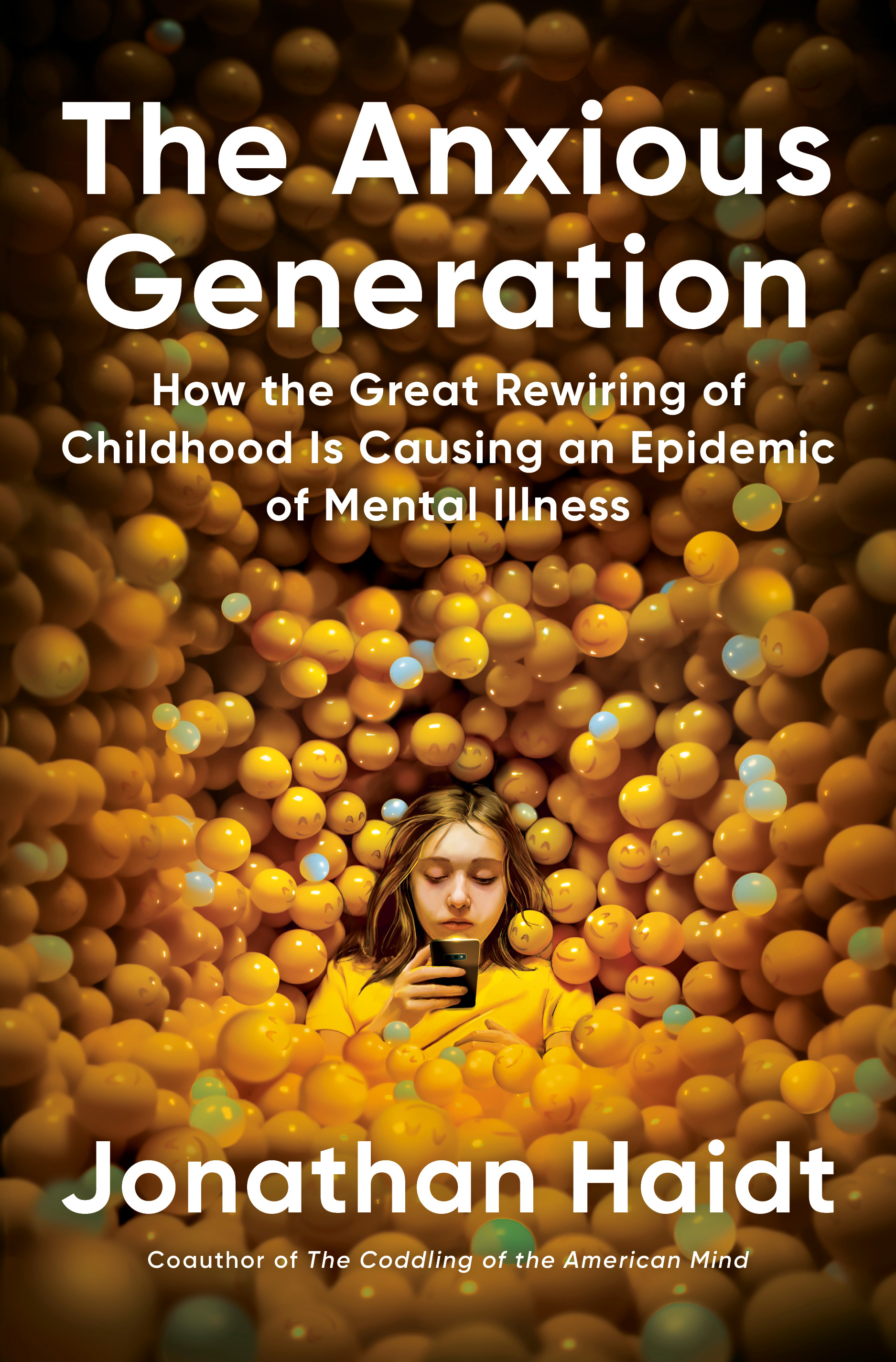
The Anxious Generation: How the Great Rewiring of Childhood is Causing an Epidemic of Mental Illness – Jonathan Haidt

After more than a decade of stability or improvement, the mental health of adolescents plunged in the early 2010s. Rates of depression, anxiety, self-harm, and suicide rose sharply, more than doubling on many measures. Why?

In The Anxious Generation, social psychologist Jonathan Haidt lays out the facts about the epidemic of teen mental illness that hit many countries at the same time. He then investigates the nature of childhood, including why children need play and independent exploration to mature into competent, thriving adults. Haidt shows how the “play-based childhood” began to decline in the 1980s, and how it was finally wiped out by the arrival of the “phone-based childhood” in the early 2010s. He presents more than a dozen mechanisms by which this “great rewiring of childhood” has interfered with children’s social and neurological development, covering everything from sleep deprivation to attention fragmentation, addiction, loneliness, social contagion, social comparison, and perfectionism. He explains why social media damages girls more than boys and why boys have been withdrawing from the real world into the virtual world, with disastrous consequences for themselves, their families, and their societies.

Most important, Haidt issues a clear call to action. He diagnoses the “collective action problems” that trap us, and then proposes four simple rules that might set us free. He describes steps that parents, teachers, schools, tech companies, and governments can take to end the epidemic of mental illness and restore a more humane childhood.

Haidt has spent his career speaking truth backed by data in the most difficult landscapes—communities polarized by politics and religion, campuses battling culture wars, and now the public health emergency faced by Gen Z. We cannot afford to ignore his findings about protecting our children—and ourselves—from the psychological damage of a phone-based life.

In My Hands Today…

The Memory Palace – Mira Bartok

People have abandoned their loved ones for much less than you’ve been through,” Mira Bartók is told at her mother’s memorial service.

It is a poignant observation about the relationship between Mira, her sister, and their mentally ill mother. Before she was struck with schizophrenia at the age of nineteen, beautiful piano protégé Norma Herr had been the most vibrant personality in the room. She loved her daughters and did her best to raise them well, but as her mental state deteriorated, Norma spoke less about Chopin and more about Nazis and her fear that her daughters would be kidnapped, murdered, or raped.

When the girls left for college, the harassment escalated–Norma called them obsessively, appeared at their apartments or jobs, threatened to kill herself if they did not return home. After a traumatic encounter, Mira and her sister were left with no choice but to change their names and sever all contact with Norma in order to stay safe. But while Mira pursued her career as an artist–exploring the ancient romance of Florence, the eerie mysticism of northern Norway, and the raw desert of Israel–the haunting memories of her mother were never far away.

Then one day, Mira’s life changed forever after a debilitating car accident. As she struggled to recover from a traumatic brain injury, she was confronted with a need to recontextualize her life–she had to relearn how to paint, read, and interact with the outside world. In her search for a way back to her lost self, Mira reached out to the homeless shelter where she believed her mother was living and discovered that Norma was dying.

Mira and her sister traveled to Cleveland, where they shared an extraordinary reconciliation with their mother that none of them had thought possible. At the hospital, Mira discovered a set of keys that opened a storage unit Norma had been keeping for seventeen years. Filled with family photos, childhood toys, and ephemera from Norma’s life, the storage unit brought back a flood of previous memories that Mira had thought were lost to her forever.

In My Hands Today…

The Age of Magical Overthinking: Notes on Modern Irrationality – Amanda Montell

Utilizing the linguistic insights of her “witty and brilliant” first book Wordslut and the sociological explorations of her breakout hit Cultish, Amanda Montell now turns her erudite eye to the inner workings of the human mind and its biases in her most personal and electrifying work yet.

“Magical thinking” can be broadly defined as the belief that one’s internal thoughts can affect unrelated events in the external Think of the conviction that one can manifest their way out of poverty, stave off cancer with positive vibes, thwart the apocalypse by learning to can their own peaches, or transform an unhealthy relationship to a glorious one with loyalty alone. In all its forms, magical thinking works in service of restoring agency amid chaos, but in The Age of Magical Overthinking, Montell argues that in the modern information age, our brain’s coping mechanisms have been overloaded, and our irrationality turned up to an eleven.

In a series of razor sharp, deeply funny chapters, Montell delves into a cornucopia of the cognitive biases that run rampant in our brains, from how the “Halo effect” cultivates worship (and hatred) of larger than life celebrities, to how the “Sunk Cost Fallacy” can keep us in detrimental relationships long after we’ve realized they’re not serving us. As she illuminates these concepts with her signature brilliance and wit, Montell’s prevailing message is one of hope, empathy, and ultimately forgiveness for our anxiety-addled human selves. If you have all but lost faith in our ability to reason, Montell aims to make some sense of the senseless. To crack open a window in our minds, and let a warm breeze in. To help quiet the cacophony for a while, or even hear a melody in it.