In My Hands Today…

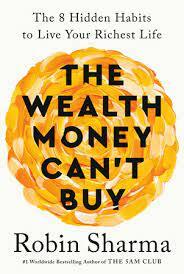
The Wealth Money Can’t Buy: The 8 Hidden Habits to Live Your Richest Life – Robin S. Sharma

Real wealth is so much more than cash in the bank, flashy cars in the driveway and luxury vacations on exotic islands. Too many financially prosperous people are surprisingly poor when it comes to the things that truly matter for a life of happiness, vitality, and serenity.

Society has sold us a version of success that has left too many people feeling empty, frustrated, and filled with regret. Fortunately, there is a much better way to live.

In The Wealth Money Can’t Buy, you will discover a life-altering system that will help you lead your richest life before it’s too late. You will learn a framework based on the eight hidden habits used by authentically rich people and gain a methodology to master your destiny. Open this book and allow a trusted mentor to offer you valuable insights, including how to become a “perfect moment” creator, why your choice of mate is 90% of your joy, the power of “The 10,000 Dinners Question”, hidden habits of authentically wealthy people, and the brilliance of “going ghost” for a year

Legendary personal growth expert Robin Sharma has mentored billionaires, superstar athletes, and heads of state, teaching them The 8 Forms of Wealth Model with transformational results. Now, you will learn it, too, and create the lifetime of your highest dreams.

Full of practical tools and transformational tactics, The Wealth Money Can’t Buy offers a life-changing philosophy and methodology for enjoying a genuinely rich life—filled with personal power, unusual authenticity, exceptionally fulfilling work, and a lifestyle that will make you feel that fortune has finally smiled on you.

In My Hands Today…

The Missing Billionaires: A Guide to Better Financial Decisions – Victor Haghani, James White

Over the past century, if the wealthiest families had spent a reasonable fraction of their wealth, paid taxes, invested in the stock market, and passed their wealth down to the next generation, there would be tens of thousands of billionaire heirs to generations-old fortunes today.

The puzzle of The Missing Billionaires is why you cannot find one such billionaire on any current rich list. There are a number of explanations, but this book is focused on one mistake which is of profound importance to all poor risk decisions, both in investing and spending. Many of these families didn’t choose bad investments– they sized them incorrectly– and allowed their spending decisions to amplify this mistake.

The Missing Billionaires book offers a simple yet powerful framework for making important lifetime financial decisions in a systematic and rational way. It’s for readers with a baseline level of financial literacy, but doesn’t require a PhD. It fills the gap between personal finance books and the academic literature, bringing the valuable insights of academic finance to non-specialists.

Part One builds the theory of optimal investment sizing from first principles, starting with betting on biased coins. Part Two covers lifetime financial decision-making, with emphasis on the integration of investment, saving and spending decisions. Part Three covers practical implementation details, including how to calibrate your personal level of risk-aversion, and how to estimate the expected return and risk on a broad spectrum of investments.

The book is packed with case studies and anecdotes, including one about Victor’s investment with LTCM as a partner, and a bonus chapter on Liar’s Poker. The authors draw extensively on their own experiences as principals of Elm Wealth, a multi-billion-dollar wealth management practice, and prior to that on their years as arbitrage traders– Victor at Salomon Brothers and LTCM, and James at Nationsbank/CRT and Citadel.

Whether you are young and building wealth, an entrepreneur invested heavily in your own business, or at a stage where your primary focus is investing and spending, The Missing A Guide to Better Financial Decisions is your must-have resource for thoughtful financial decision-making.

In My Hands Today…

She’s on the Money – Victoria Devine

Through her phenomenally popular and award-winning podcast, She’s on the Money, Victoria Devine has built an empowered and supportive community of women finding their way to financial freedom.

Honest, relatable, non-judgemental and motivating, Victoria is a financial adviser who knows what millennial life is really like and where we can get stuck with money stuff. (Did someone say ‘Afterpay’…?) So, to help you hit your money goals without skimping on brunch, she’s put all her expert advice into this accessible guide that will set you up for a healthy and happy future.

Learn how to be more secure, independent and informed with your money – with clear steps on how to budget, clear debts, build savings, start investing, buy property and much more. And along with all the practical information, Victoria will guide you through the sometimes-tricky psychology surrounding money so you can establish the values, habits and confidence that will help you build your wealth long-term.

Just like the podcast, the book is full of real-life money stories from members of the She’s on the Money community who candidly share their experiences, wins and lessons learned to inspire others to turn their stories around, too. And with templates and activities throughout, plus a twelve-month plan to get you started, you can immediately put Victoria’s recommendations into action in your own life.

You are not alone on your financial journey, and with the money principles in this book you’ll go further than you ever thought possible.

In My Hands Today,,,

Million Dollar Weekend: The Surprisingly Simple Way to Launch a 7-Figure Business in 48 Hours – Noah Kagan

The founder and CEO of AppSumo.com, Noah Kagan, knows how to launch a seven-figure business in a single weekend—and he’s done it seven times. Million Dollar Weekend will show you how.

Now is the best time in history for entrepreneurship. More than ever, the world needs new businesses and it’s cheaper than ever to create them.

And, let’s be most day jobs suck. People spend too much time doing too much work for too little money—and they know it. They want out.

But, if the barriers to starting a business are getting lower and lower, why is it SO HARD TO DO for SO MANY PEOPLE? Why are there so many wantrepreneurs playing at business on social media and so few entrepreneurs actually running them?

Ask

All those Frequent Excuses are solvable. The plan is simple—so simple it can be completed in a single weekend, but so powerful that Kagan has used to build seven businesses now worth more than $1

By Monday, you’ll have a market-tested, scalable business idea and you’ll be a entrepreneur on the path to seven figures. Million Dollar Weekend is the path to creating your dream life and attaining financial freedom. LFG.

World Savings Day

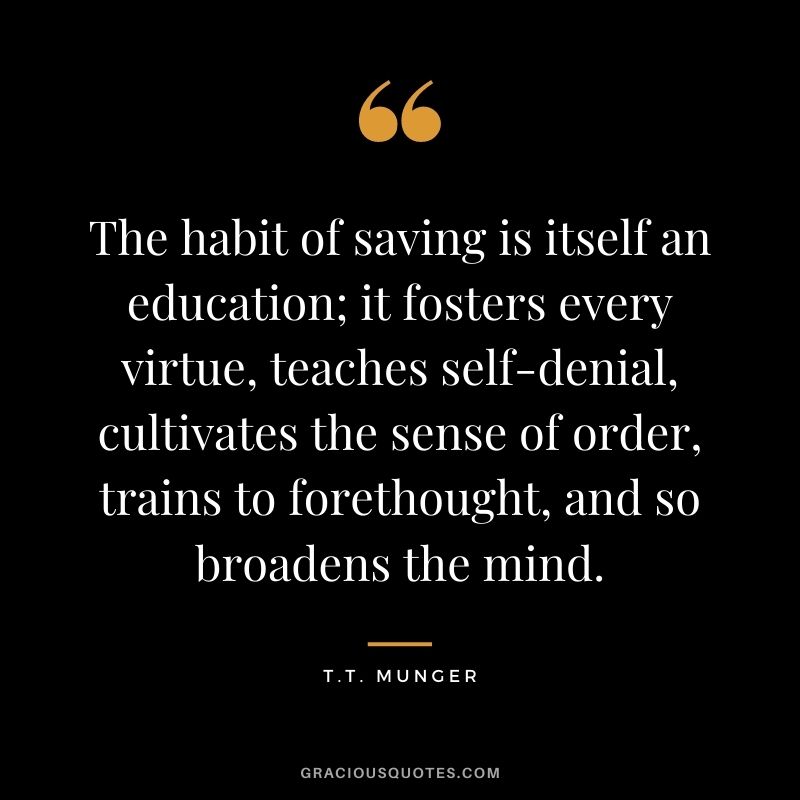
Savings is something all of us do, or hope to do. Saving money takes discipline and some sacrifices.  Saving is one of the most basic, and most repeated bits of financial advice out there. Saving provides financial security, gives you the freedom to know that when you need money, it is available and lets you take calculated risks. Also, depositors who save money can help in the economic growth of the country.

Today and in some countries, yesterday World Savings Day was celebrated. Every year on October 31st, the World Savings and Retail Banking Institute (WSBI) and its members across the world celebrate World Savings Day. World Savings Day was established on October 31, 1934, during the 1st International Savings Bank Congress or the World Society of Savings Banks in Milan, Italy. The Italian Professor Filippo Ravizza declared this day as International Saving Day on the last day of the congress and in the resolutions of the Thrift Congress, it was decided that World Thrift Day should be a day devoted to the promotion of savings all over the world. As people were not sure about saving after the First World War, the idea was to make people aware of the significance of saving money. In their efforts to promote thrift, the savings banks also worked with the support of the schools, and the clergy, as well as cultural, sports, professional, and women’s associations. As people were not sure about saving after the First World War, the idea was to make people aware of the significance of saving money.

Representatives of 29 countries wanted to bring to mind the thought of saving to the worldwide public and its relevance to the economy and the individual. World Savings Day is usually held on October 30 except in countries where this day is a public holiday since the idea is for the banks to be open so that people can transfer their savings into their accounts.

After World War II, World Thrift Day continued and reached the peak of its popularity in the years between 1955 and 1970. It practically became a veritable tradition in certain countries. In Austria, for instance, the official mascot of saving, the Sparefroh or the Happy Saver, reached a higher degree of brand awareness than the republic’s President and even a street was named after the mascot. In the 1970s, the Sparefroh Journal, an educational magazine for younger people, reached a circulation of 400,000 copies. In Germany World Savings Day is held on the last business day before October 31 since this is a public holiday in some states. In India, October 31 is the day the former Prime Minister Indira Gandhi was assassinated and so the day is celebrated on October 30.

For more than 90 years, this day has aimed to promote saving money and to raise awareness of the important role that savings and retail banking play within the general financial system. World Savings Day also highlights the ethical characteristics that banking institutions need to have to be responsible partners in communities, and serve households, small and medium-sized enterprises (SMEs) and local authorities. Today the focus of the banks that organise World Savings Day is on developing countries, where many people are unbanked. Savings banks play an important role in enhancing savings in these countries with campaigns and initiatives such as working with non-governmental organisations to double the number of savings accounts held by the poor.

To commemorate this day, go and save some money. Either drop by your bank or make an online transfer to your savings account.