In My Hands Today…

Leave Only Footprints: My Acadia-to-Zion Journey Through Every National Park – Conor Knighton

When Conor Knighton decided to spend a year wandering through “America’s Best Idea,” he was worried the whole thing might end up being his worst idea. But, after a broken engagement and a broken heart, he desperately needed a change of scenery. The ambitious plan he cooked up went a bit overboard in that department; Knighton set out to visit every single one of America’s National Parks, from Acadia to Zion.

Leave Only Footprints is the memoir of his year spent traveling across the United States, a journey that yielded his “On the Trail” series, which quickly became one of CBS Sunday Morning’s most beloved segments. In this smart, informative, and often hilarious book, he’ll share how his journey through these natural wonders, unchanged by man, ended up changing his worldview on everything from God to politics to love and technology. Whether it’s waking up early for a naked scrub in an Arkansas bathhouse or staying up late to stargaze along our loneliest highway, Knighton goes behind the scenery to provide an unfiltered look at America. In the tradition of books like A Walk in the Woods or Turn Right at Machu Picchu, this is an irresistible mix of personal narrative and travelogue-some well-placed pop culture references, too-and a must-read for any of the 331 million yearly National Parks visitors.

In My Hands Today…

Crossings: How Road Ecology Is Shaping the Future of Our Planet – Ben Goldfarb

An eye-opening account of the global ecological transformations wrought by roads, from the award-winning author of Eager.

Some 40 million miles of roadways encircle the earth, yet we tend to regard them only as infrastructure for human convenience. While roads are so ubiquitous they’re practically invisible to us, wild animals experience them as entirely alien forces of death and disruption.

In Crossings, environmental journalist Ben Goldfarb travels throughout the United States and around the world to investigate how roads have transformed our planet. A million animals are killed by cars each day in the U.S. alone, but as the new science of road ecology shows, the harms of highways extend far beyond roadkill.

Creatures from antelope to salmon are losing their ability to migrate in search of food and mates; invasive plants hitch rides in tire treads; road salt contaminates lakes and rivers; and the very noise of traffic chases songbirds from vast swaths of habitat. Yet road ecologists are also seeking to blunt the destruction through innovative solutions.

Goldfarb meets with conservationists building bridges for California’s mountain lions and tunnels for English toads, engineers deconstructing the labyrinth of logging roads that web national forests, animal rehabbers caring for Tasmania’s car-orphaned wallabies, and community organizers working to undo the havoc highways have wreaked upon American cities. Today, as our planet’s road network continues to grow exponentially, the science of road ecology has become increasingly vital. Written with passion and curiosity, Crossings is a sweeping, spirited, and timely investigation into how humans have altered the natural world―and how we can create a better future for all living beings.

In My Hands Today…

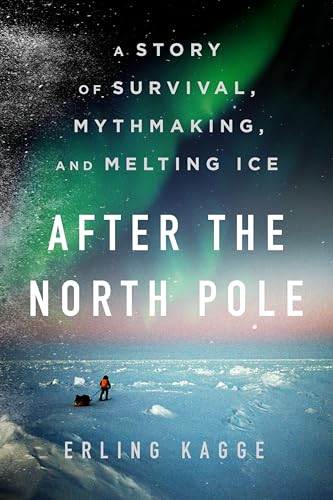
After the North Pole: A Story of Survival, Mythmaking, and Melting Ice – Erling Kagge

The North Pole looms large in our collective psyche—the ultimate Otherland in a world mapped and traversed. It is the center of our planet’s rotation, one of the places that is most vulnerable in an epoch of global climate change. Its sub-zero temperatures and strange year of one sunset and one sunrise make it an eerie, utterly disorienting place that challenges human endurance and understanding.

Erling Kagge and his friend Børge Ousland became the first people “to ever reach the pole without dogs, without depots and without motorized aids,” skiing for 58 days from a drop off point on the ice edge of Canada’s northernmost island.

In magisterial prose, Erling narrates his epic, record-making journey, probing the physical challenges and psychological motivations for embarking on such an epic expedition, the history of the territory’s exploration, its place in legend and art, and the thrilling adventures he experienced during the trek. It is another example of what bestselling author Robert MacFarlane has called “Kagge’s extraordinary life in wild places,”

Erling offers surprises on every page while observing the key role that this place holds in our current climate and geopolitical conversations. As majestic, mesmerizing, and monumental as the terrain it captures, The North Pole is for anyone who has gazed out at the horizon—and wondered what happens if you keep going.

In My Hands Today…

Deep Water: The World in the Ocean – James Bradley

The ocean has shaped and sustained life on Earth for billions of years. Its waters contain our past, from the deep history of evolutionary time to exploration and colonialism; our present, as a place of solace and pleasure, and as the highway that underpins the global economy; and – as waters heat and sea levels rise ever higher – our future.

Deep Water is both a hymn to the beauty, mystery and wonder of the ocean, and a reckoning with our complex relationship to the natural world. It is a book shaped by tidal movements and deep currents, and lit by the presence of other minds and other ways of being. Weaving together science, history and personal reflection it explores the way the ocean connects every living being on Earth, the origins of the environmental catastrophe that is overtaking us and the question of what lies ahead.

Immense in scope but also human and intimate, Deep Water offers new ways of understanding not just our relationship with the planet, but the past – and perhaps most importantly, the future.

In My Hands Today…

The Light Eaters: How the Unseen World of Plant Intelligence Offers a New Understanding of Life on Earth – Zoë Schlanger

Award-winning environment and science reporter Zoë Schlanger delivers a groundbreaking work of popular science that probes the hidden world of the plant kingdom and reveals the astonishing capabilities of the green life all around us. It takes tremendous biological creativity to be a plant. To survive and thrive while rooted in a single spot, plants have adapted ingenious methods of survival. In recent years, scientists have learned about their ability to communicate, recognize their kin and behave socially, hear sounds, morph their bodies to blend into their surroundings, store useful memories that inform their life cycle, and trick animals into behaving to their benefit, to name just a few remarkable talents.

The Light Eaters is a deep immersion into the drama of green life and the complexity of this wild and awe-inspiring world that challenges our very understanding of agency, consciousness, and intelligence. In looking closely, we see that plants, rather than imitate human intelligence, have perhaps formed a parallel system. What is intelligent life if not a vine that grows leaves to blend into the shrub on which it climbs, a flower that shapes its bloom to fit exactly the beak of its pollinator, a pea seedling that can hear water flowing and make its way toward it? Zoë Schlanger takes us across the globe, digging into her own memories and into the soil with the scientists who have spent their waking days studying these amazing entities up close.

What can we learn about life on Earth from the living things that thrive, adapt, consume, and accommodate simultaneously? More important, what do we owe these life forms once we come to understand their rich and varied abilities? Examining the latest epiphanies in botanical research, Schlanger spotlights the intellectual struggles among the researchers conceiving a wholly new view of their subject, offering a glimpse of a field in turmoil as plant scientists debate the tenets of ongoing discoveries and how they influence our understanding of what a plant is.

We need plants to survive. But what do they need us for—if at all? An eye-opening and informative look at the ecosystem we live in, this book challenges us to rethink the role of plants—and our own place—in the natural world.