In My Hands Today…

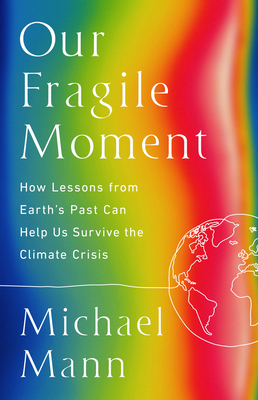
Our Fragile Moment: How Lessons from Earth’s Past Can Help Us Survive the Climate Crisis – Michael E. Mann

For the vast majority of its 4.54 billion years, Earth has proven it can manage just fine without human beings. Then came the first proto-humans, who emerged just a little more than 2 million years ago—a fleeting moment in geological time. What is it that made this benevolent moment of ours possible? Ironically, it’s the very same thing that now threatens us—climate change. The drying of the tropics during the Pleistocene period created a niche for early hominids, who could hunt prey as forests gave way to savannahs in the African tropics. The sudden cooling episode known as the “Younger Dryas” 13,000 years ago, which occurred just as Earth was thawing out of the last Ice Age, spurred the development of agriculture in the fertile crescent. The “Little Ice Age” cooling of the 16th-19th centuries led to famines and pestilence for much of Europe, yet it was a boon for the Dutch, who were able to take advantage of stronger winds to shorten their ocean voyages.

The conditions that allowed humans to live on this earth are fragile, incredibly so. Climate variability has at times created new niches that humans or their ancestors could potentially exploit, and challenges that at times have spurred innovation. But there’s a relatively narrow envelope of climate variability within which human civilization remains viable. And our survival depends on conditions remaining within that range.

In this book, renowned climate scientist Michael Mann will arm readers with the knowledge necessary to appreciate the gravity of the unfolding climate crisis, while emboldening them—and others–to act before it truly does become too late.

In My Hands Today…

Dinosaurs at the Dinner Party: How an Eccentric Group of Victorians Discovered Prehistoric Creatures and Accidentally Upended the World – Edward Dolnick

In the early 1800s the world was a safe and cozy place. But then a twelve-year-old farm boy in Massachusetts stumbled upon a row of fossilized three-toed footprints the size of dinner plates—the first dinosaur tracks ever found. Soon, in England, Victorians unearthed enormous bones—bones that reached as high as a man’s head.

Outside of myths and fairy tales, no one had imagined that creatures like three-toed giants once lumbered across the land. And if anyone conjured up such a scene, they would never imagine that all those animals could have vanished hundreds of millions years ago. The thought of sudden, arbitrary disappearance from life was unnerving and forced the Victorians to rethink everything they knew about the world. Celebrated storyteller and historian Edward Dolnick leads readers through a compelling true adventure as the paleontologists of the first half of the 19th century puzzled their way through the fossil record to create the story of dinosaurs we know today.

In My Hands Today…

The Heat Will Kill You First: Life and Death on a Scorched Planet – Jeff Goodell

The world is waking up to a new wildfires are now seasonal in California, the Northeast is getting less and less snow each winter, and the ice sheets in the Arctic and Antarctica are melting fast. Heat is the first order threat that drives all other impacts of the climate crisis. And as the temperature rises, it is revealing fault lines in our governments, our politics, our economy, and our values. The basic science is not Stop burning fossil fuels tomorrow, and the global temperature will stop rising tomorrow. Stop burning fossil fuels in 50 years, and the temperature will keep rising for 50 years, making parts of our planet virtually uninhabitable. It’s up to us. The hotter it gets, the deeper and wider our fault lines will open.

The Heat Will Kill You First is about the extreme ways in which our planet is already changing. It is about why spring is coming a few weeks earlier and fall is coming a few weeks later and the impact that will have on everything from our food supply to disease outbreaks. It is about what will happen to our lives and our communities when typical summer days in Chicago or Boston go from 90° F to 110°F. A heatwave, Goodell explains, is a predatory event— one that culls out the most vulnerable people. But that is changing. As heatwaves become more intense and more common, they will become more democratic.

As an award-winning journalist who has been at the forefront of environmental journalism for decades, Goodell’s new book may be his most provocative yet, explaining how extreme heat will dramatically change the world as we know it. Masterfully reported, mixing the latest scientific insight with on-the-ground storytelling, Jeff Goodell tackles the big questions and uncovers how extreme heat is a force beyond anything we have reckoned with before.

In My Hands Today…

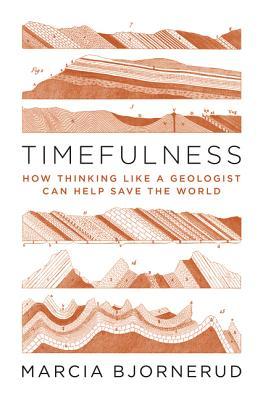
Timefulness: How Thinking Like a Geologist Can Help Save the World – Marcia Bjornerud

Why an awareness of Earth’s temporal rhythms is critical to our planetary survival

Few of us have any conception of the enormous timescales in our planet’s long history, and this narrow perspective underlies many of the environmental problems we are creating for ourselves. The passage of nine days, which is how long a drop of water typically stays in Earth’s atmosphere, is something we can easily grasp. But spans of hundreds of years–the time a molecule of carbon dioxide resides in the atmosphere–approach the limits of our comprehension. Our everyday lives are shaped by processes that vastly predate us, and our habits will in turn have consequences that will outlast us by generations.

Timefulness reveals how knowing the rhythms of Earth’s deep past and conceiving of time as a geologist does can give us the perspective we need for a more sustainable future.

Marcia Bjornerud shows how geologists chart the planet’s past, explaining how we can determine the pace of solid Earth processes such as mountain building and erosion and comparing them with the more unstable rhythms of the oceans and atmosphere. These overlapping rates of change in the Earth system–some fast, some slow–demand a poly-temporal worldview, one that Bjornerud calls “timefulness.” She explains why timefulness is vital in the Anthropocene, this human epoch of accelerating planetary change, and proposes sensible solutions for building a more time-literate society.

This compelling book presents a new way of thinking about our place in time, enabling us to make decisions on multigenerational timescales. The lifespan of Earth may seem unfathomable compared to the brevity of human existence, but this view of time denies our deep roots in Earth’s history–and the magnitude of our effects on the planet.

In My Hands Today…

Who Sought to See the Future – Peter Moore

In 1865 Admiral Robert FitzRoy locked himself in his dressing room and cut his throat. His grand meteorological project had failed. Yet only a decade later, FitzRoy’s storm warning system and “forecasts” would return, the model for what we use today.

In an age when a storm at sea was evidence of God’s wrath, nineteenth-century meteorologists had to fight against convention and religious dogma. Buoyed by the achievements of the Enlightenment, a generation of mavericks set out to decipher the secrets of the atmosphere and predict the future. Among them were Luke Howard, the first to classify clouds; Francis Beaufort, who quantified the winds; James Glaisher, who explored the upper atmosphere in a hot-air balloon; Samuel Morse, whose electric telegraph gave scientists the means by which to transmit weather warnings; and FitzRoy himself, master sailor, scientific pioneer, and founder of the U.K.’s national weather service.

Reputations were built and shattered. Fractious debates raged over decades between scientists from London and Galway, Paris and New York. Explaining the atmosphere was one thing, but predicting what it was going to do seemed a step too far. In 1854, when a politician suggested to the Commons that Londoners might soon know the weather twenty-four hours in advance, the House roared with laughter.

Peter Moore’s The Weather Experiment navigates treacherous seas and rough winds to uncover the obsession that drove these men to great invention and greater understanding.