In My Hands Today…

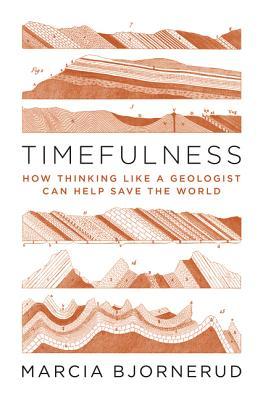
Timefulness: How Thinking Like a Geologist Can Help Save the World – Marcia Bjornerud

Why an awareness of Earth’s temporal rhythms is critical to our planetary survival

Few of us have any conception of the enormous timescales in our planet’s long history, and this narrow perspective underlies many of the environmental problems we are creating for ourselves. The passage of nine days, which is how long a drop of water typically stays in Earth’s atmosphere, is something we can easily grasp. But spans of hundreds of years–the time a molecule of carbon dioxide resides in the atmosphere–approach the limits of our comprehension. Our everyday lives are shaped by processes that vastly predate us, and our habits will in turn have consequences that will outlast us by generations.

Timefulness reveals how knowing the rhythms of Earth’s deep past and conceiving of time as a geologist does can give us the perspective we need for a more sustainable future.

Marcia Bjornerud shows how geologists chart the planet’s past, explaining how we can determine the pace of solid Earth processes such as mountain building and erosion and comparing them with the more unstable rhythms of the oceans and atmosphere. These overlapping rates of change in the Earth system–some fast, some slow–demand a poly-temporal worldview, one that Bjornerud calls “timefulness.” She explains why timefulness is vital in the Anthropocene, this human epoch of accelerating planetary change, and proposes sensible solutions for building a more time-literate society.

This compelling book presents a new way of thinking about our place in time, enabling us to make decisions on multigenerational timescales. The lifespan of Earth may seem unfathomable compared to the brevity of human existence, but this view of time denies our deep roots in Earth’s history–and the magnitude of our effects on the planet.

In My Hands Today…

Who Sought to See the Future – Peter Moore

In 1865 Admiral Robert FitzRoy locked himself in his dressing room and cut his throat. His grand meteorological project had failed. Yet only a decade later, FitzRoy’s storm warning system and “forecasts” would return, the model for what we use today.

In an age when a storm at sea was evidence of God’s wrath, nineteenth-century meteorologists had to fight against convention and religious dogma. Buoyed by the achievements of the Enlightenment, a generation of mavericks set out to decipher the secrets of the atmosphere and predict the future. Among them were Luke Howard, the first to classify clouds; Francis Beaufort, who quantified the winds; James Glaisher, who explored the upper atmosphere in a hot-air balloon; Samuel Morse, whose electric telegraph gave scientists the means by which to transmit weather warnings; and FitzRoy himself, master sailor, scientific pioneer, and founder of the U.K.’s national weather service.

Reputations were built and shattered. Fractious debates raged over decades between scientists from London and Galway, Paris and New York. Explaining the atmosphere was one thing, but predicting what it was going to do seemed a step too far. In 1854, when a politician suggested to the Commons that Londoners might soon know the weather twenty-four hours in advance, the House roared with laughter.

Peter Moore’s The Weather Experiment navigates treacherous seas and rough winds to uncover the obsession that drove these men to great invention and greater understanding.

In My Hands Today…

Awe: The New Science of Everyday Wonder and How It Can Transform Your Life – Dacher Keltner

Awe is mysterious. How do we begin to quantify the goose bumps we feel when we see the Grand Canyon, or the utter amazement when we watch a child walk for the first time? How do you put into words the collective effervescence of standing in a crowd and singing in unison, or the wonder you feel while gazing at centuries-old works of art?

Up until fifteen years ago, there was no science of awe, the feeling we experience when we encounter vast mysteries that transcend our understanding of the world. Scientists were studying emotions like fear and disgust, emotions that seemed essential to human survival. Revolutionary thinking, though, has brought into focus how, through the span of evolution, we’ve met our most basic needs socially. We’ve survived thanks to our capacities to cooperate, form communities, and create culture that strengthens our sense of shared identity—actions that are sparked and spurred by awe.

In Awe, Dacher Keltner presents a radical investigation and deeply personal inquiry into this elusive emotion. Revealing new research into how awe transforms our brains and bodies, alongside an examination of awe across history, culture, and within his own life during a period of grief, Keltner shows us how cultivating awe in our everyday life leads us to appreciate what is most humane in our human nature. And during a moment in which our world feels more divided than ever before, and more imperiled by crises of different kinds, we are greatly in need of awe. If we open our minds, it is awe that sharpens our reasoning and orients us toward big ideas and new insights, that cools our immune system’s inflammation response and strengthens our bodies. It is awe that activates our inclination to share and create strong networks, to take actions that are good for the natural and social world around us. It is awe that transforms who we are, that inspires the creation of art, music, and religion. At turns radical and profound, brimming with enlightening and practical insights, Awe is our field guide, from not only one of the leading voices on the subject but a fellow seeker of awe in his own right, for how to place awe as a vital force within our lives.

In My Hands Today…

The Earth Transformed: An Untold History – Peter Frankopan

Global warming is one of the greatest dangers mankind faces today. Even as temperatures increase, sea levels rise, and natural disasters escalate, our current environmental crisis feels difficult to predict and understand. But climate change and its effects on us are not new.

In a bold narrative that spans centuries and continents, Peter Frankopan argues that nature has always played a fundamental role in the writing of history.

From the fall of the Moche civilization in South America that came about because of the cyclical pressures of El Nino to volcanic eruptions in Iceland that affected Egypt and helped bring the Ottoman empire to its knees, climate change and its influences have always been with us.

Frankopan explains how the Vikings emerged thanks to catastrophic crop failure, why the roots of regime change in Eleventh-Century Baghdad lay in the collapse of cotton prices resulting from unusual climate patterns, and why the western expansion of the frontiers in North America was directly affected by solar flare activity in the eighteenth century. Again and again, Frankopan shows that when past empires have failed to act sustainably, they have been met with catastrophe. Blending brilliant historical writing and cutting-edge scientific research, Climate will radically reframe the way we look at the world and our future.

Instagram Interludes

While we were in Bengaluru, we made a half day trip to the Bangalore Bannerghetta National Park and Zoo. I felt the park is worth visiting, especially if you have young children. I especially enjoyed the safari, which if you do nothing else at the park, you must do. Here are some photos from the safari. The highlight of our safari was seeing a tiger stroll down the road while we were parked. That was so beautiful. I did capture that as a short reel, but since I can’t post that here, you have to be content with a photo of the tiger.

Deer
An elephant at the bathing point
Two jeuvenile bears playing
The tiger walking towards us
A lion and lioness having a siesta