In My Hands Today…

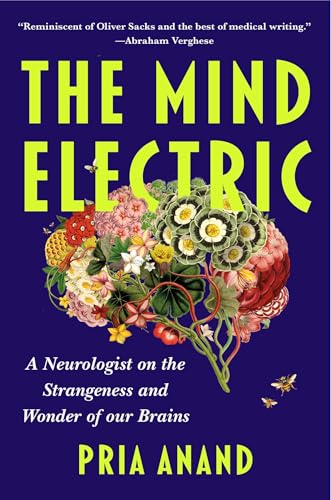
The Mind Electric: A Neurologist on the Strangeness and Wonder of Our Brains – Pria Anand

A girl believes she has been struck blind for stealing a kiss. A mother watches helplessly as each of her children is replaced by a changeling. A woman is haunted each month by the same four chords of a single song. In neurology, illness is inextricably linked with narrative, the clues to unraveling these mysteries hidden in both the details of a patient’s story and the tells of their body.

Stories are etched into the very structure of our brains, coded so deeply that the impulse for storytelling survives and even surges after the most devastating injuries. But our brains are also porous—the stories they concoct shaped by cultural narratives about bodies and illness that permeate the minds of doctors and patients alike. In the history of medicine, some stories are heard, while others—the narratives of women, of Black and brown people, of displaced people, of disempowered people—are too often dismissed.

In The Mind Electric, neurologist Pria Anand reveals—through case study, history, fable, and memoir—all that the medical establishment has the complexity and wonder of brains in health and in extremis, and the vast gray area between sanity and insanity, doctor and patient, and illness and wellness, each separated from the next by the thin veneer of a different story.

Moving from the Boston hospital where she treats her patients, to her childhood years in India, to Isla Providencia in the Caribbean and to the Republic of Guinea in West Africa, she demonstrates again and again the compelling paradox at the heart of that even the most peculiar symptoms can show us something universal about ourselves as humans.

In My Hands Today…

Who We Are and How We Got Here: Ancient DNA and the New Science of the Human Past – David Reich

A groundbreaking book about how ancient DNA has profoundly changed our understanding of human history.

Geneticists like David Reich have made astounding advances in the field of genomics, which is proving to be as important as archaeology, linguistics, and written records as a means to understand our ancestry. In Who We Are and How We Got Here, Reich allows listeners to discover how the human genome provides not only all the information a human embryo needs to develop but also the hidden story of our species.

Reich delves into how the genomic revolution is transforming our understanding of modern humans and how DNA studies reveal deep inequalities among different populations, between the sexes, and among individuals.

Provocatively, Reich’s book suggests that there might very well be biological differences among human populations but that these differences are unlikely to conform to common stereotypes.

Drawing upon revolutionary findings and unparalleled scientific studies, Who We Are and How We Got Here is a captivating glimpse into humankind—where we came from and what that says about our lives today.

In My Hands Today…

The Light Eaters: How the Unseen World of Plant Intelligence Offers a New Understanding of Life on Earth – Zoë Schlanger

Award-winning environment and science reporter Zoë Schlanger delivers a groundbreaking work of popular science that probes the hidden world of the plant kingdom and reveals the astonishing capabilities of the green life all around us. It takes tremendous biological creativity to be a plant. To survive and thrive while rooted in a single spot, plants have adapted ingenious methods of survival. In recent years, scientists have learned about their ability to communicate, recognize their kin and behave socially, hear sounds, morph their bodies to blend into their surroundings, store useful memories that inform their life cycle, and trick animals into behaving to their benefit, to name just a few remarkable talents.

The Light Eaters is a deep immersion into the drama of green life and the complexity of this wild and awe-inspiring world that challenges our very understanding of agency, consciousness, and intelligence. In looking closely, we see that plants, rather than imitate human intelligence, have perhaps formed a parallel system. What is intelligent life if not a vine that grows leaves to blend into the shrub on which it climbs, a flower that shapes its bloom to fit exactly the beak of its pollinator, a pea seedling that can hear water flowing and make its way toward it? Zoë Schlanger takes us across the globe, digging into her own memories and into the soil with the scientists who have spent their waking days studying these amazing entities up close.

What can we learn about life on Earth from the living things that thrive, adapt, consume, and accommodate simultaneously? More important, what do we owe these life forms once we come to understand their rich and varied abilities? Examining the latest epiphanies in botanical research, Schlanger spotlights the intellectual struggles among the researchers conceiving a wholly new view of their subject, offering a glimpse of a field in turmoil as plant scientists debate the tenets of ongoing discoveries and how they influence our understanding of what a plant is.

We need plants to survive. But what do they need us for—if at all? An eye-opening and informative look at the ecosystem we live in, this book challenges us to rethink the role of plants—and our own place—in the natural world.

In My Hands Today…

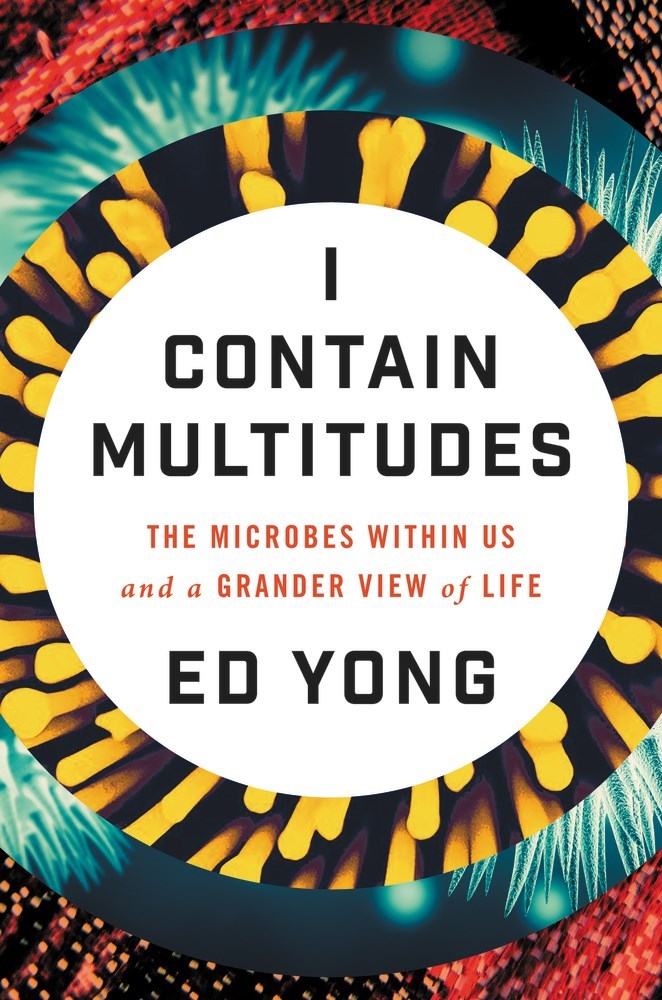
I Contain Multitudes: The Microbes Within Us and a Grander View of Life – Ed Yong

Every animal, whether human, squid, or wasp, is home to millions of bacteria and other microbes. Many people think of microbes as germs to be eradicated, but those that live with us—the microbiome—build our bodies, protect our health, shape our identities, and grant us incredible abilities. In this astonishing book, Ed Yong takes us on a grand tour through our microbial partners, and introduces us to the scientists on the front lines of discovery.

Yong, whose humor is as evident as his erudition, prompts us to look at ourselves and our animal companions in a new light—less as individuals and more as the interconnected, interdependent multitudes we assuredly are. The microbes in our bodies are part of our immune systems and protect us from disease. Those in cows and termites digest the plants they eat. In the deep oceans, mysterious creatures without mouths or guts depend on microbes for all their energy. Bacteria provide squids with invisibility cloaks, help beetles to bring down forests, and allow worms to cause diseases that afflict millions of people.

I Contain Multitudes is the story of these extraordinary partnerships, between the creatures we are familiar with and those we are not. It reveals how we humans are disrupting these partnerships and how we might manipulate them for our own good. It will change both our view of nature and our sense of where we belong in it.

In My Hands Today…

Eve: How the Female Body Drove 200 Million Years of Human Evolution – Cat Bohannon

How did the female body drive 200 million years of human evolution?

  • Why do women live longer than men?
  • Why are women more likely to get Alzheimer’s?
  • Why do girls score better at every academic subject than boys until puberty, when suddenly their scores plummet?
  • Is sexism useful for evolution?
  • And why, seriously why, do women have to sweat through our sheets every night when we hit menopause?

These questions are producing some truly exciting science—and in Eve, with boundless curiosity and sharp wit, Cat Bohannon covers the past 200 million years to explain the specific science behind the development of the female sex: “We need a kind of user’s manual for the female mammal. A no-nonsense, hard-hitting, seriously researched (but readable) account of what we are. How female bodies evolved, how they work, what it really means to biologically be a woman. Something that would rewrite the story of womanhood. This book is that story. We have to put the female body in the picture. If we don’t, it’s not just feminism that’s compromised. Modern medicine, neurobiology, paleoanthropology, even evolutionary biology all take a hit when we ignore the fact that half of us have breasts. So it’s time we talk about breasts. Breasts, and blood, and fat, and vaginas, and wombs—all of it. How they came to be and how we live with them now, no matter how weird or hilarious the truth is.”

Eve is not only a sweeping revision of human history, it’s an urgent and necessary corrective for a world that has focused primarily on the male body for far too long. Picking up where Sapiens left off, Eve will completely change what you think you know about evolution and why Homo sapiens has become such a successful and dominant species.