In My Hands Today…

The Infinite Game – Simon Sinek

Do you know how to play the game you’re in?

In finite games, like football or chess, the players are known, the rules are fixed, and the endpoint is clear. The winners and losers are easily identified.

In infinite games, like business or politics or life itself, the players come and go, the rules are changeable, and there is no defined endpoint. There are no winners or losers in an infinite game; there is only ahead and behind.

The more I started to understand the difference between finite and infinite games, the more I began to see infinite games all around us. I started to see that many of the struggles that organizations face exist simply because their leaders were playing with a finite mindset in an infinite game. These organizations tend to lag behind in innovation, discretionary effort, morale and ultimately performance.

The leaders who embrace an infinite mindset, in stark contrast, build stronger, more innovative, more inspiring organizations. Their people trust each other and their leaders. They have the resilience to thrive in an ever-changing world, while their competitors fall by the wayside. Ultimately, they are the ones who lead the rest of us into the future.

Any worthwhile undertaking starts with Why – the purpose, cause or belief that inspires us to do what we do and inspires others to join us. Good leaders know how to build Circles of Safety that promote trust and cooperation throughout their organizations. But that’s not enough to help us chart a course through the unpredictable, often chaotic landscape of today’s marketplace.

I now believe that the ability to adopt an infinite mindset is a prerequisite for any leader who aspires to leave their organization in better shape than they found it.
In My Hands Today…

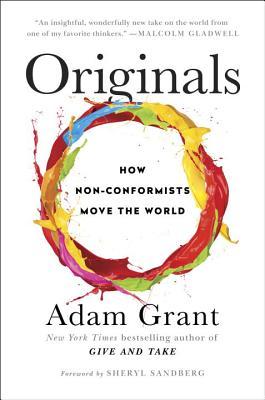
Originals: How Non-Conformists Move the World – Adam M. Grant

In Originals the author addresses the challenge of improving the world from the perspective of becoming original: choosing to champion novel ideas and values that go against the grain, battle conformity, and buck outdated traditions. How can we originate new ideas, policies, and practices without risking it all?

Using surprising studies and stories spanning business, politics, sports, and entertainment, Grant explores how to recognize a good idea, speak up without getting silenced, build a coalition of allies, choose the right time to act, and manage fear and doubt; how parents and teachers can nurture originality in children; and how leaders can build cultures that welcome dissent. Learn from an entrepreneur who pitches his start-ups by highlighting the reasons not to invest, a woman at Apple who challenged Steve Jobs from three levels below, an analyst who overturned the rule of secrecy at the CIA, a billionaire financial wizard who fires employees for failing to criticize him, and a TV executive who didn’t even work in comedy but saved Seinfeld from the cutting-room floor. The payoff is a set of groundbreaking insights about rejecting conformity and improving the status quo.

In My Hands Today…

Chatter: The Voice in Our Head, Why It Matters, and How to Harness It – Ethan Kross

Tell a stranger that you talk to yourself, and you’re likely to get written off as eccentric. But the truth is that we all have a voice in our head. When we talk to ourselves, we often hope to tap into our inner coach but find our inner critic instead. When we’re facing a tough task, our inner coach can buoy us up: Focus – you can do this. But, just as often, our inner critic sinks us entirely: I’m going to fail. They’ll all laugh at me. What’s the use?

In ‘CHATTER’, acclaimed psychologist Ethan Kross explores the silent conversations we have with ourselves. Interweaving groundbreaking behavioral and brain research from his own lab with real-world case studies – from a pitcher who forgets how to pitch, to a Harvard undergrad negotiating her double life as a spy – Kross explains how these conversations shape our lives, work, and relationships. He warns that giving in to negative and disorienting self-talk – what he calls “chatter” – can tank our health, sink our moods, strain our social connections, and cause us to fold under pressure.

But the good news is that we’re already equipped with the tools we need to make our inner voice work in our favor. These tools are often hidden in plain sight – in the words we use to think about ourselves, the technologies we embrace, the diaries we keep in our drawers, the conversations we have with our loved ones, and the cultures we create in our schools and workplaces.

Brilliantly argued, expertly researched, and filled with compelling stories, ‘CHATTER’ gives us the power to change the most important conversation we have each day: the one we have with ourselves.

In My Hands Today…

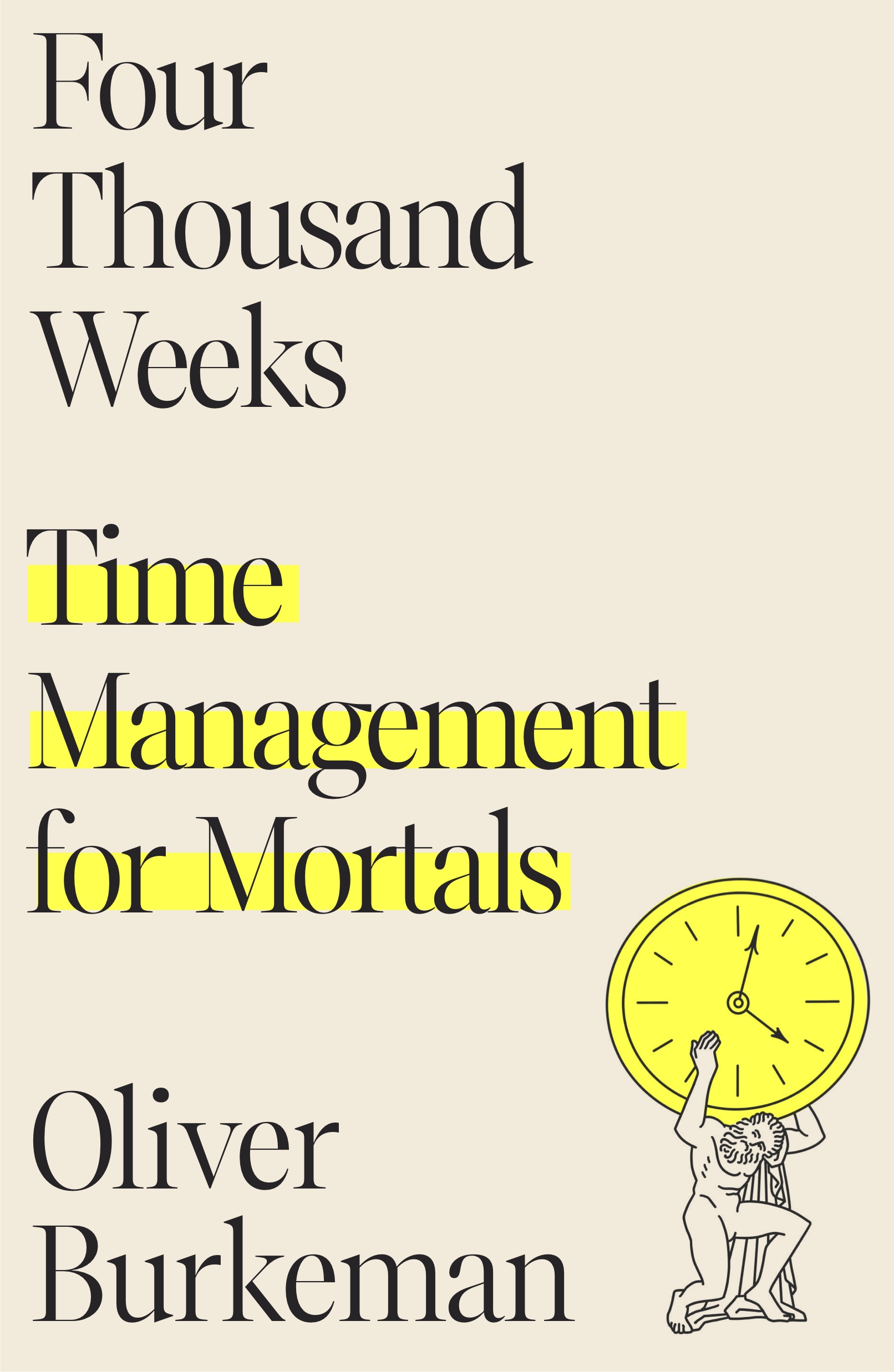
Four Thousand Weeks: Time Management for Mortals – Oliver Burkeman

The average human lifespan is absurdly, insultingly brief. Assuming you live to be eighty, you have just over four thousand weeks.

Nobody needs telling there isn’t enough time. We’re obsessed with our lengthening to-do lists, our overfilled inboxes, work-life balance, and the ceaseless battle against distraction; and we’re deluged with advice on becoming more productive and efficient, and “life hacks” to optimize our days. But such techniques often end up making things worse. The sense of anxious hurry grows more intense, and still the most meaningful parts of life seem to lie just beyond the horizon. Still, we rarely make the connection between our daily struggles with time and the ultimate time management problem: the challenge of how best to use our four thousand weeks.

Drawing on the insights of both ancient and contemporary philosophers, psychologists, and spiritual teachers, Oliver Burkeman delivers an entertaining, humorous, practical, and ultimately profound guide to time and time management. Rejecting the futile modern fixation on “getting everything done,” Four Thousand Weeks introduces readers to tools for constructing a meaningful life by embracing finitude, showing how many of the unhelpful ways we’ve come to think about time aren’t inescapable, unchanging truths, but choices we’ve made as individuals and as a society—and that we could do things differently.

In My Hands Today…

Linchpin: Are You Indispensable? – Seth Godin

There used to be two teams in every workplace: management and labor. Now there’s a third team: the linchpins. These people figure out what to do when there’s no rule book. They delight and challenge their customers and peers. They love their work, pour their best selves into it, and turn each day into a kind of art.

Linchpins are the essential building blocks of great organizations. They may not be famous but they’re indispensable. And in today’s world, they get the best jobs and the most freedom.

As Godin writes, “Every day I meet people who have so much to give but have been bullied enough or frightened enough to hold it back. It’s time to stop complying with the system and draw your own map. You have brilliance in you, your contribution is essential, and the art you create is precious. Only you can do it, and you must.”