In My Hands Today…

Option B: Facing Adversity, Building Resilience, and Finding Joy – Sheryl Sandberg and Adam Grant

After the sudden death of her husband, Sheryl Sandberg felt certain that she and her children would never feel pure joy again. “I was in ‘the void,’” she writes, “a vast emptiness that fills your heart and lungs and restricts your ability to think or even breathe.”

Her friend Adam Grant, a psychologist at Wharton, told her there are concrete steps people can take to recover and rebound from life-shattering experiences. We are not born with a fixed amount of resilience. It is a muscle that everyone can build.

Option B combines Sheryl’s personal insights with Adam’s eye-opening research on finding strength in the face of adversity. Beginning with the gut-wrenching moment when she finds her husband, Dave Goldberg, collapsed on a gym floor, Sheryl opens up her heart—and her journal—to describe the acute grief and isolation she felt in the wake of his death. But Option B goes beyond Sheryl’s loss to explore how a broad range of people have overcome hardships including illness, job loss, sexual assault, natural disasters, and the violence of war. Their stories reveal the capacity of the human spirit to persevere . . . and to rediscover joy.

Resilience comes from deep within us and from support outside us. Even after the most devastating events, it is possible to grow by finding deeper meaning and gaining greater appreciation in our lives. Option B illuminates how to help others in crisis, develop compassion for ourselves, raise strong children, and create resilient families, communities, and workplaces. Many of these lessons can be applied to everyday struggles, allowing us to brave whatever lies ahead. Two weeks after losing her husband, Sheryl was preparing for a father-child activity. “I want Dave,” she cried. Her friend replied, “Option A is not available,” and then promised to help her make the most of Option B.

We all live some form of Option B. This book will help us all make the most of it.

In My Hands Today…

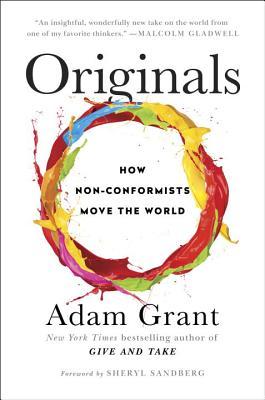
Originals: How Non-Conformists Move the World – Adam M. Grant

In Originals the author addresses the challenge of improving the world from the perspective of becoming original: choosing to champion novel ideas and values that go against the grain, battle conformity, and buck outdated traditions. How can we originate new ideas, policies, and practices without risking it all?

Using surprising studies and stories spanning business, politics, sports, and entertainment, Grant explores how to recognize a good idea, speak up without getting silenced, build a coalition of allies, choose the right time to act, and manage fear and doubt; how parents and teachers can nurture originality in children; and how leaders can build cultures that welcome dissent. Learn from an entrepreneur who pitches his start-ups by highlighting the reasons not to invest, a woman at Apple who challenged Steve Jobs from three levels below, an analyst who overturned the rule of secrecy at the CIA, a billionaire financial wizard who fires employees for failing to criticize him, and a TV executive who didn’t even work in comedy but saved Seinfeld from the cutting-room floor. The payoff is a set of groundbreaking insights about rejecting conformity and improving the status quo.

In My Hands Today…

Chatter: The Voice in Our Head, Why It Matters, and How to Harness It – Ethan Kross

Tell a stranger that you talk to yourself, and you’re likely to get written off as eccentric. But the truth is that we all have a voice in our head. When we talk to ourselves, we often hope to tap into our inner coach but find our inner critic instead. When we’re facing a tough task, our inner coach can buoy us up: Focus – you can do this. But, just as often, our inner critic sinks us entirely: I’m going to fail. They’ll all laugh at me. What’s the use?

In ‘CHATTER’, acclaimed psychologist Ethan Kross explores the silent conversations we have with ourselves. Interweaving groundbreaking behavioral and brain research from his own lab with real-world case studies – from a pitcher who forgets how to pitch, to a Harvard undergrad negotiating her double life as a spy – Kross explains how these conversations shape our lives, work, and relationships. He warns that giving in to negative and disorienting self-talk – what he calls “chatter” – can tank our health, sink our moods, strain our social connections, and cause us to fold under pressure.

But the good news is that we’re already equipped with the tools we need to make our inner voice work in our favor. These tools are often hidden in plain sight – in the words we use to think about ourselves, the technologies we embrace, the diaries we keep in our drawers, the conversations we have with our loved ones, and the cultures we create in our schools and workplaces.

Brilliantly argued, expertly researched, and filled with compelling stories, ‘CHATTER’ gives us the power to change the most important conversation we have each day: the one we have with ourselves.

In My Hands Today…

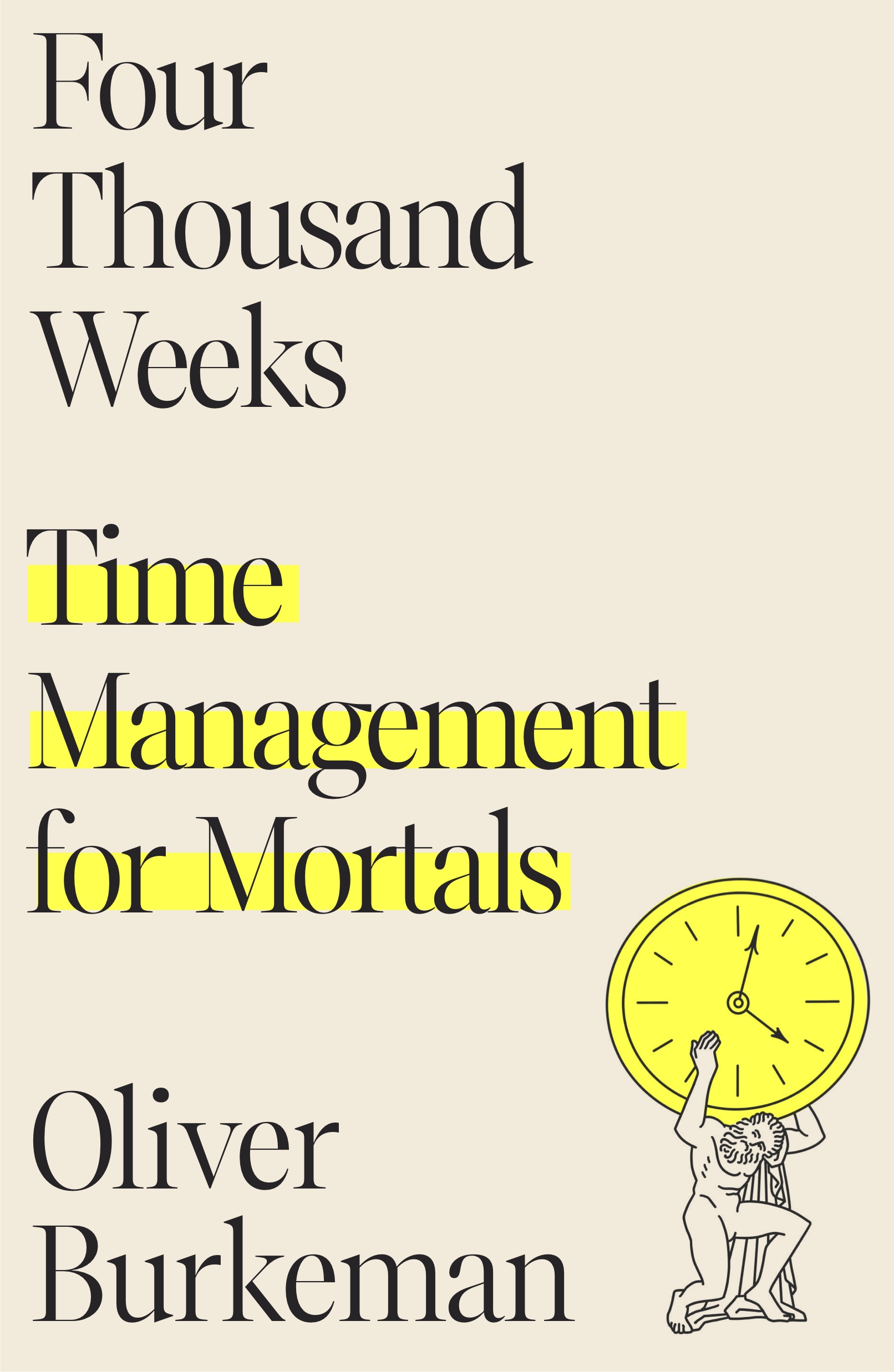
Four Thousand Weeks: Time Management for Mortals – Oliver Burkeman

The average human lifespan is absurdly, insultingly brief. Assuming you live to be eighty, you have just over four thousand weeks.

Nobody needs telling there isn’t enough time. We’re obsessed with our lengthening to-do lists, our overfilled inboxes, work-life balance, and the ceaseless battle against distraction; and we’re deluged with advice on becoming more productive and efficient, and “life hacks” to optimize our days. But such techniques often end up making things worse. The sense of anxious hurry grows more intense, and still the most meaningful parts of life seem to lie just beyond the horizon. Still, we rarely make the connection between our daily struggles with time and the ultimate time management problem: the challenge of how best to use our four thousand weeks.

Drawing on the insights of both ancient and contemporary philosophers, psychologists, and spiritual teachers, Oliver Burkeman delivers an entertaining, humorous, practical, and ultimately profound guide to time and time management. Rejecting the futile modern fixation on “getting everything done,” Four Thousand Weeks introduces readers to tools for constructing a meaningful life by embracing finitude, showing how many of the unhelpful ways we’ve come to think about time aren’t inescapable, unchanging truths, but choices we’ve made as individuals and as a society—and that we could do things differently.

In My Hands Today…

The Real Work: On the Mystery of Mastery – Adam Gopnik

Best-selling author and New Yorker writer Adam Gopnik investigates a foundational human How do we learn―and master―a new skill? For decades now, Adam Gopnik has been one of our most beloved writers, a brilliantly perceptive critic of art, food, France, and more. But recently, he became obsessed by a more fundamental matter, one he had often meditated on in The New Yorker : How do masters learn their miraculous skill, whether it was drawing a museum-ready nude or baking a perfect sourdough loaf? How could anyone become so good at anything? There seemed to be a fundamental mystery to mastery. Was it possible to unravel it?

In The Real Work ―the term magicians use for the accumulated craft that makes for a great trick―Gopnik becomes a dedicated student of several masters of their a classical painter, a boxer, a dancing instructor, a driving instructor, and others. Rejecting self-help bromides and bullet points, he nevertheless shows that the top people in any field share a set of common qualities and methods. For one, their mastery is always a process of breaking down and building up―of identifying and perfecting the small constituent parts of a skill and the combining them for an overall effect greater than the sum of those parts. For another, mastery almost always involves intentional imperfection―as in music, where vibrato, a way of not quite landing on the right note, carries maximum expressiveness. Gopnik’s simplest and most invigorating lesson, however, is that we are surrounded by mastery. Far from rare, mastery is commonplace, if we only know where to from the parent who can whip up a professional strudel to the social worker who―in one of the most personally revealing passages Gopnik has ever written―helps him master his own demons.

Spirited and profound, The Real Work will help you understand how mastery can happen in your own life―and, significantly, why each of us relentlessly seeks to better ourselves in the first place.