In My Hands Today…

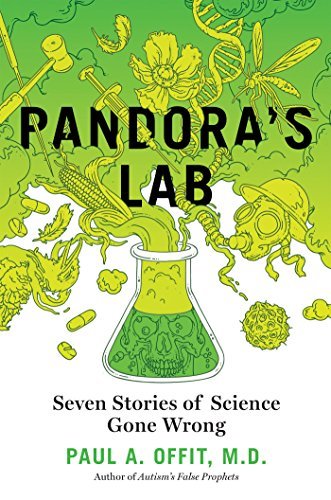
Pandora’s Lab: Seven Stories of Science Gone Wrong – Paul A. Offit


What happens when ideas presented as science lead us in the wrong direction?

History is filled with brilliant ideas that gave rise to disaster, and this book explores the most fascinating—and significant—missteps: from opium’s heyday as the pain reliever of choice to recognition of opioids as a major cause of death in the U.S.; from the rise of trans fats as the golden ingredient for tastier, cheaper food to the heart disease epidemic that followed; and from the cries to ban DDT for the sake of the environment to an epidemic-level rise in world malaria.

These are today’s sins of science—as deplorable as mistaken past ideas about advocating racial purity or using lobotomies as a cure for mental illness. These unwitting errors add up to seven lessons both cautionary and profound, narrated by renowned author and speaker Paul A. Offit. Offit uses these lessons to investigate how we can separate good science from bad, using some of today’s most controversial creations—e-cigarettes, GMOs, drug treatments for ADHD—as case studies. For every “Aha!” moment that should have been an “Oh no,” this book is an engrossing account of how science has been misused disastrously—and how we can learn to use its power for good.

In My Hands Today…

Timefulness: How Thinking Like a Geologist Can Help Save the World – Marcia Bjornerud

Why an awareness of Earth’s temporal rhythms is critical to our planetary survival

Few of us have any conception of the enormous timescales in our planet’s long history, and this narrow perspective underlies many of the environmental problems we are creating for ourselves. The passage of nine days, which is how long a drop of water typically stays in Earth’s atmosphere, is something we can easily grasp. But spans of hundreds of years–the time a molecule of carbon dioxide resides in the atmosphere–approach the limits of our comprehension. Our everyday lives are shaped by processes that vastly predate us, and our habits will in turn have consequences that will outlast us by generations.

Timefulness reveals how knowing the rhythms of Earth’s deep past and conceiving of time as a geologist does can give us the perspective we need for a more sustainable future.

Marcia Bjornerud shows how geologists chart the planet’s past, explaining how we can determine the pace of solid Earth processes such as mountain building and erosion and comparing them with the more unstable rhythms of the oceans and atmosphere. These overlapping rates of change in the Earth system–some fast, some slow–demand a poly-temporal worldview, one that Bjornerud calls “timefulness.” She explains why timefulness is vital in the Anthropocene, this human epoch of accelerating planetary change, and proposes sensible solutions for building a more time-literate society.

This compelling book presents a new way of thinking about our place in time, enabling us to make decisions on multigenerational timescales. The lifespan of Earth may seem unfathomable compared to the brevity of human existence, but this view of time denies our deep roots in Earth’s history–and the magnitude of our effects on the planet.

In My Hands Today…

Who Sought to See the Future – Peter Moore

In 1865 Admiral Robert FitzRoy locked himself in his dressing room and cut his throat. His grand meteorological project had failed. Yet only a decade later, FitzRoy’s storm warning system and “forecasts” would return, the model for what we use today.

In an age when a storm at sea was evidence of God’s wrath, nineteenth-century meteorologists had to fight against convention and religious dogma. Buoyed by the achievements of the Enlightenment, a generation of mavericks set out to decipher the secrets of the atmosphere and predict the future. Among them were Luke Howard, the first to classify clouds; Francis Beaufort, who quantified the winds; James Glaisher, who explored the upper atmosphere in a hot-air balloon; Samuel Morse, whose electric telegraph gave scientists the means by which to transmit weather warnings; and FitzRoy himself, master sailor, scientific pioneer, and founder of the U.K.’s national weather service.

Reputations were built and shattered. Fractious debates raged over decades between scientists from London and Galway, Paris and New York. Explaining the atmosphere was one thing, but predicting what it was going to do seemed a step too far. In 1854, when a politician suggested to the Commons that Londoners might soon know the weather twenty-four hours in advance, the House roared with laughter.

Peter Moore’s The Weather Experiment navigates treacherous seas and rough winds to uncover the obsession that drove these men to great invention and greater understanding.

In My Hands Today…

Our Moon: How Earth’s Celestial Companion Transformed the Planet, Guided Evolution, and Made Us Who We Are – Rebecca Boyle

Far from being a lifeless ornament in the sky, the Moon holds the key to some of science’s central questions, and in this fascinating account of our remarkable satellite, award-winning science journalist Rebecca Boyle shows us why it is the secret to our success.

The Moon stabilizes the Earth’s tilt toward the Sun, creating reliable seasons. The durability of this tilt over millennia stabilizes our climate. The Moon pulls on the ocean, driving the tides. It was these tides that mixed nutrients in the sea, enabling the evolution of complex life and, ultimately, bringing life onto land.

But the Moon also played a pivotal role in our conceptual development. While the Sun helped humans to mark daily time, hunters and gatherers used the phases of the Moon to count months and years, allowing them to situate themselves in time and plan for the future. Its role in the development of religion—Mesopotamian priests recorded the Moon’s position to make predictions about the Moon god–created the earliest known empirical, scientific observation.

Boyle deftly reframes the history of scientific discovery through a lunar lens, from Mesopotamia to the present day. Touching on ancient astronomers including Claudius Ptolemy; ancient philosophers from Anaxagoras to Plutarch; the scientific revolution of Copernicus, Galileo, and Kepler; and the lunar fiction of writers like Jules Verne–which inspired Wernher von Braun, the Nazi rocket scientist who succeeded in landing humans on the Moon–Boyle charts our path with the Moon from the origins of human civilization to the Apollo landings and up to the present.

Even as astronauts around the world prepare to return to the Moon, opening up new frontiers of discovery, profit, and politics, Our Moon brings the Moon down to Earth.

In My Hands Today…

Culinary Reactions: The Everyday Chemistry of Cooking – Simon Quellen Field

When you’re cooking, you’re a chemist! Every time you follow or modify a recipe, you are experimenting with acids and bases, emulsions and suspensions, gels and foams. In your kitchen you denature proteins, crystallize compounds, react enzymes with substrates, and nurture desired microbial life while suppressing harmful bacteria and fungi. And unlike in a laboratory, you can eat your experiments to verify your hypotheses.

In Culinary Reactions, author Simon Quellen Field turns measuring cups, stovetop burners, and mixing bowls into graduated cylinders, Bunsen burners, and beakers. How does altering the ratio of flour, sugar, yeast, salt, butter, and water affect how high bread rises? Why is whipped cream made with nitrous oxide rather than the more common carbon dioxide? And why does Hollandaise sauce call for “clarified” butter? This easy-to-follow primer even includes recipes to demonstrate the concepts being discussed, Whipped Creamsicle Topping—a foam; Cherry Dream Cheese—a protein gle; Lemonade with Chameleon Eggs—an acid indicator; and more!