In My Hands Today…

The Emotionally Intelligent Office: 20 Key Emotional Skills for the Workplace – The School of Life

Work-related stress currently costs the United States economy $300 billion a year. Modern businesses prioritize technical training, yet the true success of a business has little to do with the hard skills taught at business school and much more to do with the emotional intelligence of its employees.

This book examines the roots of our problematic behavioral patterns in the workplace and addresses how we can overcome them. The skills discussed range from giving honest feedback to accepting that it’s OK to fail, to addressing jealousies and insecurities within teams. We learn about how our childhoods impact on how we deal with colleagues, and how to speak so that others will listen.

In My Hands Today…

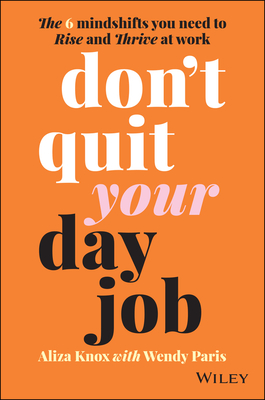
Don’t Quit Your Day Job: The 6 Mindshifts You Need to Rise and Thrive at Work – Aliza Knox, Wendy Paris

Learn how to survive and thrive within organisations. In Don’t Quit Your Day Job , former Google and Twitter executive Aliza Knox delivers hands-on, practical steps for achieving career success.

Driven by Knox’s four decades working in and leading some of the world’s most celebrated firms, and featuring candid accounts of other people’s successes and missteps in global tech, consumer goods, healthcare, academia, social services and more, this book is an essential guide to integrating your professional and personal goals to build a fulfilling, complete life.

Whether you’re just starting your first job or you’re ready to rise to the C-suite, Don’t Quit Your Day Job will help you advance and flourish in the workplace.

In My Hands Today…

Discipline Is Destiny: The Power of Self-Control – Ryan Holiday

To master anything, one must first master themselves–one’s emotions, one’s thoughts, one’s actions. Eisenhower famously said that freedom is really the opportunity to practice self-discipline. Cicero called the virtue of temperance the polish of life. Without boundaries and restraint, we risk not only failing to meet our full potential and jeopardizing what we have achieved, but we ensure misery and shame. In a world of temptation and excess, this ancient idea is more urgent than ever.

In Discipline is Destiny, Holiday draws on the stories of historical figures we can emulate as pillars of self-discipline, including Lou Gehrig, Queen Elizabeth II, boxer Floyd Patterson, Marcus Aurelius and writer Toni Morrison, as well as the cautionary tales of Napoleon, F. Scott Fitzgerald and Babe Ruth. Through these engaging examples, Holiday teaches readers the power of self-discipline and balance, and cautions against the perils of extravagance and hedonism.

At the heart of Stoicism are four simple virtues: courage, temperance, justice, and wisdom. Everything else, the Stoics believed, flows from them. Discipline is Destiny will guide readers down the path to self-mastery, upon which all the other virtues depend. Discipline is predictive. You cannot succeed without it. And if you lose it, you cannot help but bring yourself failure and unhappiness.

In My Hands Today…

The Art of Being Alone – Renuka Gavrani

Taylor Swift said once, “The scary news is, you are on your own now. But the cool news is, you are on your own now

The fear of loneliness was injected into our minds since we were kids. We have learned that the kid who eats, sits, and has no friends is pathetic. In every book or movie, the kid who eats alone and has no friends is always featured as a weak character who needs to be saved. Pick any book or movie, and you will observe a common pattern around loneliness. These people were shown as easy targets or an object of your sympathy.

No one wants to be seen as a ‘weirdo’ hence, our dread of being alone. We don’t want people to think of us as someone who needs to be saved or mocked. Someone who is unwanted or doesn’t fit in with the cool kids. We don’t want people to think that no one chose us. So what do we do? We start becoming like an ideal version of whom everyone loves. And in the race of achieving people’s acceptance and love, you end up losing yourself.

The Art of Being Alone is not just another book. It’s a story of my life. I have been alone for the majority of my life. And I still am. The only difference is, earlier I used to wish for the kind of best friend who will save me and now I enjoy every day with myself, doing things that I always wanted to and using my ‘alone time’ to GROW MYSELF and build my dream life.

And through my book, I want to take you on the journey of being cool with being alone. I have spent most of my life wishing for people to stay or have fun with me while ignoring my soul waiting for me to pay attention to myself. I know it’s tough to be lonely. But I promise, it’s fun to be alone. And it’s even more amazing when you use your alone time to build your dream life, achieve your goals, and fall in love with yourself.

We fear loneliness because we have been manipulated into believing that loneliness is a curse. And in the hope of finding people, we often end up losing ourselves and doing things that we hated in the first place. Why? Why do you hate the idea of being with yourself so much that you are ready to settle for the bare minimum?

But enough is enough. I have divided this book into two sections. The first section is about transforming loneliness into solitude. And the second section is about how you can use your solitude to turn into your growth period. If you are ready to transform your perception around loneliness and if you are all set to achieve your goals using your ‘alone time’ then welcome to ‘The Art of Being Alone’

In My Hands Today…

The Courage to Be Disliked: How to Free Yourself, Change your Life and Achieve Real Happiness – Ichiro Kishimi, Fumitake Koga

The Japanese phenomenon that teaches us the simple yet profound lessons required to liberate our real selves and find lasting happiness.

The Courage to Be Disliked shows you how to unlock the power within yourself to become your best and truest self, change your future and find lasting happiness. Using the theories of Alfred Adler, one of the three giants of 19th-century psychology alongside Freud and Jung, the authors explain how we are all free to determine our own future free of the shackles of past experiences, doubts and the expectations of others. It’s a philosophy that’s profoundly liberating, allowing us to develop the courage to change, and to ignore the limitations that we and those around us can place on ourselves.