Travel Bucket List: Nepal Part 10

Source

Panauti
Listed as a UNESCO tentative site since 1996, Panauti lies 33 km southeast of Kathmandu and is a leftover reminiscence of a time long bygone. The word ‘Panauti in Hindi means unlucky, and for some unknown reason, it sits perfectly well with the historical background of this medieval city. At one glance, the town of Panauti is a melancholic chock-a-block of wooden houses, public halls, temples and shops, all nestled together resembling the shape of a fish in the laps of Himalayan greenery. Though still dotted with enough places worth mentioning, there is a feeling of decay spread all across the once prosperous town.

On the north-east of the town lies the peak of Goraknath Hill at 2000 ft, from where a breathtaking panoramic view of the town can be seen. There are occasional courtyards or public squares as well, but one will not see a throng of tourists loitering around in this town.

Panauti was originally a small state given by King Bhupatindra Malla as dowry to his sister. The town has a population of under 15,000 people and a few prominent sites, such as the Indreswor temple and Panauti or Layaku Durbar square found in the town centre. At the end of the 13th century, Panauti was integrated into the unified kingdom of Nepal, along with Kathmandu, Patan, and Bhaktapur, all former capital cities of the Kathmandu valley. Panauti was a trading hub along the ancient Salt Trade route between Tibet and India. The recorded history of Panauti goes back to the first century AD. However, with the end of the Salt trade in the 1950s and the construction of the Arniko Highway in the 1960s bypassing the town, Panauti went into an economic rut. Panauti, consists of a variety of Buddhist and Hindu religious monuments, and is considered to be one of the area’s most important medieval sites. Panauti is also steeped in culture and tradition. Visitors will often find colorful stones, petals and other items that are laid out on the pavement to welcome everyone with great hospitality.

Panauti, situated at the confluence of the two rivers Rosi and Punyamati, has been regarded as an important religious site since very early times. In Nepali society, such rivers are considered to be sacred. A visit or just an ablution to such places enables the visitor to be freed from many sins and anxieties, as it is believed to be sacred. It is also believed that at Panauti, in addition to the two rivers, a third river Lilawati also converges making it again a tri-junction called Triveni. However, the last one is said to be visible only to the seers and intellectuals. On account of this, during every festival, a great number of devotees from all across the country pour here for a holy ablution and to pay homage to the nearby Indreshwor Mahadev Temple and other holy sites located here. The site is also regarded as Prayagtirtha of Nepal. It has been debated that Panauti was founded by Ananda Malla (1274-1310AD), others believe that there is a golden scripture dated 1385, which is located within the Indreshwar temple stating that King Harisingh Dev founded the town. Although Panauti was founded independently, as time went under the influence of Bhaktapur, increased and later it became part of Bhaktapur up until the 18th century. In 1763, King Prithvi Narayan Shah annexed Panauti to the larger and greater Nepal.

The main ethnic culture of Panauti is of the Newaris, which is spread over the bigger cities of Bhaktapur, Patan and Kathmandu. Their traditions and centuries old, and one of the most popular ones is the masked dance in devotion to multiple gods and goddesses. The earliest one is the Harisiddhi dance, done for the goddess Shakti. Another one is Nava Durga dance, whose preparations begin as early as June, by burning the old masks and throwing them into the holy river. These dances are part of the age-old culture of Panauti and are performed religiously, amidst a crowd of interested onlookers, in the Durbar Square of the town and other parts of the Kathmandu Valley area as well.

The Harisiddhi dance is considered to be the oldest traditional dance in Nepal. This dance was initiated about 2,400 years ago by King Vikramaditya. It is said to use the language of gods and speech of the spirits. As a result of discontinuity, it disappeared, and King Amar Malla was the first to re-initiate the dance. However, the tradition again vanished and was finally revived by King Pratap Malla. It was said that Raja Vikramaditya went to Ujjain, and brought the image of three Shaktis, or attributes, named Harisiddhi, placed her near Nil Tara from this, and this is how the village of Harisiddhi originated. The Raja then under the direction of the Goddess brought all the gods Nepal to that place with great ceremonies and dramatic and vocal instrumental music. It is well known that there is no dramatic performances to that of Harisiddhi.

Panauti Jatra is known as the chariot festival, which takes place every year in Panauti, at the end of the monsoon. The Jatra festival usually begins on the tenth day of the bright fortnight during the month of Jestha, in May or June. The Jatra is usually celebrated for three days, as everyone becomes busy for the preparation of celebrating the festival, known as Duin-chha-nya-ye-ke-guis, which is usually held in the evening. This event is one of the major cultural attractions of the Panauti Jatra. During this festival, images of the gods from the town’s temples are placed in a chariot and displayed around the city. The pulling of the chariot begins from the town’s old Durbar Square. A team consisting of a priest, a woman, and a porter crosses the bridge over the Punyamati River to worship the gods. This crossing over the Punyamati River is a yearly event and signifies the tradition from many years before. The following day of festival is called Mu-jatra, which means the main festival. On this day, many of the residents of Panauti will sacrifice male goats or ducks to the Gods, and many other will simply make an offering of food. The sixth day is the full moon day, which is also known as Panauti Punhi. This day is the most favorable day for visiting the river and cleaning your body.

Panauti is situated at the confluence of two main rivers, Rosi and Punyamati which has been regarded as an important religious site. In Nepali society, it is also believed that rivers are sacred places and such a visit allows man to cleanse his body and be freed from sins and anxieties. It is believed that there is also a third invisible river, the Lilawati creating a tri-junction and is historically known to have remarkably enhanced Nepal’s religious sanctity and popularity especially in Panuati. Due to the convergence of these three rivers, on festive occasions, large numbers of people from around the world come to this holy place to pay their respects, as well as visiting the Indreswor temple and other holy sites located in Panuati. The confluence of these three rivers is an important pilgrimage site where every 12 years, a month-long fair is held known as the Makar Mela. During this celebration, hundred and thousands of devotees visit Panauti to cleanse themselves in this sacred water.

The Namobuddha festival is a revered Buddhist festival, also celebrated with equal fervour by the Hindus, commemorates the great Prince Mahasatwo, who was born in Panauti and sacrificed his mortal body to feed a starving tiger and her little cubs. The festival is held city-wide, but mainly at the Namobuddha Monastery in the fringes of Panauti.

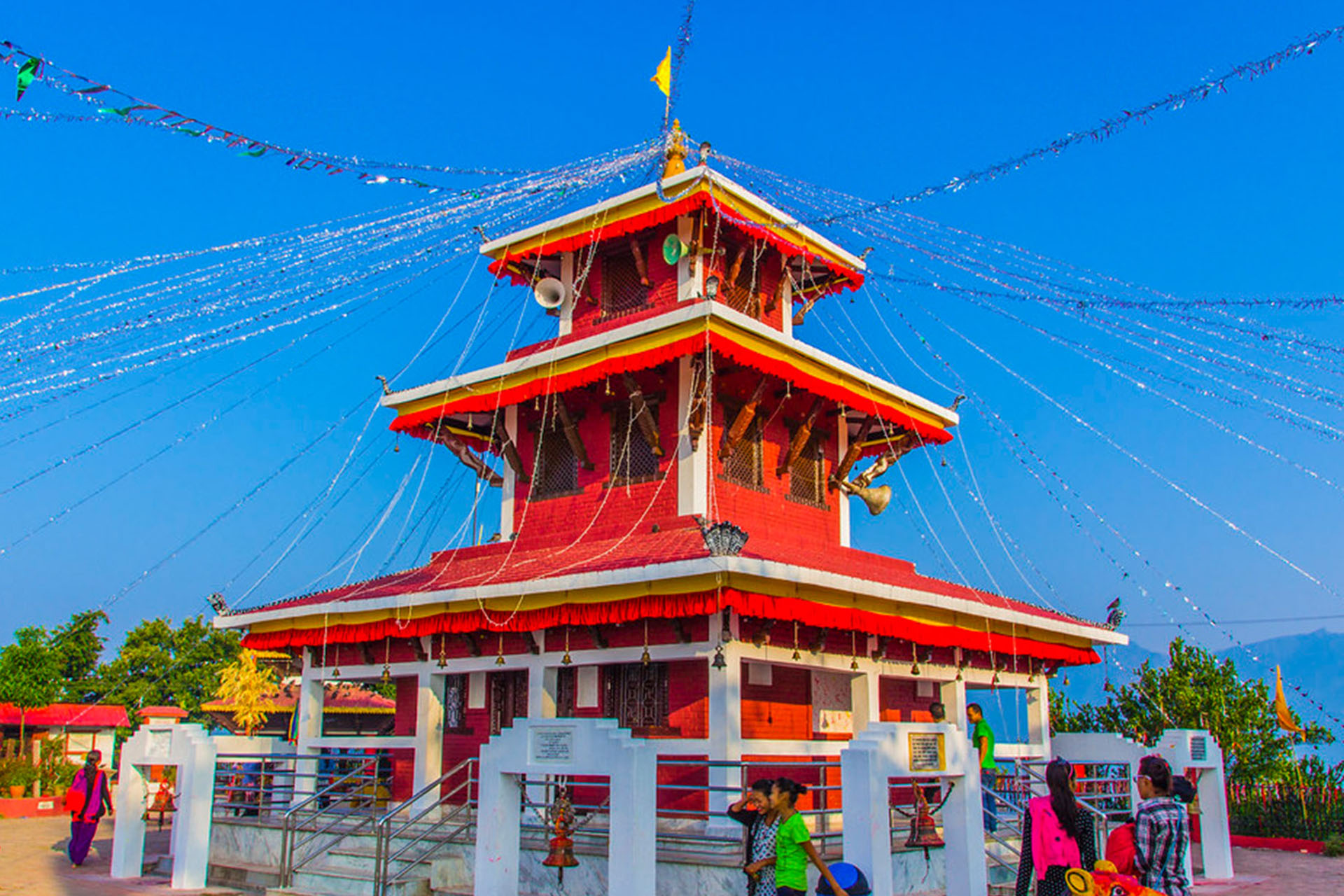
The Indreshwar Mahadev Temple is one of the largest and tallest pagoda style temples in Nepal. It was originally built over a lingam in 1294, making it the oldest surviving temple of Nepal. The roof struts embellishing the two lower stories of the temple are distinct Nepalese woodcarving and architecture. The upper section of the temple is hung with pots and pans, offerings from young married couples hoping for a happy and prosperous family life. The temple is in good condition and survived the 2015 earthquake. It is from this temple that the mystical third river of Panauti starts from leading to the Brahmayani temple across from the Tri Beni Ghats. The Indreshwar temple is kept in a very well maintained, walled in, compound which is managed by the Panauti Museum.

The non-existent, invisible part of this trident, the Lilawati River, is said to have originated from the Indreshwar Temple, located in Durbar Square. While the bottom two floors are adorned with intricate wood carvings, native to any Nepalese shrine, the top floor has endless bunches of hanging pots and pans – offerings from newly-wed couples hoping for a happy and everlasting marriage. Dedicated to Lord Shiva, the temple reflects the true essence of Newari culture and architecture in its three wooden storeys. Newars are the original descendants of the mountainous country, and their ancestors are said to have been there since civilisation started in the Kathmandu Valley.

Holding a close resemblance to the Buddhist Pagoda, but worshipping a Hindu god in its shrine, the age-old temple is a perfect embodiment of what the culture of Nepal looks like. Though scholars have dated the Indreshwar Temple back to the very late 13th century, it still stands tall and magnificent and is perhaps the most popular site in Panauti.

Other than the shrine itself, there is also a museum, a king’s palace and some other excavated brick and mortar structures scattered all across the Durbar Square, and there are some more still hidden under the earth somewhere, waiting to be dug out and explored. There is an entry fee of INR 300 for the entire place.

Other than this temple, there is also the king’s palace in Panauti’s Durbar Square, which has yet to be excavated to a larger extent in order to reveal more about Panauti. Nevertheless, there are many artifacts and remnants such as stone taps, bricks, water wells and coins found among some of the excavated sections of the palace.

The trekking route from Panauti to the colourful fluttering flags of Namo Buddha can be a charming addition to a Panauti trip. Located at 1750 metres above mean sea level, the uphill walk to the monastery takes not more than 45 minutes to one hour, depending on the speed and how many times one stops. Hikers get to see vast expanses of lush green paddy if they are travelling just before the harvest season otherwise, the sights one sees is that of farmers toiling in the fields.

Daman
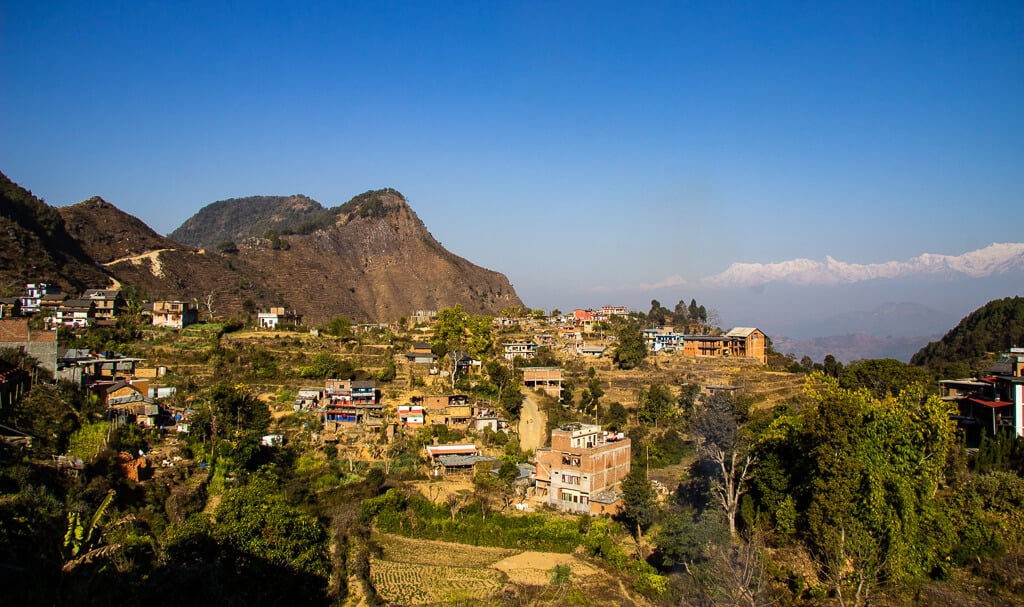
One of Nepal’s most beautiful tourist destinations, Daman lies on the Tribhuvan Highway, about 77 km southwest of Kathmandu, about halfway to Hetauda, at an elevation of 2,322 m. The town has some of the greatest views of the Himalayas, extending on a good day from Dhaulagiri in the west to Mount Everest in the east. Daman also has the Everest Panorama Resort, which includes a helipad. During winter, snowfall occurs in the hills, augmenting the beauty of the place. The Risheshor Mahadev Temple is where it is said was where Lord Shiva rested when he was mourning and lamenting, carrying dead body of his beloved wife Satidevi. Being so thirsty he just hit the big rock with his weapon, the trisula, and water came out. Even today, one can see the water flowing in between the big rocks. The main festival occurs in Fagu Purnima and Thulo Ekadashi. There is a beautiful botanical garden in Daman which is one of the biggest and oldest botanical garden in Nepal. Different varieties of Rhododendron are available here.

With many picnic spots for outings, Daman can be visited just as a one-day trip or one can stay a few days. More than 90% of the people living in Daman are dependent on agriculture and rest of them on hotel business and other. Every season has its own appeal in Daman. The springs have red rhododendrons spread all-over the mountains and in the botanical gardens as well. Autumns bring in the clearest sky of the year and perfect view of the mountains. Summers are pleasantly warm and ideal for all the hiking and biking trails. Winters in Daman are quite magical, with bone-chilling cold and snowfall – a perfect setting for Christmas. Daman is often seen as a weekend getaway with the town especially during major festivities like Diwali and Christmas. The best thing to do in Daman is to explore the town. There are multiple hiking routes, and one can find newer routes.

For the lovers of everything green, the Mountain Botanical Gardens is a must-visit place in Daman. The lawn of the garden is very well-curated and beautifully maintained. The forested area has a great collection of flora – one that you do not possibly expect in a place so secluded. During springtime, the botanical gardens get decked up in ravishing red blooms of the rhododendron – Himalaya’s most exotic blossom.

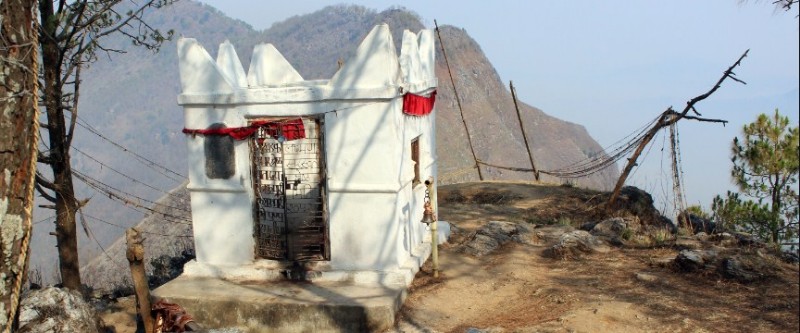
The Shree Rikheshwar Mahadev Temple is a shrine situated atop Daman, dedicated to the Hindu God of Destruction, Lord Shiva. The local people consider this temple to be very sacred and awakened, which means their wishes get granted once it is spoken to the lingam here. A common practice in Shivalinga temples is to whisper the prayers and wishes into the ear of the Nandi bull that sits guarding the sanctum. The road leading up to the Rikheshwar Mahadev Temple is even more interesting. Visitors need to hike for a short distance of 1 km on a trail covered with dense green woods.

Pokahra
Located in central Nepal, Pokhara serves as the capital of the Gandaki province and is known as Nepal’s tourism capital. It is the second most populous city after Kathmandu and the country’s largest metropolitan city in terms of area. The city also serves as the headquarters of the Kaski district. Pokhara is located 200 km west of Kathmandu on the shore of Lake Phewa, and sits at an average elevation of approximately 822 m above sea level. The Annapurna Range, with three out of the ten highest peaks in the world: Dhaulagiri, Annapurna I, and Manaslu, is within 24–56 km aerial range from the valley. In 2024, Pokhara was declared as the tourism capital of Nepal, being a base for trekkers undertaking the Annapurna Circuit through the Annapurna Conservation Area region of the Annapurna ranges in the Himalayas. The city is also home to many of the elite Gurkha soldiers. The Nepali word Pokhari means a pond, and Pokhara is a variant of Pokhari as the city has numerous ponds.

Pokhara lies on an important old trading route between China and India. In the 17th century, it was part of the Kingdom of Kaski which was one of the Chaubisi Rajya or 24 kingdoms of Nepal, ruled by a branch of the Shah dynasty. In 1786, Prithvi Narayan Shah, the last ruler of the Gorkha Kingdom and first monarch of the Kingdom of Nepal, added Pokhara to his kingdom.

The first settlement of the valley is theorised to have taken place when the first King of Kaski, Kulamandan Shah Khad, also called Bichitra Khan and Jagati Khan, made Batulechaur in the northern side of the valley his winter capital during the mid 14th century. The people settled here included Parajuli Brahmins, who were asked to look after the Bindhyabasini temple and were given some land in that locality as Birta. Dhobi Gauda was the first market center developed in Pokhara valley before the last King of Kaski brought sixteen families of Newars from Kathmandu to develop the present-day market in the 1770s. Prior to that people were settled in the peripheral hills. Pokhara was envisioned as a commercial centre by the King of Kaski in the mid 18th century when Newars of Bhaktapur migrated to Pokhara, upon being invited by the king, and settled near main business locations such as Bindhyabasini temple, Nalakomukh and Bhairab Tole. Most of Pokhara, at the time, was largely inhabited by Khas, Gurungs, Magars and Thakuris. Today the Khas, Gurung or Tamu and Magar form the dominant community of Pokhara. There is also a sizeable Newari population in the city. Batulechaur in the far north of Pokhara is home to the Gandharvas or Gaaineys who are the tribe of musicians.

From 1959 to 1962, approximately 300,000 exiles entered Nepal from neighboring Tibet following its annexation by China. Most of the Tibetan exiles then sought asylum in Dharamshala and other Tibetan exile communities in India. According to UNHCR, since 1989, approximately 2500 Tibetans cross the border into Nepal each year, many of whom arrive in Pokhara typically as a transit to Tibetan exile communities in India. About 50,000–60,000 Tibetan exiles reside in Nepal, and approximately 20,000 of the exiled Tibetans live in one of the 12 consolidated camps, eight in Kathmandu and four in and around Pokhara.

Until the end of the 1960s, the town was only accessible by foot and it was considered even more a mystical place than Kathmandu. The first road was completed in 1968 after which tourism set in and the city grew rapidly. The area along the Phewa lake, called Lakeside, has developed into one of the major tourism hubs of Nepal.

Due to the high population density and the frequency of natural disasters, western Nepal is considered one of the most disaster-prone regions in the world. Pokhara is considered particularly vulnerable to earthquakes and floods because the Seti Gandaki River flows through the city.

Pokhara lies in the northwestern corner of the Pokhara Valley, which is a widening of the Seti Gandaki valley. In this region, the mountains rise very quickly, and within 30 km, the elevation rises from 1,000 to 7,500 m. As a result of this sharp rise in altitude the area of Pokhara has one of the highest precipitation rates in the country. The Seti Gandaki is the main river flowing through the city with the river and its tributaries creating several gorges and canyons in and around Pokhara that give intriguingly long sections of terrace features to the city and surrounding areas. These long sections of terraces are interrupted by gorges that are hundreds of metres deep. The Seti gorge runs through Pokhara from north to south and then west to east; at places, these gorges are only a few metres wide. In the north and south, the canyons are wider.

In the south, the city borders Phewa Tal or Phewa Lake at an elevation of about 800 m above sea level, while north of Pokhara, the village of Lumle at 1,740 m touches the base of the Annapurna mountain range. Pokhara, the city of lakes, is the second-largest city of Nepal after Kathmandu. Three 8,000-m peaks: Dhaulagiri, Annapurna, and Manaslu, can be seen from the city while the Machhapuchchhre or fishtail with an elevation of 6,993 m is the closest to the city.

Since the 1990s, Pokhara has experienced rapid urbanisation with a result that service-sector industries have increasingly contributed to the local economy overtaking the traditional agriculture. Tourism, service sector and manufacturing contributes approximately 58% to the economy, remittances about 20% and agriculture nearly 16%.

We will be continuing learning more about this amazing city in the next part…

Travel Bucket List: Nepal Part 9

Continuing on the tour of Bhaktapur…

The Bhairavnath temple is one of the temples in Bhaktapur Durbar Square and is built in the pagoda style. The entry ticket to the Darbar Square also guarantees a visit to this temple. The temple is dedicated to Lord Bhairav, which is supposed to be the most ferocious form of Lord Shiva. Originally, the temple had just one storey which was built by King Jagat Jyoti Malla. However, in 1717, two more storeys were added to this temple by King Bhupatindra Malla. The statue of Lord Bhairav is about 12 feet long and is one of the largest statues in Kathmandu Valley. Thousands of people visit Bhairavnath temple during Bhairav Ashtami or Bhairav Jayanthi as it is celebrated religiously. Even though the temple was slightly damaged during the earthquake in November 2015, it still has retained most of its structure.

The inner part of the temple consists of the head of Lord Bhairav. There are many stories as to why and how Lord Bhairav’s head was cut off and worshipped here. According to one legend, when Sati wanted to marry Shiva, Daksha, Sati’s father, was against it and did not agree on Shiva becoming his son-in-law. One day, Daksha organised a yagna and invited everyone except Shiva. But when Daksha saw Shiva enter the yagna uninvited, Daksha got angry and killed Shiva. Hearing this, Sati jumped into the yagna fire. Shiva became very furious at Daksha and beheaded him. Then he carried Sati’s body out of the fire an danced around the world for days. On seeing this, Vishnu was afraid this would be the cause of the end of the world and transformed Sati’s body into pieces with the help of his Sudarshana Chakra. Shakti peeth emerged wherever her body pieces fell.

Another legend of this temple says that Lord Bhairav was very fond of the Lingo festival that was celebrated in Bhaktapur. It was believed that he used to come to watch the festival in a human form. When the King got to know, he wanted to capture Bhairav and keep him in the city. So, he commanded his ministers and Aachaju to look out for Bhairav. During the Lingo festival, Bhairav was caught and beheaded by Aachaju. Later, Aachaju was found feeling guilty for killing Lord Bhairav and therefore, started to worship Lord Bhairav’s head.

The Lion Gate is a 17th-century structure, created with the belief that it will protect the ancient city. The gate has two large and majestic lion statues placed on either side. The Lion Gate is located inside the Bhaktapur Durbar Square along with several other ancient buildings and artefacts, which is accessible through many well-maintained pathways. Popular belief holds the King to have chopped off the hands of the artisans who built the Lion Gate, an attempt to ensure that to Lion Gate would never be replicated. Sculptures of Lord Bhairava and his consort Goddess Ugrachandi are also installed beside the lion statues, one on each side. The legend emphasises on how significant the structure is for the locals. It thus has immense cultural significance too. A visit to check out its stunning ancient craftsmanship is highly recommended.

The magnificent Taleju temple, located in Durbar Square is dedicated to the clan Goddess of Malla kings, Devi Taleju Bhawani. Traditionally, entry into the temple was restricted to kings but has now been extended to the Hindus. It is believed that the temple was constructed in the shape of a Yantra, a form of Mandala, as was directed by the Devi herself. In the middle of Durbar Square, the temple, set atop a pedestal, is a stunning sight. The Degu Taleju Temple is not open to all. However, on the ninth day of Dasain, Hindu devotees can enter to offer prayers to the Goddess. Everyone else can explore the shrine from the outside.

Before Nepal was founded, Kathmandu was majorly ruled by the Newars who were ardent worshippers of Goddess Taleju who was believed to be an incarnation of Goddess Durga and the guardian of the kings. She is, therefore, considered to be a powerful deity and is worshipped in the region since the 14th century. The place of worship, Taleju Temple, is proof of this history and has been considered as an essential tourist attraction.

The temple is a 35-metre high monument that stands prominently on a pedestal with twelve levels or steps made of stone. On the eighth level, a wall has been built all around the shrine that acts as a compound for the temple. There are 12 smaller shrines in front of this wall. On the other side, there are four more shrines other than the main one. This ancient place of worship has traditional pagoda-style architecture with a three-tiered roof, wooden doors and window frames decorated with intricate carvings.

Located right next to the famous Durbar Square, Taumadhi square is often left unnoticed while travelling to Bhaktapur but one has to explore it in order to know about ancient legends and adore ancient architecture. The square is very popular among tourists because of the beautifully structured stones and carvings on the wood. The stone sculptures are a major attraction in this square. It represents the ancient life in Bhaktapur. Also known as Taumadi Tole, it owes much of its reputation to be the site for Nyatapola Temple, the tallest temple in Nepal towering to a height of 30 metres.

The traditional New Year celebrations are held in Taumadi Square. The idols are placed inside the chariots and the chariots are pulled by the youths. This event is followed by a tug of war between Thane and Kone, which determines who will be blessed with a good fortune. Nyatapola temple is the tallest and one of the most popular temples in Nepal. Made out of wood and bricks, this five-storey temple is dedicated to Goddess Siddhi Lakshmi. The structure and architecture of this temple are so strong that it withstood two earthquakes without causing any damage. The Til Madhav Narayan Temple is one of the hidden temples in Taumadi Square. It is often left unnoticed as it is located behind a dance platform. Inside this temple, there is the main double roof of a Narayan Temple. This is one of the oldest in the valley. An inscription in this Narayan temple denotes that it dates back to atleast 1080 AD.

Thimi
Thimi is the fourth largest town in Kathmandu Valley and is situated in between Kathmandu, Lalitpur and Bhaktapur. The Kings of Bhaktapur often called this city as Chhemi which means capable people, thus praising the people of Thimi for their constant and loyal support towards Bhaktapur. The town is a large producer of pottery and masks. Che city is filled with Newari culture and traditions. Thimi is elevated and one must climb up the valley in order to reach the city. The city was originally known as Madhyapur which translates it to ‘middle place’ which is now more often used than Thimi.

Thimi is famous for its pottery art. Chapacho, Nasanani, Tulanani, Pacho and Digutole are some of the famous pottery squares in Thimi. Bisket Jatra is celebrated every year in the mid-April to signify an end of the year and the beginning of a new year according to the calendars of Bikram Samvet. This festival is celebrated in many parts of Bhaktapur in different ways with different rituals. In this event, hundreds of people pull a chariot which consists of Lord Bhairav’s statue or there will be a number of chariots which carries Devthas (God) in them and the chariots are circulated among the youngsters. Nearly 32 chariots are circulated every year. In Bhaktapur Tamadhi, a tug of war is conducted between the upper and lower part of the city, that is, Thane and Kone.

Sindhur Jatra is a festival, when people from different parts of Thimi gather and throw coloured powders at each other while listening to Dhimay music. Neelbarahi Naach is a famous dance festival held every year in Bode. People wear various masks and dance to spiritual music. Masked people are not allowed to talk, eat or even drink water. The Layaku Bhaila Naach is a festival is performed in the month of August. The number of people taking part in this dance festival will be 5, which includes 4 youths and one child. Two out of the four youths wear masks of Lord Bhairab and the other two youths wear the masks of Daagi. The child will be a Jyapuga. The five people dance to a piece of spiritual music. Once they are done dancing, the youths start shivering and lose their sense. According to the dancers, it feels like the god himself is asking them to dance more and more. They will not be aware of what will be happening. The four youth dancers who are dancing, get hypnotised when they hear the sound of Daaga Baja, Bhusya Baja and Ponga Baja.

Thimi holds a tongue piercing ceremony where a person’s tongue is pierced by a 13-inch iron spike and he is told to walk around the city for the whole day. Many people walk around the city with the person with the pierced tongue. In the end, the person (whose tongue is pierced) must give a feast party to the ones who walked around the city with him. The legend behind this festival is that back in the days, there were man-eating demons in Thimi. The people were so haunted by these demons that they could not even walk around in the streets in the daylight. The people in the town one day requested the king to help them. The King immediately ordered the guards to catch the demons and punish them in front of Lord Bhairab. Once the demons were caught, their tounges were bored and they were made to carry 108 Dhani on their shoulders and walk around the city. Hence, this festival is celebrated even now to remind that people will be punished if they cause any trouble to other people or the country.

Dhulikhel
Located in the eastern rim of the Kathmandu Valley, Dhulikhel lies about 31 km east of the capital city at 1550 masl. Dhulikhel is a genuine Newari town and is thus the perfect place to visit if one wants to explore authentic Newari culture and heritage. The mountain bike trip from Dhulikhel to Namobuddha, a favourite tourist activity also why Dhilikhel is popular in the tourism circuit. The three-hour trek passes through the Kali Temple, then through the villages of Kavre and Faskot, and finally through a Tibetan monastery on the hilltop, below which one will find Namobuddha.

Dhulikhel boasts as a major touristic destination with attractions that range from natural scenario to cultural and historical elements. One can view the Himalayan range at an 180 degree panoramic view of mountains including Annapurna, Ganesh Himal, Langtang, Phuribichyachu, Gaurishankar, Lhotse among others. Other natural attractions include locations like Tundikhel plus cultural and religious sites like Bhagawati, Kalidevi, Gita Mandir, Gaukhureshwor.

The name Dhulikhel comes from the Nepal Bhasha word Dhali_Khela, which is the earlier form of the present Nepal Bhasha name Dhau_khyo. Dhali or Dhau means yogurt and Khela or Khyo means field in Nepala Bhasha. It is said to have come from the Lichchhi name Dhawalasrotapura. Dhulikhel was the eastern border of ancient Nepal Mandala, and it was one of the territories of Bhaktapur kingdom. Dhulikhel was among the last places to be annexed to the country by the Gorkha Kingdom that was being expanded by Prithvi Narayan Shah.

Dhulikhel is a major part of the Kathmandu Valley Cultural Trekking Trail. This five-day trail provides a short trek with Himalayas in the background and showcases a number of cultural highlights and rich biodiversity. Visits to hill stations like Chisapani, Nagarkot along with Dhulikhel will be less challenging than going to the Himalayan routes but with equal thrill and rewards. Dhulikhel is one of the starting or the middle points for hiking routes. These include walks to Panauti, Kavre village, Opi village as well as to Hazaar Sindhi all of which take as long as a half day. A longer walking route includes trail to Nagarkot and Namobuddha. The town also forms one of the points for Mountain Biking with challenging terrains as well as the site of people with rich ethnic culture and the scenery of mountain ranges along the way. Routes include Dhulikhel-Panauti, Dhulikhel-Khopasi, Dhulikhel-Palanchowk-Dhulikhel, Dhulikhel-Namobuddha-Dhulikhel.

At Dhulikhel, one can also do activities like bird and butterfly watching from various points. Hazaar Sindhi, Thulochaur Kavre, and Gosaikunda forests has as many as 72 species of birds that can be sighted. Dhulikhel is also the perfect place to stop to spend the night on the way and back from Tibet. The oldest area in the town is located in the southern end comprises of old Newari houses adorned with stunning windows and beautifully carved doors.

There are also located numerous temples in the town, including Hindu temples and a few Buddhist stupas. The Narayan Temple located in the centre of the old town with its yellow metal roofs is dedicated to Lord Krishna while the Harisidhhi Temple, also located nearby, boast of intricate wood carvings. Both the temples are fronted by two Garudas.The Bhagwati Temple, the Gaukhureshwor Mahadev Temple and the Bhagwati Kali Temple are other temples that must be visited.

Dhulikhel has been for centuries an important trading centre on the commercial route linking Nepal to Tibet. The Nepali people travel to Tibet to bring salt and gold and Tibetans, with their flocks of sheep enter Nepal during Dashain to purchase chilies and other daily necessities. Previously, walking between Kathmandu and Dhulikhel used to be a day’s walk which was easily done by the Tibetans, with an overnight stay at Dhulikhel, but after a motorable road was constructed in 1965, Dhulikhel got a face lift and developed as a tourist destination. The snowfed mountains seen from Dhuklikhel are a fine panoramic view. When a blue haze covers the lower portion of the mountains, they seem to be floating in the air. Geographically, the plains rise gradually up to the green mountains and further into the snow-capped Himalayas. The panorama offers a view of the Himalayan ranges stretching from Mount Annapurna in the far west to Mount Karolung in the far east. More than twenty Himalayan peaks including Mt. Annapurna, Mt. Ganesh Himal, Mt. Langtang, Mt. Phuribichyachu, Mt. Gaurishanker, Mt. Lhotse, and many others can be seen from Dhulikhel.
Panauti, another historical and culturally rich town located to the south east of Dhulikhel. One can reach Panauti by bus via Banepa or walk there along the trails of Namobuddha or walk along the DBP corridor. The town hosts one of the biggest festivals of Nepal, Makar Mela held every 12 years. Namobuddha is where a prince sacrificed himself for a hungry and sick tigress. This story is etched in a stone in the town. Palanchowk Bhagwati lies about a half-hour ride from Dhulikhel. The shrine is dedicated to a goddess of the same name, who is 18-armed and is the goddess of protection from danger and misfortune. The temple dates back to 503 AD. The Chandeshwori Temple is located around 1 km northeast of Banepa, and commemorates the mother goddess Chandeshwori who defeated the demon Chanda. Nala is one of the seven villages established by Ari Malla about 700 years ago, Nala boasts of temples of Karunamai Lokeshwor and Bhagawati. Located 4 km north west of Banepa, the valley is fertile and produces a number of vegetables. It can be reached from Dhulikhel through Gosaikunda Hill, Opi village and Sumara. Deriving from local language meaning village of cows, Sanga is gateway to Kavrepalanchowk district. It now has a massive statue of Lord Shiva which is 143 ft tall.

Nuwakot
Located on the banks of the Trishuli and Tandi Rivers, Nuwakot lies around 60 km west of Kathmandu, and is known as a historic town which was the capital of the Valley in the days before the unification of Nepal by Prithvi Narayan Shah. For more than 1,000 years the hilltop had served as a lookout and fort or kot guarding the western entrance to Kathmandu Valley. Nuwakot served as an important trading hub for the Malla kings of the Valley, and was along a major transit route used for trade between India and Tibet, via Kerung. The name comes from the belief that there are nine or nawa hills in the region, each of which stands for a sacred site or kort, dedicated to a particular deity. Together they look after the valley, giving Nuwakot district the name city of nine hills. This makes the Nuwakot hill the main fort including other eight forts: Malakot, Simalkot, Bhairabkot, Belkot, Kalikot, Salyankot, Dhuwankot and Pyaskot in its surrounding area, collectively named as Nawakotta or nine forts.

Because of its significance, the fort was a target for conquest by neighboring kingdoms, including the Kingdom of Gorkha. The founder of modern Nepal, Prithvi Narayan Shah attacked and finally captured the hill fort in a surprise attack on September 26, 1744. The Malla king Jaya Prakash Malla made one final attempt to get victory over Nuwakot the following year after Malla forces under Kasi Ram Thapa Magar, the chief commander of Kantipur and Nuwakot, had defeated the Gorkha army at Naldum. However, the Gorkha army was able to repel the attack and secured Nuwakot as a permanent fort under Gorkha control. Nuwakot would afterwards serve as one of the key staging grounds for the eventual conquest of all three Malla kingdoms in the Kathmandu Valley, viz. Kathmandu, Patan, and Bhadgaon, which fell between 1768 and 1769 to Prithvi Narayan Shah.

Nuwakot has featured in several prominent moments of Nepali history. Chinese forces under General Fu-k’ang-an nearly captured Nuwakot during the Nepal-China conflict in 1792. It was also the location of the first meeting between the British envoy Captain William J. Kirkpatrick and the acting Regent Bahadur Shah in 1793, shortly after the war with China ended.

The current seven-story Nuwakot Durbar and surrounding complex was expanded in the 18th century by Prithvi Narayan Shah to support the growing trade routes linking Kathmandu with India and Tibet. Built in the Malla style, the architecture of the complex is divided into the main palace, the Bhairab Temple, as well as other temples and shrines. In 2008 the site was submitted for consideration as a UNESCO World Heritage Site. Some of the temple complexes and buildings were damaged in the 2015 Nepal earthquake.
From afar, the block fortress of Nuwakot perched atop a hill looks like a painting on canvas. The road winding up to the fortress is dusty and offers a spectacular view of the valley. There is a barrack of Nepal army in front of the palace, maintaining the tradition of it being a strong holdfast. The Nuwakot fortress on the other side still stands with all its seven storeys of Newari architectural glory but with only a fraction of its strength. In front of the citadel, a beautifully curated garden marks the path to the old barracks and prison cells called Garad Ghar and the dance hall namely Ranga Mahal. They too are in a state of ruin, but the once-prominent magnificence can be observed from whatever is left. There are a couple of Vishnu shrines right in front of them.

Nearby stands the Bhairav Temple, dedicated to Lord Shiva, in his incarnation as the god of annihilation, the destructive manifestation of Shiva. The temple has similar red brick construction and a traditional Newari origin and is looked after by the local community. The smear marks of sindoor or vermillion on the ancient carved door is a mark of how revered they consider the shrine to be. A bell hangs in front of it for the devotees to pay their respects. Beyond the temple, the edge of the land offers a breathtakingly beautiful view of the western part of the valley, covered in small toyland-ish villages and rice terraces.

There is another small shrine in the region, but it is not in use anymore. Right before the Nuwakot fortress there lies the Taleju Temple on a small hillock. Built in around 1564, this is the temple for goddess Taleju, whom the Malla dynasty followed. The local tradition of worshipping a young girl as goddess Kumari Devi comes from this deity – Kumari is considered as a reincarnation of Taleju.

The Durbar Square turns into a festive arena full of colours and celebrations during the Sindure Jatra festival. It is one of the main festivals of Nuwakot, celebrated during mid-April. It marks the Nepali New Year and corresponds with the local New Year celebrations of many Indian ethnicities like Bengali, Punjabis and Tamils. It is also a harbinger of spring. The festival is celebrated by worshipping the deity of Goddess Bhairabi on a wooden chariot, singing and dancing to traditional music.

Being close to Langtang Himal, opportunities for hiking, trekking and mountain biking are within proximity of the town. In fact, the one hour climb from the bustling Trisuli Bazaar down the hill up to Nuwakot is a route that many tourists opt for.

For those looking for an even quieter mountain retreat at an even higher altitude and perfect sunrise view, Kakani is the perfect location. It is famous for strawberry farming and the memorial park for the victims of the 1992 Bangkok-Kathmandu plane crash.

Travel Bucket List: Nepal Part 8

Bhaktapur
Also known locally as Khwopa and historically called Bhadgaon, Bhaktapur, or the city of devotees lies in the eastern part of the Kathmandu Valley in Nepal, about 13 km east of Kathmandu. It is the smallest city of Nepal as well as the most densely populated. Along with Kathmandu and Lalitpur, Bhaktapur is one of the three main cities of the Kathmandu Valley and is a major Newar settlement of the country. The city is also known for its Newar tradition, cuisine, and artisans. Bhaktapur suffered heavy damage in the April 2015 earthquake.

As part of the Kathmandu Valley, it shares its history, culture and language with the other cities of the valley. Although chronicles like the Gopal Raj Vamshavali put the foundation of Bhaktapur in the 12th century, it has been the site of numerous settlements since at least the Licchavi dynasty. The capital place of Kasthamandu was Bhaktapur Nepal during the first half of Malla dynasty from the 12th century to 1482 when Nepal split into three independent kingdoms. The Malla dynasty is considered a golden period for Bhaktapur and even after its division in 1428, Bhaktapur managed to stay as a wealthy and a powerful Newar kingdom, mostly due to its position in the ancient India-Tibet trade route. In 1769, Bhaktapur was attacked and annexed into the expanding Gorkha Kingdom, which later became the Kingdom of Nepal. After its annexation, Bhaktapur remained largely isolated from other parts of Nepal which led to stagnation in the development of its economy and arts and to allowed it to remain as a homogeneous Newar city. Due to being isolated and overlooked by the central government in Kathmandu, its infrastructure and economy deteriorated and the 1934 earthquake further exacerbated the situation. Bhaktapur’s economy and infrastructure would only improve from the 1980s, largely due to tourism and aid provided by West Germany as part of the Bhaktapur Development Project.

Compared to other Newar settlements, Bhaktapur is predominantly Hindu and speaks a distinct dialect of Nepal Bhasa. The Nyatapola, a five roofed pagoda completed in 1702 is the most famous structure of Bhaktapur and along with the former royal palace, it forms the tourism center of Bhaktapur. The city is also famous for its numerous festivals and carnivals like the spring festival of Biska Jatra and the carnival of Saparu or Gai jatra, both of which are significant part of the local culture and contribute well to tourism. Bhaktapur is also called Nepal’s Music and Dance capital due to presence of over 200 types of traditional dances, most of which are masked dances and exept for a few, are a part of the annual carnival of Saparu. It is also famous for its cuisine with the juju dhau, a type of yogurt made from buffalo milk being the most popular. Bhaktapur’s potters and handicraft industries are also known nationwide. Due to its well preserved medieval nature, UNESCO inscribed Bhaktapur as a World Heritage Site since 1979.

The present day name of the city in Newar, the indigenous language of Bhaktapur is Khwopa. This name is derived from Khopring, a term that can be traced to an early form of the Newar language. The oldest instance of the name Khopring is from a Licchavi dynasty inscription from 594. The term Khopring is a combination of two words from an early form of the Newar language, kho and pring which translate to cooked rice and village, respectively. Bhaktapur boasted fertile soil conducive to rice cultivation, making it a significant rice-producing area. Consequently, the city was aptly named after its primary agricultural output. The city was also sometimes referred as Bhaktagrama instead of Bhaktapura where grama denoted a village as opposed to pura which denoted a town in Sanskrit.

By the 11th century, Khopring had evolved to Khwopa as the term appeared for the first time in a manuscript from 1004. Similarly, the Gopal Raj Vamshavali written in the 14th century refers to the city as Khwopa and in some pages of the manuscript as Khwopu and Swopa. The term Khwopa was used to describe the city in almost all of the inscriptions, manuscripts and documents from the Malla dynasty.

After the conquest of Bhaktapur by the Gorkhali armies of Prithivi Narayan Shah in 1769, Bhaktapur was started to be referred as Bhatgaon, the Khas translation of Bhaktagrama. The name Bhatgaon was used until the 1930s when Juddha Shumsher Rana, after witnessing the numerous temples in the city and the devotion of the locals towards it, decreed that the city should be referred as Bhaktapur or the city of devotees instead of Bhatgaon. However, many scholars and people from outside Bhaktapur used the name Bhatgaon till the late 20th century.

Bhaktapur’s oldest hiti is also dated from the Licchavi dynasty. It is said that the Rajkulo canals, which supply water in hitis were built and managed by Tula Rani, a mythical queen who is believed to have lived in Bhaktapur during the Licchavi dynasty. In folklore, Tula Rani made and repaired the Rajkulo canals, as she is said to only weigh a single tola, or 11 grams, and hence float on water.

In legends and chronicles, Ananda Deva, who ruled Nepal Mandala from 1146 to 1167 is credited to have established the city of Bhaktapur. Since there were already settlements in Bhaktapur like Mākhopring and Mākhoduluṃ during the Licchavi dynasty, it was more likely that Ananda Deva unified these smaller settlements into a single unit. Because Bhaktapur lay on the trade route road taken by merchants going to Tibet, its size and population continued to grow by the 12th century. Ananda Deva also established a royal court named Tripura Rajkula in the central part of Bhaktapur and declared it as the new capital of Nepal. Bhaktapur was chosen as the new capital because of its geography. It is situated on top of a small hill and the hill itself is surrounded by the Hauman river in the south and the Kasan river in the north, making it easier to defend during a foreign invasion. Ananda Deva is also credited with the establishment of shrines of the eight Matrikas, known as Ajima in Nepal Bhasa, on the edges of the city proper, due to which Bhaktapur is regarded as a sacred Mandala. In Bhaktapur, there are nine Matrikas instead of the traditional eight and the shrine of ninth goddess, Tripura Sundari, who is considered the leaders of the Matrikas of Bhaktapur, was established in the central part of the town with the goddess acting as the focal point of the mandala.

As Bhaktapur became the seat of the government, it also became the target for numerous foreign invasions. The main reasons for these attacks was the internal division among the royal family of Nepal. Soon after Ananda Deva’s death, a new royal house emerged from within. Believed to have been started by Ari Malla, they used Malla as their surname replacing their ancestral surname, Deva. When the conflictions between both houses worsened, the House of Tripura sought help from Tirhut while the House of Yuthunimam sought help from Khasa Kingdom. Thus, both of these kingdoms started interfering in the internal politics of Nepal. In the 1310s, the monarch Rudra Malla in order to improve Nepal Mandal’s relation with Tirhut married off his sister Devaladevi to the Tirhut king, Harisimhadeva.After the marriage, the relation between the two kingdoms smoothed and Tirhut’s attack on Nepal ceased.

In 1349, Nepal suffered one of the most devastating attack in its history. Shamsuddin Ilyas Shah, the Sultan of Bengal and his armies plundered the Nepal Valley for a week in the winter of 1349. Bhaktapur suffered the most from this attack as not only it was the capital at that time, the city was also in the eastern part of the valley, the same direction the 20,000 forces came from. After the invasion, which destroyed much of the city, Bhaktapur was entirely rebuilt under Devaldevi, who like Ananda Deva, did so on the basis of Sanskrit treatises in architecture. The layout of the old part of the city has remained mostly the same since then. In November 1769, Bhaktapur was attacked by and after suffering a heavy loss eventually surrendered to the expanding Gorkha kingdom which became the Kingdom of Nepal.

After its defeat in 1769, Bhaktapur lost most of its political and cultural importance to Kathmandu and Lalitpur, the capital of the newly formed Kingdom of Nepal. The great earthquake of 1833 and 1934 damaged most of the city including the palace and temples. In the earthquake of 1833, Bhaktapur suffered the most damage in the Kathmandu Valley. When the 8.0 magnitude earthquake struck in 1934, Bhaktapur was one of the most affected towns of Nepal. Almost all the buildings in Bhaktapur Durbar Square were heavily damaged and around 177 heritages were completely destroyed.Many of the Malla era temples and palaces of the city like the Basantapur Lyākū, Chaukot Lyākū and Thanthu Lyākū were completely destroyed in the earthquakes and many of them were never restored and the few that were, were reconstructed in a Mughal style stucco dome by the Ranas. The economy of Bhaktapur which had already been struggling after losing the flow of Tibetan traders was greatly crippled by the earthquakes of 1833 and 1934. The earthquake permanently damaged the Rajkulo canals that had been providing fresh water to the city since the time of the Mallas. An economically struggling Bhaktapur was unable to repair these canals and as a result fresh water became scarce in the city. The sanitation level of Bhaktapur became severely low and poverty and diseases became rampant.

In the 1950s, when the Rana dynasty ended and Nepal was opened up to the outside world, Kathmandu and the other cities around it like Patan saw a big rise in urbanisation and population. However, Bhaktapur was farther away from the capital and was left out from the development that occurred in the other cities of the Kathmandu Valley. Bhaktapur was also greatly isolated and ignored by the central powers. When a new highway was built, it completely bypassed the city and instead ran through the outskirts. Bhaktapur was the poorest city of Nepal in the 20th century. The Rajkulo canals that provided fresh water was never repaired and sanitation level was very low. Diseases were rampant and greatly affected the farmer majority population of Bhaktapur couldn’t afford modern medicine. Under the Bhaktapur Development Project which was funded by West Germany, the city’s physical infrastructure and heritage sites were all revitalised and tourism became a major source for Bhaktapur’s economy.

Once home to the Bhaktapur royal family and a UNESCO World Heritage Site today, the Bhaktapur Durbar Square is locally known as Khwopa or the ancient Newa City. The complex is made up of four squares: Taumadhi Square, Durbar Square, Pottery Square, and Dattatreya Square. Located about 13 km east of the Kathmandu Valley, it is often visited from Kathmandu. The square is a massive display of traditional Newari architecture with every building a work of art. The square was severely damaged in the 1934 and 2015 earthquakes and most of the ancient architecture suffered, and several buildings, statues, and structures were destroyed.

Bhaktapur Durbar Square comprised of buildings, temples, statues, etc. all belonging to the 18th century. The Royal Residence or Palace is located at Durbar Square, which was initially situated at Dattatreya Square. The remaining buildings are spread across the rest of the site. Here, one can see well-preserved 17th and 18th century Newari, traditional pagoda and shikhara style of architecture. There is extensive use of wood and stone that bear beautiful carvings depicting stories and mythical creatures of the time. The square is open daily from 7 am to 7 pm and entry fees are NPR 1500 for foreigners, NPT 500 for SAARC and Chinese citizens and free entry for Nepalis.

The Palace of Fifty-Five Windows was built by King Jitamitra Malla for his 55 wives, with one window for each of them. The palace dates back to the 18th century. Apart from this, the king also laid down the foundation stone for another iconic structure in the vicinity – the Nyatapola Temple. The inside of the palace has been closed for visitors for many years now. The Golden Gate, also called Sun Dhoka, is the entrance to several inner courtyards around the palace. The Golden Gate is one of the most lavish and important artefacts in Nepal. There is also a holy pool near the palace called Naga Pokari which is believed to be used by goddess Taleju for daily ritual baths. It was built like a water tank and it is encircled by a cobra.

Siddha Pokhari is an artificial rectangular pond located near the main gate of Bhaktapur Durbar Square. It is one an old and traditional Nepali ponds. Also known as Indra Daha, it was built in the 15th century during the rule of King Yakshya Malla. Siddha Pokhari is also called by the name Ta-Pukhu. The pond is surrounded by buildings, however, one can also spot snowy mountain peaks on a clear day. Ta Pukhu is a popular place for locals as well as tourists and they can often be seen feeding the fish with food bought from stalls nearby. A large fair takes place every year on the day of Ashwin Krishna Dwithiya. The devotees come here to dip into the holy water and worship goddess Indrayani and believe they will be blessed with health and happiness. The entire pond will be decorated with lamps during this day. There will be idols of Shaiva, Shakti, Baishanv and Buddha near the pond.

Changu Narayan is a synonymous word with both the old Nepalese temple and the village that surrounds it and is Nepal’s oldest temple with an authentic Newari style of architecture. With its two-storey brick-red edifice, the temple is perches atop a hill which is also called Changu or sometimes Dolagiri. Dedicated to Lord Vishnu, the temple houses several of his avatars and other deities.

One of the legends about the temple is about a cow herder. The cowheard bought a cow from Sudarshan and used to take it for grazing in the pastures of Kathmandu valley. One day when the cow went to one of the trees in the Champak forest, she gave very little milk, compared to the other days when she produced milk in large quantities. Helpless, the cowherd asked help from the man he brought the cow from, but he too could not solve the problem. One day they saw a small boy coming out of that particular tree and drinking milk from the cow. Thinking him to be a reincarnation of the devil, they cut down the Champak tree immediately. As the tree started bleeding out, they felt they had made a grave mistake by taking a life.

That is when Lord Vishnu arrived in front of them and said that it was not their fault as he was himself cursed for killing Sudarshana’s father while hunting, though unintentionally. Thus, he had to roam around the earth on his mount Garuda. When they cut the tree, they beheaded his earthly incarnation, thus freeing him from the bound of the curse. Knowing this, the two mortals started worshipping Lord Vishnu then and there. The priests of Changu Naraya temple are said to be Sudarshan’s descendants and the conservators to be the bloodline of the cowherd. The other legend is a local one, where it is believed that 400 years ago a mighty warrior of the valley named Pranjal was defeated here by another Nepali warrior called Changu. He won over the hearts of the Nepali people, and they built Changu Narayan to pay tribute to him.

The Changu Narayan temple has a unique architectural style. It is neither built in the Shikhara or the Pagoda styles, but purely Newari. The main shrine right in the middle of the temple premise has four gates. Each of them is guarded by pairs of holy animal gargoyles – lions, elephants, sarabha and Garuda himself. Among these, the one guarded by Garuda on the western side is the main gate. The four symbols of Vishnu – chakra or disc weapon, khadga or the weapon that replaces the traditional mace in Vishnu idols, kamal or lotus bud and shankha or conch shell are carved meticulously. These stone pillars are the one with the inscriptions of King Manadeva. This is considered as the oldest written inscription text in Nepal at present. Inside, the idol is of Vishnu Narayan in his Preserver of the Universe avatar. The exteriors of the temple are equally impressive. Around the courtyard of the temple, all ten avatars of Vishnu are prominently displayed in authentic Newari style. At the southwest corner, he is Narsimha – his man-lion incarnation and as Vikaranta or Vamana – his dwarf manifestation who later becomes a giant.

The 1500-year-old, ten-headed and ten-armed stone carving of Vishnu is a unique piece not seen in other Hindu temples. The Garuda Narayan idol where Vishnu rides on his vahaan as per the curse of the legend is also glimpse-worthy. Other shrines in Changu Narayan temple complex includes the headless Tantric goddess Chhinnamasta, Kileshwor shrine for Lord Shiva, Ashta Matrika temple and a small shrine for King Bhupatindra Malla and his queen Bhuvanlaxmi near the main entrance.

Nyatapola Temple is an 18th-century temple, the tallest building in the valley and the tallest temple in the country. The temple was built in 1702 and is dedicated to Goddess Siddhi Lakshmi, an incarnation of Goddess Parvati. The idol of the Goddess, which is installed in the sanctum sanctorum, is believed to be extremely fearsome. Although only the temple priests enter the sanctum sanctorum, visitors can explore the rest of the temple. The monument has survived two major earthquakes in the region and has suffered minor damages. It is also, therefore, known for its structural strength.

The temple was built during the reign of King Bhupatindra Malla who ruled Bhaktapur between 1692 and 1722. The temple has traditional pagoda-style architecture with a five-storey roof that makes it a strikingly tall building in the region. It took about seventeen months to build the temple during the time. The Goddess it is dedicated to is believed to be Tantric and hence, is also called Tantric Lakshmi. The temple is placed over five platforms or terraces built one on top of the other. Right in the middle of the yard, a stone staircase stretches leading to the temple entrance. Each level has stone statues of mythical protectors, elephants and tigers on either side. Inside, there is a sanctum sanctorum where the idol of the Goddess is placed. Across the remaining temple, Goddess and legendary incarnations in relation the goddess are carved.

According to a legend, Lord Bhairava or Lord Shiva was once causing havoc in the region. Seeking help, the people called upon Goddess Parvati to help them. The Goddess appeared in the avatar of Siddhi Lakshmi. She is said to be more potent than Lord Bhairava and carried him to control him. The temple was thus built in her honour. And because she is believed to be stronger than Lord Bhairava, her Temple was made to be sturdier and taller than the Bhairava Temple located nearby.

The Doleshwar Mahadev Temple is located 20 km from Kathmandu and is dedicated to Lord Shiva, believed to be 4000 years old. It is believed that visiting the Doleshwar Mahadev, Pashupatinath and Kedarnath temples will wash off one’s sins by receiving blessings from Lord Shiva.

We will continue learning more about Bhaktapur before checking out other cities.

Travel Bucket List: Nepal Part 7

Kirtipur
Another ancient city in Nepal, Kirtipur is the home base of the Newars, who call it Kipoo. It is located in the Kathmandu Valley, 5 km south-west of Kathmandu. The city was listed as a tentative site for UNESCO in 2008.

The name Kirtipur comes from the Sanskrit terms Kirti or glory and pur or city as well as the Kirat Kingdom of Yalamber’s dynasty. The colloquial term used for the city is Kipoo. Originally a Newar foundation, Kirtipur is still a centre of Newar culture. The southern part of Kirtipur is surrounded by the ChampaDevi Hill. On Nepali new Year or Bishak 1, people round the Kathmandu Valley hike up to the hill. It has many temples, gumbas and churches. Due to the presence of Tribhuvan University, Kirtipur is a popular area for out-of-town students and professors to rent houses and they are major contributors to the local economy.

Kirtipur’s history dates from 1099 A.D. It was part of the territory of Lalitpur at the time of the invasion of the Kathmandu Valley by the Gorkhali king Prithvi Narayan Shah in the 18th century. Kirtipur has initially been the capital of the Kathmandu Valley and was always known to be a land of rebels. King Prithvi Narayan Shah invaded the town in the 18th century when it was a part of Patan, and eventually, Kirtipur broke away and became a separate kingdom. In 1767, Kirtipur was annexed to the Gorkhali kingdom by Prithvi Narayan Shah following the Battle of Kirtipur. He conquered the town on his third attempt, after entering it by trickery. After this, he cut off the noses of the people, both male and female, over 13 years of age in the city. In 1767, the town was brought back again into the kingdom, after 23 failed attempts by the King to conquer it. These battles, later on, came to be known as the Battle of Kirtipur. As an aftereffect of these battles, the town became an anti-monarchy due to the negligence of the administration and lack of development under the former monarch. Consequently, in 2006, Kirtipur again became the hub of an uprising against the monarchy in Nepal.

Offering a breathtaking panoramic view of the valley, the town hides some of the best Newari restaurants in the valley. Being vehicle free, the town is well safeguarded and is ideal for strolling and wandering in the mornings and evenings.

The Bagh Bhairab Temple is one of the most popular temples dedicated to the angry incarnation of lord Shiva in the form of an angry tiger. This deity is regarded as the guardian of Kirtipur and the locals call it Ajudeu, a grandfather god. Bhairab, the most terrifying and awful form of Shiva, is the destroyer on one hand and the guardian on the other. Ceremonial rituals in relation to the important events of life such as rice-feeding, puberty, marriage and even the construction of houses cannot be done without propitiating this deity in most of the towns and cities of Nepal.

Bagh Bhairab is mainly worshiped by the Munsi Newars. Each of the male family members, on a yearly basis, are supposed to take the chest of Bagh Bhairab turn by turn and keep it in a secret room and worship it twice a day. It is believed that any wrong method applying for worship might curse the individual. Denial for taking the chest home accounts for a fine equivalent to US$2000.

The present three-storeyed temple of Bagh Bhairab, probably built in the 16th century, stands in the brick-paved rectangular courtyard with rest houses around it. Some small shrines and stone idols are spread over the courtyard. The main gate is at the southern side of the courtyard. There are two other gates on the eastern and western sides. The two roofs of the temple are made of tiles, while the third is covered with gilt copper. Wooden posts with the carvings of Hindu gods and goddesses adorn the temple in addition to supporting its roof. They have been installed in between windows of the second storey, and the names of the carved deities have been finely cut out below them on the pedestals.

There are eighteen pinnacles: one on the first roof, six on the middle and eleven on the top. Beneath the eaves of the first roof there are very old but faded murals depicting the stories of Ramayan. Maha Bharat and the various manifestations of Durga, the mighty goddess. These paintings are frescoes in red with white plaster background. At the right side of the main gate of the temple there is Hifa Dyo, the god of blood sacrifice is allowed directly to Bagh Bhairab, all animal offerings here are made to this deity just like the animal sacrifices are made to Kumari, a stone idol, placed at the second gate in the left side of Chandeswori in Banepa and to the Chhetrapal which is at the very beginning of the final series of the steps to the temple of Khadga Jogini in Sankhu.

There are two torans over Hifa Dyo. They bear very fine cuttings of Asta-Matriks, Asta-Bhairabs and other gods and goddesses. In the western wall of the temple there is a hollow space regarded by the local people as Nasa Dyo, the god of music and dance. Bagh Bhairab made of clay has been enshrined in the left side corner in the temple. The three glass-eyed tiger-god is tongue-less and tooth-less but covered with silver and copper plates and heavily ornamented. This deity as mentioned in the stone inscriptions has been called Bagheswor or the tiger god, Bhimsen Bhattarak or the governing deity, Gudei Sthanadhipati or the lord in the form of tiger and Ajudyo, the ancestral god. Locals regard this deity as the embodiment of prudence, knowledge, productivity and strength to resist all evils. Hence, the auspicious ceremonies such as weddings, Bratabandha or the rite of passage for adolescent boys, Pasni or the rice-feeding ceremony and other ritual performances in Kirtipur are done only after a ceremonial worship to this deity.

Chilancho Stupa is a Buddhist shrine is situated on the southern hill. Built by Emperor Ashoka back in 1515, Chilancho Vihar or monastery is situated on the eastern side of Kirtipur. Constructed in the medieval period, it has an inscription of Nepal Samvat 635 or the Licchavi period. It is one of the most important historical stupas of this region. In Nepal Bhasa, the word Chilan means immortal and the word Cho means Hill. Therefore, its literal meaning is the immortal god situated on the hill. The stupa is about 9.0-10.5 high on a quadrangular base. On all four sides, there are small chaityas. The dome is plastered white.

The Uma Maheshwor Temple, locally known as Kwacho Dega, is one of the important heritage sites of Kirtipur. This pagoda-style three-storied temple is situated at the highest point of Kirtipur at 1414 m . Since this temple is at the top of the hill, one can enjoy picturesque view of the Kathmandu valley and mountains like Langtang, Dorge Lakkpa, Chobhu Bhamure, and Gaurishankar. The temple was constructed in 1655 A.D. by Rautra Vishwanath Babu, a son of King Sidhhi Narsinga Malla. It was destroyed in an earthquake in 1832 A.D. After remaining dilapidated for about a century, it was restored in 1933 A.D. after it was again destroyed by an earthquake. The restoration process was completed only in 1982.

There is an artistic stone gate at the entrance. On each side of the stone staircase leading to the temple is a stone elephant, with sculptures of Bhimsen and Kuber as protectors of the temple. The main deities in this temple are standing Lord Shiva and Parvati. There are other images of deities like Sarasvati and Mahismardini on false doors around temple. The wooden doors, pillars, and beams are crafted with artistic figures of different gods and goddess such as Astamatrika and Asta Bhairav. Similarly, erotic figures are also carved in wooden beams. According to archeologists, these figures on beams have tantric values. The bell on the northern side of temple was cast in 1895 by Gillett & Johnston Founders, Corydon. It was one of the four quarter bells of Ghantaghar of the central Kathmandu and was reallocated to this temple after the Ghantaghar was destroyed by the earthquake in 1933.

The primary water source of Kirtipur is Dev Pukku, which is fed by underground water. Visitors can also see the well preserved Royal Palace here, to the left of the tank. Other than this, the courtyard of the Bagh Bhairab Temple is also fantastic and well maintained, and is a must visit. The Naya Bazaar or the New Market is located at the foothill, and this is where all trading and commerce take place. The market also houses the Thai style Theravada Buddhist Temple.

Nagarkot
Located 28 km northeast of Kathmandu, Nagarkot offers one of the best views of the Himalayas in the entire region as it is on an altitude of 2000 m. Perched at the edge of Kathmandu Valley, Nagarkot gives one of the widest panoramas of the Himalayan ranges – one can spot eight out of the 13 Himalayan ranges from there. The Annapurna, Manaslu, Langtang, Jugal, Everest, Numbur, Ganesh Himal and the Rolwaling ranges can be seen from Nagarkot on a clear day.

An erstwhile summer retreat of Nepali, Indian, and British royalty, this village rose to fame recently after being rediscovered by tourists. The idyllic village sits serenely in the midst of nature; the only sounds are the birds chirping and the breeze whistling through the pines.

For nature lovers and outdoor enthusiasts, there are many hiking opportunities in and around Nagarkot. Among them, the Nagarkot eco trail along with the Nagarkot panoramic hiking trail are the most popular ones. It is also possible to do paragliding with Everest view in Nagarkot. Situated in a strategic location, Nagarkot was an ancient fort of the Kathmandu valley built to monitor the external activities of other kingdoms. Later, it became a summer retreat for the royal family before becoming popular as an international hill station.

Completed in 2011, the Kailashnath Mahadev Statue in Sanga is the world’s tallest Shiva statue and the second tallest Hindu deity statue after Bali’s Garuda Wisnu. The iconic 144-feet-tall structure presents Lord Shiva in the hand gesture or mudra of blessing, surrounded by 12 Shiva lingams, and is made of copper, concrete, zinc and steel. The views of the Himalayas and Kathmandu Valley are alone worth the hike to the statue.

At an elevation of 2,195 metres, Nagarkot commands magnificent panoramas of the Himalayas, Everest and Kathmandu Valley, particularly at sunrise. With eight ranges visible from town, namely Annapurna, Manaslu, Ganesh Himal, Langtang, Rolwaling, Numbur, Mahalangur and Jugal, there are fantastic sunrise viewpoint hikes in Nagarkot. The most famous spots include Nagarkot Nature Trail, and Nagarkot Geodic Survey Tower, best visited between 5 and 5:45 am.

The Nagarkot View Point Tower or Geodic Tower, offers a 360-degree vista of eight Himalayan mountain ranges and is considered the town’s best sunrise viewpoint. This observation deck sits at the end of an hour-long east trek and has a steel staircase one can climb for views of Everest, terraced farms, villages, pine forests, and national parks. Binoculars are recommended.

The first half of the larger Nagarkot Panoramic Hiking Trail, Nagarkot Nature Trail, is a six-kilometre-long leisure walk circuit in the Himalayas. This initial trail is a 1-hour walk, running through a coniferous forest with tall pines overlooking rolling valleys, villages and terraced rice farms, and is less steep than the remainder. It starts from Danda Gaon and ends at Kartike Village.

The Nagarkot Panoramic Hiking Trail is a 12-kilometre-long hike famous for rewarding views of the Himalayas, countryside, villages and rice terraces. It includes the Tamang Village Walk and the Nagarkot Nature Trail and can be covered on foot in under 3.5 hours. In addition, there is a viewpoint explicitly built to watch the sunrise over Everest. Hikers would make one whole loop of the villages and coniferous jungle on this trail.

Commanding some of Nepal’s most awe-inspiring views of the Himalayas, the Nagarkot Buddha Peace Park Hiking Trail is a leisure hike from Nagarkot town to Buddha Peace Park. The trail is eight kilometres long, leading through pine jungles, quaint villages, viewpoints and terraced plantations in the mountains. At the end is a massive golden Buddha depicting “Bhumisparsha Mudra” amidst manicured gardens.

Amidst the snow-tipped Himalayas and valleys out of the crowded city area, paragliding in Nagarkot offers a quintessential adrenaline rush and views of Everest. The takeoff site is Lapsiphedi at an elevation of 1,905 metres, from where one can paraglide past the Annapurna, Manaslu, Ganesh Himal, Langtang and Jugal ranges with their professional guide pilot. Tandem paragliding lasting 30 minutes costs around NPR 10,224.

Chitlang
An ancient Newari village, Chitlang is surrounded by the Chandragiri hills, and is acclaimed as one of the most popular stops in the old trading routes from Tibet to India. Chitlang also serves to be the most preferred destination from Kathmandu for hiking as it is home to more than 100 species of birds, making it a haven for ornithology.

Inscriptions dating back to the Lichchavi era have been found there. Among historians, there was confusion of whether Licchavi King Udaydev was throned there or not but the inscriptions at Ganeshthan of Chilang Village proved that he was made king at that time. According to an inscription found in Toukhel, Amshubarma had given the land to shepherds and established a settlement for shepherds there, Nhulgaun and Kunchhal of Chitlang. Some historians believe that these people, called Gopalis are the descendants of rulers of the Gopal era.

The trail in Chitlang came to be known as the Rolls Royce trail. In 1900s automobiles were only for the royalties and rich aristocrats and foreign dignitaries, and this trail was used to for their transportation, that too not on wheels, but on bamboo poles borne by 60 porters, while hymning the Nepalese cry- ‘hoste- hainse’. In 1940 porters carried a 1939 Daimler-Benz gifted to King Tribhuvan by the then German Nazi Leader Adolf Hitler. The vintage car is kept on display at the Narayanhity Palace Museum.

Chitlang hosts multiple cultures, including the Tamang, Khas, Newar and Brahmin. Chitlang celebrates many Jatras and festivals throughout the year, inheriting the culture of Patan as once it was under rule of Lalitpur or Patan principalities in the Malla era and of Kathmandu as it is proximate to it. The dominant religion of the village is either Hinduism or Buddhism. During the Red Machhendra Nath Jatra at Lalitpur, Puja used to be collected from Chitlang village too. A small temple of Karunamaya or Machhindra Naths still stands at North East to Tahaphale of Chitlang. Similarly, showing its connection to Kathmandu, it celebrates the yemba thanegu festival similar to small scale Indra jatra of Kathmandu. Kartik Purnima Nach is the most popular cultural event in Chitlang. It is basically celebrated on the day of Tripurari Poornima, which is believed to be when Lord Shiva defeated Tripurasura. In Nepal, this celebrated with a religious dance.

Located just off the main street of Chitlang, the Swochhanda Bhairab Temple is an important place of worship for the locals. It is quite a calm spot and is off the radar for most tourists but still worth a visit. Resembling seven taps set in stone, Satdhara is another popular place to visit in Chitlang. It is a small trek of about an hour to get to these falls. One can witness the true Newari culture and customs while there. A scenic, open plain set against the backdrop of mountains, Bhedafarm is purported to be Nepal’s largest ground. Located close to the Markhu and Kulekhani villages, it has been used as a backdrop for a few film songs as well. At the topmost point of the Lamicchane village lies Shikhardham, which is a well-known Brahmin settlement popular for its Shiva Temple. It is said that one can get a glimpse of the Brahmin way of life here and it is nonetheless, a scenic outpost to admire the valley.

Home to the widest manmade lake in Nepal – the Indra Sarobar Lake – Markhu and Kulekhani are remote villages that still look like a land lost in time. Daily buses run here from Kathmandu and the drive through the mountain pass is a bit scary albeit scenic. It is common to do a day hike here from Chitlang and takes about 3 hours. There isn’t much to do as such, except enjoy the landscapes.

Travel Bucket List: Nepal Part 6

Lalitpur
Lalitpur Metropolitan City, also known as Patan, Yala, and Manigal, is Nepal’s fourth most populous city. Located in the south-central part of Kathmandu Valley, about 8 km south of Kathmandu, across the river Bagmati, and lies at an altitude of 1,400 m. It is best known for its rich cultural heritage, particularly its tradition of arts and crafts. Tourism is an important part of the city’s economy and it is renowned for its festivals and feasts, ancient art, and the making of metallic, wood and stone statues. Lalitpur is also home to Patan Durbar Square, which has been listed by UNESCO as a World Heritage Site.

One of the most used and typical Newar names of Lalitpur is Yala. It is said that King Yalamber or Yellung Hang named this city after himself, and since then, the city has been known as Yala. There are many legends about its name. The most popular one is the legend of the god Rato Machhindranath, also known as Bunga Dyah, who was brought to the valley from Kamaru Kamachhya, located in Assam, India, by a group of three people representing the three kingdoms centered in the Kathmandu Valley. One of them was called Lalit, a farmer who carried Lord Rato Machhindranath to the valley to overcome the worst drought in the valley. There was a strong belief that the god Rato Machhindranath would bring rain in the valley. It was due to Lalit’s effort that the god Rato Machhindranath was settled in Lalitpur. Many believe that the name of the town is kept after his name Lalit and pur meaning township. In May, a chariot festival honoring the deity known as Bunga Dyah Jatra is held in Patan. It is the longest and one of the most important religious celebrations in Patan. During the month-long festival, an idol of Rato Machhendanath is placed on a tall chariot and pulled through the city streets in stages.

Lalitpur is believed to have been founded in 249 BC by Emperor Ashoka and was further expanded by the Mallas during the medieval period. Later Lalitpur is said to have been re-established by King Veer Deva in 299 AD, but there is unanimity among scholars that Patan was a well established and developed town since ancient times. Several historical records including many other legends indicate that Patan is the oldest of all the cities of Kathmandu Valley. According to a very old Kirat chronicle, Patan was founded by Kirat rulers long before the Licchavi rulers came into the political scene in Kathmandu Valley. According to that chronicle, the earliest known capital of Kirat rulers was Thankot. Kathmandu, the present capital was most possibly removed from Thankot to Patan after the Kirati King Yalamber came into power sometimes around second century AD.

The Licchavi era was followed by the Malla era. Rulers from Tirhut, upon being attacked by the Delhi Sultanate, fled north to the Kathmandu valley. They intermarried with Nepali royalty, and this led to the Malla era. The early years of the Malla era were turbulent, with raids and attacks from Khas and Turk Muslims. There was also a devastating earthquake which claimed the lives of a third of Kathmandu’s population, including the king Abhaya Malla. These disasters led to the destruction of most of the architecture of the Licchavi era (such as Mangriha and Kailashkut Bhawan), and the loss of literature collected in various monasteries within the city. Despite the initial hardships, Kathmandu rose to prominence again and, during most of the Malla era, dominated the trade between India and Tibet. Nepali currency became the standard currency in trans-Himalayan trade.
During the later part of the Malla era, Kathmandu Valley comprised four fortified cities: Kantipur, Lalitpur, Bhaktapur, and Kirtipur. These served as the capitals of the Malla confederation of Nepal. These states competed with each other in the arts, architecture, esthetics, and trade, resulting in tremendous development. The kings of this period directly influenced or involved themselves in the construction of public buildings, squares, and temples, as well as the development of waterspouts, the institutionalisation of trusts, called guthis, the codification of laws, the writing of dramas, and the performance of plays in city squares. Evidence of an influx of ideas from India, Tibet, China, Persia, and Europe among other places can be found in a stone inscription from the time of king Pratap Malla. Books have been found from this era that describe their tantric tradition like Tantrakhyan, medicine like Haramekhala, religion like Mooldevshashidev, law, morals, and history. Amarkosh, a Sanskrit-Nepal Bhasa dictionary from 1381 AD, was also found. Architecturally notable buildings from this era include Kathmandu Durbar Square, Patan Durbar Square, Bhaktapur Durbar Square, the former durbar of Kirtipur, Nyatapola, Kumbheshwar, the Krishna temple, and others. In 1768, Lalitpur was annexed to the Gorkha Kingdom by Prithvi Narayan Shah without any battle.
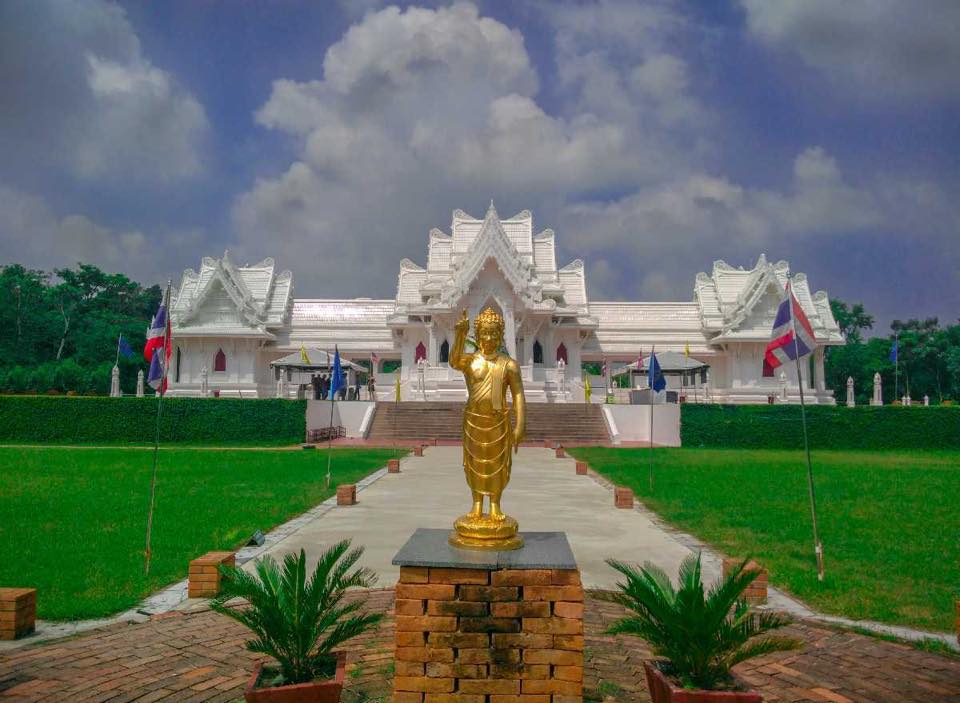
Lalitpur is on the elevated tract of land in Kathmandu Valley on the south side of the Bagmati River, which separates it from the city of Kathmandu on the northern and western side. The Karmanasa Khola acts as the boundary on the eastern side. It was developed on relatively thin layers of deposited clay and gravel in the central part of a dried ancient lake known as the Nagdaha. The city has an area of 15.43 square kilometres and is divided into 29 municipal wards.

The city was initially designed in the shape of the Buddhist Dharma-Chakra or the Wheel of Righteousness. The four thurs or mounds on the perimeter of Patan are ascribed around, one at each corner of its cardinal points, which are popularly known as Asoka Stupas. Legend has it that Emperor Asoka, the legendary King of India, visited with his daughter Charumati to Kathmandu in 250 BC and erected five Asoka Stupas, four in the surrounding and one at the middle of the Patan. There are more than 1,200 Buddhist monuments of various shapes and sizes scattered in and around the city. The most important monument of the city is Patan Durbar Square, which has been listed by UNESCO as one of seven Monument Zones that make up the Kathmandu Valley World Heritage Site. The seven monument zones were included in the World Heritage List in 1979 as one integrated site. The monument zones are declared as protected and preserved according to the Monuments Preservation Act of 1956. The Square was heavily damaged on 25 April 2015 by an earthquake. Lalitpur was planned in Vihars and Bahils. Out of 295 Vihars and Bahils of the valley 56% of them are in Patan. The water conduits, stone spouts, jaladroni or water tanks, artistic gate ways, Hindu temples and Buddhist Vihars adorn the city.

The Durbar Square at Patan is a UNESCO World Heritage Site and is located in the centre of the city and is one of the most visited places in Nepal. The Patan Durbar Square is one of the three main Durbar Squares in Kathmandu Valley and offers a perfect blend of ancient history and culture and modernity. The best time to visit Durbar Square Patan is from October to December in order to have the best outdoor experience. It is often overcrowded during the weekends so it is best to visit during the weekdays. Unfortunately, a lot of this area was destroyed during the 2015 earthquake, leading to it being seen as an unattractive place to visit. However, over the years, the government, as well as the community, have been putting in their efforts to rebuild this area, making Patan one of the most artistic Buddhist cities in the world and the Durbar Square a must-visit attraction in Nepal. Patan Durbar Square is full of captivating Newari structures with each one of them having something unique and significant to offer.

There is uncertainty regarding the origin of Patan Durbar Square. While the popular belief is that the Malla kings are to be credited for its existence, there are other contradictory legends as well. Some belief it to be a significant Pradhana crossroad, who reigned before the Mallas. The majority of the structures at the square date back to the end of the 17th century, during the reign of King Siddhi Narsingh Malla and then his son Srinivasa Sukriti. Few improvements were made by future Malla kings such as Purandarasimha, Sivasimha and Yoganarendra as well.

The Durbar Square at Patan initially had 136 courtyards and 55 temples. Due to the earthquake that occurred in 2015, only a few of them are open today. Each temple or monument is different from the other as all of them signify and represent religion in their own way. The architecture of the entire area is influenced by stone and wood, something that the restoration team tried to maintain. All the monuments either have stone or wood and have a hint of Shikhara architecture, a kind of Hindu ancient architecture. The ticket counter is open between 10:30 am and 4:30 pm Tuesdays to Saturdays and on Sundays, it is open from 10:30 am to 2:30 pm. The square is closed on Mondays. The Square is free for Nepali citizens, except for the museum for which they need to pay NPR 30. For SAARC nationals, entry to the square and museum is NPR 250 while other foreigners need to pay NPR 1000 for the same. Tickets are valid for 24 hours, which would give one the entire day to explore the square.

Displaying staggering artefacts acknowledging the long history and evolution of the Newari ethnicity, Patan museum is located in the ancient residential court in Keshav Narayan Chowk within the Patan Durbar complex. Along with the magnificence of original Nepali architecture restored carefully to its glory, the interiors of the museum are also full of antique pieces reflecting the rich history and culture of Nepal and Kathmandu Valley.

The actual inception of the complex is hard to place. Before it was a palatial residence for the Malla royalties of Kathmandu Valley, it used to be a Buddhist Monastery, whose foundations date back to around 1734 AD. Although the monastery was displaced, it is commemorated with the traditional annual public rite performed at the doorstep of the palace. However, it is believed that the site’s initial foundation dates back to the rule of the Licchavis, which was between the 3rd and 9th centuries. Patan Museum was open for the public in 1997, inaugurated by the late King of Nepal, Birendra Bir Bikram Shah. An open garden area has been transformed into the beautiful Patan Museum Cafe at the back of the complex offering authentic Nepali delicacies. There is also a gift shop selling handcrafted souvenirs.

Among the collections of Patan Museum, a majority are cast bronze and gilt copper repousse work from the different eras of Nepal’s history, along with other ethnic crafts indigenous to Patan. There are traditional deities and artefacts akin to Hinduism and Buddhism, with their origins in India, Tibet, China or Nepal itself. The museum has different opening hours for the summer and winter months. In the summer months, it is open from 8 am to 6:30 pm and in it winter, it is open from 8 am to 5:30 pm. It may be closed on certain days, so one must check before going. Entry fees are NPR 30 for Nepali nationals, NPR 15 for Nepali students upon providing ID, NPR 250 for SAARC nationals, and NPR 1000 for non-SAARC nationals.

The Royal Palace in Patan covers up the Durbar Square in the city and is one of the most famous attractions there. Built in the 14th century under the rule of the Malla King, the palace was restored after the Kathmandu earthquake in 2015. The palace includes a number of temples in its complex and it is almost impossible to take a trip to Durbar Square without having a look at the Royal Palace. The palace has a series of connecting courtyards behind the windows, overhanging eaves and delicate wooden screens. The northern gateway has been engraved with golden Toranas showing Parvati, Shiva, Ganesha and Kumar. Above the gateway, there is a window that is gilded foil wrapped around a timber frame where the king used to make his public appearances. This place also leads to the Patan Museum. The Royal Palace is open between 10:30 am and 4 pm and has an entry fee of NPR 1000.

A significant shrine dedicated to Lord Krishna, the Krishna Mandir owes its existence to a dream that King Siddhi Narsingh Malla had of the Lord standing in front of his palace. He then ordered the construction of the temple at the same spot he saw him standing. Carved entirely in dark stone, the beautiful structure of the Krishna Mandir consists of several significant sculptures and carvings on its outside walls as well as on the interior walls. The temple houses a statue of Lord Krishna in the ground floor with his consorts, Srimati Radha and Queen Rukmini on either side. The next level has a sanctum for Lord Shiva, and the topmost floor is dedicated to Lokeshwara or Avalokiteshvara – the collective Buddha consciousness. The beams along the tiers of the temple tell the stories of Mahabharata and Ramayana carved onto the stone intricately. The structure of the Krishna Mandir follows the Indian Subcontinental architectural style known as the Shikhara style. Highlights of this form of architecture include the structure that spirals up from the temple’s roof right above the sanctum sanctorum. It follows the traits of a local Nepali style called Granthakuta. The temple was completed and inaugurated in year 1637. From the courtyard, you can witness the story of Mahabharata depicted in carvings on the first-floor beam carvings. Further up on the second-floor beam, the story of Ramayana is chiselled on stone. Facing the temple is a statue of Krishna’s loyal vahana, the man-bird Garuda sits on a column. Non Hindus are not allowed inside and the temple is crowded during the festival of Lord Krishna’s birth, Krishna Jayanti or Janmashtami, sometime around August-September. During this time, the temple is lit up and is extremely beautiful.

A shrine dedicated to the third Pandava, Kunti’s middle-born and a great wrestler-warrior Bhima, the Bhimsen Temple is known for its three interconnected golden windows. It was built in 1680 by King Srinivasa Malla. Malla translates to a wrestler in English, and it is the art mastered by Bhima. However, Bhimsen is traditionally worshipped here not as a god of wars or fights, but of trade, commerce and business. The temple is situated in the northern part of Patan Durbar Square and consists of three storeys. In Newar, he is traditionally worshipped as the god of business and trade. The temple has many carvings which describe Bhimsen as the man with super strength crushing an elephant with a knee or lifting a horse in the air. Non-Hindus are not allowed to go inside the temple but can view the wild-eyed statue of Bhimsen by climbing up to the top level of this temple. The architecture of this temple is slightly unusual which makes it different from the other temples in Patan. The temple was built by Srinivasa Malla in 1680 but it had to be rebuilt in 1682 due to the destruction of the temple caused by a fire. The temple went through renovations again after the earthquake that took place in 1934 and again in 1967. And again, major damage was caused to the Bhimsen Temple by the 2015 earthquake.

Another construction by Siddhi Narsingh Malla, the Vishwanath Temple, like its namesake in Varanasi, is dedicated to Lord Shiva. Built in 1627, the temple features exquisite erotic carvings along its facade, keeping in tradition with almost every antique Shiva temples in the Indian subcontinent. The front gate of the temple is guarded by two majestic stone elephants, while on one of the sides, there is the iconic bull statue, ever-present at a Shiva temple. The bull represents Shiva’s mount, servant and closest confidante, Nandi.

The Kumbeshwar Temple, also known as the Kumbeshwar Mahadev Mandir, one of the three five-storey temples in Patan is quite often ignored due to its neighbouring Golden Temple. Even though Patan is known for having only Hindu Temples, the Kumbeshwar temple is quite famous for being one of the most sacred ones in Nepal. Dedicated to Lord Shiva, the temple is the oldest one in the region and was built by the King Jayasthiti Malla in the 14th century. It is believed that a dip into the holy ponds of the temple is especially purifying as the water comes naturally all the way from Gosaikunda , which is almost 42km away. There is also a legend that says that the town of Patan, which is also known a ‘Lalitpur gets its name from the temple.

It is believed that Rato Machhendranath Temple is where the patron of god, Rato Macchendranath or Matsyendranath spent most of his life. Rato Machhendranath was said to have been moved from Bungamati to Patan several times, which is central to the most famous rituals in Kathmandu. The place where the deity resided, Shikhara, was unfortunately destroyed during the 2015 earthquake in Nepal. Nevertheless, this attraction is a must-visit for tourists since it truly represents the culture of Bungamati. The most famous festival here is the Machhendranath festival which takes place during April and May. This temple, created in 1673, has a protected metal fence with 4 doorways that are protected by stone lions on the ground floor. Yeti like demons can be found carved in the corners of the temple. In front of the temple premises, one can also find metal structures of animals such as a Garuda, a snake, fish, a lion, a horse, and a buffalo.

Uku Bahal is a Buddhist monastery located south of Patan Durbar Square. It is also called Rudra Varna Mahavir and is filled with sacred images and shrines. Consisting of three courtyards, the outer courtyard has two flag-bearing British style lion statues and an impressive gate. One can find splendid items such as brass bells, winged horses, statues of peacocks, elephants Garudas and thunderbolts called Dorjes. Along with that, a statue of Rana Prime Minister Juddha Shumsher, as well as paintworks and preserved roof struts, are a few things that people can see.

There are three chowks or courtyards in the Patan Durbar Square. One of them is Keshav Narayan Chowk, located inside the premise of Patan Museum. The largest one of them is Mul Chowk, which houses the Vidya Temple and the shrine of Taleju Bhawani – the family deity of the Mallas. Ganesh, Hanuman and Vishnu’s sphinx avatar Narsingha guard the entrance to the third courtyard.

Sundari Chowk, which also happens to have a sunken tank within its boundaries, is named Tusha Hiti, with an entrance guarded by the three impressive statues of Hindu deities Hanuman, Ganesh and Narsingha. Built in 1647, this Chowk had been under reconstruction as a part of the UNESCO World Heritage Site and the north, south and west wings here were near completion when Nepal was struck by a massive earthquake in 2015. It was however the east wing which was severely destroyed, owing to its old architecture. After restoration work which lasted for almost 3 years, Sundari Chowk was reopened in 2018 and made available for exhibitions and to the public.

With this, we bid goodbye to Lalitpur and go on to the next town in the Kathmandu Valley.