After a good night’s rest, we woke up refreshed and ready to tackle the new day. We had another action-packed day planned, one that would end quite late….
Yus was waiting for us around 8 am and we started the day with the plan on going to the Kraton or the palace. As a small detour, we made a pit stop to a batik store near the hotel called Batik Soga. We had actually seen this place on the way to the Ambarrukmo Plaza on our first day here, but shied away as we thought it may be too expensive. Yus was the one who suggested this place when we asked for suggestions on good inexpensive but authentic batik to be given as gifts. The place was actually decently priced and we brought batik as gifts for pretty much everyone home!
On to the Kraton then….
The Kraton or to give it’s full name of Keraton Ngayogyakarta Hadiningrat is a palace complex which is the main seat Sultan of Yogyakarta and his family. It serves as a cultural center for the Javanese people and contains a museum that displays the sultanate’s artifacts. The museum is actually what is open to the public and that was what we went to see.
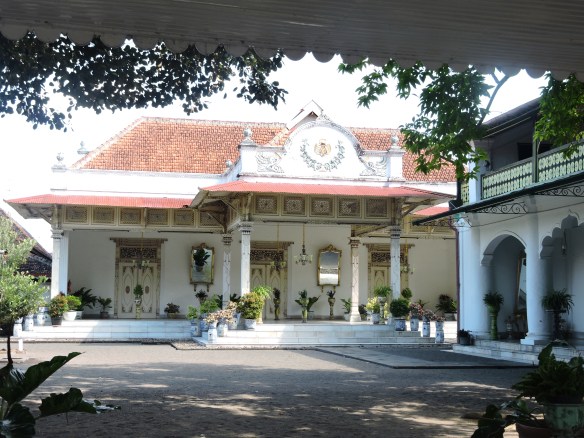
The Sultan’s private residence which is out of bounds
Built in 1755-1756, the Kraton is the symbol of the sultanate of Yogyakarta and the official residence. The current sultan, His Majesty Sri Sultan Hamengkubuwono X, is also the governor of Yogyakarta and stays in the complex which is out of bounds for visitors. There is also a separate wing for the crown prince, which is empty right now, as the current sultan has five daughters. Our guides did speak of the succession issue there and there was a lot of speculation as to who would be the next sultan.
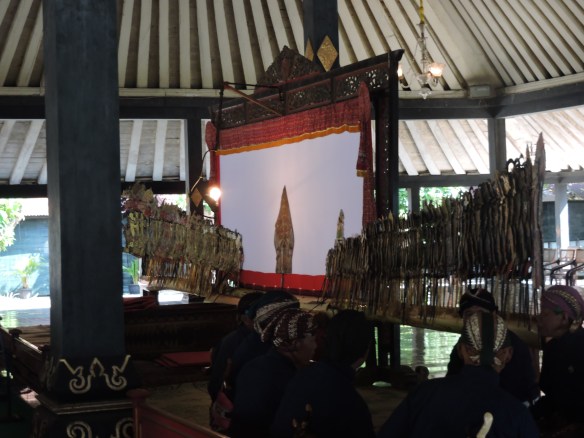
Getting ready for the Wayang Kulit performance

The instruments of the traditional Gamelan
The Kraton is quite close to the shopping district of Malioboro. On arriving at the Kraton, we paid our entrance fee of IDR 12,500 per person plus another IDR 1,000 for one camera as well as hired a guide. They have guides in-house and based on the language you need the guide to be fluent in, the person from whom you buy the entrance fee will allocate one to you. Our guide was an elderly man who had worked here for years. There is no cost to the guide and you just tip him/her as much as you like at the end of the session. We tipped the guide IDR 30,000. The palace is open to public from 8 am – 2 pm daily. The palace is closed to public one hour earlier on Friday. There are also daily Javanese cultural performances there and on the day we went, it was a Wayang Kulit (Shadow Puppets) performance.

The Javanese script, which brings to mind some Indian scripts as well as the Khmer and Balinese scripts
The Kraton is a blend of Javanese architecture with influences from Islam and Hinduism. Our guide told us that the Javanese population can actually be traced to immigrants from the state of Gujarat in India, though I am a wee bit sceptical by this.
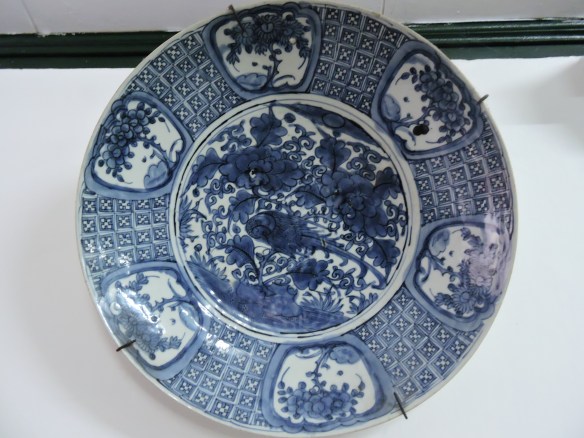
Chinese plates in the museum

The current Sultan’s family. The pictures on the side are his five daughters, with the oldest the furthest away.
The Kraton has many antiques in the museum, though the treasures are not kept as well as it should be. What I found especially fascinating were the family geneology trees of the sultans, where all their children are included. The Sultan is a tree and the sons are depicted as fruits and the daughters as leaves. So at a glance, you can see which Sultan had more sons and who had more daughters!

The throne room!
We also saw many palace guards just sitting and doing nothing. Our guide told us that most of them are locals who volunteer at the Palace, why they do this, I can’t remember the guide telling us.
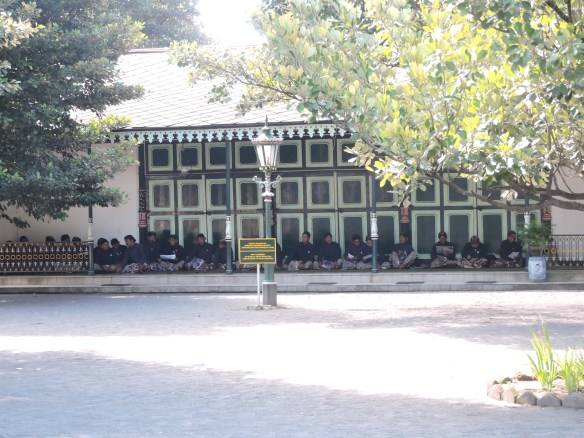
Volunteer guards sitting and waiting….
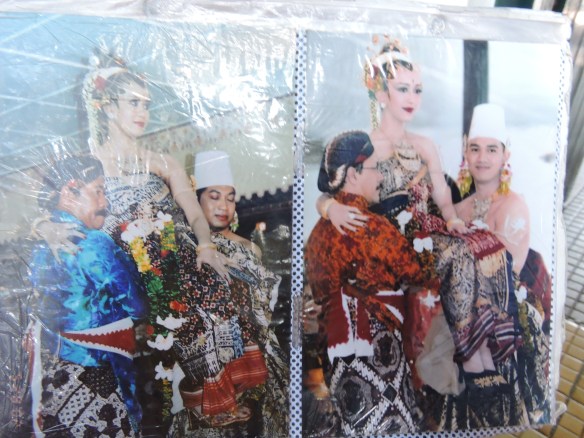
The two oldest princesses on their wedding days
Taman Sari Water Castle
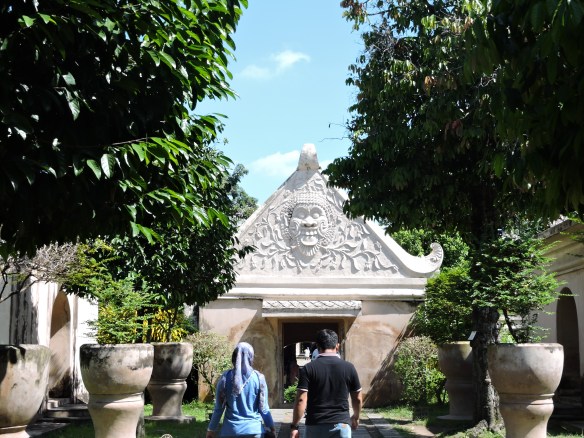
Entrance to Taman Sari Water Castle
After the Kraton, we got into the car for a short drive to the Taman Sari Water Palace. Again, I’d heard mixed reviews about this place, and wondered if we should go there. In hindsight, it was ok, nothing spectacular, but nothing I would miss also if I didn’t go.
The admission fee was IDR 15,000 and another IDR 1,000 for a camera. As we did at the Kraton we hired a guide. At this point, we had no change with us and so we paid the guide all the change we had which came to around IDR 28,000.
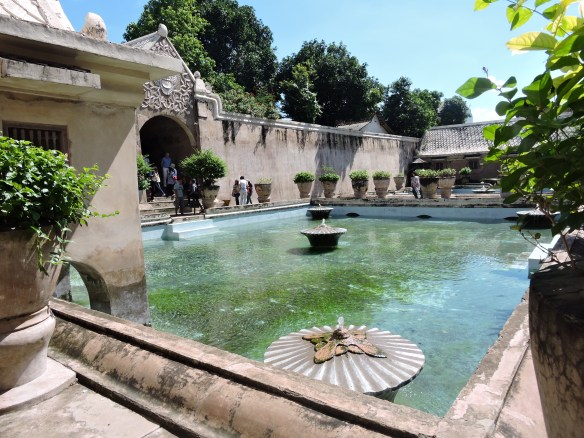
The main bathing area
Taman Sari also known as Taman Sari Water Castle is part of the main Kraton complex and is located about 2 km south within the grounds of the Kraton. Built in the mid-18th century, the Taman Sari’s primary function was as a pleasure garden for the Sultan and his wives and concubines.

Another smaller, more private pool for the Sultan to use with his chosen concubine/wife
Taman Sari consisted of four distinct areas: a large artificial lake with islands and pavilions located in the west, a bathing complex in the centre, a complex of pavilions and pools in the south, and a smaller lake in the east. Today only the central bathing complex is well preserved, while the other areas have been largely occupied by the Kampung Taman settlement.

The space where the sultan would get a massage pre and post bath
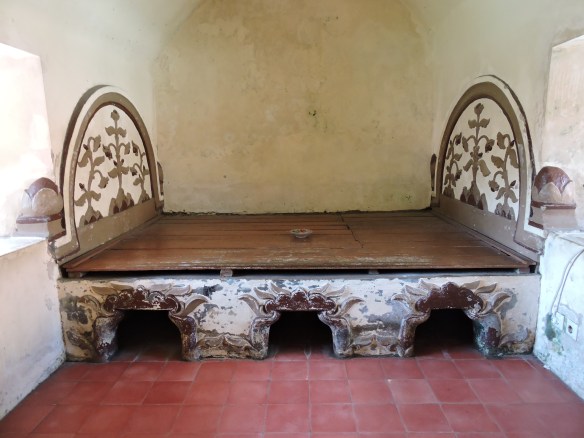
The room the Sultan and his favourite wife/concubine would use post bath
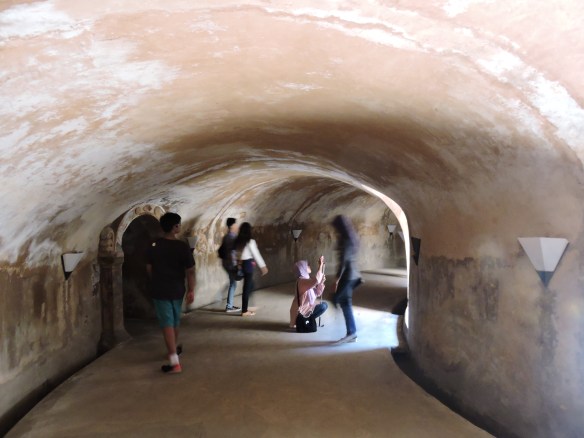
The underground passage
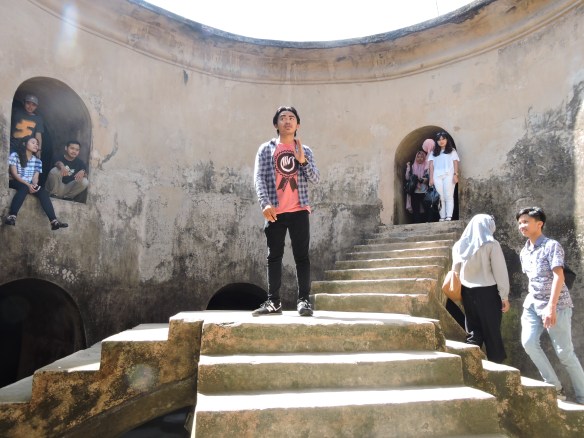
Steps which lead to the underground mosque. The top portion was for the women
After visiting the main bathing area of the castle, our guide took us down a winding path, through the settlements which have cropped up to the underground mosque. You need to go down steps to an underground passage to reach this place, though there is nothing there now to suggest it was a mosque.

The West entrance of the Taman Sari Water Castle
After the Water Castle, we went t-shirt shopping! S wanted to buy some for friends and so Yus drove us to this shop which seemed reasonable. The prices were in the range of IDR 80,000 with good material. I tried finding the name of the store, but can’t find it, and will update once I am able to get hold of the bag from the store!
Next on the agenda seemed lunch, but Yus had an ace up his sleeve. Since there was still time for lunch according to him, he decided to take us to another temple, one which was not on our original agenda. This was the Candi Sambisari.
Candi Sambisari
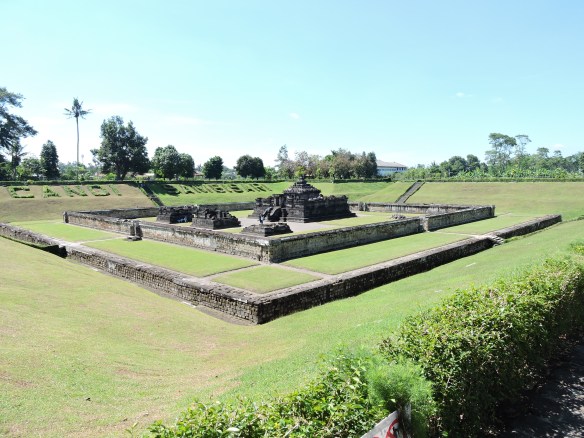
Candi Sambisari in it’s entirety!
Candi Sambisari is a 9th-century Hindu temple which was buried about five metres underground and parts of the original temple have been excavated. The temple emerged in July 1966 by a farmer when working on the land. His hoe hit the carved stone which was a part of the buried temple ruins. The temple is thought to have been buried by an eruption of volcanic ash from the nearby Mount Merapi.

The main temple
Based on architectural and ornamental similarities to another Hindu temple in Indonesia, Prambanan, the presence of Hindu statues around the temple walls, and the lingga-yoni inside the main temple, historians have concluded that Sambisari was a Shivaite Hindu temple built around the first or second decade of the 9th century (circa 812-838). This conclusion was supported by the findings of a gold plate in the vicinity engraved with letters that according to paleography were used in early 9th century ancient Java.
According to Wanua Tengah inscription III dated 908 that contains the name of kings that ruled Mataram Kingdom, the temple was probably built during the reign of Rakai Garung (ruled 828-846). However, historians also consider that the construction of a temple was not always issued by a king. Lesser nobles might have also ordered and funded the construction.
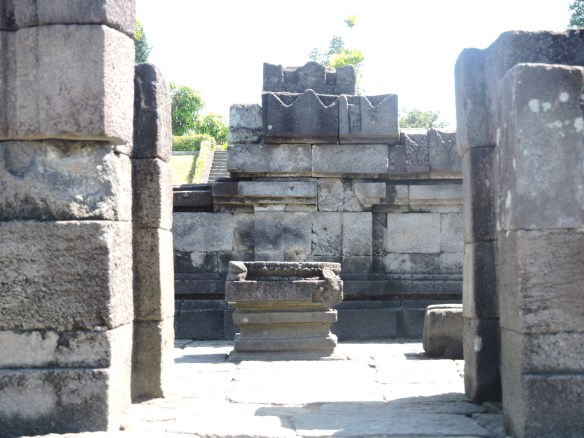
The smaller lingas in the temple courtyard
We descended a flight of stairs to reach the central part of the temple, the base of which is 6.5 meters lower than the current ground level. The Sambisari complex was surrounded by a rectangular wall made from white stone with eight small lingga, four located at the cardinal points and four others in the corners. Around the temple walls are niches containing statues of Hindu gods including Durga, Ganesh and Agastya as well as a linga inside the temple.

The Shivling inside the temple sanctum
The temple was beautiful in the heat of the afternoon and we left feeling satisfied in this unexpected treat! The entrance fee to the temple was IDR 2000 per person, the cheapest entry fee that we saw in Yogya!
Lunch was at a restaurant midway between the Sambisari Temple and the Prambanan temple Complex which was our next stop. The restaurant also sold tickets to the Prambanan temple at the same price it was sold at the temple (they were an agent) as well as to Ratu Boko which was our stop after Prambanan.

 India’s Westernized elite, cut off from local traditions, ‘want to write a full stop in a land where there are no full stops’. From that striking insight Mark Tully has woven a superb series of ‘stories’ which explore Calcutta, from the Kumbh Mela in Allahabad (probably the biggest religious festival in the world) to the televising of a Hindu epic. Throughout, he combines analysis of major issues with a feel for the fine texture and human realities of Indian life. The result is a revelation. ‘The ten essays, written with clarity, warmth of feeling and critical balance and understanding, provide as lively a view as one can hope for of the panorama of India.
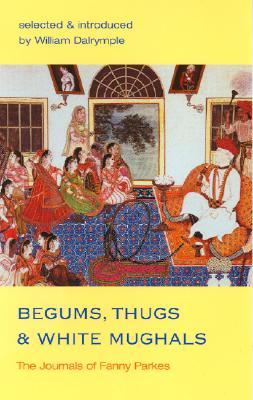 Fanny Parkes, who lived in India between 1822 and 1846, was the ideal travel writer – courageous, indefatigably curious and determinedly independent. Her delightful journal traces her journey from prim memsahib, married to a minor civil servant of the Raj, to eccentric, sitar-playing Indophile, fluent in Urdu, critical of British rule and passionate in her appreciation of Indian culture. Fanny is fascinated by everything, from the trial of the thugs and the efficacy of opium on headaches to the adorning of a Hindu bride. To read her is to get as close as one can to a true picture of early colonial India – the sacred and the profane, the violent and the beautiful, the straight-laced sahibs and the more eccentric White Mughals who fell in love with India and did their best, like Fanny, to build bridges across cultures.
 Twenty-one-year-old Christina Lamb left suburban England for Peshawar on the frontier of the Afghan war. Captivated, she spent two years tracking the final stages of the mujaheddin victory over the Soviets, as Afghan friends smuggled her in and out of their country in a variety of guises.





 Memories and Such