In My Hands Today…

Bravehearts of Bharat: Vignettes from Indian History – Vikram Sampath

History has always been the handmaiden of the victor. ‘Until the lions have their own storytellers,’ said Chinua Achebe, ‘the history of the hunt will always glorify the hunter!’ Exploring the lives, times and works of long-forgotten and mostly neglected fifteen unsung heroes and heroines of our past, this book brings to light the contribution of the warriors who not only donned an armour and burst into the battlefield but also kept the flame of hope alive under adverse circumstances.

Narrating the tales of valour and success that India, as a nation and civilization, bore witness to in its long and tumultuous past, the book opens a window to the stories of select men and women who valiantly fought against invaders for their rights, faith and freedom.

From Rajarshi Bhagyachandra Jai Singh of Manipur, Lalitaditya Muktapida of Kashmir, Chand Bibi of Ahmednagar, Lachit Barphukan of Assam, Begum Hazrat Mahal of Awadh to Rani Abbakka Chowta of Ullal, Martanda Varma of Travancore, Rani Rudrama Devi of Warangal, Rani Naiki Devi of Gujarat and Banda Singh Bahadur, among others, are some of the ‘bravehearts’ who fought to uphold the tradition and culture of their land.

In My Hands Today…

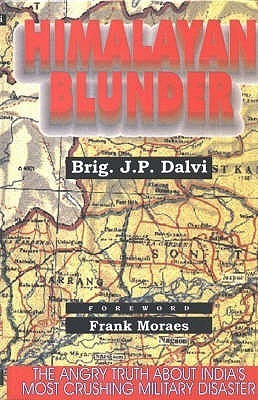
Himalayan Blunder: The Angry Truth About India’s Most Crushing Military Disaster – J.P. Dalvi

Himalayan Blunder: The Angry Truth About India’s Most Crushing Military Disaster is Brigadier J. P. Dalvi’s retelling of the Sino-Indian war that took place in 1962 – a war that India lost. Dalvi fought the war as the Commander of the 7th Infantry Brigade in NEFA (North-East Frontier Agency).

His account of the war is graphic and telling. He was captured by the Chinese forces and held for seven months. As a participant of the war, he was privy to all that went on at the battlefield as well as behind the scenes. Based on his firsthand experiences, he recounts the events that occurred between September 8, 1962 and October 20, 1962.

As early as 1951, China silently and steadily began to work its way onto Indian soil. Even in the face of indisputable evidence, India insisted on maintaining cordial relations with the Chinese. China seemed only too happy to play along.

Dalvi narrates the manner in which India’s own political leadership traitorously worked against its cause. In no uncertain terms, he holds three men responsible for India’s defeat – Jawaharlal Nehru, Krishna Menon, and General Brij Mohan Kaul.

Issuing orders from Delhi, they seemed to be clueless about the situation on the battlefield. Undoubtedly, when they were rushed into battle, the Indian soldiers – underfed, ill-equipped, and unprepared as they were – never stood a chance against the powerful Chinese army. Regardless of that, the soldiers fought bravely and laid down their lives for their homeland.

Dalvi claims that the apathy and the sheer ineptitude of those at the helm of India’s political affairs sacrificed hundreds of valuable lives. Brigadier Dalvi’s detailed narrative of the massacre of the Indian soldiers, a horror that he witnessed firsthand, is heart-rending.

The book was published in 1969. Among all the books based on the subject of the 1962 Sino-Indian war, this book is considered to be one the most striking and authentic versions. Due to its sensitive subject matter and its portrayal of India’s leaders in a harshly negative light, the book was banned by the Indian government upon its release.

In My Hands Today…

Ô Jérusalem – Dominique Lapierre, Larry Collins

This book recounts, moment by moment, the process that gave birth to the state of Israel.

Collins & Lapierre weave a tapestry of shattered hopes, valor & fierce pride as the Arabs, Jews & British collide in their fight for control of Jerusalem.

O Jerusalem! meticulously recreates this historic struggle. It penetrates the battle from the inside, exploring each party’s interests, intentions & concessions as the city of their dreams teeters on the brink of destruction.

From the Jewish fighters & their heroic commanders to the Arab chieftain whose death in battle doomed his cause along with the Mufti of Jerusalem’s support for Hitler and the extermination of the Jews, but inspired a generation of Palestinians, O Jerusalem! tells the 3-dimensional story of this high-stakes, emotional conflict.

In My Hands Today…

What the Taliban Told Me – Ian Fritz

When Ian Fritz joined the Air Force at eighteen, he did so out of necessity. He hadn’t been accepted into college thanks to an indifferent high school career. He’d too often slept through his classes as he worked long hours at a Chinese restaurant to help pay the bills for his trailer-dwelling family in Lake City, Florida.

But the Air Force recognizes his potential and sends him to the elite Defense Language Institute in Monterey, California, to learn Dari and Pashto, the main languages of Afghanistan. By 2011, Fritz was an airborne cryptologic linguist and one of only a tiny number of people in the world trained to do this job on low-flying gunships. He monitors communications on the ground and determines in real time which Afghans are Taliban and which are innocent civilians.

This eavesdropping is critical to supporting Special Forces units on the ground, but there is no training to counter the emotional complexity that develops as you listen to people’s most intimate conversations. Over the course of two tours, Fritz listens to the Taliban for hundreds of hours, all over the country night and day, in moments of peace and in the middle of battle. What he hears teaches him about the people of Afghanistan—Taliban and otherwise—the war, and himself. Fritz’s fluency is his greatest asset to the military, yet it becomes the greatest liability to his own commitment to the cause.

In My Hands Today…

The Book Collectors: A Band of Syrian Rebels and the Stories That Carried Them Through a War – Delphine Minoui, translated by Lara Vergnaud

Day in, day out, bombs fall on Daraya, a town outside Damascus, the very spot where the Syrian Civil War began. In the midst of chaos and bloodshed, a group searching for survivors stumbles on a cache of books. They collect the books, then look for more. In a week they have six thousand volumes. In a month, fifteen thousand. A sanctuary is born: a library where the people of Daraya can explore beyond the blockade.

Long a site of peaceful resistance to the Assad regimes, Daraya was under siege for four years. No one entered or left, and international aid was blocked.

In 2015, French-Iranian journalist Delphine Minoui saw a post on Facebook about this secret library and tracked down one of its founders, twenty-three-year-old Ahmad, an aspiring photojournalist himself. Over WhatsApp and Facebook, Minoui learned about the young men who gathered in the library, exchanged ideas, learned English, and imagined how to shape the future, even as bombs fell above. They devoured a marvelous range of books–from American self-help like The Seven Habits of Highly Effective People to international bestsellers like The Alchemist, from Arabic poetry by Mahmoud Darwish to Shakespearean plays to stories of war in other times and places, such as the siege of Sarajevo. They also shared photos and stories of their lives before and during the war, planned how to build a democracy, and began to sustain a community in shell-shocked soil.

As these everyday heroes struggle to hold their ground, they become as much an inspiration as the books they read. And in the course of telling their stories, Delphine Minoui makes this far-off, complicated war immediate. In the vein of classic tales of the triumph of the human spirit–like All the Beautiful Forevers, A Long Way Gone, and Reading Lolita in Tehran–The Book Collectors will inspire readers and encourage them to imagine the wider world.