Resilience: The ability to pick yourself up after a fall

Resilience is defined as “The capacity to recover quickly from difficulties; or toughness”. But what exactly is resilience and why is this word so important today? In today’s post, let’s try to unpack what it means to be resilient and what you can do to cultivate this trait yourself and inculcate it in the young people in your lives.

Life is not a smooth path that you coast through without any setbacks. Life will thow you curveballs from time to time, some more serious than others from everyday challenges to perhaps a serious life-threatening illness or the death of a loved one. Every such change affetcs people in different ways, with each incident bringing with itself a unique set of thoughts, emotions and uncertainties. But in most cases, most of us generally adapt to these twists and turns in our lives, some better than others, in most part because we are resilient.

Psychologists define resilience as the process of adapting well in the face of adversity, trauma, tragedy, threats or significant sources of stress — such as family and relationship problems, serious health problems, or workplace and financial stressors. As much as resilience involves “bouncing back” from these difficult experiences, it can also involve profound personal growth. While these adverse events, much like rough river waters, are certainly painful and difficult, they don’t have to determine the outcome of your life. There are many aspects of your life you can control, modify and grow with. That’s the role of resilience. Becoming more resilient not only helps you get through difficult circumstances, it also empowers you to grow and even improve your life along the way.

Being resilient doesn’t mean that someone won’t experience difficulty or distress. People who have suffered major adversity or trauma in their lives commonly experience emotional pain and stress. In fact, the road to resilience is likely to involve considerable emotional distress. While certain factors might make some individuals more resilient than others, resilience isn’t necessarily a personality trait that only some people possess. On the contrary, resilience involves behaviours, thoughts and actions that anyone can learn and develop. The ability to learn resilience is one reason research has shown that resilience is ordinary, not extraordinary. Like building a muscle, increasing your resilience takes time and intentionality.

Nowhere else but in the workplace is resilience needed more than ever. Our fast-paced work culture results in people working hard, meeting tight deadlines, managing work relationships and staying constantly connected through mobile devices. But this pace can lead to stress and burnout and navigating through these challenges requires skills and strategies that can be developed. Resilience is a key strategy that helps employees tackle stress, a competitive job market, workplace conflicts, and address challenges on the job. Improving resilience is important because employees identify work as the number one stressor in their lives.

When employees are resilient, they are able to handle work stress better, have greater job satisfaction, work happiness, organisational commitment and employee engagement. Increased resilience also contributes to improved self-esteem, a sense of control over life events, a sense of purpose in life and improved employee interpersonal relationships and increased productivity.

For employers, to foster resilience amongst your employees, allow autonomy whenever possible and let individuals do their jobs. Reward employees for good work and allow them to have flexible schedules so they can work at a pace and time that work best for them. Also, employers need to be more reasonable about work expectationsand be more vigilent about policies on work expectations and work hours. Lastly, employers need to provide access to services and support needed to maintain good physical and mental health.

So how can you learn to be more resilient. By focusing on core components, which include connections, wellness, healthy thinking and meaning, you can empower yourself to withstand and learn from difficult and traumatic experiences. To increase your capacity for resilience to weather and grow from the difficulties, use these strategies.

Build your connections and prioritise relationships. Connecting with empathetic and understanding people can remind you that you’re not alone in the midst of difficulties. Focus on finding trustworthy and compassionate individuals who validate your feelings, which will support the skill of resilience. Do not isolate yourself when you are in a situation which causes you pain or trauma, instead accept the help and support of those who love and care for you and connect with them in a genuine way. Along with one-to-one connections, some people find that being active in groups provides them with a sense of support, purpose and joy.

Foster wellness and take care of your body. Self-care is not just a popular buzzword, but is also a legitimate practice for mental health and building resilience. I say this because stress is just as much physical as it is emotional. Promoting positive lifestyle factors like proper nutrition, ample sleep, hydration and regular exercise can strengthen your body to adapt to stress and reduce the toll of emotions like anxiety or depression.

Practice mindfulness. I can’t stress this strategy enough. Mindful journaling, yoga, meditation and prayer can help people build connections and restore hope, which can then prime you to deal with situations that require resilience. When you journal, meditate, or pray, ruminate on the positive aspects of your life and recall the things you’re grateful for, even during personal trials. At the same time, avoid negative outlets. It may be tempting to mask your pain with alcohol, drugs or other substances, but that’s like putting a bandage on a deep wound. Focus instead on giving your body the resources to manage stress, rather than seeking to eliminate the feeling of stress altogether.

Find some purpose in life and help others. When you help others by volunteering, you gather a sense of purpose, foster self-worth, connect with other people and tangibly help others, all of which can empower you to grow in resilience. During these hard times, learn to be proactive and know that it is helpful to acknowledge and accept your emotions, but it’s also important to help you foster self-discovery by asking yourself, “What can I do about a problem in my life?” If the problems seem too big to tackle, break them down into manageable pieces. Move toward your goals and develop some realistic goals and do something regularly, even if it seems like a small accomplishment, that enables you to move toward the things you want to accomplish. Instead of focusing on tasks that seem unachievable, ask yourself, “What’s one thing I know I can accomplish today that helps me move in the direction I want to go?” Look for opportunities for self-discovery. People often find that they have grown in some respect as a result of a struggle. It is seen that after a tragedy or hardship, people have reported better relationships and a greater sense of strength, even while feeling vulnerable which can increase their sense of self-worth and heighten their appreciation for life.

Compartmentalise your cognitive load. We receive more than 11 million bits of information every second, but our brains can only effectively process about 40 bits of information. So though we can’t decrease what we receive, we can compartmenalise our tasks to optimise how we can process this information. We should be more deliberate about how and what we compartmentalise and this is useful when you consider that switching from one type of task to another reduces productivity by as much as 40%. Creating dedicated times of the day to do specific types of work may create the best set of conditions to process information and make quality decisions while decreasing cognitive load and strain.

Take detachment breaks. Throughout the workday, it’s important to pay attention to the peaks and valleys of energy and productivity that we all experience, what health psychologists call our ultradian or hourly as opposed to our circadian or daily rhythms. Mental focus, clarity and energy cycles are typically 90-120 minutes long, so it is useful to step away from our work for even a few minutes to reset energy and attention. Research suggests that balancing work activity with even a brief time for detaching from those activities can promote greater energy, mental clarity, creativity and focus, ultimately growing our capacity for resilience throughout the course of the workday. The long-term payoff is that we preserve energy and prevent burnout over the course of days, weeks and months.

Embrace healthy thoughts and keep things in perspective. How you think can play a significant part in how you feel, and how resilient you are when faced with obstacles. I feel that those with a positive mindset overcome obstacles faster and better than those who see a glass as half empty. Try to identify areas of irrational thinking, such as a tendency to catastrophise difficulties or assume the world is out to get you, and adopt a more balanced and realistic thinking pattern. You may not be able to change a highly stressful event, but you can change how you interpret and respond to it. Accept change and also accept that change is a part of life. Certain goals or ideals may no longer be attainable as a result of adverse situations in your life. Accepting circumstances that cannot be changed can help you focus on circumstances that you can alter. You should also maintain a hopeful outlook in life. I know it’s hard to be positive when life isn’t going your way, but an optimistic outlook empowers you to expect that good things will happen to you. Visualisation is a good way to to see what you want, rather than worrying about what you fear. Along the way, note any subtle ways in which you start to feel better as you deal with difficult situations. And most important in this step is to learn from your past. By looking back at who or what was helpful in previous times of distress, you may discover how you can respond effectively to new difficult situations. Remind yourself of where you’ve been able to find strength and ask yourself what you’ve learned from those experiences.

Cultivate compassion. One of the most overlooked aspects of the resilience skill set is the ability to cultivate compassion; both self-compassion and compassion for others. According to some research, compassion increases positive emotions, creates positive work relationships, and increases cooperation and collaboration and such practices increase happiness and well-being and decrease stress.

Getting help when you need it is crucial in building your resilience. For most people, using their own resources and the strategies mentioned above may be enough to build their resilience, but there at times and individuals for whom and when this may not be enough. In such cases, reach out to a licensed mental health professional who can assist you in developing an appropriate strategy for moving forward in life. It is important to get professional help if you feel like you are unable to function as well as you would like or perform basic activities of daily living as a result of a traumatic or other stressful life experience.

The important thing is to remember you’re not alone on the journey. While you may not be able to control all of your circumstances, you can grow by focusing on the aspects of life’s challenges you can manage with the support of loved ones and trusted professionals.

Here are some interesting Ted Talks about resilience and how we can learn from some super resilient people!


Working From Home – Some Tips

Today the term Working from Home does not raise as many eyebrow as it does even a few months back. To many, it is the new normal and will remain so for the near future. In fact, for many it may even become something they can now negotiate in their jobs.

I remember meeting a neighbour a year or so back around 3 pm in the afternoon when I was coming home after a meeting. He asked me if I came home early from work or if I was on leave. When I told him that I worked from home, his eyebrows raised and he told me that he wished he could also do the same. I know what was in his mind – he was thinking I was slacking because I was working at home. And this thought is not a new one, especially in countries like Singapore where face time equates to productivity and managers are not happy if they don’t see you around the office, doing anything it would seem, but you can’t leave the office until the official dismissal time or later, even if you are just slacking and killing time before you can log off.

I can’t talk highly enough about working from home, as an introvert, it’s a dream job, but I do know other people don’t share my views and I have had some interesting discussions with family and friends who need other people around them to be productive and who hate this situation. And then there are those who have young children who are at home because schools are closed. Looking after them and trying to be productive is a whole new ballgame altogether and I have loads of respect for them.

But today’s new normal is working from home and I decided that, from my experiences, I should share some tips on how to maximise your productivity while working at home.

Organise your workspace
Keep aside a dedicated space for you to work on a daily basis. Make sure what is behind the space you will be working in. This is what your colleagues will be seeing when you are on video conference calls. Also it will be helpful if this space is a quiet place where you can concentrate and where you are unlikely to be disturbed during calls. This can be anyplace in your home, my office is my dining table which is quite central in the house. When S works at home, he is usually on the couch or uses a small pouf to work on the coffee table. This is entirely your choice, but if this a long time gig, you should have a space which is your office when your working. When I am not working, it transforms back into our dining table. I also have some scented candles and a diffuser close by which I use when I want the place to smell nice.

Maintain office hours
Keep as much as you can to your regular office hours and stick to it as much as you can. It helps if you can do a hard stop at the end of each day so you have time to do other things, like a hobby, working out or even watching television! If you are doing more on a particular day, like starting early or ending late, make up the next day so you are able to rest. What I do is basically maintain office hours. I am at my laptop not later than 8 am and don’t work past 6 pm. It has to be an emergency for me to continue past 6 pm, though I sometimes stop earlier too. My hard stop is when I switch off my laptop and move it out of the dining table to my room. Once I do this, I don’t touch my laptop unless it’s an emergency until the next morning.

Create a morning routine
I am strong proponent of having a good morning routine which allows you to have a work mindset when you start your work day. It must be wonderful to get out of bed and start working, but your brain is still at home that way! What works for me is to sit down at my desk after I am done with my morning chores and have had my bath and breakfast, so I am now in work mode. Also with video calls on the rise now, imagine having your boss or colleagues catching you in ratty sleepwear? While I don’t advocate business clothing, wear home clothes which are clean, neat and don’t have visible holes.

Set ground rules with your household
The other day I saw a very cute post on LinkedIn where a mum had previously posted the note she has on her door. What it says was if you can see this note and the door is shut, it means mommy is working and can’t be disturbed. Soon she posted a note her son posted on his door which basically mirrored hers and which told the parents not to enter the room when the door is closed because they are doing e-learning and they don’t want their teachers and friends to see their parents around, especially when they are busy! So yes, set ground rules for your family in advance. If you have older children like I do, it’s easier since they are also closeted in their rooms and won’t disturb you. But for those with younger children, maybe something like the note above can help or even using the traffic stoplights as a sign where red means not to be disturbed and green means they can enter the room. Also let your family know you can’t run errands anytime they say so just because you are at home, but can do all this at specific times in the day (this is when the breaks come into the picture). Let them know that just because you don’t work in an office, does not mean you are free anytime they want something or want to chat.

Take regular breaks
When you are in the office, you do take coffee and lunch breaks rights? Sometimes colleagues get together to have a discussion around the coffee machine and nobody raises an eyebrow. When you are at home, do make time for regular breaks, be it getting up to grab a cup of coffee or going outside for lunch or even a short walk. What I do is walk in the house for about 15-20 minutes for every two hours that I am in my desk. I use these walks to try and clock up my 10k steps for the day. I also advocate the Pomodoro method where say you work for a certain amount of time and then give yourself a break for a specified number of minutes.

Know your productive times
Know yourself and see what are your most productive times. Try and do the hard stuff at that point and schedule calls and conferencing for the times you are not 100%. Everyone works differently and only you can figure this out. I am most productive twice a day, first thing in the morning and then another run around mid afternoon after I have had coffee. That is when I am mostly like to be writing. Of course, we can’t choose when to work what at times and when I have meetings and events outside, I try and work around those.

Use technology to keep in touch
Use Whatsapp, Viber, Facetime, Skype as well as video conferencing options like Zoom and Blue Jeans to keep in touch with your friends and colleagues when you are working from home or stuck up at home because of a lockdown. I also know of people who have done virtual happy hours and meals with others because they can’t meet. Instant messaging and videoconferencing tools can make it easy to check in with coworkers and remind you how your work is contributing to the big picture.

Invest in a good pair of headphones
Even if you have a brand new laptop or a new smartphone, invest in a pair of good quality headphones with a mic. Noise-canceling features with a mute button can really help improve the clarity of your phone calls. The last thing you want is to be in an online meeting and have the doorbell ring or your children asking you to help them.

Listen to music or watch videos
If I am alone at home, sometimes I find the silence disconcerting. I find watching videos on Youtube on a tablet near me works for me. I can concentrate watching some inane videos, but I have also heard that keeping the television on in the background with a channel you are usually not fond of would work for others. I also like listening to music as background noise to help me concentrate. Spotify is one great option for when you feel like listening to music. You can choose your mood and Spotify will play music based on that. The only con to the free service is the constant adverts, but everything in life is not free, right? These days Spotify has many playlists for those working from home.

Use ‘To-Do’ lists to maintain and corral your task lists
Working from home without a boss breathing down your neck and no one to see when you are playing games instead of working may be challenging to complete your tasks for the day or week. What works best for me is to have weekly To-Do lists where I put down all my tasks, both personal, profession and my blog tasks for the week and check them out as they finish. I love Trello which allows you to create boards to work in. This is also a great tool to use when collaborating with others. I have multiple boards on Trello, including one where I put my blog posting schedule, one which is a catch-all for my blog post ideas, one for any travel I plan (which is redundant as of now) and of course my To-Do list. My Trello ‘To-Do’ Board has cards, one for each week this year and I use a checklist within the cards to plan my week. I really love it when I check all my items for the week and then archieve them. But that’s me. There are other online apps like ToDoist, Google Tasks, Prrofhub, Evernote, Remember the Milk and Wunderlist. I have used many of these previously and have settled on Trello as the one which works best for me. You can also play around with these apps and see what works best for you. Some of these are paid apps, but I have not used any paid versions and my version of Trello is also the free one. Most of these also have mobile versions which sync with the online version, so you can update your list on the go which I have found extremely useful.

Overcommunicate
When you are working from home, some people who equate face time to productivity may think you are slacking. This means you have to overcommunicate. Tell everyone who needs to know about your schedule and availability often. When you finish a project or important task, say so, especially to your team and manager so that they know you are not home watching videos and doing household chores instead of working. If you need to, email or call them to remind them you are in fact working and not playing!

Be positive
This time too shall pass and our world will go back to normal, or as normal as it can be. But the fact is that when you don’t have face time with people, they may not know how to interpret your tone either by email or phone. While video conferencing does mitigate this to an extent, being positive and upbeat helps when you are not on a screen.

Don’t Be Too Hard on Yourself
Somedays you just can’t hold it all together. It happens to the best of us and you can only wonder what happened when the day ends and you have nothing to show for it. Give yourself some slack when this happens and make sure you are super motivated and productive the next day to make it up.

So there you have it, a bakers dozen of 13 tips to help you navigate working from home. Do you have some tips to share which are not there above? Please do share, I love learning more about how I can be more productive as I work from home!

Gig Economy – The future of work

Source

If you are like me, you have probably heard the phrases ‘Gig Economy’ and ‘Gig Worker’ bandied about quite frequently, especially in the recent years. So what does this mean? And especially what it measn to our children who will join the workforce in a few years from now? I got to find out and share with you.

A gig economy is a free market system in which temporary positions are common and organizations contract with independent workers for short-term engagements. The term “gig” is a slang word meaning “a job for a specified period of time” and is typically used in referring to musicians. Examples of gig employees in the workforce could include freelancers, independent contractors, project-based workers and temporary or part-time hires. The freelancer economy (or freelance economy) differs from traditional employment in that jobs are not permanent, but more specifically, the term relates to many one-off tasks or individual shift assignments.

In the 2000s, the digitalization of the economy and industry was carried out rapidly due to the development of information and communication technologies such as the Internet and the popularization of smartphones. As a result, on-demand platforms based on digital technologies have created jobs and employment forms that are differentiated from existing offline transactions based on accessibility, convenience and price competitiveness, the so-called Gig economy has become a focus. In general, “work” is described as a full-time worker with a set working hours, including benefits. But the definition of work began to change with changing economic conditions and continued technological advances, and the change in the economy created a new labor force characterized by independent and contractual labor, such as well.

So how does this Gig Economy work? Individually, a gig (an individual task, assignment, or job) represents a small portion of a worker’s income. When workers aggregate a variety of tasks or shifts for different clients or companies, their cumulative earnings can be similar to that of full-time employment. Others leverage short-term gigs as a way to earn a part-time income or supplemental income on the side. It works both ways, with workers seeking flexible, short-term working arrangements and companies seeking to hire temporary contract workers in lieu of full-time employees. What is the gig economy?

Increasingly, the gig economy operates on technology platforms that aim to connect workers looking for flexible work arrangements with the companies who need them in a centralized location, such as an app or website. Some platforms are focused on certain niches, such as hospitality and warehouse workers, dog-walking services, or other specific services, while others are broader, connecting gig workers with companies and clients for tasks ranging from housekeeping services to writing.

In the freelance economy, workers operate as independent contractors, meaning their clients pay them an agreed-upon rate for services rendered. In an independent contracting arrangement, workers are responsible for saving and paying their own taxes and aren’t eligible for the typical benefits of full-time employment.

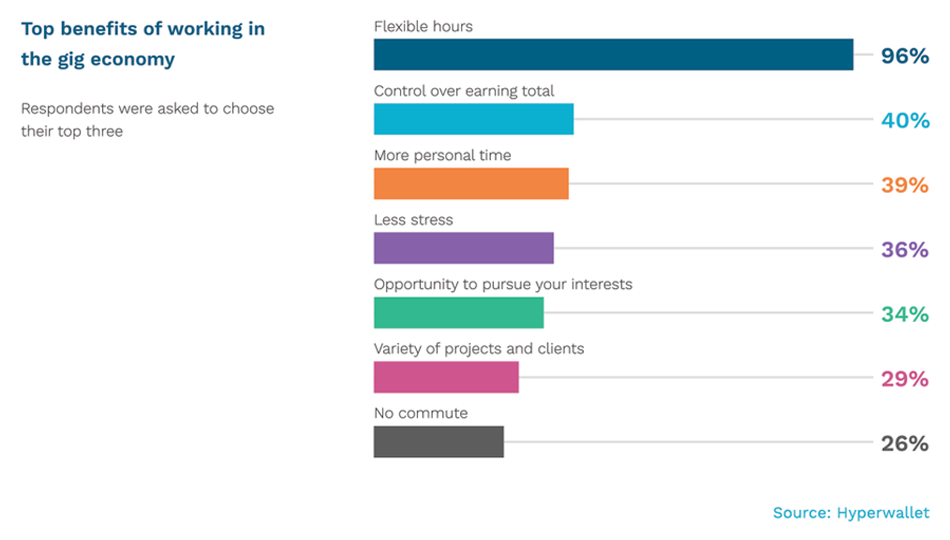
Hate waking up early and working in a cubicle? You are a perfect candidate to be a gig worker. Those who leverage the freelance economy to earn or supplement their incomes often cite flexibility as the biggest appeal. When a professional isn’t committed to a single employer in a full-time employment arrangement, they maintain greater control over their work schedules thanks to the ability to accept only the gigs, assignments, or shifts that don’t interfere with their other commitments. When you work full-time, but want to supplement your income, you can easily pick up a few gigs in the evening or over the weekends. Skilled professionals can exert more control over their career trajectory by engaging in challenging projects and building an impressive resume of results, enabling them to secure higher-level and better-paying full-time positions. Many, however, simply opt to remain a part of the independent workforce thanks to the flexibility and earnings potential it affords them.

The rise of the independent workforce benefits not only workers but also companies who can reap the cost savings of enlisting short-term help to accommodate demand without the administrative costs of hiring full-time staff. Companies aren’t making employer contributions to retirement savings accounts, for instance, or contributing to the cost of group health insurance coverage for gig workers, so the overall cost of hiring help is often less compared to the cost of hiring a full-time employee.

When companies hire gig workers, they can easily leverage skilled professionals for specific, short-term projects who would otherwise be too costly for a growing company to maintain as a full-time staffer. Additionally, it boosts the economy at large by making it possible to deliver goods and services faster and more efficiently. Studies estimate that by the end of this year, 43 percent of the American workforce will consist of independent contractors. With digitization and automation threatening some traditional jobs, the freelance economy can provide job security, but not in the traditional sense. While that may seem backwards – you may wonder how can embracing temporary work possibly contribute to long-term job security – it pays homage to the idea that you shouldn’t put all your eggs in one basket; in the independent workforce, having your position downsized doesn’t mean you’ve suddenly lost your entire income.

Gig work is growing almost exponentially in developing economies, with this type of work growing by around 30 percent annually in such countries. Certain industries like IT tend to have more freelancers or gig workers than say marketing, but these industries are also showing a growing trend.

However, if you want to be a successful gig worker, you have to balance vitality and viability. What this means is that in most cases, being a gig worker can be a very lonely life, especially if you are used to being in a bustling office space with co-workers to chat with and have coffee and lunch breaks with. Of course, technology like Whatsapp and other messaging services have to a large extent mitigated this issue, but the human touch is still missing in most gig work.

You must also find your niche and utlise your existing skills and interests, but also follow your passions. Once you have done that, leverage on available technology and platforms, especially those that connect freelancers with the skills you posses to those who need them. Have a schedule. While most gig workers start freelancing because of the flexibility it offers them, having a daily schedule makes it easy for you to determine if you can complete the work in the timeframe either provided by the company or what you have promised your client. You also have to have a strict watch on your finances. You no longer have the stability of a regular job, so incomes may fluctuate month to month. Develop a system for documenting income and expenses and you will thank yourself during tax time. Also save what you can in months of plenty, so you can sit back and not worry during the lean times.

The gig economy offers abundant opportunities for the workforce and employers alike. The rise of the independent workforce is here to stay, thanks to technology advancements that make it easier than ever for workers to find temporary jobs that afford them the freedom and flexibility they want.

Lastly most gig workers work that way because they want to balance their lives and to them success is not just making a lot of money. So find the path that works best for you and you will be very successful in the Gig Economy.