

Thirukannamangai Temple, Thirukannamangai, Tamil Nadu
The Thirukannamangai Temple is situated in the village of Thirukannamangai, near Thiruvarur, and is dedicated to Lord Vishnu as Bhaktavatsala Perumal, the lover of devotees, and his consort, Lakshmi, as Bhaktavatsala Nayaki. One of the Divya Desams, the site is also known as Krishna Mangala Kshetram, the place of Vishnu’s cosmic marriage to Lakshmi. A beehive in the goddess’s shrine adds a unique element to its rituals. Devotees visit for blessings related to marriage, relief from curses, and spiritual liberation.
Lakshmi emerged from the churning of the ocean but felt shy about approaching Vishnu. She retreated to a forest in Thirukannamangai to perform penance. Vishnu left his abode in the ocean to marry her here. The devas witnessed the union and, in their joy, transformed into bees that have remained in her shrine ever since. This event gave the place the name Lakshmi Vanam, or the forest of Lakshmi, marking it as the site of their eternal marriage.
Other legends enrich the temple’s lore. Varuna regained his noose weapon, lost to Ravana, through prayer at this spot. Sage Markandeya performed penance for immortality and became one of the chiranjeevis, or eternal beings. Chandran, cursed with a wasting disease for his sin against Brihaspati’s wife, bathed in the Darshana Pushkarani tank and found a cure. The sage Romasa narrated the story of Nala to the Pandavas during their exile. Brahma washed Vamana’s feet, and the drops formed the sacred tank. Brahmi bathed here instead of the Ganga. Shiva stands guard at the four corners. Staying one night is said to grant moksha.
The Cholas constructed the temple in the 8th and 9th centuries. Three inscriptions record their land grants and donations. The Thanjavur Nayaks made later additions. The Padma Purana and Brahmanda Purana reference the site. Thirumangai Alvar’s hymns elevated it to Divya Desam status. Floods and decay prompted restorations by locals over time. The beehive ritual honours the devas uniquely. Shiva’s presence at the corners is rare in Vishnu temples. These features set it apart in the region’s sacred landscape.

A granite wall encloses the temple complex. The five-tier Rajagopuram faces east and welcomes visitors. The Utpala Vimana rises above the sanctum. Inside, Bhaktavatsala Perumal stands in four-armed form, holding conch, discus, mace, and lotus. The Nayaki shrine houses the beehive. The Darshana Pushkarani tank lies nearby. Pillars feature carvings of Vishnu’s avatars, the ocean churning, and wedding scenes. The design follows classic Dravidian style with Chola foundations and Nayak embellishments. No radical innovations are apparent, but the layout strikes a balance between compactness and openness. Elements evoke the marriage theme throughout.
Six pujas occur daily from dawn to dusk. Priests dress the deities, offer food, and perform lamp ceremonies. Nagaswaram and tavil provide music. Chants from the Divya Prabandham fill the air. The Brahmotsavam in Panguni draws large crowds. Vaikunta Ekadasi opens special gates. Monthly bee pujas honour the devas. Couples seek wedding blessings here. Locals sponsor community meals, clean the shrines, and participate in processions. These practices strengthen village bonds.
To get to the temple, one needs to travel 10 km from Thiruvarur through flat fields. The village feels quiet and welcoming. Shops near the gate sell flowers and coconuts. Bathe in the tank to cleanse curses. Darshan proceeds smoothly on weekdays. The hum of bees in the Nayaki shrine creates a living link to the legends. Villagers share stories like Chandran’s cure. Paths through remnant forest areas recall Lakshmi’s penance. The calm atmosphere supports quiet prayer and reflection.
Thirumangai Alvar’s paasurams are recited in every puja. They inspire songs and dances during festivals. The bee legend features in local tales. The village views the temple as a marriage blessing spot. Hymns connect it to the broader Alvar tradition. Art depicts the shy Lakshmi and a buzzing hive. In society, it aids unions and curse removal. Its influence stays strong locally rather than widespread. The HR&CE department oversees operations. Restorations maintain walls and repaint the gopuram. Festivals attract mostly locals, with some from temple tours. Devotees come for marriage rites and dosha nivarana. Online bookings increase access. The bee ritual persists unchanged.

Thirukannamangai holds a place in the Divya Desams as the forest of divine marriage. Myths show devotion drawing the god to earth. Chola architecture endures floods and time. Bees symbolise lasting joy from the wedding. The deva-bee connection delights but raises questions. In the circuit, it links ocean myths to land unions. For Indian heritage, it teaches that sincere penance wins the divine. Visit and listen to the hum. Consider what your heart calls forth.
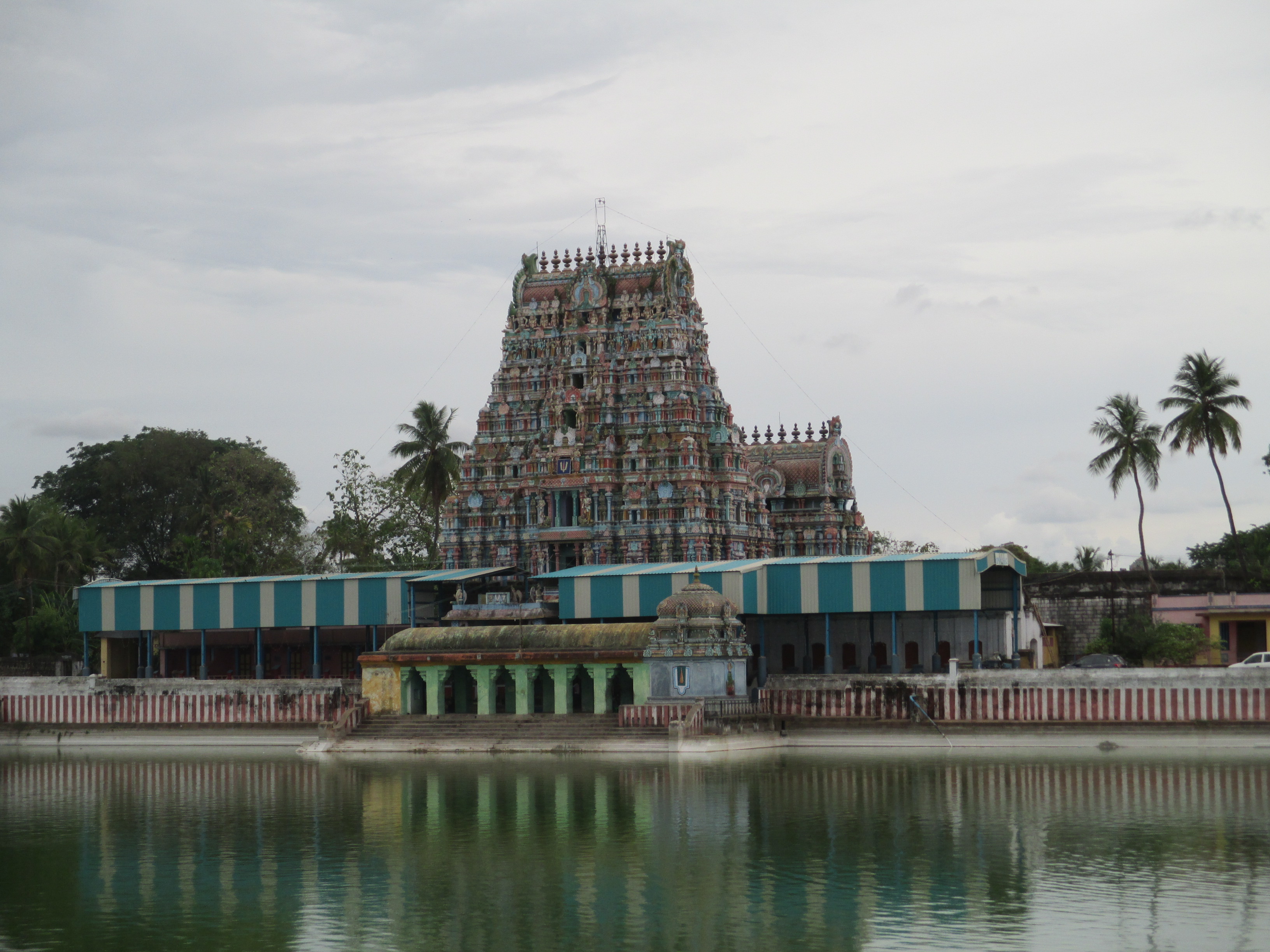
Thirukannapuram Temple, Tirukannapuram, Tamil Nadu
Thirukannapuram’s Neelamegha Perumal Temple, better known today as Sowriraja Perumal Temple, stands in the village of Thirukannapuram near Nagapattinam in Tamil Nadu. The presiding deity is Neelamegha Perumal, a dark, rain-cloud–hued Vishnu, with his consort Thirukannapura Nayagi. In practice, many devotees relate to him through the utsava murti, Sowriraja Perumal, “the lord with the wig,” whose very form comes from a story of loyalty, risk, and divine intervention.
You can already see the tension in that nickname. Why would an all-powerful god need a wig? That is where the temple’s central legend pushes you to think about how far grace will go to protect a devotee, even when the devotee is flawed.
One of the most striking legends here involves Rangabhatta, a priest deeply devoted to Neelamegha Perumal. Each day, a courtesan offered a garland to the deity, but she would first wear it herself before handing it to the priest. Rangabhatta knew that this was not proper ritual practice, but he valued her devotion and continued the arrangement. One day, the local king visited, received the garland as prasadam, and found a hair in it. Suspicious, he demanded an explanation. The priest, cornered, said the hair belonged to the deity himself. To test this, the king ordered the sanctum opened so he could inspect the image.
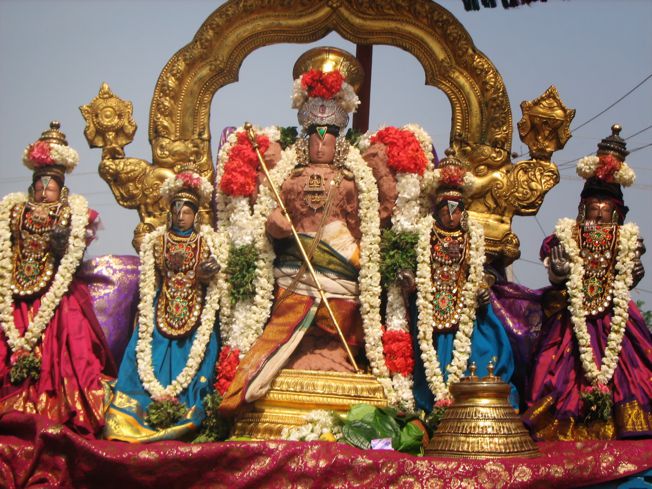
At this point, the story takes its sharp turn. According to the Sthala Purana, when the king looked at the murti, he saw that Vishnu had manifested with long hair, a sowri, to match Rangabhatta’s claim. The king accepted this as proof, spared the priest, and the deity has since been known as Sowriraja Perumal. The theological claim here is strong: the god changes form to protect a devotee from the consequences of mixed motives and compromised practice. If you push on the logic, it is uncomfortable. Should a deity endorse a lie and casual ritual impurity? The legend answers by shifting the focus. It rewards loyalty and the priest’s basic trust, while still leaving you to wrestle with the cost of bending rules. The temple, in that sense, is not selling neat moralism; it is selling a god who prioritises relationship over clean narratives.
Another legend comes from the Padma Purana. King Vasu, also called Uparisravas, had the strange gift of flying through the skies. He used this power to hunt down demons who harassed the world. One day, flying over Thirukannapuram, he mistook a group of sages in deep meditation for asuras and attacked. Vishnu appeared as a sixteen‑year‑old boy, defeated Vasu, and revealed his true form only after humbling him. When the king realised what he had done, he begged forgiveness and asked that Vishnu marry his daughter Padmini. Vishnu agreed. This story gives the temple a marriage axis: Vishnu here is not only the god with long tresses but also the son‑in‑law of Vasu, another pattern where divine grace cleans up human misjudgement without erasing responsibility.
There is also a darker thread involving Indra and Brahmahatti dosha. In one line of tradition, Indra kills the demon created by Dwashta, then spends ages haunted by the sin of killing a brahmin or someone protected by the sacred order. Various versions tie his relief to worship here, and extend the story into Nahusha temporarily taking Indra’s place, misusing power, and getting cursed into a serpent form. These episodes say plainly that even the king of the gods is bound by moral law, and that misuse of power, even under the cover of “doing the right thing”, carries a cost that cannot be wished away.
If you’re willing to question the details: why a wig, why flying kings, why this one village as the stage?, you get to the underlying themes. The temple’s myths lean hard on three points: God will go to strange lengths to protect his devotees; power, even divine or kingly, is accountable; and appearances mislead, whether it is a courtesan’s garland or sages mistaken for demons.

Architecturally and epigraphically, Thirukannapuram is rooted in the Chola period. The core temple structure is generally dated to medieval Chola times, with substantial later expansions under the Thanjavur Nayaks. Inscriptions record land grants, lamps, and endowments for festivals, showing that this was not a marginal shrine but an active religious and economic node. Over time, the temple acquired an identity as one of the five Krishnaranya or Pancha Krishna Kshetrams, alongside Thirukannangudi, Kabisthalam, Thirukannamangai, and Thirukovilur. That networked identity mattered politically and ritually. It tied different localities into a shared story‑world of Krishna and Vishnu devotion, while still allowing each temple a distinctive myth, here, the wig and the flying king.
Some local traditions claim that the temple complex once extended all the way to the sea, suggesting either coastal recession or partial loss of property over time. You can’t verify that neatly, but it aligns with the broader pattern of large temple estates being carved up, encroached upon, or re‑purposed through colonial and post‑colonial land reforms. So when people say “it once reached the shore,” what they are also saying is “we remember when this place felt bigger, both physically and in social reach.”
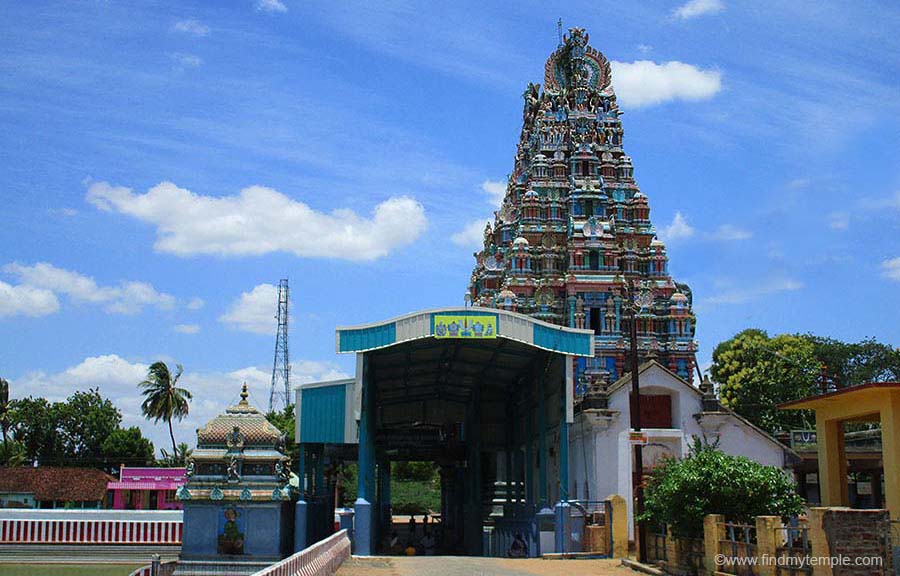
Thirukannapuram is a textbook Dravidian complex, but on a large and expressive scale. A seven‑tier rajagopuram dominates the entrance, with a granite wall enclosing the shrines and three of the temple’s seven water bodies. Immediately in front lies a huge temple tank, Nithya Pushkarani, which shapes the visual approach and the ritual calendar. The main sanctum houses Neelamegha Perumal, flanked by Sridevi and Bhudevi, with Garuda and sage Dandaka also present in close proximity. The utsava murti, Sowriraja Perumal, is the one most associated with processions and the wig legend. In many depictions, his discus is shown ready to be hurled, tied to another story where he supposedly used it to repel a hostile king’s forces. That posture stands out against the more static discs of many other Vishnu images.
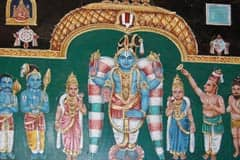
The temple follows the usual granite‑base, brick‑superstructure pattern, with mandapams filled with sculpted pillars. You see scenes from the puranas, Alvar figures, yalis, and ornamental work that likely received Nayak‑period embellishments. There is no single “innovation,” but two things are notable. First, the scale: for what is now a quiet village, the gopuram and tank feel oversized, hinting at a time when this was a central hub. Second, the way narrative and space merge: the long hair of the lord, the youthful form for Vasu, and the discus story all get encoded in iconography and procession routes.
Daily worship follows standard Vaishnava agamic patterns, with six main pujas from early morning to late evening. Each involves alankaram, neivedyam, and deepa aradanai, against a soundtrack of nagaswaram, tavil, and recitation of Divya Prabandham verses. The theology here is simple but demanding: the deity must be treated as a living, royal presence, fed and honoured on time, every day, without fail.
Three annual festivals stand out. The chariot festival in Vaikasi (roughly April–May) brings out the temple car in a major procession around the streets. Brahmotsavams and Vaikunta Ekadasi celebrations draw regional crowds. Given the Sowriraja legend, there is also continuing emphasis on the daily garland offerings and on seva roles that tie back to the priest–king tension at the heart of the story. Local families sponsor parts of the festivals, provide lamps and oil, and help with crowd management and annadanam. That is not just piety; it is also a way of signalling status and continuity. If you think critically, you might ask whether this reinforces caste and class hierarchies. It often does. At the same time, these same structures have kept the temple functioning in periods when state support was thin or inconsistent.
Reaching Thirukannapuram usually involves travelling from Nagapattinam, Nannilam, or nearby towns, through flat delta fields, irrigation channels, and small hamlets. The temple gopuram rises above the village houses and is visible from a distance, framed by the sky and, often, flocks of birds over the tank. The approach is typical: rows of small shops selling flowers, coconuts, oil, and pictures of Sowriraja Perumal; children playing near the tank steps; and elders seated in shade, watching arrivals. Inside, Darshan is usually manageable on non‑festival days. You can stand for a while before Neelamegha Perumal, take in the dark stone glow, and then move to the utsava murti, looking for the subtle hair detailing that marks him as Sowriraja.
Many pilgrims come specifically for graha dosha and general trouble relief, because local belief holds that the lord’s gaze falls on the navagrahas here and reduces planetary afflictions. Others come for marital, career, or health reasons. One pattern you hear in people’s stories is this: “I came here when nothing else worked.” The legends reinforce that frame: Rangabhatta boxed in by a king, Vasu humbled after violence, Indra burdened by brahmahatti, people at a breaking point, seeking a creative, even unlikely, outlet.
As a Divya Desam, Thirukannapuram features in the Nalayira Divya Prabandham, anchoring it firmly in the Sri Vaishnava sacred geography. Those hymns continue to be sung daily, which means the temple is not just a backdrop but a participant in an ongoing poetic recitation that spans centuries. That alone gives it more cultural “weight” than many structurally similar but unsung shrines. The Sowriraja story has had a long afterlife in discourse about bhakti. It is often cited as an example of the lord taking the devotee’s side even when the devotee is technically wrong. That can be inspiring, but it can also be misused to justify sloppy practice or blind loyalty to human gurus. A sharper reading would say: grace does not erase consequences, but sometimes overrides them in specific, relational contexts, something you cannot universalise cheaply.
The temple also sits among the Pancha Krishna/ Krishnaranya kshetras, which support shared festivals, itineraries, and storytelling across multiple sites. In local identity, being from “Sowriraja Perumal koil” country carries a certain pride, especially for those in traditional Vaishnava lineages and temple‑service families. Visual culture: calendar art, posters, and sand mall framed prints often depict the lord with flowing hair, making this one of the more visually distinctive Vishnu images in the region.
Today, the temple functions under the Tamil Nadu HR&CE administration, with daily worship and festivals continuing alongside periodic renovation works. Gopuram painting, stone‑work consolidation, and tank desilting come up in cycles, driven by a mix of state funds and donor contributions. There is also growing digital visibility through videos, live‑streams, and social media posts that narrate the Sowriraja story in simplified form.

Visitor demographics are mixed: local devotees who see it as their “home” Vishnu temple; Divya Desam circuit pilgrims trying to cover all 108 shrines; and a smaller group of heritage‑minded travellers interested in inscriptions and architecture. One tension here is between turning these places into tourist checkpoints and preserving them as lived sacred spaces. The temple’s scale and slightly off‑main‑highway location have, so far, helped keep it more pilgrim‑oriented than tourism‑driven.
If you look critically, you might ask whether the “miracle” narrative of the wig still makes sense in an age shaped by science and scepticism. The answer depends on what you expect from it. As history, it is unverifiable. As theology, it is a claim about divine involvement in messy, everyday crises. In psychology, it shows a community choosing to remember a moment when their god “took their side” against royal power. Those layers can all be true in different registers, without needing you to suspend all critical thought.
Within the Divya Desam circuit, Thirukannapuram stands out as a place where grace and risk collide. The wig legend, the flying king Vasu, and the Indra‑Nahusha episodes all push the same uncomfortable point: power and piety do not make you infallible, and divine help may come in forms that bend the rules to protect a relationship rather than to preserve a system. That is not an easy message if you prefer neat morality. It is a more realistic one if you accept that religious life happens in grey zones. The temple’s Chola‑Nayak architecture, its large tank and seven‑tier gopuram, and its continued recitation of Alvar hymns root it deeply in South Indian sacred history. At the same time, the stories it carries still speak to modern dilemmas: fear of authority, anxiety about mistakes, the hope that someone greater might step in when the consequences feel unbearable. Engaging with Thirukannapuram on those terms; not as a miracle factory, but as a long conversation about loyalty, accountability, and mercy, lets the place do more than just sit on a checklist. It becomes a testing ground for how far you think compassion should go, and what it might cost.

