Today is another Friday, so time to lighten up!


Today is another Friday, so time to lighten up!
Echoes From Afar – Tamara McKinley

So this is Paris, she thought in awe. Spread out before her beneath a clear blue sky, it was like a precious gift after the smog and filth of London. No wonder it was called the city of love . . .
After a spiteful rumour ruins her career in London, Annabelle Blake must travel to Paris to start afresh. There she makes the acquaintance of Etienne and Henri – one a poet, the other a painter – both charming, talented and handsome. They spend their days flirting and drinking with the city’s artists and Bohemians, and soon Annabelle too is swept up in the exotic and exhilarating world of 1930s Paris.
But as ever more young people are drawn to the fight against Fascism in Spain, Annabelle must wake from the dream and confront the reality of war. A lifetime later, gifted artist Eugenie Ashton falls in love with Paris the moment she sets foot outside the Gare de Lyon. Like her mother Annabelle before her, the artistic delights of the city are a bright new world to her: but Eugenie will soon find that in its shadows are hidden the secrets of her family’s past.
According to the World Economic Forum, in the next five years, more than one-third of skills (35%) that are considered important in today’s workforce will have changed. What was relevant yesterday is already disappearing and new skills will be needed for job seekers to be relevant to the job market in the near future. What this means to us parents is that we need to equip our children with the skills that are the most relevant to them as they get ready to start working.
The world of work is changing – and some jobs are changing faster than others. According to the latest research, soon we’ll only be as good as the skills we possess. But which skills are they, and how can we make sure we keep pace?
New categories of jobs will emerge, partly or wholly displacing others. The skillsets required in both old and new occupations will change in most industries and transform how and where people work. This change in skillsets and new jobs may also affect female and male workers differently and transform the dynamics of the industry gender gap. As technological breakthroughs rapidly shift the frontier between the work tasks performed by humans and those performed by machines and algorithms, global labor markets are likely to undergo major transformations. These transformations, if managed wisely, could lead to a new age of good work, good jobs and improved quality of life for all, but if managed poorly, pose the risk of widening skills gaps, greater inequality and broader polarization.
In many ways, the time to shape the future of work is now.
Automation, robotization and digitization look different across different industries: High-speed mobile internet, artificial intelligence, big data analytics, and cloud technology are set to spearhead companies’ adoption of new technologies between 2018 and 2022. Many will also look to machine learning and augmented and virtual reality for considerable business investment. By contrast, investment in the kind of robotic technologies imagined in movies and popular fiction will remain somewhat more niche over the period – but is nevertheless picking up pace. Stationary robots are likely to be the most widely adopted by 2022 – but different industries have distinct use cases and preferences.
There is a net positive outlook for jobs – amid significant job disruption: By 2022, today’s newly emerging occupations are set to grow from 16% to 27% of the employee base of large firms globally, while job roles currently affected by technological obsolescence are set to decrease from 31% to 21%. In purely quantitative terms, 75 million current job roles may be displaced by the shift in the division of labour between humans, machines and algorithms, while 133 million new job roles may emerge at the same time. Growing occupations include roles such as Data Analysts, Software and Applications Developers and E-commerce and Social Media Specialists – jobs that are significantly based on, and enhanced by, the use of technology. However, also expected to grow are job roles based on distinctively ‘human’ traits, such as Customer Service Workers, Sales and Marketing Professionals, Training and Development, People and Culture, and Organizational Development Specialists as well as Innovation Managers.
The division of labour between humans, machines and algorithms is shifting fast: Employers anticipate a significant shift in the division of labour between humans, machines and algorithms for the tasks of today. Currently an average of 71% of total task hours across the industries covered by our Future of Jobs Report are performed by humans, compared to 29% by machines or algorithms. By 2022 this average is expected to have shifted to 58% task hours performed by humans, and 42% by machines or algorithms. In terms of total working hours, no work task is yet performed predominantly by machines or algorithms today. By 2022, 62% of organization’s data processing and information search and transmission tasks will be performed by machines. Relative to their starting point today, the expansion of machines’ share of work task performance will be particularly marked in reasoning and decision-making, administrative and information search tasks. Even work tasks overwhelmingly performed by humans today — communicating, interacting, coordinating, managing and advising — will begin to be taken on by machines, although to a lesser degree.
New tasks at work are driving demand for new skills: By 2022 the skills required to perform most jobs will have shifted significantly. Global average “skills stability”— the proportion of core skills required to perform a job that will remain the same — is expected to be about 58%. That means workers will see an average shift of 42% in required workplace skills in the period leading up to 2022. Skills growing in prominence include analytical thinking and active learning as well as skills such as technology design, highlighting the growing demand for various forms of technology competency. However, proficiency in new technologies is only one part of the 2022 skills equation. “Human” skills such as creativity, originality and initiative, critical thinking, persuasion and negotiation will likewise retain or increase their value, as will attention to detail, resilience, flexibility and complex problem-solving. Emotional intelligence, leadership and social influence as well as service orientation are also set to see particular increase in demand relative to their current prominence today.
We will all need to become lifelong learners: On average, employees will need 101 days of retraining and upskilling in the period up to 2022. Emerging skills gaps — both among individual workers and among companies’ senior leadership — may significantly obstruct organization’s transformation management. Depending on industry and geography, between one-half and two-thirds of companies are likely to turn to external contractors, temporary staff and freelancers to address their skills gaps. A comprehensive approach to workforce planning, reskilling and upskilling will be the key for positive, proactive management of such trends.
Based on the above trends, we need to get our children trained in technology as that will not go anywhere but become more and more entrenched into our lives. Plus never stop learning, you are never old to learn something new!
Last Letter from Istanbul – Lucy Foley

Constantinople, 1921
Each day Nur gazes across the waters of the Bosphorus to her childhood home, a grand white house, nestled on the opposite bank. Memories float on the breeze – the fragrance of the fig trees, the saffron sunsets of languid summer evenings. But now those days are dead.
The house has been transformed into an army hospital, it is a prize of war in the hands of the British. And as Nur weaves through the streets carrying the embroideries that have become her livelihood, Constantinople swarms with Allied soldiers – a reminder of how far her she and her city have fallen.
The most precious thing in Nur’s new life is the orphan in her care – a boy with a terrible secret. When he falls dangerously ill Nur’s world becomes entwined with the enemy’s. She must return to where she grew up, and plead for help from Medical Officer George Monroe.
As the lines between enemy and friend become fainter, a new danger emerges – something even more threatening than the lingering shadow of war.
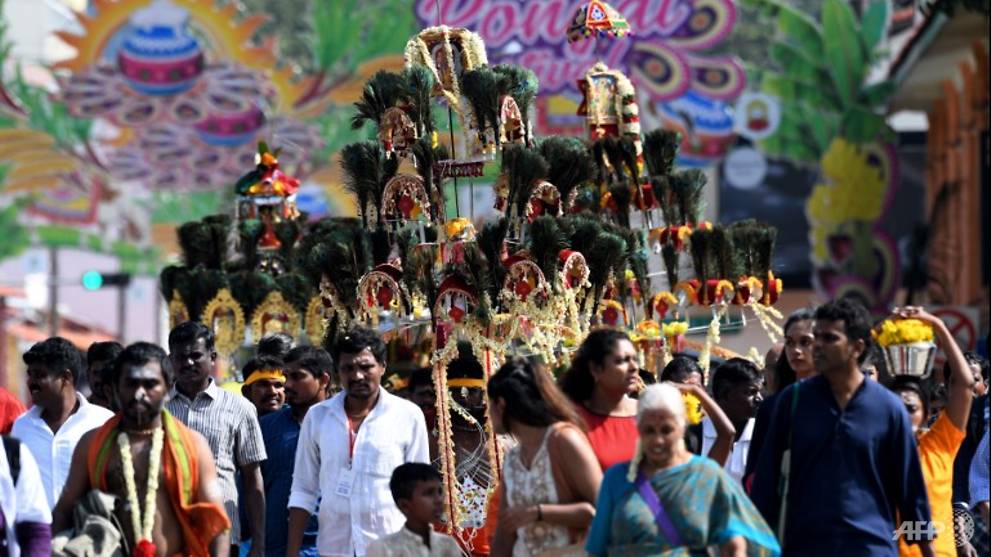
Last Saturday, Tamils all over the world celebrated the festival of Thaipusam. This festival is celebrated on the full moon in the Tamil month of Thai which starts in in mid-January, usually coinciding with Pushya star, known as Poosam in Tamil. It is mainly observed in countries where there is a significant presence of Tamil community. It is quite a big celebration
It is a national holiday in countries like Malaysia, Sri Lanka and Mauritius. In certain states of Malaysia and in the nations of Sri Lanka and Mauritius it is a government and a bank holiday.In Singapore, it was previously a national holiday but was removed from the official list of national holidays.
The word Thaipusam is a combination of the name of the month, Thai, and the name of a star, Pusam. This particular star is at its highest point during the festival. The festival commemorates the occasion when Parvati gave Murugan a Vel “spear” so he could vanquish the evil demon Soorapadman. It is commonly believed that Thaipusam marks Murugan’s birthday.
This festival was, according to one tradition, said to have been supposedly created during one of the battles between the Asuras (or to be more specific Soorapadman) and the Devas. At one point, the latter were defeated several times by the former. The Devas were unable to resist the onslaught of the Asura forces. In despair, they approached Shiva and entreated to give them an able leader under whose heroic leadership they might obtain victory over the Asuras. They surrendered themselves completely and prayed to Shiva. Shiva granted their request by creating the mighty warrior, Skanda, out of his own power or Achintya Shakti. He at once assumed leadership of the celestial forces, inspired them and defeated the Asura forces and to recognise that day the people created the festival, Thaipusam.
According to Skanda Puranam, the legend of Murugan, and Thirupugal which are divine verses on Murugan, adhere to Shaivam principles. Murugan is the embodiment of Shiva’s light and wisdom and devotees pray to him to overcome the obstacles they face, as He is the divine vanquisher of evil. The motive of Thaipusam festival is to pray to God to receive his grace so that bad traits are destroyed.
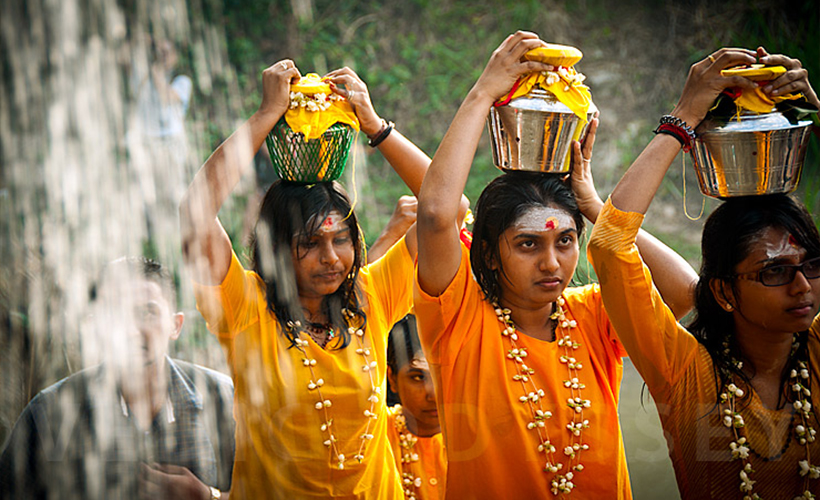
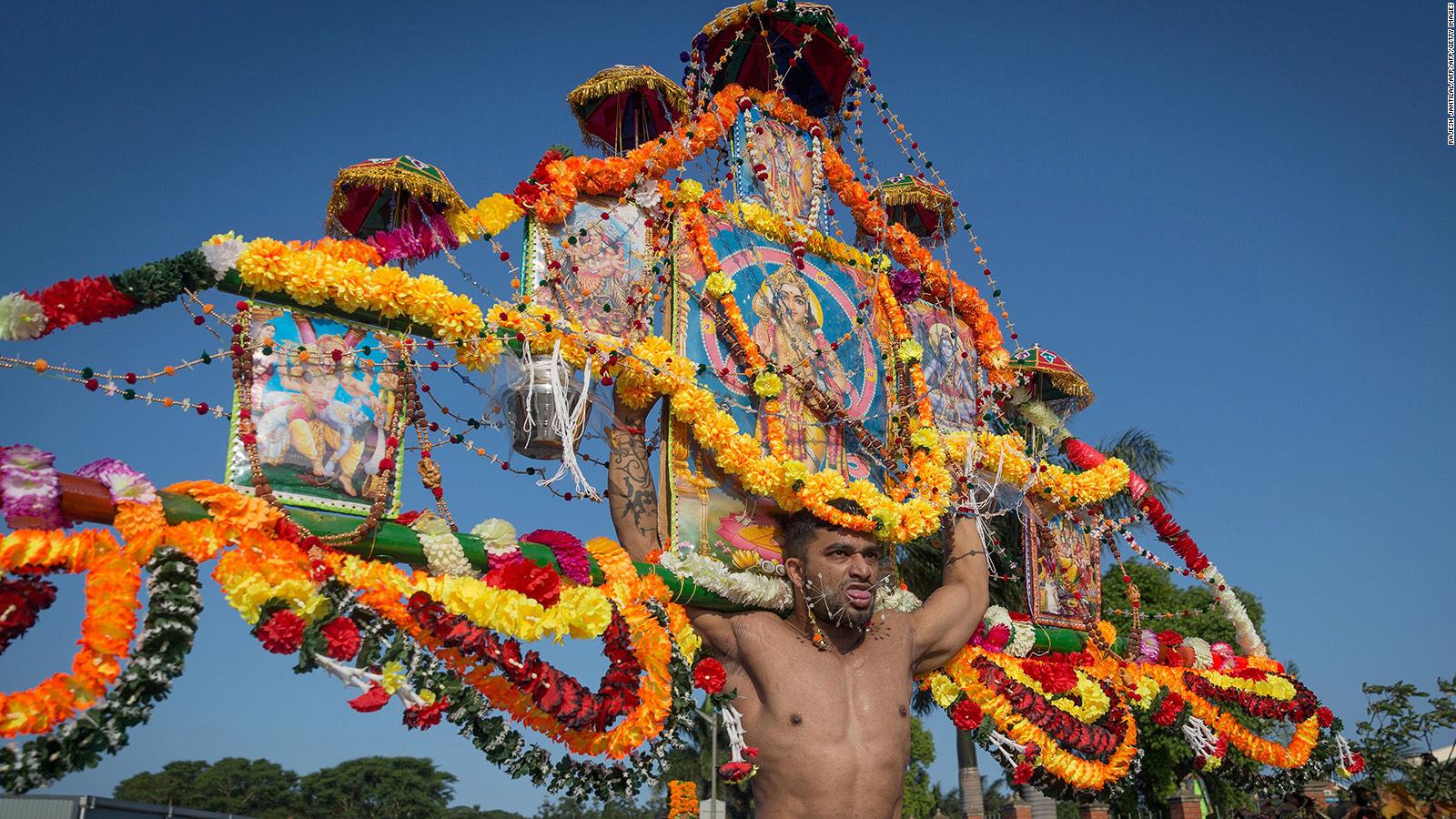
The Kavadi Attam (“kavadi dance”) is a ceremonial act of devotional sacrifice through dance, food offerings, and bodily self-mortification. It is often performed by devotees during the festival of Thaipusam in honor of Murugan. The kavadi is a heavy semicircular, decorated canopy or shrine supported by a wooden rod that the pilgrim carries on their shoulders to the temple and attached to the devotee with shrap skewers. They symbolize the burdens carried. The largest of the burdens, known as the vel kavadi, requires the person carrying it to be pierced by 108 small spears or vels! Other worshipers carry pots of milk, fruit, or grains as offerings to Lord Murgan, symbolising abundance and fertility.
The worshipers who pierce their tongues, cheeks, and faces with sharp objects hardly bleed and report feeling very little pain! Many claim that their wounds heal nearly immediately and don’t produce scars. Before being pierced, devotees are worked into a trance-like state with chanting and drums. Once entranced, the crowd helps to take care of them as they are led through the procession. Tongues are often pierced and pinned through the cheeks as a symbolic gesture of the volunteer giving up the gift of speech.
The devotee makes the pilgrimage (the nadai payanam) with bare feet, dressed in bright orange and yellow — Lord Murugan’s favorite colors — while they chant and walk to the temple. bearing food offerings on the kavadi. Depending on the location of the temple, this walk to the temple can take more than a week. The temple of Murugan in Palani is a popular destination, as it is one among the arupadai veedu (“six houses” – the sites sacred to Murugan). The Palani Murugan temple also has a reputation as a place of healing. Bogar (an ancient siddhar and devotee of Murugan) made the statue of Murugan in Palani, with the mixture of several sidhha medicines.
Devotees prepare for the celebration by keeping their body always clean, doing regular prayers, following a vegetarian diet and fasting before the Thaipusam. Kavadi-bearers have to perform elaborate ceremonies at the time of assuming the kavadi and at the time of offering it to Murugan. The kavadi-bearer observes celibacy and consumes only certain types of foods known as satvik food, once a day, while continuously thinking of God. On the day of the festival, devotees shave their heads and undertake a pilgrimage along a set route, while engaging in various acts of devotion, notably carrying the various types of kavadi. The devotees believe that worshiping lord Murugan every year in this way makes them physically and mentally healthy, and helps clear them of karmic debts they may have incurred. It is believed that only when the mind is free of material worth and the body free from physical pleasures can a devotee undertake the sacred task without feeling any pain.
At its simplest, the pilgrimage may entail walking the route carrying a pot of milk, but mortification of the flesh by piercing the skin, tongue or cheeks with vel skewers is also common. In addition, some pierce their tongues or cheeks, all the way through, with a small spear. similar practice is performed by the Nagarathar community in Pazhani, India. This is known as the Nagarathar Kavadi.


 Memories and Such