Today, Punjab will come together to celebrate the festival of Lohri. A celebration of the winter solstice, Lohri is is a popular Punjabi winter folk festival which is beloved in the Punjab region. The significance and legends about the Lohri festival are many and these link the festival to the region. It is believed by many that the festival commemorates the passing of the winter solstice. Lohri marks the end of winter, and is a traditional welcome of longer days and the sun’s journey to the northern hemisphere by Sikhs and Hindus in the region. Lohri is observed the night before Makar Sankranti, also known as Maghi, according to the solar part of the lunisolar Bikrami calendar and typically falls about the same date every year which is January 13 in the month of Paush and is set by the solar part of the lunisolar Punjabi calendar and in most years it falls around 13 January of the Gregorian calendar. An official restricted holiday in the Indian Punjab, Haryana and the National Capital Territory of Delhi, Lohri is not a holiday in the Pakistani Punjab, but It is, observed by Hindus, Sikhs and some Muslims there.
There are many folklores about Lohri which is the celebration of the arrival of longer days after the winter solstice. According to folklore, in ancient times Lohri was celebrated at the end of the traditional month when the winter solstice occurs with the day after Lohri celebrated as Maghi Sangrand.
The festival is ancient, originating in the regions near the Himalayan mountains where winter is colder than the rest of the subcontinent. Hindus traditionally lit bonfires in their yards after the weeks of the rabi season cropping work, socialised around the fire, sang and danced together as they marked the end of winter and the onset of longer days. After the night of bonfire celebrations, Hindus would mark Makar Sankranti and go to a sacred water body such as a river or lake to bathe. Over the years, however, instead of celebrating Lohri on the eve of when winter solstice actually occurs, Punjabis started to celebrate it on the last day of the month during which winter solstice takes place.
The festival’s ancient significance is both as a winter crop season celebration and a remembrance of the Sun deity or Surya. Lohri songs mention the Sun god asking for heat and thanking him for his return. Other legends explain the celebration as a folk reverence for the Lord of fire or Agni or the goddess of Lohri. Yet another folklore links Lohri to the tale of Dulla Bhatti. The central theme of many Lohri songs is the legend of Dulla Bhatti who lived in Punjab during the reign of Mughal emperor Akbar. He was regarded as a hero in Punjab, for rescuing Hindu girls from being forcibly taken to be sold in slave market of the Middle East. Amongst those he saved were two girls Sundri & Mundri, who gradually became a theme of Punjab’s folklore. As a part of Lohri celebrations, children go around homes singing the traditional folk songs of Lohri with Dulla Bhatti’s name included in them. One person sings, while others end each line with a loud “Ho!” sung in unison. After the song ends, the adult of the home is expected to give snacks and money to the singing troupe of youngsters.
Some people believe that Lohri has derived its name from Loi, the wife of Saint Kabir. There is a legend amongst some people that Lohri comes from the word ‘loh’, which means the light and the warmness of fire. Lohri is also called lohi in rural Punjab. According to another legend Holika and Lohri were sisters. While the former perished in the Holi fire, the latter survived with Prahlad. Eating of til or sesame seeds and rorhi or jaggery is considered to be essential on Lohri day. Perhaps the words til and rorhi merged to become tilorhi, which eventually got shortened to Lohri.
Lohri is celebrated with a bonfire, the lighting of which during this winter festival is an ancient tradition. Eating sheaves of roasted corn from the new harvest and celebrating the January sugarcane harvest is how Lohri is celebrated. Sugarcane products such as jaggery and gachak or peanut candy are central to Lohri celebrations, as are nuts which are harvested in January. The other important food items of Lohri are radishes and mustard greens. During this time, it is traditional to eat gajak, sarson da saag with makki di roti, radish, ground nuts and jaggery as well as til rice which is made by mixing jaggery, sesame seeds and rice. In some places, this dish is called Tricholi.
In various places of the Punjab, about 10 to 15 days before Lohri, groups of young and teenage boys and girls go around the neighbourhood collecting logs for the Lohri bonfire. In some places, they also collect items such as grains and jaggery which are sold and the sale proceeds are divided amongst the group. In some parts of Punjab, there is a popular “trick or treat” activity which is engaged in by boys to select a group member to smear his face with ash and tie a rope around his waist. The idea is for the selected person to act as a deterrent for people who refrain from giving Lohri items. The boys will sing Lohri songs asking for Lohri items. If not enough is given, the householder will be given an ultimatum to either give more or the rope will be loosened. If not enough is given, then the boy who has his face smeared will try to enter the house and smash clay pots or the clay stove.
During the day, children go from door to door singing folk songs. These children are given sweets and savories, and occasionally, money. Turning them back empty-handed is regarded inauspicious. Where families have newly-weds and new borns, the requests for treats increases. The collections gathered by the children are known as Lohri and consist of til, gachchak, crystal sugar, jaggery, peanuts and phuliya or popcorn. Lohri is then distributed at night during the festival. Sesame seeds, peanuts, popcorn and other food items are also thrown into the fire. For some, throwing food into the fire represents the burning of the old year and start the next year on Makar Sankranti
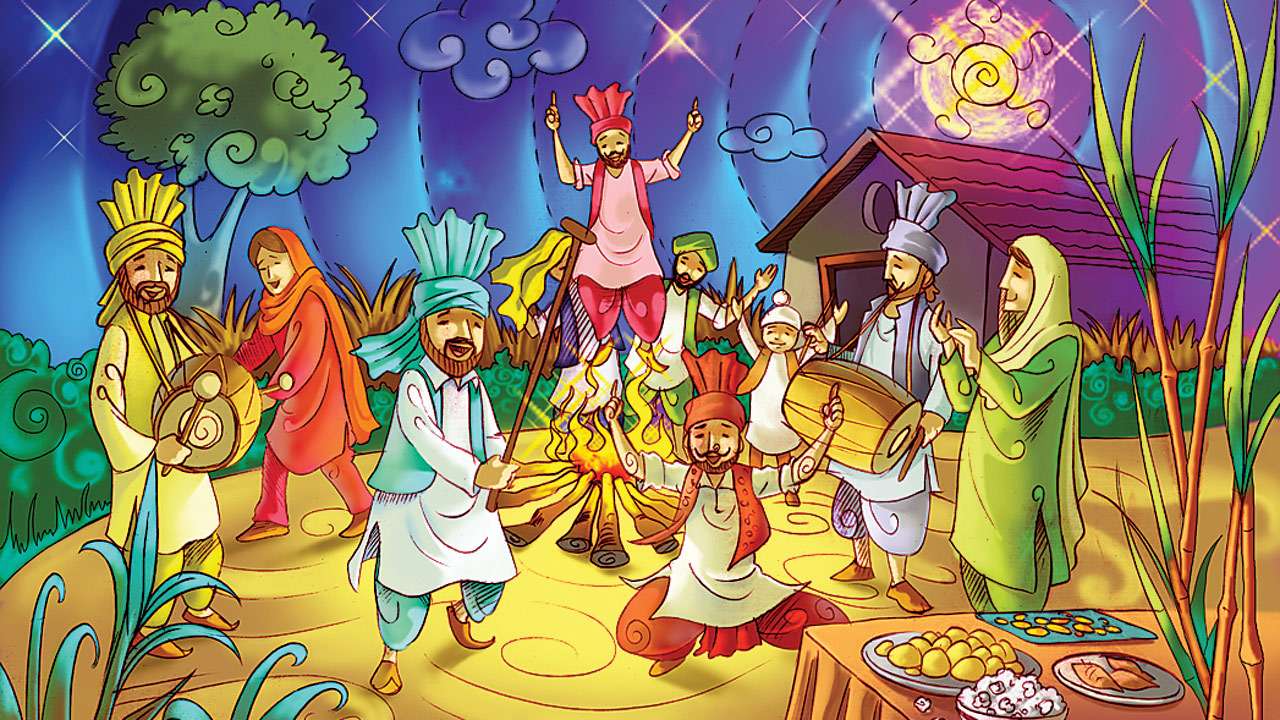
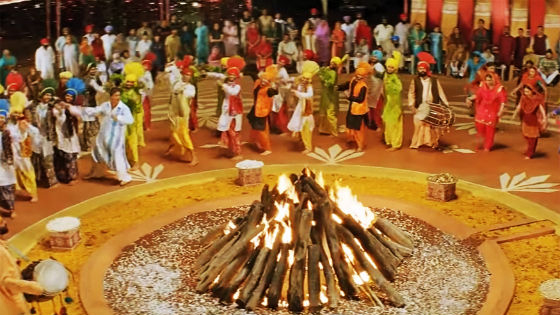
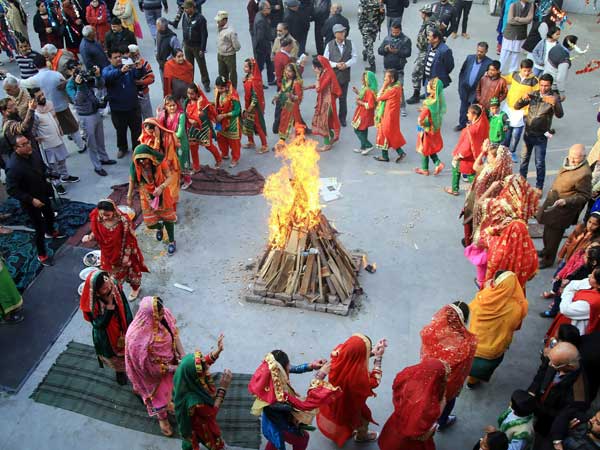
The bonfire ceremony differs depending on the location in Punjab. In some parts, a small image of the folk Lohri goddess is made with gobar or cattle dung decorating it, kindling a fire beneath it and chanting its praises. The folk Lohri goddess is believed to be an ancient aspect of the celebration, and is part of a long tradition of the winter solstice celebrations manifesting as a god or goddess. In other parts, the Lohri fire consists of cow dung and wood with no reference to the Lohri goddess. The bonfire is lit at sunset in the main village square. People toss sesame seeds, gur, sugar-candy and rewaries on the bonfire, sit around it, sing and dance till the fire dies out. Some people perform a prayer and go around the fire. This is to show respect to the natural element of fire, a tradition common in winter solstice celebrations. It is traditional to offer guests til, gachchak, jaggery, peanuts and phuliya or popcorn. Milk and water are also poured around the bonfire by Hindus to thank the Sun God and seeking his continued protection. Chants of “Aadar aye dilather jaye” meaning “may honour come and poverty vanish” are chanted while moving around the fire.
In the northern union territory of Jammu and Kashmir, Lohri in Jammu is special because of various additional traditions associated with it like Chajja making and dancing, hiran dance and preparing Lohri garlands. Young children prepare a replica of a peacock known as Chajja. They carry this Chajja and then go from one house to other house celebrating Lohri. In and around Jammu, a special hiran or deer dance is performed. Selected houses which have auspicious ceremonies prepare eatables and children wear special garlands made of groundnuts, dry fruits and candies on the day of the festival.
Among some sections of the Sindhi community, the festival is traditionally celebrated as Lal Loi. On the day of Lal Loee children bring wood sticks from their grandparents and aunts and light a fire burning the sticks in the night with people enjoying, dancing and playing around the fire. The festival is gaining popularity amongst other Sindhis where Lohri is not a traditional festival.




 Memories and Such