

The train screeched to a halt at Lonavala station, and Arjun practically bounced out of his seat. “Finally! Fresh air!” he declared dramatically, throwing his arms wide as if he could already breathe in the hill station’s crisp atmosphere through the train’s grimy windows.
“Calm down, Mountain Man,” laughed Priya, adjusting her oversized sunglasses. “We haven’t even gotten off yet.”
Their group of six had been planning this weekend trip for months. There was Arjun, the eternal optimist and self-appointed trip organiser; Priya, sharp-tongued but fiercely loyal; Rohit, quiet and thoughtful, who’d been harboring feelings for Priya since their first year; Kavya, bubbly and Instagram-obsessed; Vikram, the skeptic who complained about everything but never missed a hangout; and Neha, practical and level-headed, often the voice of reason.
“I still think we should have booked a proper hotel,” Vikram grumbled, hefting his designer backpack. “This Airbnb thing sounds sketchy.“
“It’s not sketchy, it’s authentic,” Arjun countered. “The listing said it’s a colonial-era bungalow with ‘old-world charm.’ How cool is that?”
“Old-world charm usually means no Wi-Fi and questionable plumbing,” Vikram muttered.
Kavya, who had been frantically taking selfies since they’d entered the Western Ghats, looked up from her phone. “Guys, I’m getting no signal. Like, zero bars. How am I supposed to post our trip?”
“That’s the point!” Arjun said. “Digital detox! Quality time! Bonding!”
“I’m already feeling detoxed,” Neha said dryly. “Mainly of my will to live.”
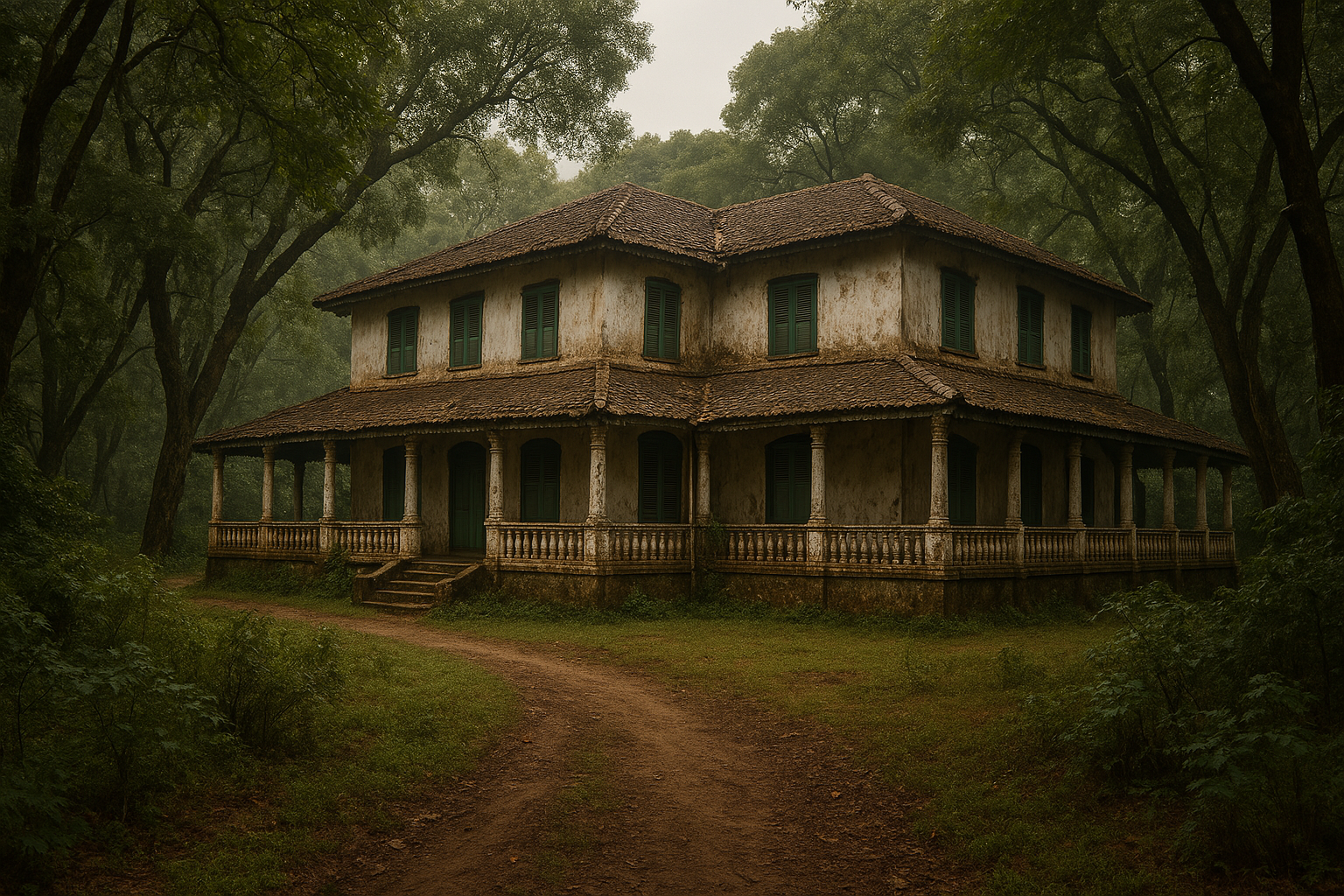
After a bumpy auto-rickshaw ride through winding roads flanked by misty hills and cascading waterfalls, they arrived at their destination. The bungalow stood at the end of a narrow dirt path, surrounded by dense trees that seemed to lean in conspiratorially. It was exactly as advertised: a sprawling colonial structure with weathered white walls, green shutters, and a wraparound veranda that had seen better decades.
“It looks like something out of a horror movie,” Rohit observed quietly.
“Or a romantic period drama,” Priya added, and Rohit’s heart did a little skip.
“Why not both?” Kavya said cheerfully, finally finding one tiny bar of signal and immediately snapping photos.
The caretaker, an elderly man named Raman uncle, greeted them with a mixture of warmth and what seemed like concern. He was lean and weathered, with kind eyes that seemed to hold secrets.
“Welcome, welcome,” he said, jangling a large set of keys. “You are the college group, yes? From Mumbai?”
“That’s us!” Arjun beamed. “Ready for the best weekend ever!”
Raman uncle’s smile faltered slightly. “Ah, yes. Well, let me show you the house. There are just a few… guidelines.”
As he led them through the musty interior, pointing out the kitchen, bathrooms, and bedrooms, his tone grew more serious. “Please, do not go to the third floor. It is not safe, old floorboards, you understand. And after sunset, it is better to stay inside. The forest can be… confusing at night.”
“Confusing how?” Neha asked, her practical mind immediately catching the euphemism.
“Animals,” Raman uncle said quickly. “Leopards, sometimes. And the paths, they all look the same in the dark.”
Vikram shot Arjun a pointed look. “Leopards. Great choice, organiser.”
“Leopards are scared of humans,” Arjun said dismissively. “And look at this place! It’s perfect!“
After Raman uncle left, promising to return the next evening, the group settled in. They distributed themselves across the four bedrooms on the second floor, with Arjun and Vikram sharing one, Priya and Kavya sharing another, and Rohit and Neha taking the remaining two rooms.
The first evening passed pleasantly enough. They cooked a chaotic dinner together, with Priya demonstrating her surprising culinary skills. At the same time, Kavya documented every dish for her Instagram story (which she couldn’t post due to the poor signal, leading to much dramatic sighing). Rohit found excuses to help Priya in the kitchen, and she didn’t seem to mind, which gave him hope.
“This is nice,” Vikram admitted grudgingly as they sat on the veranda after dinner, sharing bottles of beer they’d brought from Mumbai. “Peaceful.“
“See? I told you…” Arjun began, but was interrupted by a strange sound from above.
Thump. Drag. Thump. Drag.
Everyone looked up at the ceiling.
“What was that?” Kavya whispered.
“Probably just the wind,” Neha said, but her voice lacked conviction.
“Wind doesn’t make dragging sounds,” Rohit pointed out.
Thump. Drag. Thump. Drag.
The sound came again, clearly footsteps, but dragging, as if someone was pulling something heavy across the floor above them.
“That’s the third floor,” Priya said quietly. “The one we’re not supposed to go to.”
“Maybe it’s just settling,” Arjun suggested, though his usual confidence seemed shaken. “Old houses make weird noises.”
Vikram stood up abruptly. “I’m going to check.”
“Are you insane?” Kavya hissed. “Raman uncle specifically said not to go up there!”
“Raman uncle also said there were leopards, and I haven’t seen any paw prints. I bet he just doesn’t want us messing with his storage or something.”
Before anyone could stop him, Vikram had stalked inside and up the creaking staircase. The others followed reluctantly, clustering at the bottom of the stairs leading to the third floor.
“Vikram?” Arjun called. “Find anything?”
There was a long pause, then Vikram’s voice, strangely strained: “Guys? You need to see this.”
They climbed the narrow staircase to find Vikram standing in a doorway, his face pale. Beyond him was a room that looked like it belonged in a different century, or a different world entirely.
The room was filled with old photographs, hundreds of them, covering every wall. But these weren’t ordinary family photos. They showed the same group of six young people, over and over again, in different poses, different clothes, but always the same faces. Their faces.
“What the hell?” Priya breathed.
Kavya grabbed Neha’s arm. “Those are us. Those are literally us.”
In photo after photo, they could see themselves, laughing on the veranda downstairs, cooking in the kitchen, sitting around the very same table where they’d just eaten dinner. The photos looked old, yellowed at the edges, as if they’d been taken decades ago.
“This is impossible,” Rohit said, stepping closer to examine one of the images. “These photos… they look vintage, but that’s definitely me.”
“And me,” Arjun whispered, pointing to a photo showing him with his arm around a laughing Priya. “But I’ve never seen this picture before in my life.”
Neha, ever practical, was examining the room more carefully. “Look at this,” she said, pointing to a corner where dozens of diaries were stacked. She opened one at random and began reading aloud:
“Day 1: Arrived at the bungalow with the group. Arjun is as enthusiastic as ever, Vikram is complaining, and Kavya can’t stop taking photos. Rohit keeps looking at Priya when he thinks no one is watching. Some things never change.”
“What does that mean, ‘some things never change’?” Kavya asked, her voice small.
Neha flipped to another entry: “‘Day 15: We tried to leave today, but the path just led us back to the house. Raman uncle won’t explain what’s happening. He just smiles sadly and tells us to be patient.”
“Day 15?” Arjun repeated. “We’ve only been here one day.”
“Keep reading,” Priya urged, though her voice was shaking.
“Day 43: Rohit finally told Priya how he feels. She said she’d known all along and had been waiting for him to find the courage. Even trapped here, there’s still room for happiness.”
Rohit and Priya looked at each other, and despite the surreal horror of the situation, something passed between them.
“Day 78: We think we understand now. We’ve been here before. Many times. The photos prove it. But each time, we forget when we arrive. We only start remembering as the cycle nears its end.”
“Cycle?” Vikram’s voice cracked. “What cycle?”
Neha flipped ahead frantically. “Day 127: This is my last entry. Tomorrow we’ll try to leave again, and we’ll wake up in Mumbai with no memory of this place, planning another trip to Lonavala. But maybe this time, if we’re lucky, someone will read these diaries before it’s too late. If you’re reading this, you are us, and we are you. Find Raman uncle. Ask him about the curse. Ask him about the English sahib who died here in 1923. Ask him how to break free.”
The room fell silent except for the sound of their collective breathing.
“This is insane,” Vikram said finally. “Someone’s playing an elaborate prank. Those photos are doctored, the diaries are fake…“
He was interrupted by the sound of footsteps on the stairs. They all turned to see Raman uncle ascending slowly, his face grave.
“You found the room,” he said simply.
“What is this?” Arjun demanded, his voice higher than usual. “What’s happening to us?”
Raman uncle sighed deeply. “It is a long story. There was an Englishman, James Worthington, who built this house in 1922. He fell in love with a local woman, Kamala, but her family forbade the match. In his anger and heartbreak, he… he did something terrible. He turned to dark practices, tried to bind her spirit to this place so she could never leave him.”
“And?” Priya prompted when he paused.
“The ritual went wrong. Instead of binding just her, he created a trap for love itself. Young couples, groups of friends with love between them, they come here, and the house feeds on their connections, their emotions. It keeps them in a loop, living the same experiences over and over.”
“That’s impossible,” Neha said, but her voice lacked conviction.
“How many times?” Rohit asked quietly. “How many times have we been here?“
Raman uncle’s eyes were sad. “This is your forty-seventh visit.”
The number hit them like a physical blow.
“Forty-seven times,” Kavya whispered. “We’ve lived through this forty-seven times?”
“But we don’t remember,” Priya said, as if trying to make sense of it. “We go back to Mumbai and plan the trip again, with no memory of what happened here.”
“The house lets you leave when the cycle completes,” Raman uncle explained. “But it also makes you forget, ensuring you’ll return. Only in the final days do the memories begin to surface.”
“So, how do we break it?” Arjun asked. “There has to be a way.”
Raman uncle looked at them for a long moment. “The curse was born from love turned selfish, possessive. It can only be broken by love freely given, without expectation of return.“
“What does that mean?” Vikram demanded.
But before Raman uncle could answer, something extraordinary happened. Despite the supernatural horror of their situation, despite being trapped in a cosmic loop for who knows how long, Rohit stepped forward and took Priya’s hand.
“I need to tell you something,” he said, his voice steady despite everything. “I’ve been in love with you since the first year. Maybe that’s why we keep coming back here, I don’t know. But if we’re trapped, if this is all we have, I want you to know.”
Priya looked at him, tears in her eyes. “I know,” she said softly. “I’ve always known. And I’ve been waiting for you to be brave enough to say it.”
They kissed then, simple and sweet, and something in the house seemed to shudder.
“Well, this is awkward,” Kavya said, but she was smiling through her tears. “Here I thought the scariest part would be the supernatural imprisonment.”
“Actually,” Neha said thoughtfully, “I think they might be onto something. Raman uncle, when you said love freely given…”
“The curse feeds on selfish love, possessive love,” Raman uncle confirmed. “But love that expects nothing in return, love that wishes only happiness for the other person…”
Arjun suddenly laughed, and they all turned to stare at him. “You know what’s funny? In forty-seven loops, we’ve probably become the best of friends anyone could ask for. We’ve shared everything, been through everything together, even if we don’t remember it.”
“We have,” Vikram agreed, and for once, he wasn’t complaining. “And honestly? Even if we’re trapped, even if this is all insane, I can’t think of five people I’d rather be trapped with.”
One by one, they moved closer together, forming a circle on the dusty floor of the photograph room.
“I love you all,” Kavya said simply. “Not romantically, well, except you two are adorable, but I love our friendship. I love that Arjun always believes the best in everything, that Vikram pretends to be cynical but cares more than anyone, that Neha always keeps us grounded, that Priya makes us all braver, and that Rohit sees beauty in everything.”
“I love that we found each other,” Neha added. “In all the chaos of college, in Mumbai, in life, we found each other.”
“And I love that even here, even in this impossible situation, we’re still us,” Priya said. “We’re still taking care of each other.”
The house began to tremble. The photographs on the walls started to fade, their edges curling as if being consumed by invisible flames.
“It’s working,” Raman uncle said, his voice filled with wonder. “In forty-seven cycles, you never… You were always trying to escape, to get away. You never chose to stay together.”
“Because we never remembered how much we meant to each other,” Rohit realised.
The trembling intensified, and a warm light began to fill the room. One by one, the photographs crumbled to dust, decades of trapped moments finally released.
“What happens now?” Arjun asked.
“Now you choose,” Raman uncle said. “You can leave, return to Mumbai, and continue your lives with the full memory of what happened here. The curse is broken, you’ll never be drawn back.”
“Or?” Priya prompted.
Raman uncle smiled. “Or you acknowledge what you’ve learned in forty-seven lifetimes of friendship. That some bonds are stronger than any magic.”
They looked at each other, these six friends who had been through more together than any group should ever have to endure, even if they couldn’t remember most of it.
“We’re graduating next year anyway,” Kavya pointed out. “We were all worried about staying in touch, starting careers, growing apart.”
“Can’t really grow apart from people you’ve been cosmically bonded to,” Vikram said with a grin.
“So we stay together?” Neha asked. “Always?”
“Not trapped,” Rohit clarified, squeezing Priya’s hand. “But connected. By choice.”
“I can’t think of anything I’d want more,” Arjun said honestly.
The light grew brighter, and they felt themselves being lifted, not by any supernatural force, but by the simple power of choosing love, friendship, romance, and loyalty over fear.
When the light faded, they were standing on the veranda of the bungalow, but it looked different now. Cleaner, brighter, as if decades of sadness had been washed away. The sun was rising over the Western Ghats, painting the sky in shades of gold and pink.
“So,” Kavya said, pulling out her phone and finding, miraculously, full signal bars. “Anyone want to extend this trip a few more days? I have a feeling we’ve got some catching up to do.”
They laughed, and the sound echoed across the hills, free and clear and full of promise.
Later, much later, as they sat around the kitchen table sharing stories and filling in gaps that memory couldn’t quite bridge, Raman uncle appeared in the doorway. But he looked different now, younger, lighter, as if a great weight had been lifted from his shoulders.
“Thank you,” he said simply. “I have been the caretaker here for sixty years, watching groups come and go, trapped in their cycles. You are the first to choose love over escape.”
“What will you do now?” Neha asked.
He smiled. “Return to my own life, I think. I have grandchildren I have not seen in many years.”
As he prepared to leave, Arjun called out to him. “Raman uncle, one more question. In forty-seven cycles, did we ever… did Rohit and Priya ever…?”
“Every time,” the old man said with a twinkle in his eye. “Love always finds a way, beta. Even in the worst circumstances.”
And as their laughter filled the morning air, echoing across the hills of Lonavala, six friends discovered that some stories don’t end, they just begin again, deeper and truer than before.
The house stood peaceful in the morning light, no longer a prison but a place where love had learned to set itself free.






 Memories and Such