In My Hands Today…

Mistress of the Art of Death – Ariana Franklin
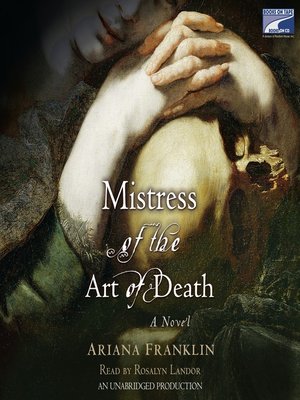
A chilling, mesmerizing novel that combines the best of modern forensic thrillers with the detail and drama of historical fiction. In medieval Cambridge, England, four children have been murdered. The crimes are immediately blamed on the town’s Jewish community, taken as evidence that Jews sacrifice Christian children in blasphemous ceremonies. To save them from the rioting mob, the king places the Cambridge Jews under his protection and hides them in a castle fortress. King Henry II is no friend of the Jews-or anyone, really-but he is invested in their fate. Without the taxes received from Jewish merchants, his treasuries would go bankrupt.

Hoping scientific investigation will exonerate the Jews, Henry calls on his cousin the King of Sicily-whose subjects include the best medical experts in Europe-and asks for his finest “master of the art of death,” an early version of the medical examiner. The Italian doctor chosen for the task is a young prodigy from the University of Salerno. But her name is Adelia-the king has been sent a “mistress” of the art of death. Adelia and her companions-Simon, a Jew, and Mansur, a Moor-travel to England to unravel the mystery of the Cambridge murders, which turn out to be the work of a serial killer, most likely one who has been on Crusade with the king.

In a backward and superstitious country like England, Adelia must conceal her true identity as a doctor in order to avoid accusations of witchcraft. Along the way, she is assisted by Sir Rowley Picot, one of the king’s tax collectors, a man with a personal stake in the investigation. Rowley may be a needed friend, or the fiend for whom they are searching. As Adelia’s investigation takes her into Cambridge’s shadowy river paths and behind the closed doors of its churches and nunneries, the hunt intensifies and the killer prepares to strike again.

In My Hands Today…

The Pindar Diamond – Katie Hickman

In a small town on the Italian coast, a mysterious woman washes ashore. She is crippled, mute, and clutches a bundle to her chest—a baby the townspeople insist is a real-life mermaid. It can only bring bad luck; they pay a troupe of acrobats to carry mother and child away.

In the bustling trade center of Venice, merchant Paul Pindar is the subject of his colleagues’ concern. Since his return from Constantinople, they have found him changed; raging over the loss of his beloved, Celia, he has gambled away his fortune at the gaming tables. But when a priceless blue diamond surfaces in the city, Pindar recognizes the opportunity to regain everything he has lost—including, perhaps, the woman he loves.

In My Hands Today…

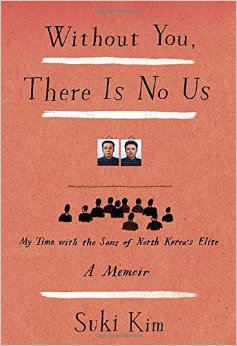
Without You, There Is No Us: My Time with the Son’s of North Korea’s Elite          A Memoir by Suki Kim

Every day, three times a day, the students march in two straight lines, singing praises to Kim Jong-il and North Korea: Without you, there is no motherland. Without you, there is no us. It is a chilling scene, but gradually Suki Kim, too, learns the tune and, without noticing, begins to hum it. It is 2011, and all universities in North Korea have been shut down for an entire year, the students sent to construction fields—except for the 270 students at the all-male Pyongyang University of Science and Technology (PUST), a walled compound where portraits of Kim Il-sung and Kim Jong-il look on impassively from the walls of every room, and where Suki has accepted a job teaching English. Over the next six months, she will eat three meals a day with her young charges and struggle to teach them to write, all under the watchful eye of the regime.

Life at PUST is lonely and claustrophobic, especially for Suki, whose letters are read by censors and who must hide her notes and photographs not only from her minders but from her colleagues—evangelical Christian missionaries who don’t know or choose to ignore that Suki doesn’t share their faith. As the weeks pass, she is mystified by how easily her students lie, unnerved by their obedience to the regime. At the same time, they offer Suki tantalizing glimpses of their private selves—their boyish enthusiasm, their eagerness to please, the flashes of curiosity that have not yet been extinguished. She in turn begins to hint at the existence of a world beyond their own—at such exotic activities as surfing the Internet or traveling freely and, more dangerously, at electoral democracy and other ideas forbidden in a country where defectors risk torture and execution. But when Kim Jong-il dies, and the boys she has come to love appear devastated, she wonders whether the gulf between her world and theirs can ever be bridged.

Without You, There Is No Us offers a moving and incalculably rare glimpse of life in the world’s most unknowable country, and at the privileged young men she calls “soldiers and slaves.”

In My Hands Today…

The Palace of Illusions – Chitra Banerjee Divakaruni

A reimagining of the world-famous Indian epic, the Mahabharat—told from the point of view of an amazing woman.

Relevant to today’s war-torn world, The Palace of Illusions takes us back to a time that is half history, half myth, and wholly magical. Narrated by Panchaali, the wife of the legendary Pandavas brothers in the Mahabharat, the novel gives us a new interpretation of this ancient tale.

The novel traces the princess Panchaali’s life, beginning with her birth in fire and following her spirited balancing act as a woman with five husbands who have been cheated out of their father’s kingdom. Panchaali is swept into their quest to reclaim their birthright, remaining at their side through years of exile and a terrible civil war involving all the important kings of India. Meanwhile, we never lose sight of her strategic duels with her mother-in-law, her complicated friendship with the enigmatic Krishna, or her secret attraction to the mysterious man who is her husbands’ most dangerous enemy. Panchaali is a fiery female redefining for us a world of warriors, gods, and the ever-manipulating hands of fate.

In My Hands Today…

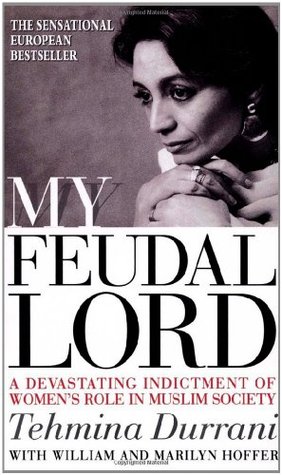
My Feudal Lord – Tehmina Durrani, William Hoffer and Marilyn Hoffer

Born into one of Pakistan’s most influential families, Tehmina Durrani was raised in the privileged milieu of Lahore high society. Like all women of her rank, she was expected to marry a prosperous Muslim from a respectable family, bear him many children and lead a sheltered life of leisure.

Her marriage to Mustafa Khar, one of Pakistan’s most eminent political figures, soon turned into a nightmare. Violently possessive and pathologically jealous, Mustafa Khar succeeded in cutting her off from the outside world. For fourteen years, Tehmina suffered alone, in silence.

When she decided to rebel, the price she paid was extremely high: as a Muslim woman seeking a divorce, she signed away all financial support, lost the custody of her four children, and found herself alienated from her friends and disowned by her parents.
When this book was first published it shook Pakistani society to its foundations. Here at last was someone who had succeded in reconciling her faith in Islam with her ardent belief in women’s rights. Tehmina Durrani’s story provided extraordinary insights into the vulnerable position of women caught in the complex web of Muslim society.