In My Hands Today…

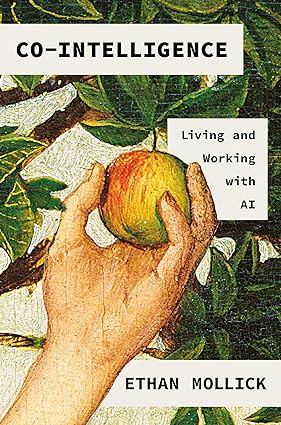
Co-Intelligence: Living and Working with AI – Ethan Mollick

Consumer AI has arrived. And with it, inescapable upheaval as we grapple with what it means for our jobs, lives and the future of humanity.

Cutting through the noise of AI evangelists and AI doom-mongers, Wharton professor Ethan Mollick has become one of the most prominent and provocative explainers of AI, focusing on the practical aspects of how these new tools for thought can transform our world. In Co-Intelligence, he urges us to engage with AI as co-worker, co-teacher and coach. Wide ranging, hugely thought-provoking and optimistic, Co-Intelligence reveals the promise and power of this new era.

In My Hands Today…

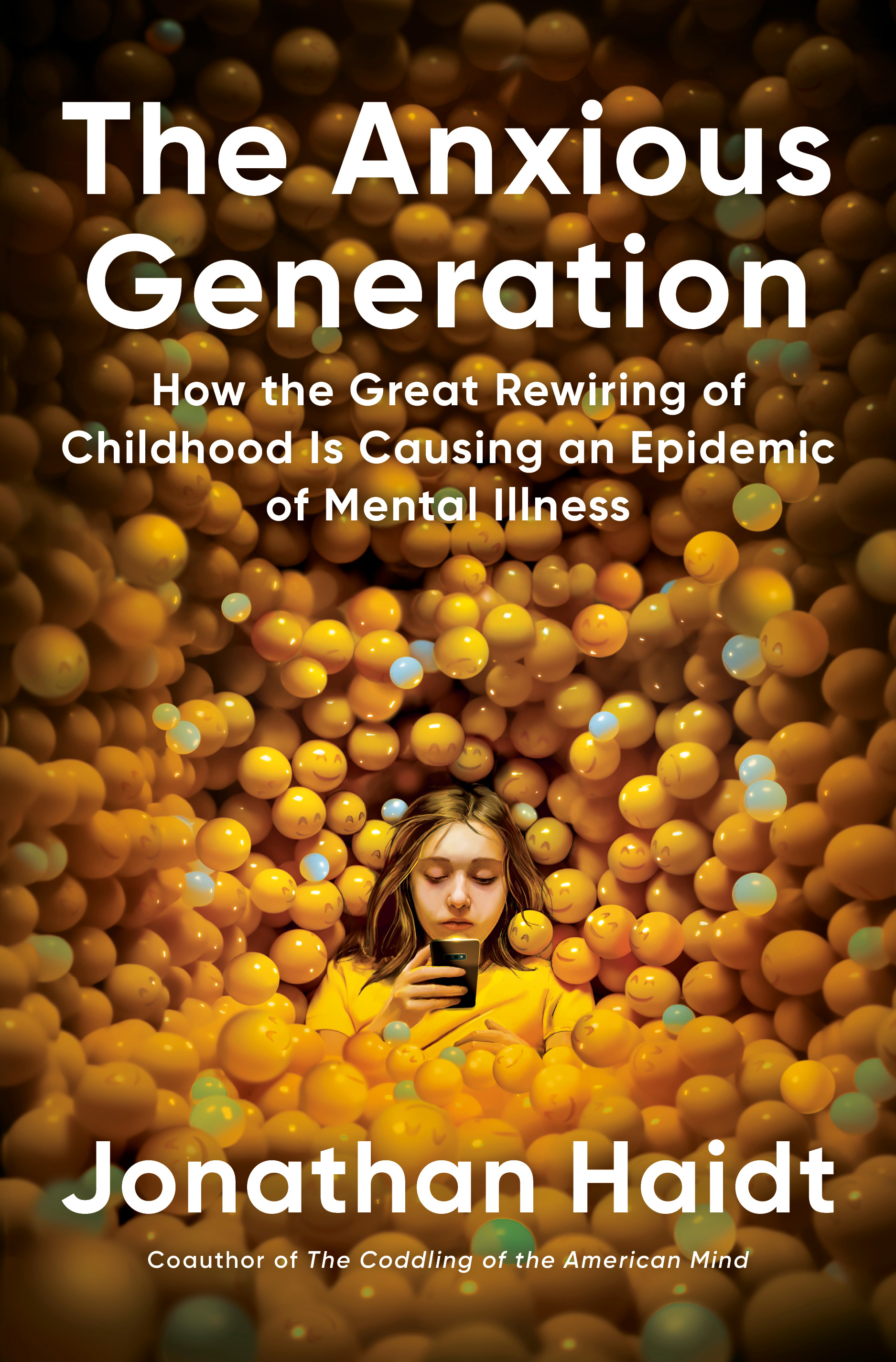
The Anxious Generation: How the Great Rewiring of Childhood is Causing an Epidemic of Mental Illness – Jonathan Haidt

After more than a decade of stability or improvement, the mental health of adolescents plunged in the early 2010s. Rates of depression, anxiety, self-harm, and suicide rose sharply, more than doubling on many measures. Why?

In The Anxious Generation, social psychologist Jonathan Haidt lays out the facts about the epidemic of teen mental illness that hit many countries at the same time. He then investigates the nature of childhood, including why children need play and independent exploration to mature into competent, thriving adults. Haidt shows how the “play-based childhood” began to decline in the 1980s, and how it was finally wiped out by the arrival of the “phone-based childhood” in the early 2010s. He presents more than a dozen mechanisms by which this “great rewiring of childhood” has interfered with children’s social and neurological development, covering everything from sleep deprivation to attention fragmentation, addiction, loneliness, social contagion, social comparison, and perfectionism. He explains why social media damages girls more than boys and why boys have been withdrawing from the real world into the virtual world, with disastrous consequences for themselves, their families, and their societies.

Most important, Haidt issues a clear call to action. He diagnoses the “collective action problems” that trap us, and then proposes four simple rules that might set us free. He describes steps that parents, teachers, schools, tech companies, and governments can take to end the epidemic of mental illness and restore a more humane childhood.

Haidt has spent his career speaking truth backed by data in the most difficult landscapes—communities polarized by politics and religion, campuses battling culture wars, and now the public health emergency faced by Gen Z. We cannot afford to ignore his findings about protecting our children—and ourselves—from the psychological damage of a phone-based life.

In My Hands Today…

Your Face Belongs to Us: A Secretive Startup’s Quest to End Privacy as We Know It – Kashmir Hill

New York Times tech reporter Kashmir Hill was skeptical when she got a tip about a mysterious app called Clearview AI that claimed it could, with 99 percent accuracy, identify anyone based on just one snapshot of their face. The app could supposedly scan a face and, in just seconds, surface every detail of a person’s online their name, social media profiles, friends and family members, home address, and photos that they might not have even known existed. If it was everything it claimed to be, it would be the ultimate surveillance tool, and it would open the door to everything from stalking to totalitarian state control. Could it be true?

In this riveting account, Hill tracks the improbable rise of Clearview AI, helmed by Hoan Ton-That, an Australian computer engineer, and Richard Schwartz, a former Rudy Giuliani advisor, and its astounding collection of billions of faces from the internet. The company was boosted by a cast of controversial characters, including conservative provocateur Charles C. Johnson and billionaire Donald Trump backer Peter Thiel—who all seemed eager to release this society-altering technology on the public. Google and Facebook decided that a tool to identify strangers was too radical to release, but Clearview forged ahead, sharing the app with private investors, pitching it to businesses, and offering it to thousands of law enforcement agencies around the world.
      
Facial recognition technology has been quietly growing more powerful for decades. This technology has already been used in wrongful arrests in the United States. Unregulated, it could expand the reach of policing, as it has in China and Russia, to a terrifying, dystopian level.
     
Your Face Belongs to Us is a gripping true story about the rise of a technological superpower and an urgent warning that, in the absence of vigilance and government regulation, Clearview AI is one of many new technologies that challenge what Supreme Court Justice Louis Brandeis once called “the right to be let alone.”

In My Hands Today…

Optimal: How to Sustain Personal and Organizational Excellence Every Day – Daniel Goleman, Cary Cherniss

In his groundbreaking #1 bestseller Emotional Intelligence , Daniel Goleman revolutionized how we think about intelligence. Now, he reveals practical methods for using these inner resources to more readily enter an optimal state of high performance and satisfaction while avoiding burnout.

There are moments when we achieve peak An athlete plays a perfect game; a business has a quarter with once-in-a-lifetime profits. But these moments are often elusive, and for every amazing day, we may have a hundred ordinary and even unsatisfying days.

Fulfillment doesn’t come from isolated peak experiences, but rather from many consistent good days. So how do we sustain performance, while avoiding burnout and maintaining balance?

In Optimal , Daniel Goleman and Cary Cherniss reveal how emotional intelligence can help us have a great day, any day. They explain how to set a realistic, attainable goal of feeling satisfied that you’ve had a productive day — to consistently work at your ‘optimal’ level.

Based on research of how hundreds of people build the inner architecture of having a good day, they sketch what an optimal state feels like, and show how emotional intelligence holds the key to our best performance. Optimal is the culmination of decades of scientific discoveries bearing on emotional intelligence. Enhanced emotional intelligence pays off in improved engagement, productivity, and more satisfying days.

In this book, you’ll find the keys to competence in emotional intelligence, and practical methods for applying this skill set more readily. It will equip you to become a highly effective leader and enable you to build an organizational culture that empowers workers to sustain high performance.

In My Hands Today…

The Missing Billionaires: A Guide to Better Financial Decisions – Victor Haghani, James White

Over the past century, if the wealthiest families had spent a reasonable fraction of their wealth, paid taxes, invested in the stock market, and passed their wealth down to the next generation, there would be tens of thousands of billionaire heirs to generations-old fortunes today.

The puzzle of The Missing Billionaires is why you cannot find one such billionaire on any current rich list. There are a number of explanations, but this book is focused on one mistake which is of profound importance to all poor risk decisions, both in investing and spending. Many of these families didn’t choose bad investments– they sized them incorrectly– and allowed their spending decisions to amplify this mistake.

The Missing Billionaires book offers a simple yet powerful framework for making important lifetime financial decisions in a systematic and rational way. It’s for readers with a baseline level of financial literacy, but doesn’t require a PhD. It fills the gap between personal finance books and the academic literature, bringing the valuable insights of academic finance to non-specialists.

Part One builds the theory of optimal investment sizing from first principles, starting with betting on biased coins. Part Two covers lifetime financial decision-making, with emphasis on the integration of investment, saving and spending decisions. Part Three covers practical implementation details, including how to calibrate your personal level of risk-aversion, and how to estimate the expected return and risk on a broad spectrum of investments.

The book is packed with case studies and anecdotes, including one about Victor’s investment with LTCM as a partner, and a bonus chapter on Liar’s Poker. The authors draw extensively on their own experiences as principals of Elm Wealth, a multi-billion-dollar wealth management practice, and prior to that on their years as arbitrage traders– Victor at Salomon Brothers and LTCM, and James at Nationsbank/CRT and Citadel.

Whether you are young and building wealth, an entrepreneur invested heavily in your own business, or at a stage where your primary focus is investing and spending, The Missing A Guide to Better Financial Decisions is your must-have resource for thoughtful financial decision-making.