Happy New Year!

Happy New Year folks! Its the start of a new decade and out with the old and in with the new!

2019 has been an intense year for us, as regualr visitors to this page will know. BB & GG sat for their O level exam (results of which should be out in the next two weeks or so) and I got more grey hair during this period than even the PSLE exams. The one silver lining which allowed us some respite during the exams was that both the children got an acceptance into a course of their choice. This means that as long as their meet the minimum requirements of their chosen course, their admission is confirmed once the results are declared.

I am hopeful for both of them for 2020 as they embark on a new chapter in their lives. They will be studying subjects they are interested and passionate about and I hope this translates into doing well in school and living their best lives.

On the work front, things were a bit quiet in 2019 as I was more focussed with the children this year. I work with some wonderful ladies and in 2020 want to expand what I am currently doing.

On a personal front, I have decided that that my word for 2020 will be “Bloom”! I am a fairly ecclectic person with varied interests and this year I want to expand the interests that consume me during the year. I want to bloom both personally and professionally in 2020 and give my best to whatever I do.

I also want to work more on this blog and provide interesting content. For a blog where I write anonymously and don’t share content with anyone and anywhere, I have great pleasure when I see all those who choose to follow me because you think the content I post is something you are interested in. So a huge Thank you from the bottom of my heart!

Here’s wishing all of you a very Happy New Year! May 2020 be the best year of your lives and hope you achieve all that you set out to in the year. I leave you with a quote from Albert Einstein – Learn from yesterday, live for today, hope for tomorrow.

Navratri Recipes: Green Peas Sundal

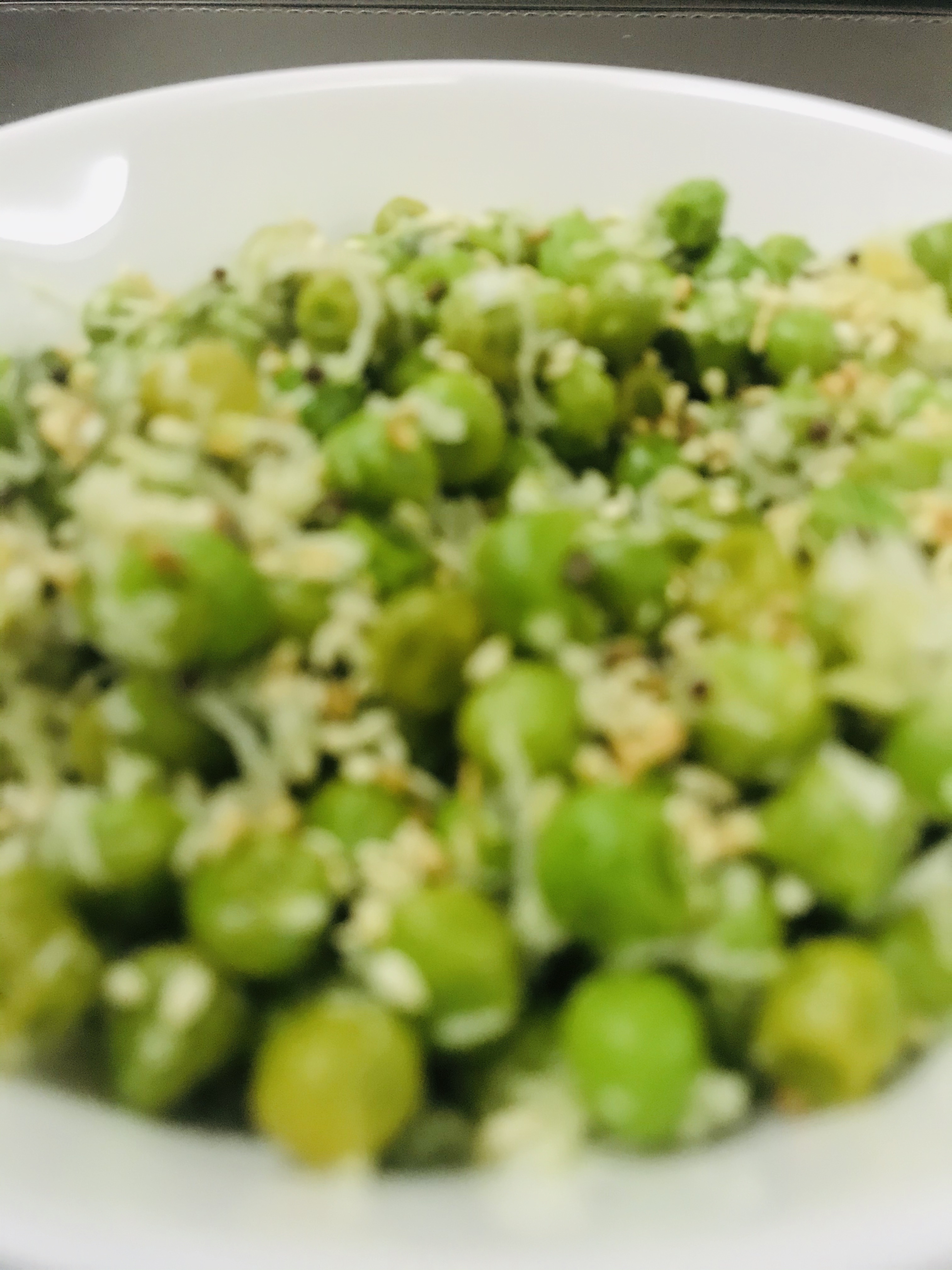
Another day during Navratri and another sundal to offer the Goddess. The Sundal this time is made of fresh peas and is another super quick recipe. You could make this as a quick afternoon snack when the children are home from school and it is also very healthy to boot! This is a far cry from the commercial and suage and salt laden biscuits and sweets that are usually eaten.

Green Peas Sundal

Ingredients:

  • 2 cups fresh or frozen green peas
  • 1 tsp mustard seeds
  • 1 tsp urad dal
  • 1/8 tsp asafoetida powder
  • 4-5 curry leaves
  • 1 tsp green chilli paste
  • 2-3 tbsp grated coconut
  • 1 tbsp oil
  • Lemon juice to taste
  • Salt to taste
  • Coriander leaves to garnish

Method:

  • Soak the frozen green peas in hot water for 15 minutes and then cook them in a microwave or the stovetop till the peas are cooked, but still retain their green colour. Drain and keep aside.
  • Heat the oil in a pan and when the oil is warm, add the mustard seeds and let them pop.
  • Then add the urad dal and let it start to brown. Next add the asafoetida powder, curry leaves and green chilli paste and stir for a couple of seconds.
  • Now add the boiled and drained green peas and season with salt. Stir for a few minutes.
  • Then drizzle the lemon juice and add the coconut and stir well to mix into the peas.
  • Garnish with coriander leaves and serve warm or cold as a salad or snack.

Navratri Recipes: Chana Dal Sundal

Since it’s the festival of Navratri going on, I am making some kind of Sundal every day as an offering or neividhyam to the Goddess. Today’s Sundal is a simple and delicious Sundal made out of Chana Dal. This is easy to make and took me less than 10 minutes to make (without taking into account the soak time). This is a definite keeper for me.

Chana Dal Sundal

Ingredients:

  • 2 cups chana dal
  • 2-3 tbsp grated coconut
  • 1 tbsp oil
  • 1 tsp mustard seeds
  • 1 tsp split urad dal
  • 4-5 curry leaves
  • 3-4 dried red chillies, broken
  • 1/4 tsp turmeric powder
  • 1/4 tsp asafoetida powder
  • 2 tbsp lemon juice
  • 1 tsp grated ginger
  • Salt to taste
  • Coriander leaves to garnish

Method:

  • Soak the chana dal in hot water for 1-2 hours.
  • Cook the chana dal in the same pan it was soaked in with 1/4 tsp turmeric powder, salt and 1/8 tsp asafoetida in enough water on the stove till it gets cooked, but still retains it’s shape. Remove from the flame and drain and cool the chana dal.
  • If you plan to use the pressure cooker, just cook it for a max of 2 whistles. Remove from the cooker when the pressure goes down and drain the chana dal.
  • In another pan, heat the oil and when it warms up, add the mustard seeds and let the seeds pop.
  • Then add the urad dal, remaining asafoetida, curry leaves, grated ginger and broken dried red chillies and stir for a few seconds.
  • Now pour in the drained chana dal and stir well to mix everything for a few minutes.
  • Switch off the flame and add the lemon juice and grated coconut. Garnish with coriander leaves and serve as a salad or side with a south indian meal.

For more Navratri Sundal recipes, here are some other recipes:

Chinese New Year Myths and Legends

Source

Yesterday marked the start of the new Lunar New Year and living in Singapore, this becomes just as important to us (and not just for the 2.5 days public holidays we get). We Lo Hei in offices and great our friends, neighbours and colleagues a Happy New Year. I’ve blogged in detail about the Chinese New Year previously, so this year, I was looking at some of the myths and legends associated with the new year that I wanted to share with you all.

Source

The Legend of the New Year or Nian

The legend of the new year or Nian is a famous one. Long ago in the mountains, there lived a horrible demon creature named Nian. Every year, on the first day of the year, the creature would awaken and descend upon the village. He would eat all the grain and livestock. And if there were any children unfortunately stuck outside, they would disappear.

The villagers lived in fear of this beast and boarded up their houses on this night to protect their families. One year, right before this event was to occur, an old man visited the village. He turned to the villagers and asked, “Why do you fear this creature such? You are many and he is but one. Surely he could not swallow all of you.”

But the villagers remained sceptical and locked themselves up anyway. That night, Nian did not come. The old man had ridden him until dawn and the creature went back to its cave hungry. This went on for several nights until the old man revealed, “I cannot protect you forever.”

He turned out to be a god and had to return to his duties elsewhere. The villagers were terrified that once the old man left, they would once again see Nian return.

So the old man informed them, “The beast is easily scared. He does not like the colour red. He fears loud noises and strange creatures. So tonight, spread red across the village. Hang red signs on every door. Make loud noises with drums, music, and fireworks. And to protect your children, give them face masks and lanterns to protect them.” The villagers did as the old man instructed and Nian never returned again.

Source

The Legend of Why Red Envelopes Are Given

During the Chinese New Year period, the married or the elderly give red envelopes to children or unmarried juniors. A red envelope is also called yasui qian (“suppressing Sui money”).

According to legend, on New Year’s Eve, besides the monster Nian, there was a demon named Sui that came out to terrify children while they were asleep.

It was said that the children who were touched by the demon would be too scared to cry out loud, and got a terrible fever and even became mentally unstable. To keep children safe from being harmed by Sui, parents would light candles and stay up for the whole night.

On one New Year’s Eve, in an official’s family household, the parents gave their child eight coins to play with in order to keep him awake, so as to avoid him being hurt by the demon. The child wrapped the coins in red paper, opened the packet, rewrapped it, and reopened it until he was too tired to fall asleep. Then the parents placed the packet with eight coins under his pillow.

When Sui tried to touch his head, the eight coins emitted a strong light and scared the demon away. The eight coins turned out to be eight fairies. From then on, giving red envelopes became a way to keep children safe and bring good luck.

Source

The Legend of Why Spring Couplets Are Pasted

It is recorded that the origin of spring couplets can be dated back to 1,000 years ago when people hung taofu (written charms on peach wood) on doors.

Legend has it that there was a huge peach tree stretching for more than 1,500 kilometers on a mountain in the ghost world. To the northeast of the tree, two guards named Shentu and Yulei guarded the entrance to the ghost world. They would catch the ghosts who harmed people and then sent them to tigers as food.

Therefore, all ghosts were afraid of the two guards. It was believed that to hang a piece of peach wood with an inscription of the two guards’ names on doors could scare evil things away.

By the Song Dynasty (960-1279), people began to write two auspicious antithetical lines on the peach wood instead of the names of the two guards. Later, the peach wood was replaced by red paper, which symbolizes good luck and happiness. Since then, pasting spring couplets has been a custom to welcome the new year and express best wishes.

Source

The Legend of the Upside Down Calligraphy

Another decoration is calligraphy. The most common word is fú, meaning happiness or fortune. But you’ll rarely see it upright.

It is said that in the Ming dynasty, the Emperor ordered every household to decorate by pasting fu onto their doors. On New Year’s Day, he sent soldiers to check. They found that one illiterate family pasted the word upside down.

The Emperor ordered the family to be punished by death. Thankfully, the Empress was there and came up with an explanation: “Upside down” (dào) is a homophone of “here” (dào). When it’s upside down, it means that fu is here.

The explanation made sense to the Emperor and he set the family free. From then on, people would hang the word upside down, both for fortune and in remembrance of the kind Empress.

Source

The Legend of the Kitchen God and Candy

The Stove God (zào shén) is in charge of people’s meals and livelihoods. He’s one of the gods that interact with humans the most.

On the little new year (xiao nián) before the official “big” New Year (dà nián), he returns to the heavens. The Stove God reports to the Jade Emperor (yù dì), telling him how each family was during the year. He later returns to Earth to either bless or punish the families, as ordered by the Jade Emperor.

This is why families will make malt candy gourds and leave it out at night. The candy will sweeten the Stove God’s mouth so he’ll only praise the family. It can also stick his teeth together, stopping him from saying bad things. This way, the family will enjoy plentiful food the entire year.

Pal Payasam

Since yesterday was Diwali, here’s a sweet recipe to sweeten your lives. Happy Diwali folks!

As the name suggests, it is a milk kheer or milk sweet. In its very basic form, this is the simplest of the south Indian sweets and hardly needs 3-4 ingredients to make. It’s fairly easy to make with the only effort being in reducing the milk.

Pal Payasam

Ingredients:

  • 1-litre milk
  • 1 tbsp basmati rice (or any long grained rice)
  • 4-6 tbsp sugar
  • 1 tsp ghee
  • A pinch of cardamom powder (optional)

Method:

  • In a large pan, boil the milk and when the milk starts to boil over and bubble, reduce the heat and continue to boil the milk.
  • In a smaller pan, heat the ghee and fry the rice for around 30 seconds.
  • Pour the rice into the boiling milk and keep stirring till it reduces to half the original quantity.
  • When the rice has completely cooked, add the sugar and the cardamom powder (if you are using it).
  • At this point, you can also use a few strands of saffron as well as some fried cashew nuts and raisins.
  • Continue boiling until the sugar gets absorbed into the milk.
  • Switch off the flame and serve hot or cold.