Arachavitta Sambhar

This is a very traditional South Indian recipe. Archavitta literally means with ground spices. This sambhar is different from the usual one we make on a regular basis in that there is no sambhar powder used.

I have wanted to make this for a few weeks now. The last time I tried making it, I found I didn’t have coconut at home and so had to postpone making it. I finally made it with the basic recipe from my bible of tam bram cooking – Cook and See by S. Meenakshi Ammal. I used the recipe from Book 1 of Cook and See and tweaked it a bit using advice given to me by my mother and mother-in-law.

Arachivitta Sambhar

Ingredients:

  • ½ cup red gram dal (toor dal)
  • 1 small lime sized ball of tamarind, soaked in water and the pulp squeezed out
  • 1 cup shallots
  • 1-2 carrots, peeled and cut into big pieces
  • ½ a yellow pumpkin, peeled and cut into big cubes
  • 4-5 potatoes, cut into largish cubes
  • 2-3 tsps oil
  • 1 tsp mustard seeds
  • Salt to taste
  • Coriander leaves to garnish

To be ground into a paste:

  • 6-8 dried red chillies
  • 2 tsps coriander seeds
  • 1 tsp Bengal gram seeds (chana dal)
  • 1 tsp fenugreek seeds
  • 4-5 shallots
  • ½ cup fresh, grated coconut

Method:

In a small pressure cooker, pressure cook the toor dal with a pinch of turmeric powder till it is soft and the dal has broken down. This usually will take around 3 whistles in the cooker.

Heat 1 tsp of oil in a pan and one by one add the ingredients to be gound into a paste and roast them till the coconut is golden and the water in it evaporates. Transfer to a mixer and when cool, grind it to a fine paste using a bit of water. Keep aside.

In the same pan, heat the remaining oil and add the mustard seeds. When they pop, put in the shallot and stir for a few minutes. Then add the potatoes, carrots and pumpkin and fry for a few minutes.

Now add the gound paste and stir into the vegetables. Once it is all mixed in, pour in the tamarind water and add salt to taste.

Let this boil for around ten minutes. Check to see if the vegetables are cooked. When the vegetables and shallots reached the almost cooked stage, add the cooked dal.

Let it boil well, check for seasoning and switch off the gas. Garnish with coriander leaves and serve hot with white rice.

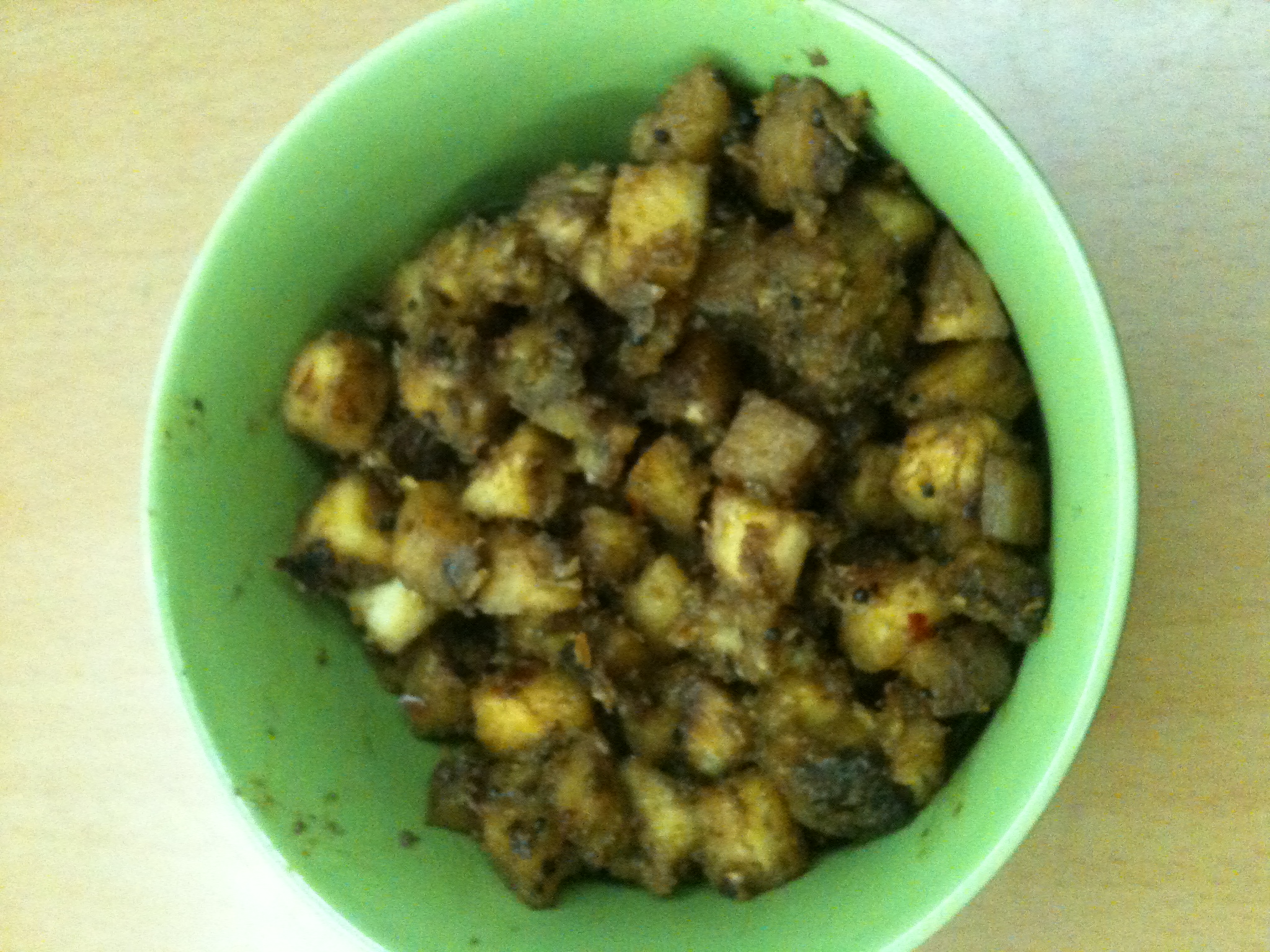
Vazhakkai Masala Curry (Raw Green Bananas Masala Curry)

I had the urge to try something different to the usual saturday cooking and so decided to make this raw green banana curry. I usually make this with just salt, red chilli powder and turmeric powder with a tadka of mustard, asafoetida and some curry leaves. Today was different. Here’s what I did.

Vazhakkai Masala Curry

Ingredients:

–   4-5 vazhakkais (raw green bananas), peeled and cubed

–   3 tbsps oil

–   1 tsp mustard seeds

–   ½ tsp turmeric powder

–   A pinch of asafoetida

–   3-4 sprigs curry leaves

To be ground into a coarse paste

–   4 tbsps fresh, grated cocounut

–   2 tsps coriander seeds

–   2 tsps cumin seeds

–   1 tsp fennel seeds (saunf)

–   6-8 dried red chillies

–   A small pebble-sized ball of tamarind

Method:

Grind to a coarse paste the ingredients for the paste, using as little water as possible.

In a deep bottomed pan, heat the oil and add the mustard seeds. When the mustard seeds splutter, add the asafoetida, turmeric powder and curry leaves.

Next put the ground masala paste and sauté it for a few minutes. Now add the cubed vazhakkai and mix well. Add salt to taste. At this point, if you feel the curry is not spicy enough, you can add some red chilli powder also. Let it cook well and enjoy. This goes well with rice and dal or sambhar.

Verdict: This was a very different from what we normally eat for this vegetable. It was spicy, but not overtly spicy and my children could eat it with complaining. There was also a tangy undertone to the curry due to the tamarind in the masala which I liked a lot!

In My Hands Today…

Untold Story – Monica Ali

When Princess Diana died in Paris’ Alma tunnel, she was thirty-seven years old. Had she lived, she would have turned fifty on July 1, 2011. Who would the beloved icon be if she were alive today? What would she be doing? And where? One of the most versatile and bold writers of our time Monica Ali has imagined a different fate for Diana in her spectacular new novel, Untold Story.

Diana’s life and marriage were both fairy tale and nightmare rolled into one. Adored by millions, she suffered rejection, heartbreak and betrayal. Surrounded by glamour and glitz and the constant attention of the press, she fought to carve a meaningful role for herself in helping the needy and dispossessed. The contradictions and pressures of her situation fuelled her increasingly reckless behaviour, but her stature and her connection with her public never ceased to grow. If Diana had lived, would she ever have found peace and happiness, or would the curse of fame always have been too great.

Fast-forward a decade after the (averted) Paris tragedy, and an Englishwoman named Lydia is living in a small, nondescript town somewhere in the American Midwest. She has a circle of friends: one owns a dress shop, one is a Realtor, another is a frenzied stay-at-home mom. Lydia volunteers at an animal shelter and swims a lot. Her lover, who adores her, feels she won’t let him know her. Who is she?

Untold Story is about the cost of celebrity, the meaning of identity, and the possibility—or impossibility—of reinventing a life. Ali’s fictional princess is beautiful, intrepid, and resourceful and has established a fragile peace. And then the past threatens to destroy her new life. Ali has created a riveting novel inspired by the cultural icon she calls “a gorgeous bundle of trouble.”

Playing Tourists…

We played tourists yesterday when the loong Chinese New Year break was on.

BB & GG wanted to go out somewhere and somehow every suggestion was shot down by  one of us. Finally we decided on the museums (although BB was not very sure about this). We decided to take advantage of the free entrance that the Singapore museums were offering the public in the view of the Chinese New Year holidays. So off we went to the Asian Civilisations Museum at Empress Place. We had a bit of problem finding the place, but the journey was totally worth it!

We caught two very interesting exhibits there, both very different and oh so fantastic – The Tang Shipwreck: Gold and Ceramics from 9th-century China and the Patterns of Trade: Indian Textiles For Export, 1400–1900.

Here are some pictures of the exhibitions plus some more from the other gallerys…Enjoy and drool…..

Tang Shipwreck Pictures

Patterns of Trade 

Photos from Other Gallaries

Happy New Year

So after a nice break where I didn’t think of work or anything unpleasant, we’re back home to our usual boring routine.

Back home, last week, I got a bout of stomach flu and am still feeling it’s after effects.

This post is merely to reassure people that I’m still here. I’ll start posting regularly soon just as soon as I am well. Somehow being sick is just not conducive to thinking and writing…

So Happy New Year 2012 folks and see you around!