In My Hands Today…

Paris Undercover – Matthew Goodman

Etta Shiber and Kitty Bonnefous are the unlikeliest of two seemingly ordinary women, an American widow and an English divorcée, living quietly together in Paris. Yet during the Nazi occupation, these two friends find themselves unexpectedly plunged into the whirlwind of history. With the help of a French country priest and others, they rescue untold numbers of British and French soldiers trapped behind enemy lines—some of whom they daringly smuggle through Nazi checkpoints in the trunk of their car.

Ultimately the Gestapo captures them both. After eighteen months in prison, Etta, a New Yorker of Jewish descent, is returned to the United States in a prisoner exchange. Back home, hoping to bring attention to her friend Kitty’s bravery, Etta publishes a memoir about their work. Paris-Underground becomes a publishing sensation and Etta a celebrity. Meanwhile Kitty spends the rest of the war in solitary confinement in a Nazi prison, entirely unaware of the book that has been written about her – and the deeds that have been claimed in her name.

In researching this story, Matthew Goodman uncovered military records, personal testimonies, and Etta Shiber’s own never-before-seen wartime letters. Together they reveal, for the first time, the shocking truth behind Etta’s bestselling memoir and the unexpected, far-reaching consequences of its publication. More than just a story of two women’s remarkable courage, Paris Undercover is also a vivid, gripping account of deceit, betrayal, and personal redemption.

In My Hands Today…

Realm of Ice and Sky: Triumph, Tragedy, and History’s Greatest Arctic Rescue – Buddy Levy

Arctic explorer and American visionary Walter Wellman pioneered both polar and trans-Atlantic airship aviation, making history’s first attempts at each. Wellman has been cast as a self-promoting egomaniac known mostly for his catastrophic failures. Instead he was a courageous innovator who pushed the boundaries of polar exploration and paved the way for the ultimate conquest of the North Pole—which would be achieved not by dogsled or airplane, but by airship.

American explorer Dr. Frederick Cook was the first to claim he made it to the North Pole in 1908. A year later, so did American Robert Peary, but both Cook’s and Peary’s claims had been seriously questioned. There was enough doubt that Norwegian explorer extraordinaire Roald Amundsen—who’d made history and a name for himself by being first to sail through the Northwest Passage and first man to the South Pole—picked up where Walter Wellman left off, attempting to fly to the North Pole by airship. He would go in the Norge, designed by Italian aeronautical engineer Umberto Nobile. The 350-foot Norge flew over the North Pole on May 12, 1926, and Amundsen was able to accurately record and verify their exact location.

However, the engineer Nobile felt slighted by Amundsen. Two years later, Nobile returned, this time in the Italia, backed by Prime Minister Benito Mussolini. This was an Italian enterprise, and Nobile intended to win back the global accolades and reputation he believed Amundsen had stripped from him. The journey ended in disaster, death, and accusations of cannibalism, launching one of the great rescue operations the world had ever seen.

In My Hands Today…

The Rebel Romanov: Julie of Saxe-Coburg, the Empress Russia Never Had – Helen Rappaport

In 1795, Catherine the Great of Russia was in search of a bride for her grandson Constantine, who stood third in line to her throne. In an eerie echo of her own story, Catherine selected an innocent young German princess, Julie of Saxe-Coburg, aunt of the future Queen Victoria. Though Julie had everything a young bride could wish for, she was alone in a court dominated by an aging empress and riven with rivalries, plotting, and gossip―not to mention her brute of a husband, who was tender one moment and violent the next. She longed to leave Russia and her disastrous marriage, but her family in Germany refused to allow her to do so.

Desperate for love, Julie allegedly sought consolation in the arms of others. Finally, Tsar Alexander granted her permission to leave in 1801, even though her husband was now heir to the throne. Rootless in Europe, Julie gave birth to two―possibly three―illegitimate children, all of whom she was forced to give up for adoption. Despite entreaties from Constantine to return and provide an heir, she refused, eventually finding love with her own married physician.

At a time when many royal brides meekly submitted to disastrous marriages, Julie proved to be a woman ahead of her time, sacrificing her reputation and a life of luxury in exchange for the freedom to live as she wished. The Rebel Romanov is the inspiring tale of a bold woman who, until now, has been ignored by history.

In My Hands Today…

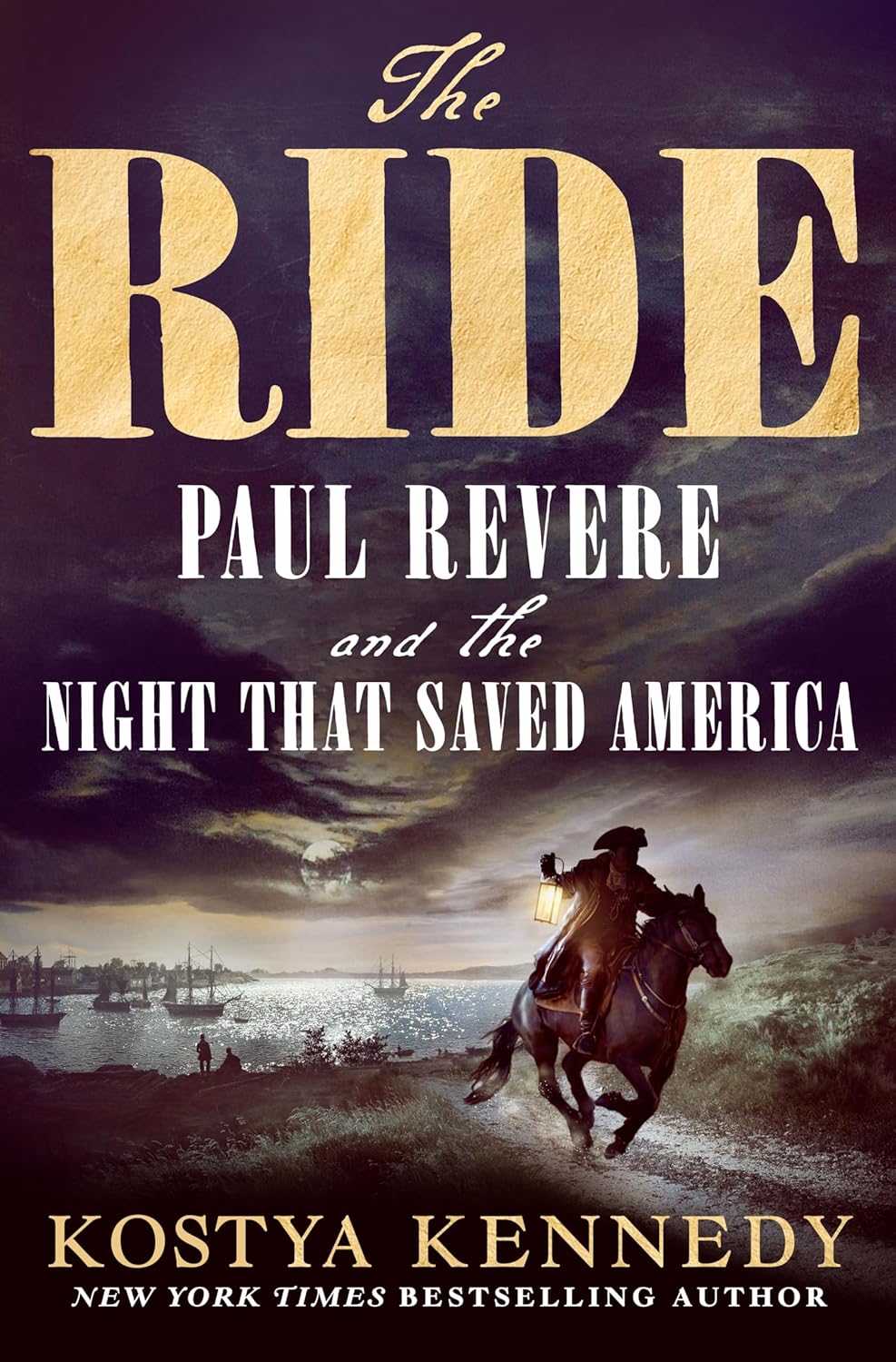
The Ride: Paul Revere and the Night That Saved America – Kostya Kennedy

On April 18, 1775, a Boston-based silversmith, engraver, and anti-British political operative named Paul Revere set out on a borrowed horse to fulfill a dangerous but crucial task to alert American colonists of advancing British troops, which would seek to crush their nascent revolt. Revere was not the only rider that night, and indeed, he had completed at least 18 previous rides throughout New England, disseminating intelligence about British movements. But this ride was like no other, and its consequences in the months and years to come—as the American Revolution morphed from isolated skirmishes to a full-fledged war—became one of our founding legends.

In The Ride, Kostya Kennedy presents a dramatic new narrative of the events of April 18 and 19, 1775, informed by fresh primary and secondary source research into archives, family letters and diaries, contemporary accounts, and more. Kennedy reveals Revere’s ride to be more complex than it is usually portrayed—a coordinated series of rides by numerous men, near-disaster, capture by British forces, and finally success. While Revere was central to the ride and its plotting, Kennedy reveals the other men (and, perhaps, a woman with information about the movement of British forces) who helped to set in motion the events that would lead to America’s independence.

In My Hands Today…

The Tatas: How a Family Built a Business and a Nation – Girish Kuber

The Tatas is the story of one of India’s leading business families.

It starts in the nineteenth century with Nusserwanji Tata – a middle-class Parsi priest from the village of Navsari in Gujarat, and widely regarded as the Father of Indian Industry – and ends with Ratan Tata – chairman of the Tata Group until 2012.

But it is more than just a history of the industrial house; it is an inspiring account of India in the making. It chronicles how each generation of the family invested not only in the expansion of its own business interests but also in nation building.

For instance, few know that the first hydel project in the world was conceived and built by the Tatas in India. Nor that some radical labour concepts such as eight-hour work shifts were born in India, at the Tata mill in Nagpur.

The National Centre for the Performing Arts, the Tata Cancer Research Centre, the Tata Institute of Fundamental Research – the list about the Tatas’ contribution to India is a long one. A bestseller in Marathi when it was first published in 2015, this is the only book that tells the complete Tata story over two hundred years.