In My Hands Today…

The Art Thief: A True Story of Love, Crime, and a Dangerous Obsession – Michael Finkel

For centuries, works of art have been stolen in countless ways from all over the world, but no one has been quite as successful at it as the master thief Stéphane Breitwieser. Carrying out more than two hundred heists over nearly eight years—in museums and cathedrals all over Europe—Breitwieser, along with his girlfriend who worked as his lookout, stole more than three hundred objects, until it all fell apart in spectacular fashion.

In The Art Thief, Michael Finkel brings us into Breitwieser’s strange and fascinating world. Unlike most thieves, Breitwieser never stole for money. Instead, he displayed all his treasures in a pair of secret rooms, where he could admire them to his heart’s content. Possessing remarkable athleticism and an innate ability to circumvent practically any security system, Breitwieser managed to pull off a breathtaking number of audacious thefts. Yet these strange talents bred a growing disregard for risk and an addict’s need to score, leading Breitwieser to ignore his girlfriend’s pleas to stop—until one final act of hubris brought everything crashing down.
In My Hands Today…

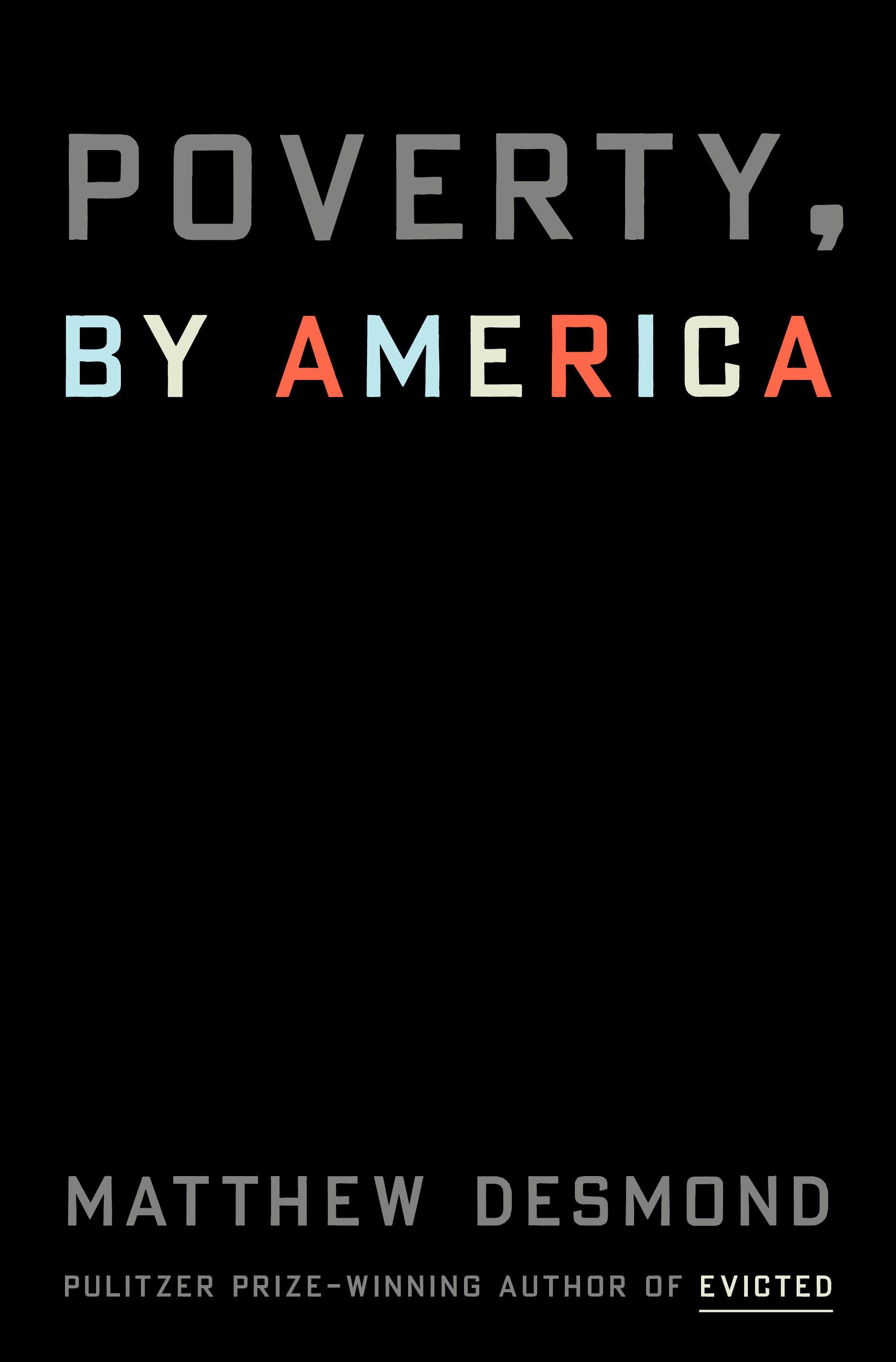
Poverty, by America – Matthew Desmond

The United States, the richest country on earth, has more poverty than any other advanced democracy. Why? Why does this land of plenty allow one in every eight of its children to go without basic necessities, permit scores of its citizens to live and die on the streets, and authorize its corporations to pay poverty wages?

In this landmark book, acclaimed sociologist Matthew Desmond draws on history, research, and original reporting to show how affluent Americans knowingly and unknowingly keep poor people poor. Those of us who are financially secure exploit the poor, driving down their wages while forcing them to overpay for housing and access to cash and credit. We prioritize the subsidization of our wealth over the alleviation of poverty, designing a welfare state that gives the most to those who need the least. And we stockpile opportunity in exclusive communities, creating zones of concentrated riches alongside those of concentrated despair. Some lives are made small so that others may grow.

Elegantly written and fiercely argued, this compassionate book gives us new ways of thinking about a morally urgent problem. It also helps us imagine solutions. Desmond builds a startlingly original and ambitious case for ending poverty. He calls on us all to become poverty abolitionists, engaged in a politics of collective belonging to usher in a new age of shared prosperity and, at last, true freedom.

In My Hands Today…

Histories of Nations: How Their Identities Were Forged – edited by Peter Furtado

Global histories tend to be written from the narrow viewpoint of a single author and a single perspective, with the inevitable bias that it entails. But in this thought-provoking collection, twenty-eight writers and scholars give engaging, often passionate accounts of their own nation’s history.

The countries have been selected to represent every continent and every type of state: large and small; mature democracies and religious autocracies; states that have existed for thousands of years; and those born as recently as the twentieth century. Together, they contain two-thirds of the world’s population.

In the United States, for example, the myth of the nation’s “historylessness” remains strong, but in China, history is seen to play a crucial role in legitimising three thousand years of imperial authority.

“History wars” over the content of textbooks rage in countries as diverse as Australia, Russia, and Japan. Some countries, such as Iran or Egypt, are blessed—or cursed—with a glorious ancient history that the present cannot equal; others, such as Germany, must find ways of approaching and reconciling the pain of the recent past.

In My Hands Today…

The Map That Changed the World: William Smith and the Birth of Modern Geology – Simon Winchester

William Smith was not rich or well connected, but his passion for rocks and fossils, and his twenty-year obsession with single-handedly mapping the geology of Britain made him one of the most significant men of the nineteenth century.

However his vision cost him dear – his wife went mad, his work was stolen by jealous colleagues who eventually ruined him, and he was imprisoned for debt.

Simon Winchester tells the fascinating story of ‘Strata’ Smith, a man who crossed boundaries of class, wealth and science to produce a map that fundamentally changed the way we view the world.

In My Hands Today…

The Heat Will Kill You First: Life and Death on a Scorched Planet – Jeff Goodell

The world is waking up to a new wildfires are now seasonal in California, the Northeast is getting less and less snow each winter, and the ice sheets in the Arctic and Antarctica are melting fast. Heat is the first order threat that drives all other impacts of the climate crisis. And as the temperature rises, it is revealing fault lines in our governments, our politics, our economy, and our values. The basic science is not Stop burning fossil fuels tomorrow, and the global temperature will stop rising tomorrow. Stop burning fossil fuels in 50 years, and the temperature will keep rising for 50 years, making parts of our planet virtually uninhabitable. It’s up to us. The hotter it gets, the deeper and wider our fault lines will open.

The Heat Will Kill You First is about the extreme ways in which our planet is already changing. It is about why spring is coming a few weeks earlier and fall is coming a few weeks later and the impact that will have on everything from our food supply to disease outbreaks. It is about what will happen to our lives and our communities when typical summer days in Chicago or Boston go from 90° F to 110°F. A heatwave, Goodell explains, is a predatory event— one that culls out the most vulnerable people. But that is changing. As heatwaves become more intense and more common, they will become more democratic.

As an award-winning journalist who has been at the forefront of environmental journalism for decades, Goodell’s new book may be his most provocative yet, explaining how extreme heat will dramatically change the world as we know it. Masterfully reported, mixing the latest scientific insight with on-the-ground storytelling, Jeff Goodell tackles the big questions and uncovers how extreme heat is a force beyond anything we have reckoned with before.