In My Hands Today…

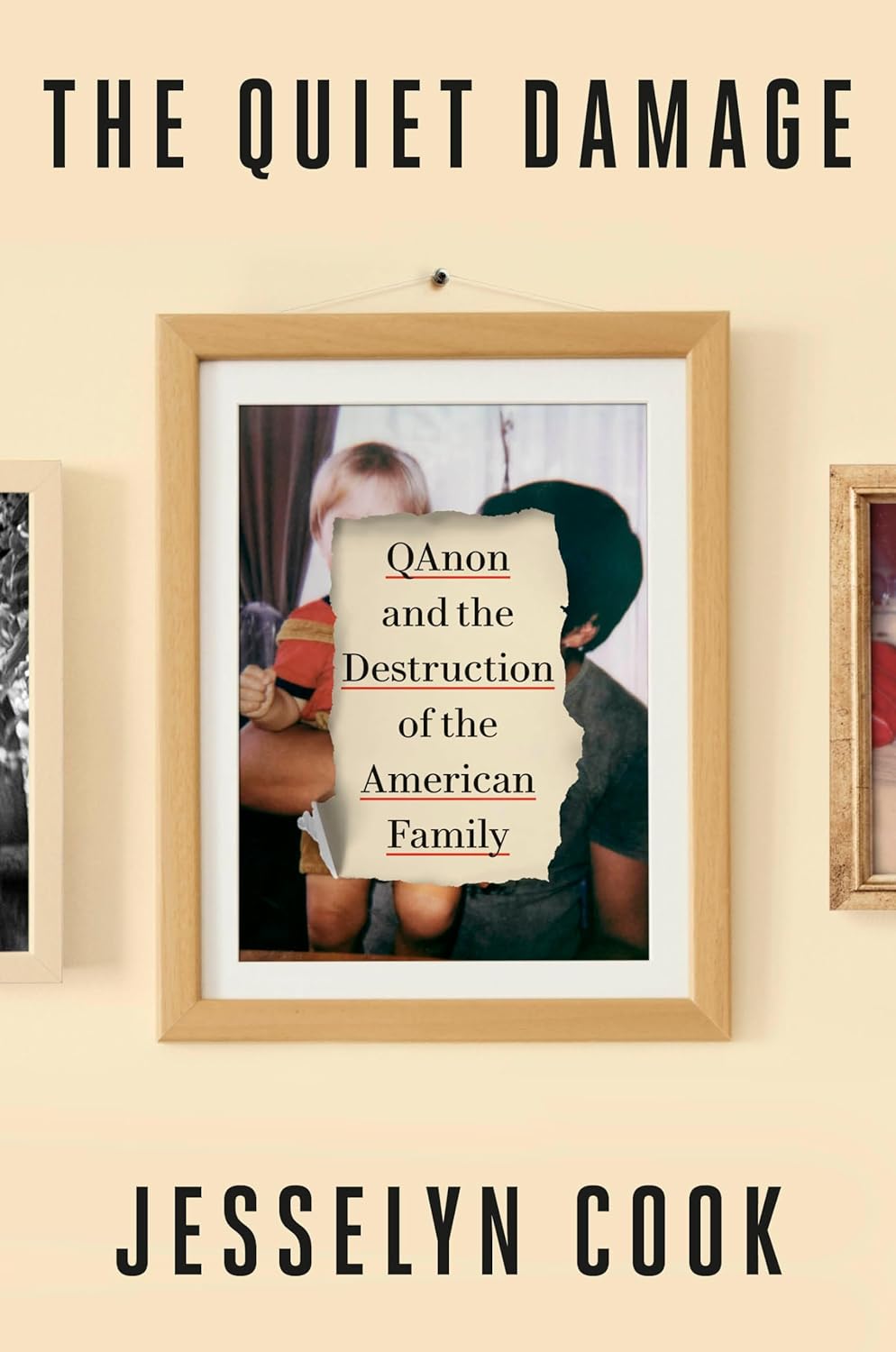
The Quiet Damage: QAnon and the Destruction of the American Family – Jesselyn Cook

The riveting story of five families shattered by pernicious, pervasive conspiracy theories, and how we might set ourselves free from a crisis that could haunt American life for generations.

“SHED MY DNA”: three excruciating words uttered by a QAnon-obsessed mother, once a highly respected lawyer, to her only son, once the closest person in her life. QAnon beliefs and adjacent conspiracy theories have had devastating political consequences as they’ve exploded in popularity. What’s often overlooked is the lasting havoc they wreak on our society at its most basic and intimate level—the family.

In The Quiet Damage, celebrated reporter Jesselyn Cook paints a harrowing portrait of the vulnerabilities that have left so many of us susceptible to outrageous falsehoods promising order, purpose, and control. Braided throughout are the stories of five American families: an elderly couple whose fifty-year romance takes a heartbreaking turn; millennial sisters of color who grew up in dire poverty—one to become a BLM activist, the other, a hardcore conspiracy theorist pulling her little boy down the rabbit hole with her; a Bay Area hippie-type and her business-executive fiancé, who must decide whether to stay with her as she turns into a stranger before his eyes; evangelical parents whose simple life in a sleepy suburb spirals into delusion-fueled chaos; and a rural mother-son duo who, after carrying each other through unspeakable tragedy, stop speaking at all as ludicrous untruths shatter a bond long thought unbreakable.

Charting the arc of each believer’s path from their first intersection with conspiracy theories to the depths of their cultish conviction, to—in some cases—their rejection of disinformation and the mending of fractured relationships, Cook offers a rare, intimate look into the psychology of how and why ordinary people come to believe the unbelievable. Profound, brilliantly researched, and beautifully written, The Quiet Damage lays bare how we have been taken hostage by grifters peddling lies built on false hope—and how we might release our loved ones, and ourselves, from their grasp.

In My Hands Today…

Generations: The Real Differences Between Gen Z, Millennials, Gen X, Boomers, and Silents―and What They Mean for America’s Future – Jean M. Twenge

A groundbreaking, revelatory portrait of the six generations that currently live in the United States and how they connect, conflict, and compete with one another—from the acclaimed author of Generation Me and iGen

The United States is currently home to six generations: the Silents, Baby Boomers, Generation X, Millennials, Generation Z, and Generation Alpha. They have had vastly different life experiences and thus, one assumes, they must have vastly diverging beliefs and behaviors–but what are those differences, what causes them, and how deep do they actually run?

Professor of psychology Jean Twenge does a deep dive into a treasure trove of long-running, government-funded surveys and databases to answer these questions. Are we truly defined by major historical events, such as the Great Depression for the Silents and September 11 for Millennials? Or, as Twenge argues, is it the rapid evolution of technology that differentiates the generations?

With her clear-eyed and insightful voice, Twenge explores what the Silents and Boomers want out of the rest of their lives; how Gen X-ers are facing middle age; the ideals of Millennials as parents and in the workplace; and how Gen Z has been changed by COVID-19, among other fascinating topics. Surprising, engaging, and informative, Generations will forever change the way you view your parents, peers, coworkers, and children, no matter what your generation.

In My Hands Today…

Abundance – Ezra Klein, Derek Thompson

To trace the global history of the twenty-first century so far is to trace a history of growing unaffordability and shortage. After years of refusing to build sufficient housing, the entire country has a national housing crisis. After years of slashing immigration, we don’t have enough workers. After decades of off-shoring manufacturing, we have a shortage of chips for cars and computers. Despite decades of being warned about the consequences of climate change, we haven’t built anything close to the clean energy infrastructure we need. The crisis that’s clicking into focus now has been building for decades—because we haven’t been building enough.

Abundance explains that our problems today are not the results of yesteryear’s villains. Rather, one generation’s solutions have become the next generation’s problems. Rules and regulations designed to solve the environmental problems of the 1970s often prevent urban density and green energy projects that would help solve the environmental problems of the 2020s. Laws meant to ensure that government considers the consequences of its actions in matters of education and healthcare have made it too difficult for government to act consequentially. In the last few decades, our capacity to see problems has sharpened while our ability to solve them has diminished.

Progress requires the ability to see promise rather than just peril in the creation of new ideas and projects, and an instinct to design systems and institutions that make building possible. In a book exploring how can move from a liberalism that not only protects and preserves but also builds, Klein and Thompson trace the political, economic, and cultural barriers to progress and how we can adopt a mindset directed toward abundance, and not scarcity, to overcome them.

In My Hands Today…

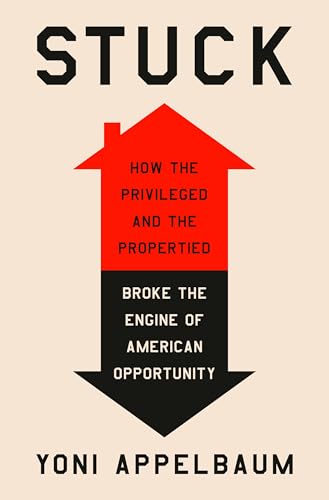
Stuck: How the Privileged and the Propertied Broke the Engine of American Opportunity – Yoni Appelbaum

How did America cease to be the land of opportunity?

We take it for granted that good neighbourhoods—with good schools and good housing—are only accessible to the wealthy. But in America, this wasn’t always the case.

Though for most of world history, your prospects were tied to where you were born, Americans came up with a revolutionary If you didn’t like your lot in life, you could find a better location and reinvent yourself there. Americans moved to new places with unprecedented frequency, and, for two hundred years, that remarkable mobility was the linchpin of American economic and social opportunity.

In this illuminating debut, Yoni Appelbaum, historian and journalist for The Atlantic, shows us that this idea has been under attack since reformers first developed zoning laws to ghettoize Chinese Americans in nineteenth-century Modesto, California. The century of legal segregation that ensued—from the zoning laws enacted to force Jewish workers back into New York’s Lower East Side to the private-sector discrimination and racist public policy that trapped Black families in Flint, Michigan to Jane Jacobs’ efforts to protect her vision of the West Village—has raised housing prices, deepened political divides, emboldened bigots, and trapped generations of people in poverty. Appelbaum shows us that these problems have a common people can’t move as readily as they used to. They are, in a word, stuck.

Cutting through more than a century of mythmaking, Stuck tells a vivid, surprising story of the people and ideas that caused our economic and social sclerosis and lays out common-sense ways to get Americans moving again.

In My Hands Today…

The Anxious Generation: How the Great Rewiring of Childhood Caused an Epidemic of Mental Illness – Jonathan Haidt

A must-read for all parents: the generation-defining investigation into the collapse of youth mental health in the era of smartphones, social media, and big tech—and a plan for a healthier, freer childhood.

After more than a decade of stability or improvement, the mental health of adolescents plunged in the early 2010s. Rates of depression, anxiety, self-harm, and suicide rose sharply, more than doubling on many measures. Why?

In The Anxious Generation, social psychologist Jonathan Haidt lays out the facts about the epidemic of teen mental illness that hit many countries at the same time. He then investigates the nature of childhood, including why children need play and independent exploration to mature into competent, thriving adults. Haidt shows how the “play-based childhood” began to decline in the 1980s, and how it was finally wiped out by the arrival of the “phone-based childhood” in the early 2010s. He presents more than a dozen mechanisms by which this “great rewiring of childhood” has interfered with children’s social and neurological development, covering everything from sleep deprivation to attention fragmentation, addiction, loneliness, social contagion, social comparison, and perfectionism. He explains why social media damages girls more than boys and why boys have been withdrawing from the real world into the virtual world, with disastrous consequences for themselves, their families, and their societies.

Most important, Haidt issues a clear call to action. He diagnoses the “collective action problems” that trap us, and then proposes four simple rules that might set us free. He describes steps that parents, teachers, schools, tech companies, and governments can take to end the epidemic of mental illness and restore a more humane childhood.

Haidt has spent his career speaking truth backed by data in the most difficult landscapes—communities polarized by politics and religion, campuses battling culture wars, and now the public health emergency faced by Gen Z. We cannot afford to ignore his findings about protecting our children—and ourselves—from the psychological damage of a phone-based life.