In My Hands Today…

The Exvangelicals: Loving, Living, and Leaving the White Evangelical Church – Sarah McCammon

Growing up in a deeply evangelical family in the Midwest in the ‘80s and ‘90s, Sarah McCammon was strictly taught to fear God, obey him, and not question the faith. Persistently worried that her gay grandfather would go to hell unless she could reach him, or that her Muslim friend would need to be converted, and that she, too, would go to hell if she did not believe fervently enough, McCammon was a rule-follower and–most of the time–a true believer. But through it all, she was increasingly plagued by fears and deep questions as the belief system she’d been carefully taught clashed with her expanding understanding of the outside world.

After spending her early adult life striving to make sense of an unraveling worldview, by her 30s, she found herself face-to-face with it once again as she covered the Trump campaign for NPR, where she witnessed first-hand the power and influence that evangelical Christian beliefs held on the political right. McCammon also came to discover that she is among a rising generation of the children of evangelicalism who are growing up and fleeing the fold, who are thinking for themselves and deconstructing what feel like the “alternative facts” of their childhood.

Rigorously reported and deeply personal, The Exvangelicals is the story of the people who make up this generational tipping point, including McCammon herself. Part memoir, part investigative journalism, this is the first definitive book that names and describes the post-evangelical movement–identifying its origins, telling the stories of its members, and examining its vast cultural, social, and political impact.
In My Hands Today…

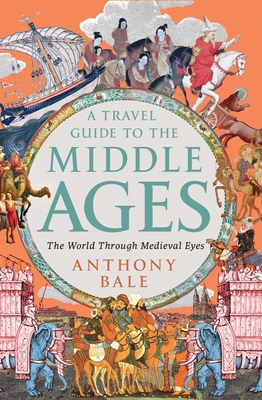
A Travel Guide to the Middle Ages: The World Through Medieval Eyes – Anthony Bale

A captivating journey of the expansive world of medieval travel, from London to Constantinople to the court of China and beyond. Europeans of the Middle Ages were the first to use travel guides to orient their wanderings, as they moved through a world punctuated with miraculous wonders and beguiling encounters.

In this vivid and alluring history, medievalist Anthony Bale invites readers on an odyssey across the medieval world, recounting the advice that circulated among those venturing to the road for pilgrimage, trade, diplomacy, and war. Journeying alongside scholars, spies, and saints, from Western Europe to the Far East, the Antipodes and the ends of the earth, Bale provides indispensable information on the exchange rate between Bohemian ducats and Venetian groats, medieval cures for seasickness, and how to avoid extortionist tour guides and singing sirens.

He takes us from the streets of Rome, more ruin than tourist spot, and tours of the Khan’s court in Beijing to Mamluk-controlled Jerusalem, where we ride asses across the holy terrain, and bustling bazaars of Tabriz. We also learn of rumored fantastical places, like ones where lambs grow on trees and giant canes grow fruit made of gems. And we are offered a glimpse of what non-European travelers thought of the West on their own travels.

Using previously untranslated contemporaneous documents from a colorful range of travelers, and from as far and wide as Turkey, Iceland, North Africa, and Russia, A Travel Guide to the Middle Ages is a witty and unforgettable exploration of how Europeans understood―and often misunderstood―the larger world. 20 illustrations; 6 maps

In My Hands Today…

The King’s Shadow: Obsession, Betrayal, and the Deadly Quest for the Lost City of Alexandria – Edmund Richardson

For centuries the city of Alexandria Beneath the Mountains was a meeting point of East and West. Then it vanished. In 1833 it was discovered in Afghanistan by the unlikeliest person imaginable: Charles Masson, deserter, pilgrim, doctor, archaeologist, spy, one of the most respected scholars in Asia, and the greatest of nineteenth-century travelers.

On the way into one of history’s most extraordinary stories, he would take tea with kings, travel with holy men and become the master of a hundred disguises; he would see things no westerner had glimpsed before and few have glimpsed since. He would spy for the East India Company and be suspected of spying for Russia at the same time, for this was the era of the Great Game, when imperial powers confronted each other in these staggeringly beautiful lands. Masson discovered tens of thousands of pieces of Afghan history, including the 2,000-year-old Bimaran golden casket, which has upon it the earliest known face of the Buddha. He would be offered his own kingdom; he would change the world, and the world would destroy him.

This is a wild journey through nineteenth-century India and Afghanistan, with impeccably researched storytelling that shows us a world of espionage and dreamers, ne’er-do-wells and opportunists, extreme violence both personal and military, and boundless hope. At the edge of empire, amid the deserts and the mountains, it is the story of an obsession passed down the centuries.

In My Hands Today…

A History of the World in 12 Maps – Jerry Brotton

A fascinating look at twelve maps—from Ancient Greece to Google Earth—and how they changed our world

In this masterful study, historian and cartography expert Jerry Brotton explores a dozen of history’s most influential maps, from stone tablet to vibrant computer screen. Starting with Ptolemy, “father of modern geography,” and ending with satellite cartography, A History of the World in 12 Maps brings maps from classical Greece, Renaissance Europe, and the Islamic and Buddhist worlds to life and reveals their influence on how we—literally—look at our present world.

As Brotton shows, the long road to our present geographical reality was rife with controversy, manipulation, and special interests trumping science. Through the centuries maps have been wielded to promote any number of imperial, religious, and economic agendas, and have represented the idiosyncratic and uneasy fusion of science and subjectivity. Brotton also conjures the worlds that produced these notable works of cartography and tells the stories of those who created, used, and misused them for their own ends.

In My Hands Today…

So Fetch – Jennifer Keishin Armstrong

From the New York Times bestselling author of Seinfeldia comes the totally fetch story of one of the most iconic teen comedies of all time, Mean Girls , revealing how it happened, how it defined a generation, “like, invented” meme culture, and why it just won’t go away, filled with exclusive interviews from the director, cast, and crew.

Get in, loser. We’re going back to 2004. It’s been 20 years since Mean Girls hit theaters, winning over critics and audiences alike with its razor-sharp wit, star-making turns for its then unknown cast, and obsessively quotable screenplay by Tina Fey.

Fast forward two decades and Mean Girls remains as relevant as ever. Arguably, no other movie from the 2000s has had as big of an impact on pop culture. In So Fetch, New York Times bestselling author of Seinfeldia , Jennifer Keishin Armstrong, offers the first ever authoritative book about this beloved classic that shaped an entire generation.

Based off revealing interviews with the director, cast, and crew, So Fetch tells the full story of the making of Mean Girls , from Tina Fey’s brilliant adaptation of a self-help guide for parents of teen girls, to the challenges of casting Lindsay Lohan, Rachel McAdams, and the iconic supporting players. So Fetch also explores the film’s lasting cultural influence, from its role in the rise of Y2K tabloid culture, impact on girls of all ages and lgbtq+ culture, to how we use it to define female relationships to this day. Timed for the 20th anniversary and the release of the new movie musical adaptation, So Fetch is the perfect companion for fans and anyone who understands that when it comes to Mean Girls ’ enduring legacy, the limit does not exist!