In My Hands Today…

Making Relationships Work at Work: A toolkit for getting more done with less stress – Richard Fox, Anneliese Guerin-Letendre

Nowadays, work is all about relationships

Getting things done depends on getting along. And when relationships are difficult, it’s not just our work that suffers: it’s often our health and wellbeing too.

Making Relationships Work at Work is the first book to cover comprehensively all the main components of building and maintaining great relationships at work.
Based on 50 years’ experience of working with a wide variety of organisations, teams and individuals and packed with practical strategies, tips and tools for making work relationships work better, it will not only help you to become more effective with less stress, but also to enjoy your working life more.

Richard Fox is a partner in The Learning Corporation, a pan-European firm of leadership coaches, facilitators and business mentors. He is a PCC credentialed coach with the International Coach Federation, a Master NLP practitioner and a member of the International Association for Coaching. He helped create The Learning Corporation after a successful period as a partner with KPMG, having played a leading role with them in setting up an office and developing a thriving client base. As a leadership coach Richard helps leaders and managers create and sustain an environment in which people can express themselves, optimise their potential and do their best work.

He is an experienced business mentor, facilitator and coach with specialist skills in the key areas of developing people in line with strategy; collaborative working, talent development, building strategic alliances, partnerships and structured networks. As a master facilitator, Richard works with organisations facilitating workshops on e.g. personal effectiveness, building networking capability, visioning, strategic thinking, managing change, leadership, coaching and mentoring, organisational learning, team working, creativity and innovation.

In My Hands Today…

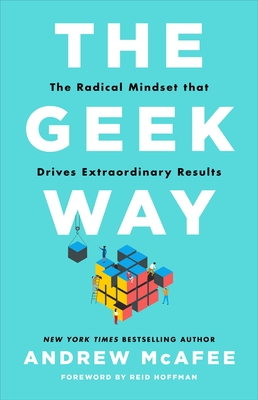
The Geek Way: The Radical Mindset that Drives Extraordinary Results – Andrew McAfee

In this “handbook for disruptors” (Eric Schmidt), The Geek Way reveals a new way to get big things done. It will change the way you think about work, teams, projects, and culture, and give you the insight and tools you need to harness our human superpowers of learning and cooperation. What is “being geeky?” It’s being a perennially curious person, one who’s not afraid to tackle hard problems and embrace unconventional solutions. McAfee shows how the geeks have created a new culture based around four science, ownership, speed, and openness. The geek way seems odd at first. It’s not deferential to experts, fond of planning and process, afraid of mistakes, or obsessed with “winning.” But it explains everything from why Montessori babies turn out to be creative tinkerers to how newcomers are disrupting industry after industry (and still just getting started).

When all four norms are in place, a culture emerges that is freewheeling, fast-moving, egalitarian, evidence-driven, argumentative, and autonomous. Why does the geek way work so much better? McAfee provides an original because it taps into humanity’s superpower, which is our ability to cooperate intensely and learn rapidly. By providing insights from the young discipline of cultural evolution, McAfee shows that when we come together under the right conditions, we quickly figure out how to build reusable spaceships and self-correcting organizations. Under the wrong conditions, though, we create bureaucracy, chronic delays, cultures of silence, and the other classic dysfunctions of the Industrial Era.

Mixing cutting-edge science, history, analysis, and stories that show the geek way in action, McAfee offers a new way to see the world and empowering tools for seizing the big opportunities of today and tomorrow.

In My Hands Today…

How Big Things Get Done: The Surprising Factors That Determine the Fate of Every Project, from Home Renovations to Space Exploration and Everything In Between – Bent Flyvbjerg, Dan Gardner

Nothing is more inspiring than a big vision that becomes a triumphant, new reality. Think of how the Empire State Building went from a sketch to the jewel of New York’s skyline in twenty-one months, or how Apple’s iPod went from a project with a single employee to a product launch in eleven months.

These are wonderful stories. But most of the time big visions turn into nightmares. Remember Boston’s “Big Dig”? Almost every sizeable city in the world has such a fiasco in its backyard. In fact, no less than 92% of megaprojects come in over budget or over schedule, or both. The cost of California’s high-speed rail project soared from $33 billion to $100 billon—and won’t even go where promised. More modest endeavors, whether launching a small business, organizing a conference, or just finishing a work project on time, also commonly fail. Why?

Understanding what distinguishes the triumphs from the failures has been the life’s work of Oxford professor Bent Flyvbjerg, dubbed “the world’s leading megaproject expert.” In How Big Things Get Done, he identifies the errors in judgment and decision-making that lead projects, both big and small, to fail, and the research-based principles that will make you succeed with yours. For example:

  • Understand your odds. If you don’t know them, you won’t win.
  • Plan slow, act fast. Getting to the action quick feels right. But it’s wrong.
  • Think right to left. Start with your goal, then identify the steps to get there.
  • Find your Lego. Big is best built from small.
  • Be a team maker. You won’t succeed without an “us.”
  • Master the unknown unknowns. Most think they can’t, so they fail. Flyvbjerg shows how you can.
  • Know that your biggest risk is you.

Full of vivid examples ranging from the building of the Sydney Opera House, to the making of the latest Pixar blockbusters, to a home renovation in Brooklyn gone awry, How Big Things Get Done reveals how to get any ambitious project done—on time and on budget.

In My Hands Today…

The War Below: Lithium, Copper, and the Global Battle to Power Our Lives – Ernest Scheyder

Tough choices loom if the world wants to go green. The United States and other countries must decide where and how to procure the materials that make our renewable energy economy possible. To build electric vehicles, solar panels, cell phones, and millions of other devices means the world must dig more mines to extract lithium, copper, cobalt, rare earths, and nickel. But mines are deeply unpopular, even as they have a role to play in fighting climate change. These tensions have sparked a worldwide reckoning over the sourcing of these critical minerals, and no one understands the complexities of these issues better than Ernest Scheyder, whose exclusive access has allowed him to report from the front lines on the key players in this global battle to power our future.

This is not a story of tree-hugging activists, but rather of industry titans, scientists, and policymakers jostling over how best to save the planet. Scheyder explores how a proposed lithium mine in Nevada would help global automakers slash their dependance on fossil fuels, but developing that mine could cause the extinction of a flower found nowhere else on the planet. A hedge fund manager’s attempt to resuscitate rare earths mining in California relies on Chinese expertise, exposing the paradox in Washington’s quest for minerals independence. The fight to end child labor in Africa’s mining sector is a key reason, supporters contend, to dig out a vast reserve of cobalt and nickel under Minnesota’s vulnerable wetlands. An international mining conglomerate’s plan to extract copper for electric vehicles deep beneath Arizona’s desert would destroy a Native American holy site, fueling tough questions about what matters more.

In The War Below , Scheyder crafts a business story that matters to everyone. If China continues to dominate production of these critical minerals, it will have a profound impact on the geopolitical order. Beyond China, countries such as Bolivia, Indonesia, and the Democratic Republic of the Congo aim to wield their vast reserves of key minerals. There are no easy answers when it comes to energy. Scheyder paints a powerfully honest and nuanced picture of what is needed to fight climate change and secure energy independence, revealing how America and the rest of the world’s hunt for the “new oil” directly affects us all.

In My Hands Today…

Right Kind of Wrong: The Science of Failing Well – Amy C. Edmondson

We used to think of failure as the opposite of success. Now, we’re often torn between two “failure cultures”: one that says to avoid failure at all costs, the other that says fail fast, fail often. The trouble is that both approaches lack the crucial distinctions to help us separate good failure from bad. As a result, we miss the opportunity to fail well.

After decades of award-winning research, Amy Edmondson is here to upend our understanding of failure and make it work for us. In Right Kind of Wrong, Edmondson provides the framework to think, discuss, and practice failure wisely. Outlining the three archetypes of failure—simple, complex, and intelligent—Amy showcases how to minimize unproductive failure while maximizing what we gain from flubs of all stripes. She illustrates how we and our organizations can embrace our human fallibility, learn exactly when failure is our friend, and prevent most of it when it is not. This is the key to pursuing smart risks and preventing avoidable harm.

With vivid, real-life stories from business, pop culture, history, and more, Edmondson gives us specifically tailored practices, skills, and mindsets to help us replace shame and blame with curiosity, vulnerability, and personal growth. You’ll never look at failure the same way again.