In My Hands Today…

Read People Like a Book: How to Analyze, Understand, and Predict People’s Emotions, Thoughts, Intentions, and Behaviors – Patrick King

Speed read people, decipher body language, detect lies, and understand human nature. Is it possible to analyze people without them saying a word? Yes, it is. Learn how to become a “mind reader” and forge deep connections.

How to get inside people’s heads without them knowing. Read People Like a Book isn’t a normal book on body language of facial expressions. Yes, it includes all of those things, as well as new techniques on how to truly detect lies in your everyday life, but this book is more about understanding human psychology and nature. We are who we are because of our experiences and pasts, and this guides our habits and behaviors more than anything else. Parts of this book read like the most interesting and applicable psychology textbook you’ve ever read. Take a look inside yourself and others!

Understand the subtle signals that you are sending out and increase your emotional intelligence. Patrick King is an internationally bestselling author and social skills coach. His writing draws of a variety of sources, from scientific research, academic experience, coaching, and real life experience. Learn the keys to influencing and persuading others. What people’s limbs can tell us about their emotions. Why lie detecting isn’t so reliable when ignoring context. Diagnosing personality as a means to understanding motivation. Deducing the most with the least amount of information. Exactly the kinds of eye contact to use and avoid

Find shortcuts to connect quickly and deeply with strangers. The art of reading and analyzing people is truly the art of understanding human nature. Consider it like a cheat code that will allow you to see through people’s actions and words. Decode people’s thoughts and intentions, and you can go in any direction you want with them.
In My Hands Today…

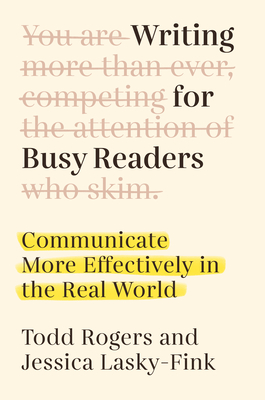
Writing for Busy Readers: Communicate More Effectively in the Real World – Todd Rogers, Jessica Lasky-Fink

Writing well is for school. Writing effectively is for life .

Todd Rogers and Jessica Lasky-Fink offer the most valuable practical writing advice today. Building on their own research in behavioral science, they outline cognitive facts about how people actually read and distill them into six principles that will transform the power of your
Including many real-world examples, a checklist and other tools, this guide will make you a more successful and productive communicator. Rogers and Lasky-Fink bring Strunk and White’s core ideas into the twenty-first century’s attention marketplace.

When the influential guides to writing prose were written, the internet hadn’t been invented. Now, the average American adult is inundated with digital messages each day. With all this correspondence, capturing a busy reader’s attention is more challenging than ever. This is how to do it.

In My Hands Today…

Think Faster, Talk Smarter: How to Speak Successfully When You’re Put on the Spot – Matt Abrahams

Many of us dread having to convey our ideas to others, often feeling ill-equipped, anxious, and awkward. Public speaking experts help by focusing on planned communication experiences such as slide presentations, pitches, or formal talks. Yet, most of our professional and personal communication occurs in spontaneous situations that creep up on us and all too often leave us flustered and stumbling for words. How can we rise to the occasion and shine when we’re put on the spot?

In Think Faster, Talk Smarter, Stanford lecturer, podcast host, and communication expert Matt Abrahams provides tangible, actionable skills to help even the most anxious of speakers succeed when speaking spontaneously. Abrahams provides science-based strategies for managing anxiety, responding to the mood of the room, and making content concise, relevant, compelling, and memorable. Drawing on stories from his clients and students, he offers best practices for navigating Q&A sessions, shining in job interviews, providing effective feedback, making small talk, fixing faux pas, persuading others, and handling other impromptu speaking tasks.

Whether it’s a prospective client asking you an unexpected question during a meeting or all eyes turning to you at a dinner party, you’ll know how to navigate the situation like a pro and bring out your very best. Think Faster, Talk Smarter is an accessible guide to communication that will help you master new techniques in no time.

In My Hands Today,,,

Supercommunicators: How to Unlock the Secret Language of Connection – Charles Duhigg

Come inside a jury room as one juror leads a starkly divided room to consensus. Join a young CIA officer as he recruits a reluctant foreign agent. And sit with an accomplished surgeon as he tries, and fails, to convince yet another cancer patient to opt for the less risky course of treatment. In Supercommunicators, Charles Duhigg blends deep research and his trademark storytelling skills to show how we can all learn to identify and leverage the hidden layers that lurk beneath every conversation.

Communication is a superpower and the best communicators understand that whenever we speak, we’re actually participating in one of three conversations: practical (What’s this really about?), emotional (How do we feel?), and social (Who are we?). If you don’t know what kind of conversation you’re having, you’re unlikely to connect.

Supercommunicators know the importance of recognizing—and then matching—each kind of conversation, and how to hear the complex emotions, subtle negotiations, and deeply held beliefs that color so much of what we say and how we listen. Our experiences, our values, our emotional lives—and how we see ourselves, and others—shape every discussion, from who will pick up the kids to how we want to be treated at work. In this book, you will learn why some people are able to make themselves heard, and to hear others, so clearly.

With his storytelling that takes us from the writers’ room of The Big Bang Theory to the couches of leading marriage counselors, Duhigg shows readers how to recognize these three conversations—and teaches us the tips and skills we need to navigate them more successfully.

In the end, he delivers a simple but powerful lesson: With the right tools, we can connect with anyone.