Adulting 101: The Art of Effective Communication in Life and Work

Communication might seem simple, even automatic. We talk every day, texting, posting, and chatting. But effective communication? That’s an art and an essential adult skill that too often goes unlearned. Whether you’re navigating friendships, family, or the workplace, knowing how to communicate well is your secret weapon. It shapes how others see you, how you solve problems, and how you build trust.

Communication is more than talking. Most people think communication means just speaking or typing words. But it’s much bigger. It’s about connection. It starts with listening, really listening. Active listening means giving your full attention, not just waiting for your turn to speak. It’s about understanding the other person’s point of view, even if you don’t agree. This kind of listening builds respect and opens the door for honest dialogue.

Here’s the catch: active listening is hard. We’re wired to react quickly, defend our ideas, or zone out. But if you want to communicate better, you have to slow down and focus. Put away your phone, make eye contact, and ask clarifying questions. These simple moves show you care and help avoid misunderstandings.

People often think being polite means being vague or avoiding hard truths. That’s wrong. Being clear and direct doesn’t mean being rude. It means expressing your thoughts and feelings plainly while respecting others. Instead of bottling up frustrations or hinting around, say what you mean calmly. For example, say, “I felt upset when our plan changed last minute” instead of “You never stick to plans.”

Avoid blaming or attacking language. Use “I” statements: they focus on your feelings without accusing the other person. For example, “I feel overwhelmed when emails pile up” works better than “You’re bad at organising.” This reduces defensiveness and keeps the conversation productive.

Your body language says just as much as your words. Eye contact, posture, facial expressions, and tone all carry messages. Crossing your arms might signal defensiveness; avoiding eye contact can seem evasive. These cues shape how your message is received. If your words say one thing but your body another, people pick up on the mismatch. Be aware of your nonverbal signals and try to keep them open and relaxed. Nod when listening, smile genuinely, and lean in slightly to show engagement. These little things build connection and trust.

Not every message fits every medium. Some things are best said face-to-face, where you can see reactions and use tone and body language. Texts or emails suit quick updates or simple questions. But sensitive topics, conflicts, or complex discussions often need a voice or in-person talks to avoid misinterpretation. For example, don’t text someone about a serious disagreement. It’s easy to misread tone, which can escalate tensions. A phone call or meeting lets you clarify instantly and keep emotions in check.

Communication isn’t one-size-fits-all. How you speak to your boss differs from how you chat with friends or family. Consider culture, age, personality, and context. Some coworkers prefer direct emails, while others appreciate casual check-ins. Paying attention to these cues shows emotional intelligence and respect. Also, be mindful of differences in communication styles. Some people are more reserved; others are outspoken. Meeting people halfway and adapting your style builds a better rapport.

In the workplace, communication is money and influence. Clear communication prevents mistakes, aligns teams, and drives projects forward. It also shapes perceptions of your competence and leadership potential. Those who listen deeply, speak clearly, and handle conflicts calmly are more likely to succeed.

Job interviews, meetings, emails, and presentations all demand strong communication. Practice summarising your ideas briefly and backing them with facts. Avoid jargon or filler words that dilute your message. And don’t forget to ask questions; it shows interest and helps you understand expectations.

Some believe good communicators are born, not made. That’s misleading. Communication is a skill. You can learn, practice, and improve. Another myth is that talking more makes you persuasive. Often, the opposite is true. Listening better and saying less with clear intent wins respect. Technology has changed communication but not replaced fundamentals. Emojis and memes don’t substitute for empathy and clarity. Use digital tools wisely, but don’t rely on them completely.

Communication often breaks down because of fear, assumptions, or distractions. Fear of judgment can make you hold back; assumptions can cause misunderstandings; distractions reduce focus. Address these directly. Build confidence by starting small. Don’t assume others know what you think. Clarify. Repeat. And be patient; effective communication takes effort and time.

The art of communication is a lifelong journey. There’s no finish line. But every conversation is an opportunity. Reflect on what worked, where you stumbled, and how to improve. Seek feedback honestly. Read books, watch talks, or even practice in front of a mirror if you must. Remember, communication is about connection, not perfection. Be real. Be respectful. Be clear.

In My Hands Today…

Read People Like a Book: How to Analyze, Understand, and Predict People’s Emotions, Thoughts, Intentions, and Behaviors – Patrick King

Speed read people, decipher body language, detect lies, and understand human nature. Is it possible to analyze people without them saying a word? Yes, it is. Learn how to become a “mind reader” and forge deep connections.

How to get inside people’s heads without them knowing. Read People Like a Book isn’t a normal book on body language of facial expressions. Yes, it includes all of those things, as well as new techniques on how to truly detect lies in your everyday life, but this book is more about understanding human psychology and nature. We are who we are because of our experiences and pasts, and this guides our habits and behaviors more than anything else. Parts of this book read like the most interesting and applicable psychology textbook you’ve ever read. Take a look inside yourself and others!

Understand the subtle signals that you are sending out and increase your emotional intelligence. Patrick King is an internationally bestselling author and social skills coach. His writing draws of a variety of sources, from scientific research, academic experience, coaching, and real life experience. Learn the keys to influencing and persuading others. What people’s limbs can tell us about their emotions. Why lie detecting isn’t so reliable when ignoring context. Diagnosing personality as a means to understanding motivation. Deducing the most with the least amount of information. Exactly the kinds of eye contact to use and avoid

Find shortcuts to connect quickly and deeply with strangers. The art of reading and analyzing people is truly the art of understanding human nature. Consider it like a cheat code that will allow you to see through people’s actions and words. Decode people’s thoughts and intentions, and you can go in any direction you want with them.

In My Hands Today…

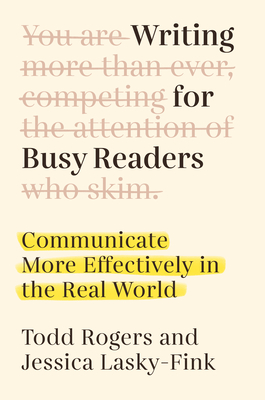
Writing for Busy Readers: Communicate More Effectively in the Real World – Todd Rogers, Jessica Lasky-Fink

Writing well is for school. Writing effectively is for life .

Todd Rogers and Jessica Lasky-Fink offer the most valuable practical writing advice today. Building on their own research in behavioral science, they outline cognitive facts about how people actually read and distill them into six principles that will transform the power of your
Including many real-world examples, a checklist and other tools, this guide will make you a more successful and productive communicator. Rogers and Lasky-Fink bring Strunk and White’s core ideas into the twenty-first century’s attention marketplace.

When the influential guides to writing prose were written, the internet hadn’t been invented. Now, the average American adult is inundated with digital messages each day. With all this correspondence, capturing a busy reader’s attention is more challenging than ever. This is how to do it.

In My Hands Today…

Think Faster, Talk Smarter: How to Speak Successfully When You’re Put on the Spot – Matt Abrahams

Many of us dread having to convey our ideas to others, often feeling ill-equipped, anxious, and awkward. Public speaking experts help by focusing on planned communication experiences such as slide presentations, pitches, or formal talks. Yet, most of our professional and personal communication occurs in spontaneous situations that creep up on us and all too often leave us flustered and stumbling for words. How can we rise to the occasion and shine when we’re put on the spot?

In Think Faster, Talk Smarter, Stanford lecturer, podcast host, and communication expert Matt Abrahams provides tangible, actionable skills to help even the most anxious of speakers succeed when speaking spontaneously. Abrahams provides science-based strategies for managing anxiety, responding to the mood of the room, and making content concise, relevant, compelling, and memorable. Drawing on stories from his clients and students, he offers best practices for navigating Q&A sessions, shining in job interviews, providing effective feedback, making small talk, fixing faux pas, persuading others, and handling other impromptu speaking tasks.

Whether it’s a prospective client asking you an unexpected question during a meeting or all eyes turning to you at a dinner party, you’ll know how to navigate the situation like a pro and bring out your very best. Think Faster, Talk Smarter is an accessible guide to communication that will help you master new techniques in no time.

In My Hands Today,,,

Supercommunicators: How to Unlock the Secret Language of Connection – Charles Duhigg

Come inside a jury room as one juror leads a starkly divided room to consensus. Join a young CIA officer as he recruits a reluctant foreign agent. And sit with an accomplished surgeon as he tries, and fails, to convince yet another cancer patient to opt for the less risky course of treatment. In Supercommunicators, Charles Duhigg blends deep research and his trademark storytelling skills to show how we can all learn to identify and leverage the hidden layers that lurk beneath every conversation.

Communication is a superpower and the best communicators understand that whenever we speak, we’re actually participating in one of three conversations: practical (What’s this really about?), emotional (How do we feel?), and social (Who are we?). If you don’t know what kind of conversation you’re having, you’re unlikely to connect.

Supercommunicators know the importance of recognizing—and then matching—each kind of conversation, and how to hear the complex emotions, subtle negotiations, and deeply held beliefs that color so much of what we say and how we listen. Our experiences, our values, our emotional lives—and how we see ourselves, and others—shape every discussion, from who will pick up the kids to how we want to be treated at work. In this book, you will learn why some people are able to make themselves heard, and to hear others, so clearly.

With his storytelling that takes us from the writers’ room of The Big Bang Theory to the couches of leading marriage counselors, Duhigg shows readers how to recognize these three conversations—and teaches us the tips and skills we need to navigate them more successfully.

In the end, he delivers a simple but powerful lesson: With the right tools, we can connect with anyone.