In My Hands Today…

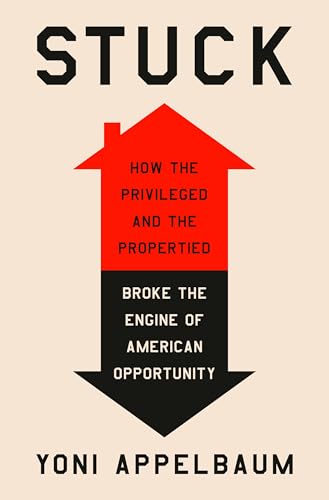
Stuck: How the Privileged and the Propertied Broke the Engine of American Opportunity – Yoni Appelbaum

How did America cease to be the land of opportunity?

We take it for granted that good neighbourhoods—with good schools and good housing—are only accessible to the wealthy. But in America, this wasn’t always the case.

Though for most of world history, your prospects were tied to where you were born, Americans came up with a revolutionary If you didn’t like your lot in life, you could find a better location and reinvent yourself there. Americans moved to new places with unprecedented frequency, and, for two hundred years, that remarkable mobility was the linchpin of American economic and social opportunity.

In this illuminating debut, Yoni Appelbaum, historian and journalist for The Atlantic, shows us that this idea has been under attack since reformers first developed zoning laws to ghettoize Chinese Americans in nineteenth-century Modesto, California. The century of legal segregation that ensued—from the zoning laws enacted to force Jewish workers back into New York’s Lower East Side to the private-sector discrimination and racist public policy that trapped Black families in Flint, Michigan to Jane Jacobs’ efforts to protect her vision of the West Village—has raised housing prices, deepened political divides, emboldened bigots, and trapped generations of people in poverty. Appelbaum shows us that these problems have a common people can’t move as readily as they used to. They are, in a word, stuck.

Cutting through more than a century of mythmaking, Stuck tells a vivid, surprising story of the people and ideas that caused our economic and social sclerosis and lays out common-sense ways to get Americans moving again.

In My Hands Today…

The India Way: Strategies for an Uncertain World – S. Jaishankar

The decade from the 2008 global financial crisis to the 2020 coronavirus pandemic has seen a real transformation of the world order. The very nature of international relations and its rules are changing before our eyes.

For India, this means optimal relationships with all the major powers to best advance its goals. It also requires a bolder and non-reciprocal approach to its neighbourhood. A global footprint is now in the making that leverages India’s greater capability and relevance, as well as its unique diaspora. This era of global upheaval entails greater expectations from India, putting it on the path to becoming a leading power.

In The India Way, S. Jaishankar, India’s Minister of External Affairs, analyses these challenges and spells out possible policy responses. He places this thinking in the context of history and tradition, appropriate for a civilizational power that seeks to reclaim its place on the world stage.

In My Hands Today…

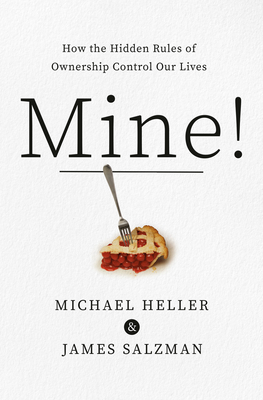
Mine!: How the Hidden Rules of Ownership Control Our Lives – Michael A. Heller, James Salzman

A hidden set of rules governs who owns what–explaining everything from whether you can recline your airplane seat to why HBO lets you borrow a password illegally–and in this lively and entertaining guide, two acclaimed law professors reveal how things become mine.

Mine is one of the first words babies learn. By the time we grow up, the idea of ownership seems natural, whether buying a cup of coffee or a house. But who controls the space behind your airplane seat: you reclining or the squished laptop user behind? Why is plagiarism wrong, but it’s okay to knock-off a recipe or a dress design? And after a snowstorm, why does a chair in the street hold your parking space in Chicago, but in New York you lose the space and the chair?

Mine! explains these puzzles and many more. Surprisingly, there are just six simple stories that everyone uses to claim everything. Owners choose the story that steers us to do what they want. But we can always pick a different story. This is true not just for airplane seats, but also for battles over digital privacy, climate change, and wealth inequality. As Michael Heller and James Salzman show–in the spirited style of Freakonomics, Nudge, and Predictably Irrational–ownership is always up for grabs.

With stories that are eye-opening, mind-bending, and sometimes infuriating, Mine! reveals the rules of ownership that secretly control our lives.

In My Hands Today…

The Woke Salaryman Crash Course on Capitalism & Money: Lessons from the World’s Most Expensive City – The Woke Salaryman

Learn the rules of the game of capitalism so you can play to win and build wealth. This crash course on capitalism and lessons from the world’s most expensive city is not your typical personal finance guide.

Written by the founders of the top personal finance blog in Singapore, this book acknowledges the frustrations many young people feel as they enter the world of money, and it shows you how to develop the mindset necessary to thrive for the rest of your life.

Through visual storytelling, Crash Course on Capitalism and Money melds personal finance, economics, sociology, and psychology to create a book that shows you the path to financial success. If you’re ready to rise above discontentment, accept the reality you find yourself in, and put in the work it takes to survive, then thrive in today’s world―then this is the book for you.

In this book, you’ll find a collection of the most popular comics by The Woke Salaryman. The stories are accompanied by commentaries that offer additional context on how each story fits within the bigger framework of approaching the daunting challenge of navigating money, life and purpose in these times. Why you should get the For young people just beginning their personal finance journeys, as well as anyone who wants to make better financial and life choices while navigating the rules of capitalism and wealth, Crash Course on Capitalism and Money is a fun and enlightening read.
Genres
Nonfiction
Finance
Personal Finance
Self Help
Business
Economics
Psychology

In My Hands Today…

The War Below: Lithium, Copper, and the Global Battle to Power Our Lives – Ernest Scheyder

Tough choices loom if the world wants to go green. The United States and other countries must decide where and how to procure the materials that make our renewable energy economy possible. To build electric vehicles, solar panels, cell phones, and millions of other devices means the world must dig more mines to extract lithium, copper, cobalt, rare earths, and nickel. But mines are deeply unpopular, even as they have a role to play in fighting climate change. These tensions have sparked a worldwide reckoning over the sourcing of these critical minerals, and no one understands the complexities of these issues better than Ernest Scheyder, whose exclusive access has allowed him to report from the front lines on the key players in this global battle to power our future.

This is not a story of tree-hugging activists, but rather of industry titans, scientists, and policymakers jostling over how best to save the planet. Scheyder explores how a proposed lithium mine in Nevada would help global automakers slash their dependance on fossil fuels, but developing that mine could cause the extinction of a flower found nowhere else on the planet. A hedge fund manager’s attempt to resuscitate rare earths mining in California relies on Chinese expertise, exposing the paradox in Washington’s quest for minerals independence. The fight to end child labor in Africa’s mining sector is a key reason, supporters contend, to dig out a vast reserve of cobalt and nickel under Minnesota’s vulnerable wetlands. An international mining conglomerate’s plan to extract copper for electric vehicles deep beneath Arizona’s desert would destroy a Native American holy site, fueling tough questions about what matters more.

In The War Below , Scheyder crafts a business story that matters to everyone. If China continues to dominate production of these critical minerals, it will have a profound impact on the geopolitical order. Beyond China, countries such as Bolivia, Indonesia, and the Democratic Republic of the Congo aim to wield their vast reserves of key minerals. There are no easy answers when it comes to energy. Scheyder paints a powerfully honest and nuanced picture of what is needed to fight climate change and secure energy independence, revealing how America and the rest of the world’s hunt for the “new oil” directly affects us all.