In My Hands Today…

Make It Stick: The Science of Successful Learning – Peter C. Brown, Henry L. Roediger III, Mark A. McDaniel

To most of us, learning something “the hard way” implies wasted time and effort. Good teaching, we believe, should be creatively tailored to the different learning styles of students and should use strategies that make learning easier. Make It Stick turns fashionable ideas like these on their head. Drawing on recent discoveries in cognitive psychology and other disciplines, the authors offer concrete techniques for becoming more productive learners.

Memory plays a central role in our ability to carry out complex cognitive tasks, such as applying knowledge to problems never before encountered and drawing inferences from facts already known. New insights into how memory is encoded, consolidated, and later retrieved have led to a better understanding of how we learn. Grappling with the impediments that make learning challenging leads both to more complex mastery and better retention of what was learned.

Many common study habits and practice routines turn out to be counterproductive. Underlining and highlighting, rereading, cramming, and single-minded repetition of new skills create the illusion of mastery, but gains fade quickly. More complex and durable learning come from self-testing, introducing certain difficulties in practice, waiting to re-study new material until a little forgetting has set in, and interleaving the practice of one skill or topic with another. Speaking most urgently to students, teachers, trainers, and athletes, Make It Stick will appeal to all those interested in the challenge of lifelong learning and self-improvement.

In My Hands Today…

All the Knowledge in the World: The Extraordinary History of the Encyclopedia – Simon Garfield

The encyclopaedia once shaped our understanding of the world.

Created by thousands of scholars and the most obsessive of editors, a good set conveyed a sense of absolute wisdom on its reader. Contributions from Albert Einstein, Sigmund Freud, Orville Wright, Alfred Hitchcock, Marie Curie and Indira Gandhi helped millions of children with their homework. Adults cleared their shelves in the belief that everything that was explainable was now effortlessly accessible in their living rooms.

But now these huge books gather dust, and sell for almost nothing on eBay, and we derive our information from our phones and computers, apparently for free. What have we lost in this transition? And how did we tell the progress of our lives in the past?

All the Knowledge in the World is a history and celebration of those who created the most ground-breaking and remarkable publishing phenomenon of any age. It tracks the story from Ancient Greece to Wikipedia, from modest single-volumes to the 11,000-volume Chinese manuscript that was too big to print. It looks at how Encyclopaedia Britannica came to dominate the industry, how it spawned hundreds of competitors, and how an army of ingenious door-to-door salesmen sold their wares to guilt-ridden parents. It explains how encyclopaedias have reflected our changing attitudes towards sexuality, race and technology, and exposes how these ultimate bastions of trust were often riddled with errors and prejudice.

With his characteristic ability to tackle the broadest of subjects in an illuminating and highly entertaining way, Simon Garfield uncovers a fascinating and important part of our shared past, and wonders whether the promise of complete knowledge – that most human of ambitions – will forever be beyond our grasp.

In My Hands Today…

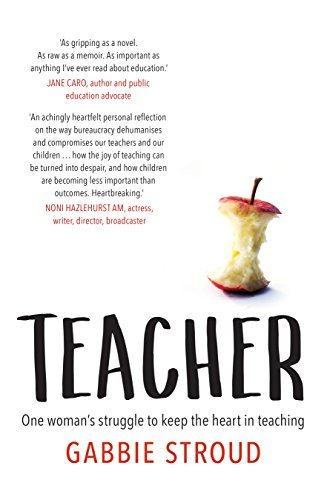
Teacher – Gabbie Stroud

Watching children learn is a beautiful and extraordinary experience. Their bodies transform, reflecting inner changes. Teeth fall out. Knees scab. Freckles multiply. Throughout the year they grow in endless ways and I can almost see their self-esteem rising, their confidence soaring, their small bodies now empowered. Given wings.

They fall in love with learning.

It is a kind of magic, a kind of loving, a kind of art.

It is teaching.

Just teaching.

Just what I do.

What I did.

Past tense.

In 2014, Gabrielle Stroud was a very dedicated teacher with over a decade of experience. Months later, she resigned in frustration and despair when she realised that the Naplan-test education model was stopping her from doing the very thing she was best teaching individual children according to their needs and talents. Her ground-breaking essay ‘Teaching Australia’ in the Feb 2016 Griffith Review outlined her experiences and provoked a huge response from former and current teachers around the world. That essay lifted the lid on a scandal that is yet to properly break – that our education system is unfair to our children and destroying their teachers.

In a powerful memoir inspired by her original essay, Gabrielle tells the full how she came to teaching, what makes a great teacher, what our kids need from their teachers, and what it was that finally broke her. A brilliant and heart-breaking memoir that cuts to the heart of a vital matter of national importance.

In My Hands Today…

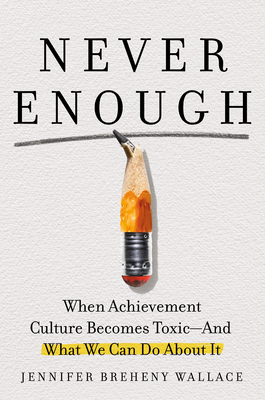
Never Enough: When Achievement Culture Becomes Toxic-and What We Can Do About It – Jennifer Breheny Wallace

In the ever more competitive race to secure the best possible future, today’s students face unprecedented pressure to succeed. They jam-pack their schedules with AP classes, fill every waking hour with resume-padding activities, and even sabotage relationships with friends to “get ahead.” Family incomes and schedules are stretched to the breaking point by tutoring fees and athletic schedules. Yet this drive to optimize performance has only resulted in skyrocketing rates of anxiety, depression, and even self-harm in America’s highest achieving schools. Parents, educators, and community leaders are facing the same how can we teach our kids to strive towards excellence without crushing them?

In Never Enough, award-winning reporter Jennifer Breheny Wallace investigates the deep roots of toxic achievement culture, and finds out what we must do to fight back. Drawing on interviews with families, educators, and an original survey of nearly 6,000 parents, she exposes how the pressure to perform is not a matter of parental choice but baked in to our larger society and spurred by increasing income inequality and dwindling opportunities. As a result, children are increasingly absorbing the message that they have no value outside of their accomplishments, a message that is reinforced by the media and greater culture at large.

Through deep research and interviews with today’s leading child psychologists, Wallace shows what kids need from the adults in the room is not more pressure, but to feel like they matter , and have intrinsic self-worth not contingent upon external achievements. Parents and educators who adopt the language and values of mattering help children see themselves as a valuable contributor to a larger community. And in an ironic twist, kids who receive consistent feedback that they matter no matter what are more likely to have the resilience, self-confidence, and psychological security to thrive.

Packed with memorable stories and offering a powerful toolkit for positive change, Never Enough offers an urgent, humane view of the crisis plaguing today’s teens and a practical framework for how to help.

International Day of Education

Education is every human being’s fundamental right. And today, as we celebrate the International Day of Education, this couldn’t be more true.

The International Day of Education was proclaimed by the United Nations General Assembly in December 2018 to recognize the role of education in promoting peace, sustainable development, and global citizenship. The choice of January 24th commemorates the adoption of the Sustainable Development Goals or SDGs, in 2015, with Goal 4 specifically focusing on ensuring inclusive and equitable quality education for all.

Despite its undeniable importance, access to quality education remains a pressing global challenge. According to UNESCO, 258 million children and youth are still out of school, and 763 million adults are illiterate. These disparities disproportionately affect girls, minorities, and individuals living in conflict-affected areas. These statistics represent not just numbers, but human lives robbed of the opportunities that education affords. Imagine a world where every child, regardless of their background, has the chance to learn, to dream, and to contribute to the betterment of society. This is the world we must strive for, and education is the bridge that will lead us there.

Education is not merely the transfer of knowledge; it is a catalyst for societal transformation. It is the key that unlocks doors to opportunities, empowers individuals to realise their full potential, and propels communities towards progress.

Education has the power to break the intergenerational cycle of poverty. It equips individuals with the skills and knowledge needed to secure better economic opportunities, creating a ripple effect that uplifts families and communities. Education is a potent tool in dismantling gender disparities. It empowers girls and women, providing them with the tools to challenge societal norms, pursue careers, and contribute meaningfully to their communities. It nurtures a sense of global citizenship, and instills values of empathy, tolerance, and understanding, fostering a generation that is aware of and engaged with the interconnected world in which we live. In the face of challenges, be they economic downturns or global health crises, educated societies are more resilient. Education equips individuals and communities with problem-solving skills, adaptability, and the ability to navigate uncertainties.

While the International Day of Education is a celebration of progress, it is also an opportunity to acknowledge the challenges that persist in the realm of global education. Despite concerted efforts, millions around the world still face barriers to accessing quality education. These challenges include disparities in access to quality education, both within and between countries. Marginalised communities, rural areas, and conflict zones often face limited educational resources, perpetuating cycles of poverty. While progress has been made in advancing gender equality in education, disparities persist. Girls, particularly in certain regions, may still face barriers to access, including cultural norms, early marriage, and lack of resources. Access alone is not enough; the quality of education is equally crucial. In some regions, even when children have access to schools, the quality of teaching, infrastructure, and learning materials may fall below acceptable standards. The digital revolution has opened new frontiers in education, but a digital divide persists. Not all students have equal access to technology and online learning resources, exacerbating existing inequalities. Global crises, such as the COVID-19 pandemic, have underscored the vulnerability of education systems. Disruptions, whether due to pandemics, conflicts, or natural disasters, can have lasting consequences on the education of millions of children and youth.

In 2024, children should not have to fight for their right to educate themselves. The power of knowledge should be used to address the challenges of our time. Let us use education to build a world where everyone has the opportunity to reach their full potential and contribute to a more just, peaceful, and sustainable future. Every action, however small, can make a difference. Together, we can make education a reality for every child and young person, paving the way for a brighter future for all.

Remember, education is not a luxury; it is a fundamental human right. It is the foundation for a just and equitable society, and it is the key to a sustainable future. Without inclusive and equitable quality education and lifelong opportunities for all, countries will not succeed in achieving gender equality and breaking the cycle of poverty that is leaving millions of children, youth and adults behind.